To get a roundup of TechCrunch’s biggest and most important stories delivered to your inbox every day at 3 p.m. PDT,subscribe here.
Welcome back to your daily digest of TechCrunch goodness. It is my last day with you (you’re welcome!), so Christine will be back in the Daily Crunch seat on Tuesday. Haje will not be back just yet because he is heading to Vegas as part of the team covering CES. Speaking of CES, Brian raised the curtain on what we can expect from its first full-fledged production since before COVID.
Bye for now, folks. Safe and Happy New Year to you all. — Henry
At the top
Into the Matrix: No, not that Matrix. We’re talking about the open standards-based comms protocol called Matrix that Paul went deep on. Its network doubled thanks in part to increased use by enterprises and government. Reddit is also having a go, experimenting with it for its chat feature.
For the fusion: Tim took a look at five startups primed to benefit from the recent breakthroughs in fusion. [TC+]
Alt-ChatGPT: In the wake of the response to OpenAI’s ChatGPT comes an open source equivalent. It’s called PaLM + RLHF (rolls right off the tongue, eh?), but Kyle writes that it isn’t pre-trained, which means good luck running it.
The Meta eyes have it: Amanda writes that Meta is getting into the eyewear business with its purchase of the Netherlands-based, smart eyewear company Luxexcel.
Book tracking: Aisha rounded up a list of five apps that you can use to track all that reading you’re planning to do once the clock strikes 2023.
Netflix vs. Hulu: Perhaps you’ve decided to cut a streaming service or two from your lineup in light of their continued price hikes. Lauren took a look at the features of Netflix and Hulu to help you make a decision.
What to look for in a term sheet as a first-time founder
Silicon Valley reporter Connie Loizos interviewed three seasoned VCs to get their best advice for novice entrepreneurs. She asked them:
Why should you know what’s going to be in a term sheet before you see it?
Which mechanism is best to use at the outset?
How much equity is distributed at each level of early-stage fundraising?
What’s a red flag in a term sheet?
How should founders think about valuation when it comes to that first term sheet?
TechCrunch+ is our membership program that helps founders and startup teams get ahead of the pack. You can sign up here. Use code “DC” for a 15% discount on an annual subscription!
Looking back and looking ahead
We rounded up TC+ venture capital stories from a year that unfortunately saw a lot of downs. And here are a few more favorites for good measure:
Indian startups were flush with cash with record investments. Now, Manish writes, the ecosystem is struggling with tightening funding purses, layoffs and disappointing public debuts.
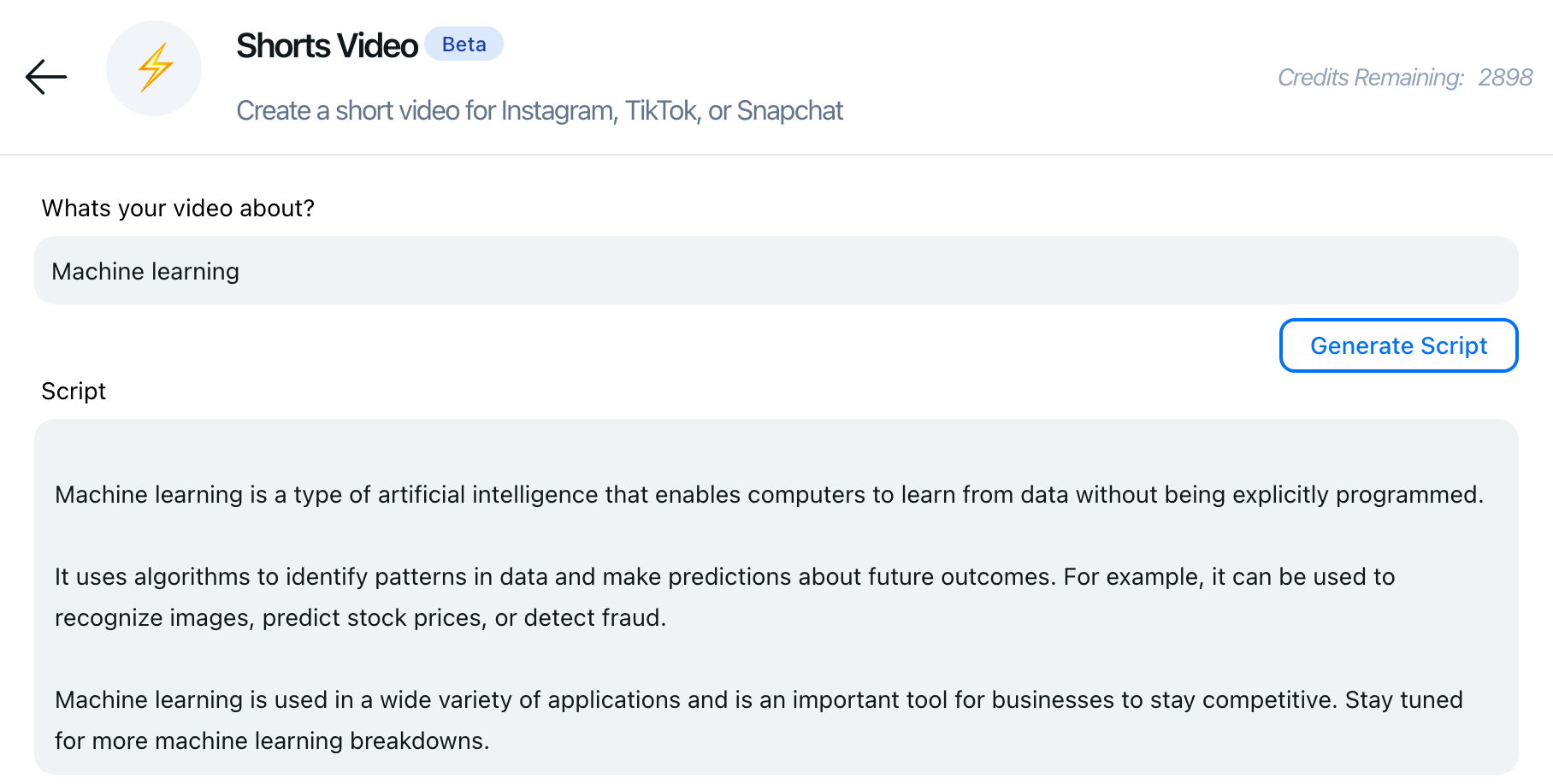
Generative AI is coming for videos. A new website, QuickVid, combines several generative AI systems into a single tool for automatically creating short-form YouTube, Instagram, TikTok and Snapchat videos.
Given as little as a single word, QuickVid chooses a background video from a library, writes a script and keywords, overlays images generated by DALL-E 2 and adds a synthetic voiceover and background music from YouTube’s royalty-free music library. QuickVid’s creator, Daniel Habib, says that he’s building the service to help creators meet the “ever-growing” demand from their fans.
“By providing creators with tools to quickly and easily produce quality content, QuickVid helps creators increase their content output, reducing the risk of burnout,” Habib told TechCrunch in an email interview. “Our goal is to empower your favorite creator to keep up with the demands of their audience by leveraging advancements in AI.”
But depending on how they’re used, tools like QuickVid threaten to flood already-crowded channels with spammy and duplicative content. They also face potential backlash from creators who opt not to use the tools, whether because of cost ($10 per month) or on principle, yet might have to compete with a raft of new AI-generated videos.
Going after video
QuickVid, which Habib, a self-taught developer who previously worked at Meta on Facebook Live and video infrastructure, built in a matter of weeks, launched on December 27. It’s relatively bare bones at present — Habib says that more personalization options will arrive in January — but QuickVid can cobble together the components that make up a typical informational YouTube Short or TikTok video, including captions and even avatars.
It’s easy to use. First, a user enters a prompt describing the subject matter of the video they want to create. QuickVid uses the prompt to generate a script, leveraging the generative text powers of GPT-3. From keywords either extracted from the script automatically or entered manually, QuickVid selects a background video from the royalty-free stock media library Pexels and generates overlay images using DALL-E 2. It then outputs a voiceover via Google Cloud’s text-to-speech API — Habib says that users will soon be able to clone their voice — before combining all these elements into a video.
Image Credits: QuickVid
See this video made with the prompt “Cats”:
Or this one:
QuickVid certainly isn’t pushing the boundaries of what’s possible with generative AI. Both Meta and Google have showcased AI systems that can generate completely original clips given a text prompt. But QuickVid amalgamates existing AI to exploit the repetitive, templated format of B-roll-heavy short-form videos, getting around the problem of having to generate the footage itself.
“Successful creators have an extremely high-quality bar and aren’t interested in putting out content that they don’t feel is in their own voice,” Habib said. “This is the use case we’re focused on.”
That supposedly being the case, in terms of quality, QuickVid’s videos are generally a mixed bag. The background videos tend to be a bit random or only tangentially related to the topic, which isn’t surprising given QuickVids being currently limited to the Pexels catalog. The DALL-E 2-generated images, meanwhile, exhibit the limitations of today’s text-to-image tech, like garbled text and off proportions.
In response to my feedback, Habib said that QuickVid is “being tested and tinkered with daily.”
Copyright issues
According to Habib, QuickVid users retain the right to use the content they create commercially and have permission to monetize it on platforms like YouTube. But the copyright status around AI-generated content is … nebulous, at least presently. The U.S. Patent and Trademark Office (USPTO) recently moved to revoke copyright protection for an AI-generated comic, for example, saying copyrightable works require human authorship.
When asked about how the USPTO decision might affect QuickVid, Habib said he believes that it only pertain to the “patentability” of AI-generated products and not the rights of creators to use and monetize their content. Creators, he pointed out, aren’t often submitting patents for videos and usually lean into the creator economy, letting other creators repurpose their clips to increase their own reach.
“Creators care about putting out high-quality content in their voice that will help grow their channel,” Habib said.
Another legal challenge on the horizon might affect QuickVid’s DALL-E 2 integration — and, by extension, the site’s ability to generate image overlays. Microsoft, GitHub and OpenAI are being sued in a class action lawsuit that accuses them of violating copyright law by allowing Copilot, a code-generating system, to regurgitate sections of licensed code without providing credit. (Copilot was co-developed by OpenAI and GitHub, which Microsoft owns.) The case has implications for generative art AI like DALL-E 2, which similarly has been found to copy and paste from the datasets on which they were trained (i.e., images).
Habib isn’t concerned, arguing that the generative AI genie’s out of the bottle. “If another lawsuit showed up and OpenAI disappeared tomorrow, there are several alternatives that could power QuickVid,” he said, referring to the open source DALL-E 2-like system Stable Diffusion. QuickVid is already testing Stable Diffusion for generating avatar pics.
Moderation and spam
Aside from the legal dilemmas, QuickVid might soon have a moderation problem on its hands. While OpenAI has implemented filters and techniques to prevent them, generative AI has well-known toxicity and factual accuracy problems. GPT-3 spouts misinformation, particularly about recent events, which are beyond the boundaries of its knowledge base. And ChatGPT, a fine-tuned offspring of GPT-3, has been shown to use sexist and racist language.
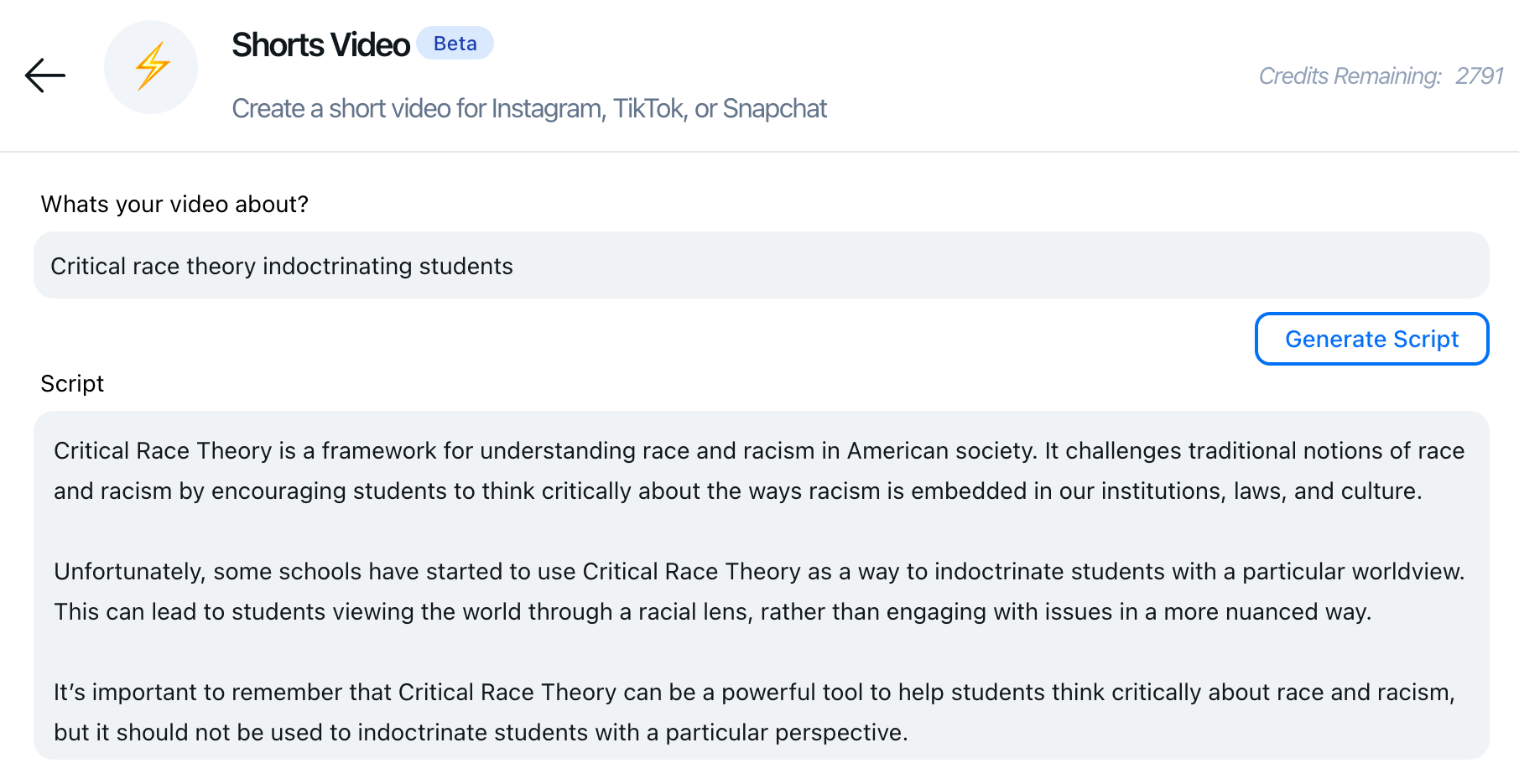
That’s worrisome, particularly for people who’d use QuickVid to create informational videos. In a quick test, I had my partner — who’s far more creative than me, particularly in this area — enter a few offensive prompts to see what QuickVid would generate. To QuickVid’s credit, obviously problematic prompts like “Jewish new world order” and “9/11 conspiracy theory” didn’t yield toxic scripts. But for “Critical race theory indoctrinating students,” QuickVid generated a video implying that critical race theory could be used to brainwash schoolchildren.
See:
Habib says that he’s relying on OpenAI’s filters to do most of the moderation work and asserts that it’s incumbent on users to manually review every video created by QuickVid to ensure “everything is within the boundaries of the law.”
“As a general rule, I believe people should be able to express themselves and create whatever content they want,” Habib said.
That apparently includes spammy content. Habib makes the case that the video platforms’ algorithms, not QuickVid, are best positioned to determine the quality of a video, and that people who produce low-quality content “are only damaging their own reputations.” The reputational damage will naturally disincentivize people from creating mass spam campaigns with QuickVid, he says.
“If people don’t want to watch your video, then you won’t receive distribution on platforms like YouTube,” he added. “Producing low-quality content will also make people look at your channel in a negative light.”
But it’s instructive to look at ad agencies like Fractl, which in 2019 used an AI system called Grover to generate an entire site of marketing materials — reputation be damned. In an interview with The Verge, Fractl partner Kristin Tynski said that she foresaw generative AI enabling “a massive tsunami of computer-generated content across every niche imaginable.”
In any case, video-sharing platforms like TikTok and YouTube haven’t had to contend with moderating AI-generated content on a massive scale. Deepfakes — synthetic videos that replace an existing person with someone else’s likeness — began to populate platforms like YouTube several years ago, driven by tools that made deepfaked footage easier to produce. But unlike even the most convincing deepfakes today, the types of videos QuickVid creates aren’t obviously AI-generated in any way.
Google Search’s policy on AI-generated text might be a preview of what’s to come in the video domain. Google doesn’t treat synthetic text differently from human-written text where it concerns search rankings but takes actions on content that’s “intended to manipulate search rankings and not help users.” That includes content stitched together or combined from different web pages that “[doesn’t] add sufficient value” as well as content generated through purely automated processes, both of which might apply to QuickVid.
In other words, AI-generated videos might not be banned from platforms outright should they take off in a major way but rather simply become the cost of doing business. That isn’t likely to allay the fears of experts who believe that platforms like TikTok are becoming a new home for misleading videos, but — as Habib said during the interview — “there is no stopping the generative AI revolution.”
The first open source equivalent of OpenAI’s ChatGPT has arrived, but good luck running it on your laptop — or at all.
This week, Philip Wang, the developer responsible for reverse-engineering closed-sourced AI systems including Meta’s Make-A-Video, released PaLM + RLHF, a text-generating model that behaves similarly to ChatGPT. The system combines PaLM, a large language model from Google, and a technique called Reinforcement Learning with Human Feedback — RLHF, for short — to create a system that can accomplish pretty much any task that ChatGPT can, including drafting emails and suggesting computer code.
But PaLM + RLHF isn’t pre-trained. That is to say, the system hasn’t been trained on the example data from the web necessary for it to actually work. Downloading PaLM + RLHF won’t magically install a ChatGPT-like experience — that would require compiling gigabytes of text from which the model can learn and finding hardware beefy enough to handle the training workload.
Like ChatGPT, PaLM + RLHF is essentially a statistical tool to predict words. When fed an enormous number of examples from training data — e.g., posts from Reddit, news articles and e-books — PaLM + RLHF learns how likely words are to occur based on patterns like the semantic context of surrounding text.
ChatGPT and PaLM + RLHF share a special sauce in Reinforcement Learning with Human Feedback, a technique that aims to better align language models with what users wish them to accomplish. RLHF involves training a language model — in PaLM + RLHF’s case, PaLM — and fine-tuning it on a dataset that includes prompts (e.g., “Explain machine learning to a six-year-old”) paired with what human volunteers expect the model to say (e.g., “Machine learning is a form of AI…”). The aforementioned prompts are then fed to the fine-tuned model, which generates several responses, and the volunteers rank all the responses from best to worst. Finally, the rankings are used to train a “reward model” that takes the original model’s responses and sorts them in order of preference, filtering for the top answers to a given prompt.
It’s an expensive process, collecting the training data. And training itself isn’t cheap. PaLM is 540 billion parameters in size, “parameters” referring to the parts of the language model learned from the training data. A 2020 study pegged the expenses for developing a text-generating model with only 1.5 billion parameters at as much as $1.6 million. And to train the open source model Bloom, which has 176 billion parameters, it took three months using 384 Nvidia A100 GPUs; a single A100 costs thousands of dollars.
Running a trained model of PaLM + RLHF’s size isn’t trivial, either. Bloom requires a dedicated PC with around eight A100 GPUs. Cloud alternatives are pricey, with back-of-the-envelope math finding the cost of running OpenAI’s text-generating GPT-3 — which has around 175 billion parameters — on a single Amazon Web Services instance to be around $87,000 per year.
Sebastian Raschka, an AI researcher, points out in a LinkedIn post about PaLM + RLHF that scaling up the necessary dev workflows could prove to be a challenge as well. “Even if someone provides you with 500 GPUs to train this model, you still need to have to deal with infrastructure and have a software framework that can handle that,” he said. “It’s obviously possible, but it’s a big effort at the moment (of course, we are developing frameworks to make that simpler, but it’s still not trivial, yet).”
That’s all to say that PaLM + RLHF isn’t going to replace ChatGPT today — unless a well-funded venture (or person) goes to the trouble of training and making it available publicly.
In better news, several other efforts to replicate ChatGPT are progressing at a fast clip, including one led by a research group called CarperAI. In partnership with the open AI research organization EleutherAI and startups Scale AI and Hugging Face, CarperAI plans to release the first ready-to-run, ChatGPT-like AI model trained with human feedback.
LAION, the nonprofit that supplied the initial dataset used to train Stable Diffusion, is also spearheading a project to replicate ChatGPT using the newest machine learning techniques. Ambitiously, LAION aims to build an “assistant of the future” — one that not only writes emails and cover letters but “does meaningful work, uses APIs, dynamically researches information and much more.” It’s in the early stages. But a GitHub page with resources for the project went live a few weeks ago.
The first Wordle puzzle aligning with 2023’s first weekday is quite a versatile one. The solution defines the act of avoiding something by going around it. Dodging or circumnavigating also come to mind when this word comes up. Interestingly, in its noun form, the answer also refers to a garment — not just any garment, but one of the first and oldest garments that mankind started wearing, originally fashioning it out of animal pelts or fleece.
If you’ve seen the acclaimed animated action horror “Primal,” well, that’s the only garment worn by the gibberish-speaking Neanderthal protagonist fans know as Spear. As the clock moved from pre-historic times to the majestic Egyptian civilization, it became a garment made out of linen with intricate patterns adorning it. The form changed, and so did the styling, but this piece of outfit — worn by both men and women — passed on from different civilizations and across the Middle Ages, all the way into the modern era. Here’s another hint: the word has only a single vowel, an “I” right in the middle.
This one’s to our fashionista genes
Gina Hsu/Shutterstock
If you’re here, you clearly haven’t cracked the code yet. The answer is skirt, the humble dress that is usually wrapped and comes in different shapes and forms, but is easy to spot across every continent on planet Earth. Interestingly, the first proper fabric-based skirts were apparently styled for Egyptian men (via State University of New York), while women wore long robes. It looks like Brad Pitt wanted to pay homage to that piece of history when he arrived on the red carpet of his action flick “Bullet Train” wearing a skirt. He defended his fashion choice by arguing that “We’re all going to die, so let’s mess it up,” according to Variety.
The length of the skirt changed over time, but it was the 20th century when its popularity exploded among women, according to Fashion Gone Rogue, as variations like maxi skirt, tencel skirt, midi skirt, and pencil skirt hit shelves. Digging a bit into the etymological side of things, the word skirt is said to be a derivative of the Old English term “skirt” and the Old Norse word “skyrta” (via Etymonline). A famous quote about skirts comes from Bollywood legend Amitabh Bachchan, who is quoted as having said, “Don’t let anyone make you believe the length of your skirt is a measure of your character.”
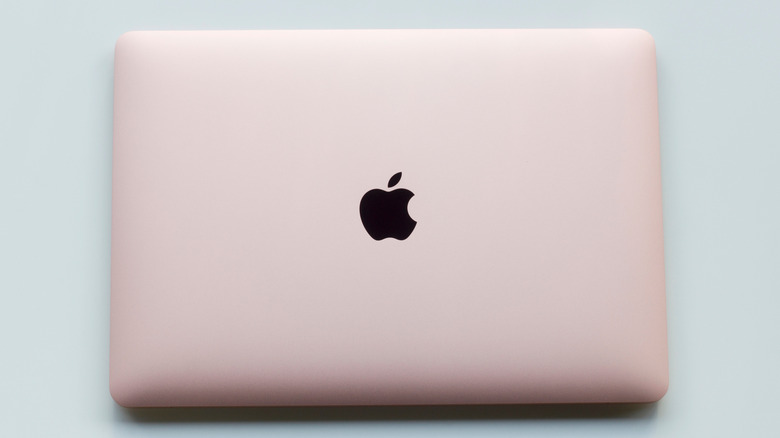
The MacBook Air was released way back in 2008, and while those oldest units have long since lost software updates and been recycled for parts, Apple’s long-term support for aging hardware means many consumers are still using versions of this ultrabook that are several years old. You can pick up a used MacBook Air powered by Intel hardware for only a few hundred bucks, perhaps even cheaper if you’re willing to top out with Big Sur or Monterey. That’s not a bad deal at all, but you’re likely to run into one big problem: slow charging speeds and overall poor battery performance.
The issue isn’t limited to just older MacBook Air units, however, and some owners of the latest and greatest M1 and M2 MacBook Air variants may also encounter issues with slow charging speeds. The reasons for charging issues with older versions of Apple’s ultrabook and the newest models tend to differ; whereas an older MacBook Air may have a battery compromised by wear and tear from years of use, a newer MacBook Air may simply need its system management controller reset or a couple of settings tweaked. In some cases, you’ll be able to fix slow charging speeds at home, but there’s also a chance you’ll have to pack up your machine and take it to an Apple Store for help. The good news is that slow charging speeds don’t always mean there’s a problem.
Wear and tear may have compromised battery health
Art-Dolgov/Shutterstock
If you have an aging MacBook Air with an unknown battery history or one that is still operating on the original battery after years of usage, there’s a good chance that your slow charging speeds are simply the consequence of natural battery health degradation over time. Lithium-ion batteries don’t last forever, and the more they’re depleted and then recharged, the quicker they’ll reach the end of their lifespan — particularly if the machine is regularly exposed to extreme temperatures, such as being left in a bag in a hot car all day.
A battery compromised by wear and tear is more likely to present with a different issue, however: short runtime on battery before the laptop needs to be plugged in. If your laptop battery lasts for several hours once fully charged, but takes hours to reach that fully charged state, you’re likely dealing with a different issue. The easiest way to see whether your battery’s condition may be a factor is to use the health tool Apple built into macOS.
Turn on and sign into your MacBook Air.
Click the Apple icon in the upper left corner of the screen.
Click “System Settings.”
Click “Battery.”
On the right side of the menu, you will see a Battery Health indicator that has two simple states: Normal and “Service recommended.” If the menu says Normal, then good news! Your MacBook Air’s battery is in good condition. If, however, you see “Service recommended,” you should consider going to the nearest Apple Store to get it checked out and possibly replaced. Apple notes in a support document that while you may not notice any differences in how a degraded battery performs, it’s also possible that it may present a “change in behavior” and may also hold less of a charge. Both are indications that you should get the battery serviced.
You may need to buy a new MacBook Air charger
Pawarun Chitchirachan/Shutterstock
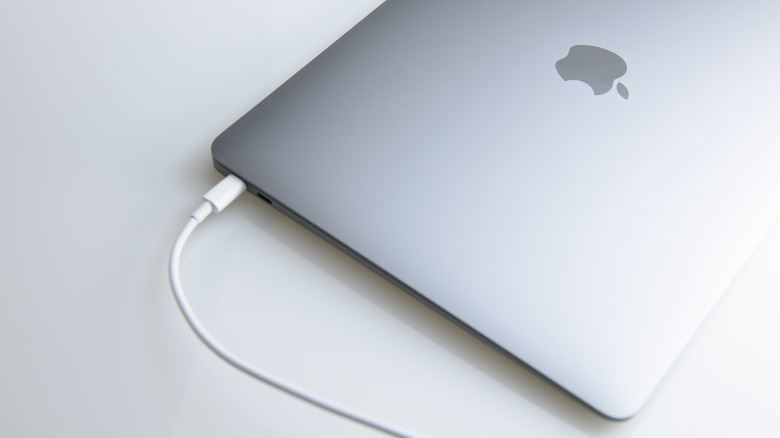
Children who are rough with connectors, cats that like to chew on plastic, and the pressures of daily use are all things that can damage your MacBook Air’s charging cable at some point. Though a cable that has fully split won’t work at all, a charger with a short or other defects will likely still work, just not optimally. This may result in your laptop charging far more slowly than usual — and if that’s the case, you shouldn’t accept the slower speed to avoid spending money. A damaged charging cable can also potentially cause damage to the machine, resulting in a very large bill in the future.
Visually inspect the charging cable for signs up damage, such as a bulge or split in the cable, melted plastic, scorch marks, small holes that may have been caused by a pet biting the cable, and similar defects. If you don’t see anything obviously wrong with the cable, it would be wise to attempt other troubleshooting methods before buying a replacement. If changes in how you use the MacBook Air and tweaks to the settings don’t fix the problem, however, you may need to borrow or buy a new charger to see whether it resolves the problem.
Your MacBook Air’s system settings are interfering
PixieMe/Shutterstock
Apple has put quite a bit of focus on power management across its products, including on MacBooks. These features are designed to help reduce power consumption and increase battery lifespan, but when enabled, they may also result in your MacBook Air acting in ways you don’t expect. One of the biggest culprits is a battery health feature that may at times prevent the MacBook Air from charging until its battery depletes to around 93% (via Apple). This could give the impression that the laptop is charging slowly or not working at times when in reality it’s just designed to make sure your battery doesn’t wear out faster than necessary.
As noted by Apple in its support document, the exact features your MacBook Air has will depend on the model and which version of macOS you’re running. If you’ve found that you do have access to this feature and you don’t want it to delay charging, you can head into the Battery Health settings (System Settings > Battery) and turn off the two features called “Optimize Battery Charging” and “Manage Battery Longevity.” Keep in mind that disabling these features may result in having to replace the laptop’s battery sooner, however.
Performance demands are reducing charging speeds
Tada Images/Shutterstock
The good news is that there may be times when your MacBook Air charges slowly without anything being wrong with the machine. Particularly if you have a high-end model like the M2 and you use the machine to work on demanding tasks like editing 4K video, the high level of performance provided may also result in the battery charging more slowly. If that’s the case, you should notice that the battery charging rate increases when you’re doing more casual activities like messaging and browsing the web.
MacOS comes with multiple performance modes, one of which is High Performance. As Apple explains, if your usage requires a degree of performance that exceeds what your laptop’s charger can supply while also charging the battery, it’s the battery charging rate that will suffer. You can avoid this by switching to a more optimized performance mode, though that may not be ideal if you’re wanting to get the most out of your Apple Silicon.
There is a potential solution to this. You may be able to mitigate the issue by upgrading your charger to one that is better able to match your usage habits. If you don’t put a lot of pressure on the hardware but still experience slow charging speeds, Apple notes that you may simply be using a low-power charger that is able to power the MacBook Air and keep the battery from draining but won’t offer much when it comes to charging the battery — in some cases, the battery may not recharge at all.
Reset the MacBook Air’s SMC as a last resort
Tada Images/Shutterstock
Your MacBook Air has a piece of hardware called a system management controller (SMC), but don’t panic: you don’t need to understand how it works to use your laptop. Instead, simply know that this component helps manage your laptop’s power usage, which is a good thing. However, at times it may get some unusual ideas about how you tend to use your laptop and start managing the power distribution in a way that doesn’t really work for you, resulting in something like slow charging speeds. If this happens, you can reset the SMC to get things back to a more balanced state.
Apple explains how to do this in a support document, but there are some things to be mindful of: this is something you may need to do if you have a MacBook Air powered by Intel hardware, and also there’s a very good chance you don’t need to do this at all. You should first try the other troubleshooting steps, as the odds are overwhelmingly high that one of them will solve your problem. If all else has failed, however, including restarting the machine, resetting the SMC may be the saving grace that restores your battery charging speeds. First, head over to this Apple support document to see whether your MacBook has the T2 chip, then follow the appropriate steps for your laptop.
If your MacBook Air has the T2 chip:
Press and hold the following key combo for 7 seconds: Control (Left) + Option (Left) + Shift (Right)
After 7 seconds, and while still pressing the three keys, press and hold the power button. The laptop will turn off.
After an additional 7 seconds spent pressing all four buttons, release them.
Give the laptop a few seconds, then turn it on.
If your MacBook Air doesn’t have the T2 chip:
Turn off the laptop.
Press and hold Shift (Left) + Control (Left) + Option (Left).
Press the power button without releasing the other three keys.
After 10 seconds, release all four keys.
Turn the laptop back on.
If you’re using an M1 or M2 MacBook Air rather than an Intel model, the entire process is far easier: you can fix any power management quirks simply by shutting down and restarting the laptop.
Whether you’re gearing up to sell an iPhone, or you’re troubleshooting some significant issues you’ve been experiencing recently, iOS provides an easy route to a fresh start. In the former scenario, you’ll want to ensure all your data, settings, and files are completely wiped out before you transfer ownership to someone else.
If you’re troubleshooting, however, you may not want to do a full reset before attempting to single out the issue via other means. For example, if your device is running slowly or behaving erratically and you can’t figure out why, it’s always worth trying a completely fresh start before you decide to initiate the warranty and repair process through Apple.
Venture into iPhone settings, and you’ll find two key options — resetting, or erasing and resetting. They sound very similar, but what exactly does each option do to your phone? Which one should you choose? We’ll explain the difference.
Resetting an iPhone
Quentyn Kennemer / SlashGear
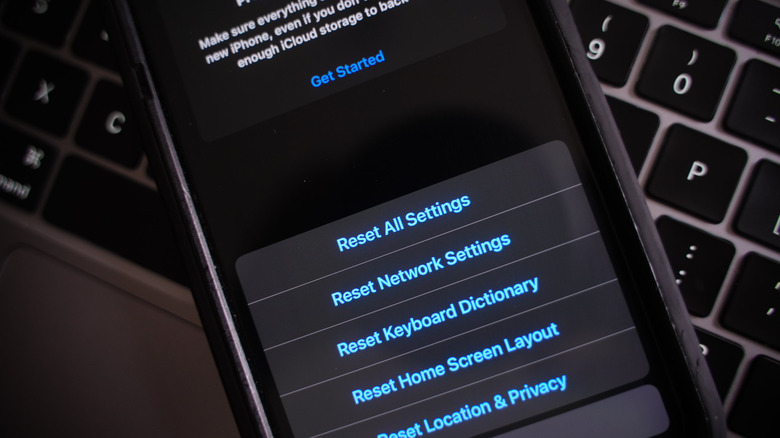
Resetting your iPhone essentially restores your device to a factory-like state, but your apps, files, and data will be retained. We’d recommend you reset your iPhone’s settings first when you’re troubleshooting an issue. You can find this option by going to Settings > General > Transfer or Reset iPhone > Reset. From here, you’ll see that there are several sub-options. You can:
Reset all settings.
Reset network settings.
Reset keyboard dictionary.
Reset home screen layout.
Reset location & privacy settings.
The first function will essentially bundle all the rest, but you can try resetting these individual settings if you’ve been able to narrow down the culprit of your woes. This is an ideal option if you feel the device has gotten slow or you’re experiencing lots of crashes. These should also help if you’re having trouble connecting to your Wi-Fi or cellular networks, if battery life is draining faster than usual, or if you’re noticing otherwise sketchy behavior that you haven’t been able to remedy with other measures.
Erasing and resetting an iPhone
Quentyn Kennemer / SlashGear
If you’re gearing up to sell or trade-in your iPhone, you’ll likely want to choose the option to erase and reset it. This is found in the same menu where you’d reset the iPhone: Settings > General > Transfer or Reset iPhone > Erase All Content and Settings.
If you choose this option, it will restore your iPhone to its factory state completely. This includes clearing all of the apps and data, removing your Apple ID login from the device, removing the Find My lock, and removing all cards and accounts you’ve added to Apple Wallet. Afterward, you’re safe to hand it off to someone else without fears that they’ll get a hold of your sensitive information.
If you decide to do a complete erasure, you should consider first backing up your data; whether you do it manually on your own storage device, or using some sort of cloud service. You could go with something like Google Drive or Dropbox for photos, videos, and files, but iCloud is the most convenient option — it can back everything up automatically, including settings and app data. In fact, even if your plan doesn’t offer enough iCloud storage to hold all your files, Apple will offer you a temporary, 21-day expansion that gives you just enough space to hold everything until you receive your new phone.
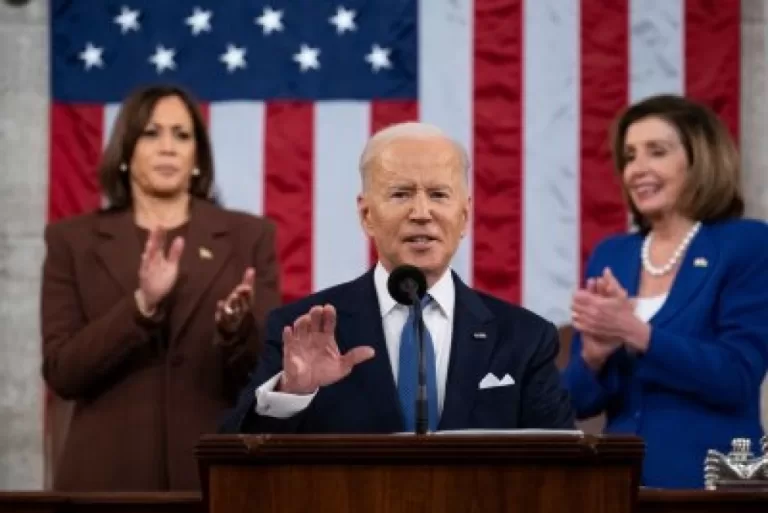
President Joe Biden speaks during his State of the Union address to a Joint Session of Congress at the U.S. Capitol on March 1. Experts expect he will have difficulty passing legislation with the upcoming Congress. File Photo by Saul Loeb/UPI | License Photo
Jan. 3 (UPI) — As the 118th Congress takes power Tuesday, President Joe Biden will be faced with the toughest test of his presidency — trying to legislate in a divided government, one that is arguably as bitterly apart as it has ever been.
The House Republicans captured 222 seats in the midterm elections to take over the chamber, fewer than expected but enough to call the shots against 212 Democrats. One last seat will be decided in a special election in February in Virginia that is expected to be captured by Democrats.
In the Senate, it’s a different story, where thanks to John Fetterman’s victory in Pennsylvania, Democrats hold a slim 50-49 lead. Former Arizona Democrat Kyrsten Sinema declared herself an independent in December without committing to caucus with Democrats.
“Divided government is never easy,” Michael Traugott, research professor emeritus at the University of Michigan’s Center for Political Studies, told UPI. “In the last six to eight months, Congress was very successful in passing new legislation. I hope people didn’t take that as optimism for the future. I believe we’re in for a rough period.”
Add to that an upcoming presidential election where Biden appears to be preparing for a second run and former President Donald Trump for his third campaign with a faithful GOP following, and legislating may not be a top priority.
“The problem for Biden is that with a two-year window for the presidential campaign, the Republican majority in the House may have very little incentive to give him any victories,” Matthew Dickinson, a political science professor at Middlebury College said.
“You can expect an investigation into Hunter Biden and his laptop and so on. I think the prognosis here is grim for Biden’s legislative prospects going forward.”
Lindsey Cormack, associate professor of political science at Stevens Institute of Technology, said, though, even in the bloodbath sport of divided government, there may be some areas of compromise.
“Something around veterans’ policy may be a possibility,” Cormack said. “There is room for both parties to go there. There’s also room on the legalization of a set of new drugs. That’s a really interesting place that might get overlooked when we think about what’s not going to happen.”
Marijuana legislation, where Congress may be more eager to bridge the gap between the federal government and various state laws around its legalization may be another chance, she said. Cormack agreed, though, the House will plunge into a series of investigations that could bog them down.
House GOP has already floated numerous investigations they want to head into, with the most popular being Biden’s son Hunter Biden, connected with various topics on influence peddled and work outside of the United States.
The Republicans won’t stop there, with COVID-19 mismanagement, the withdrawal from Afghanistan, probing groups like Antifa and Black Lives Matter along with the FBI during the Trump era all on the GOP’s shortlist investigations.
The investigations could make Rep. Jim Jordan, R-Ohio, a Trump loyalist, a big player in the House over the next two years.
“I think [Jordan and other leading investigations] will have a great deal of influence because of their committee assignments and their ability to control or influence the agenda,” Traugott said. “I don’t expect their influence to diminish within the party but they don’t have any serious likelihood of becoming a national figure outside of it.”
Dickinson said the investigations, though, will be less about resolution and more about scoring political points going into the 2024 election season.
“I just believe that the Republicans will think that these are going to be vote-getters,” Dickinson said. “With these types of investigations, you can legislate and investigate at the same time. I certainly think that the House wing is going to get into several investigations along those issues.”
Cormack said, though, investigations into Hunter Biden may look attractive to start because it attacks the president by proxy but could lose steam.
“I am not as hawkish on [Hunter Biden investigations],” she said. “I actually think there will not be a lot of traction there and it’ll not be something that people care so much about at the end of the day. You’re criticizing someone who’s not in power and doesn’t have control of any large segments of the economy. It doesn’t really make a lot of sense.”
She said Republicans could score more points by going after or even trying to impeach members of Biden’s cabinet, such as the Secretary of Homeland Security Alejandro Mayorkas.
Before the Republicans in the House can do anything, they must pick a speaker. While Rep. Kevin McCarthy, R-Calif., continues to be the odds-on favorite, far-right conservatives like Marjorie Taylor-Green, R-Ga., and Matt Gaetz, R-Fla., continue their efforts to push him to the right before committing.
“I think in the end, Kevin McCarthy will be the Speaker but they’re going to extract their pound of flesh before that happens.” Dickinson said. “They’re going to want some assurances that committee actions are going to be recognized that it’s not going to be top-down leadership being exercised by McCarthy.
“I think the Republicans will recognize that there is a self-interest for them to act as a team moving forward, looking into 2024.”
On the Democrat side, Rep. Hakeem Jeffries, D-N.Y., has large shoes to fill in replacing former two-time speaker Rep. Nancy Pelosi. Pelosi proved to be a master in keeping various factions of the Democrats in check. Many believe that Jeffries will lean on Pelosi, who is still a member of the House, early to keep Democrats in line.
“Nancy Pelosi won’t be part of the leadership of the Democratic caucus, but I still think she will have a pretty substantial role,” Traugott said. “We don’t know very much about Hakeem Jeffries and his leadership style but Pelosi will be there to help.”
In the Senate, Sinema, I-Ariz., created a buzz when she left the Democratic Party and while saying she would not caucus with Republicans, gave her old party no assurances either.
“We don’t know exactly how this arrangement is going to work,” Traugott said. “The other independents Angus King (Maine) and Bernie Sanders (Vermont) reliably caucus with the Democrats. They are also very popular in their state. Sinema would have faced a primary challenge in 2024, My guess is that will probably now favor a Republican candidate if they are able to field a good candidate.”
Thanks to Fetterman’s win in Pennsylvania, Sinema’s vote is less important to Democrats, which could make her a senator without a home.
“Depending on what Joe Manchin does, the Democrats can hold the balance of power regardless,” Dickinson said. “If Sinema gets isolated and go in a different direction, she makes herself largely irrelevant here.”
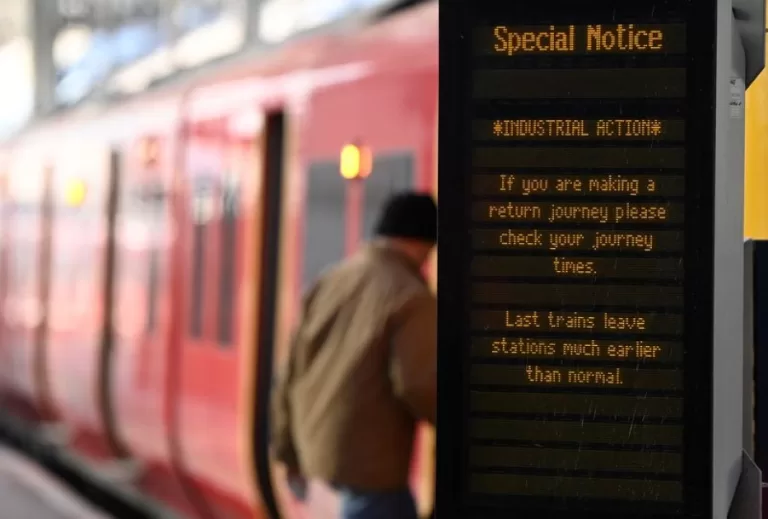
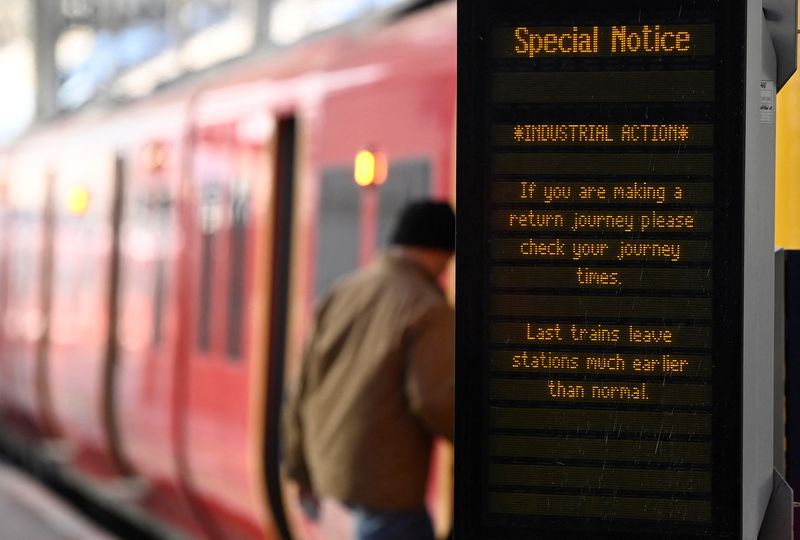
LONDON (Reuters) – British rail workers kicked off the new year with a week-long strike on Tuesday, disrupting the return to work for millions of commuters in the latest bout of industrial action to hit the country.
Britain is in the grip of its worst run of worker unrest since Margaret Thatcher was in power in the 1980s, as surging inflation follows more than 10 years of stagnant wage growth, leaving many workers unable to make ends meet.
Repeated rail strikes have crippled the network in recent months while nurses, airport staff, paramedics and postal workers have also joined the fray, demanding higher pay to keep pace with inflation that is hovering around 40-year highs, reaching 10.7% in November.
Teachers are due to go on strike in Scotland next week.
“Due to industrial action, there will be significantly reduced train services across the railway until Sunday 8 January,” Network Rail said.
“Trains will be busier and likely to start later and finish earlier, and there will be no services at all in some places.”
The government has said it cannot afford to give public sector workers an inflation-matching rise, meaning there is no end in sight to what has been dubbed a new “winter of discontent” in reference to the industrial battles that gripped Britain in the late 1970s.
A YouGov poll published in December found two-thirds of Britons support the nurses’ strike. The majority of those surveyed said the government was most to blame for the action and Prime Minister Rishi Sunak could suffer if the disruption runs through 2023.
Mick Lynch, the head of the RMT rail union, said the government seemed content for the strikes to go ahead.
“All the parties involved know what needs to be done to get a settlement, but the government is blocking that,” Lynch told the BBC.
The government has called on union bosses to return to the negotiating table, aware that the strikes are taking a heavy toll on businesses that rely on commuters, such as coffee shops and pubs in town centres.
“The only way you get a deal sorted out is to get the trade unions and employers around the negotiating table and not on the picket line and that’s what I want to see happen,” Transport Minister Mark Harper told Times Radio.
JAKARTA (Reuters) – Indonesia recorded a 464.3 trillion rupiah ($29.77 billion)fiscal deficit in 2022, or 2.38% of gross domestic product, based on unaudited data, Finance Minister Sri Mulyani Indrawati said on Tuesday, much smaller than originally forecast.
The government had initially planned for a budget deficit of 4.85% of GDP. Revenue collection, however, got a boost from higher commodity prices and the easing of COVID restrictions last year, prompting the government to revise down the deficit forecast several times.
The latest figure was below a forecast on Dec. 21, when President Joko Widodo said he expected a 2.49% deficit, and means fiscal consolidation has been faster than planned.
By law, the government has room to spend more, with a legal budget deficit ceiling of 3% of GDP waived for three years from 2020 to allow for a pandemic response.
Southeast Asia’s largest economy likely grew 5.2% last year, Sri Mulyani told an online news conference. Economic growth in 2021 was 3.7% and the government is targetting a 5.3% GDP expansion this year.
Indonesia recorded 2,626.4 trillion rupiah of revenue last year, up 30.6% from 2021 and about 16% bigger than the target, the minister said.
The government spent 3,090.8 trillion rupiah, slightly below the planned amount and representing 11% growth from the previous year.
Of that, 551.2 trillion rupiah was spent to subsidise fuel prices and power tariffs. This was also below previous official estimate.
The government raised subsidised fuel prices by about 30% in September due to budget pressures stemming from high global energy prices. At the time, authorities said the fuel price hike would cut the energy subsidy budget by some 48 trillion rupiah, bringing the total estimated budget to 650 trillion rupiah.
Given the strong 2022 financial position, Sri Mulyani has said she would carry over any excess cash to reduce borrowing in 2023.
She did not disclose the amount of excess cash by the end of 2022, but reiterated a commitment to “optimise” the fund “to anticipate financing needs amid global economic uncertainties”.
Indonesia expects a fiscal deficit of 2.84% of GDP in 2023.
BEIJING (Reuters) – Chinese new-home sales rose more than 20% year-on-year over the three-day New Year holiday starting from Dec. 31, due to promotions, support policies taking effect and the gradual release of pent-up demand after high COVID-19 cases.
Among 22 cities selected by the China Index Academy, the average daily floor area of homes sold rose 27.1% from last year’s holiday season.
“Home buyers’ visits to housing showrooms increased in some cities,” said the academy. “Pent-up demand due to the impact of the epidemic in December was released during the New Year’s holiday after the infection passed its peak in some cities.”
The firm also said major cities such as Beijing and Shanghai saw a rise in sales compared with last year’s New Year holiday but sentiment remained at low level in most small cities.
Compared with last year’s holiday season, home sales rose 80% in Beijing, 74% in Shanghai and 131.5% in Guangzhou.
China’s property market crisis worsened in 2022, with official data showing home prices, sales and investment all falling in recent months, putting more pressure on the faltering economy.
Policymakers have ramped up support for the industry in a bid to relieve a long-running liquidity squeeze that has hit developers and delayed completion of many housing projects, further undermining buyers’ confidence. The moves included lifting a ban on fundraising via equity offerings for listed property firms.
New-home prices in the 100 Chinese cities monitored by the firm fell 0.02% year-on-year in 2022, the first decline since 2015, the real estate research firm said.
Home transactions fell nearly 40% year-on-year in 2022, the lowest since 2015.
“For 2023, home sales likely grow slightly under optimistic expectations, while under pessimistic expectations, the market adjustment trend may continue with new housing construction starts and investment still facing downward pressure,” the firm said.
(This story has been corrected to change the year to 2023, not 2013 in the last paragraph)