Forward-looking: To say 2022 was a rough time for crypto is an understatement. Following a long period of rising prices and delighted investors, last year saw the arrival of a crypto winter that brought Bitcoin’s price crashing down, bankrupted companies, and wiped over $1 trillion off the market, and that’s not even mentioning the collapse of FTX. But what will 2023 bring? Analysts’ predictions vary wildly, from Bitcoin almost quadrupling its previous record high and reaching $250,000, to the digital coin crashing to $5,000, which would be its lowest price since 2019.
Bitcoin started 2022 at close to $48,000. That’s down from its highest-ever price of almost $68,000 a few months earlier, but it was still welcome news for those who invested a few years prior when BTC was under $10,000.
However, the last 12 months have been some of crypto’s worst. The collapse of stablecoin TerraUSD and its support coin Luna crushed the industry in May. It led to huge crypto businesses such as Celsius going bankrupt and the market dipping below $1 trillion as the price of Bitcoin and other digital assets crashed. Then came the FTX controversy, which has seen the arrest of founder Sam Bankman-Fried and lawsuits against celebrities who promoted the company in TV ads.
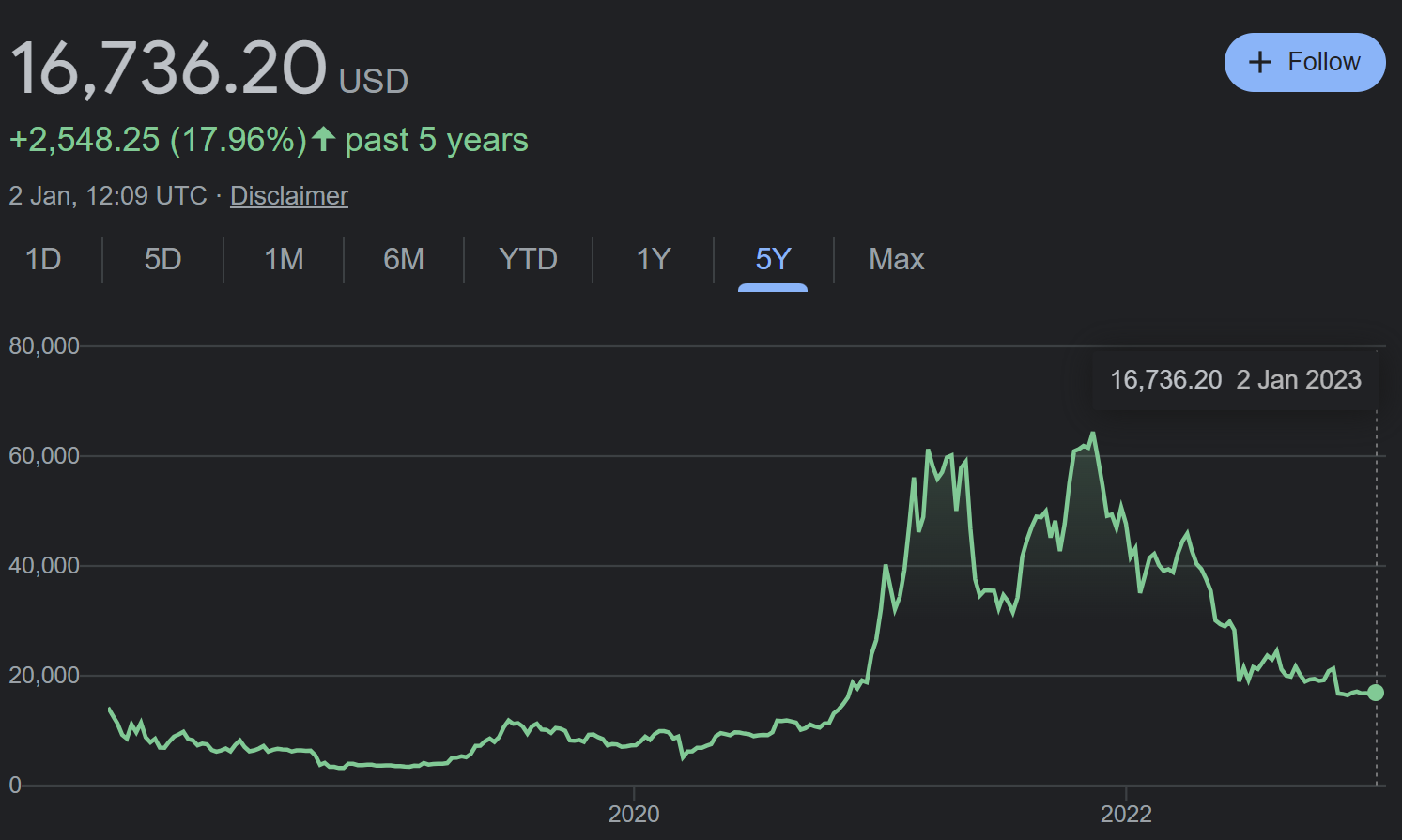
Bitcoin has been hovering between $16,000 and $17,000 since mid-December. But how will the world’s most popular crypto fare in 2023? CNBC round up some predictions from analysts, investors, and others within the industry.
Bitcoin’s price over the last five years. Will it go up or down in 2023?
The most optimistic call comes from billionaire venture capitalist Tim Draper. He believes Bitcoin will rally 1,400% to end the year worth $250,000. “My assumption is that since women control 80% of retail spending, and only 1 in 7 bitcoin wallets are currently held by women that the dam is about to break,” Draper told CNBC. He expects things to get even better in 2024 when the halving—an event that occurs every four years in which the reward for Bitcoin mining is cut in half—takes place.
On the opposite end of the scale is Standard Chartered’s global head of research, Eric Robertsen, who believes Bitcoin’s fall will continue to $5,000 next year, a drop of about 70% from its current price. Veteran investor Mark Mobius has a similarly pessimistic outlook, believing BTC will drop to $10,000 in 2023.
Carol Alexander, a professor of finance at Sussex University, has better news for holders. She believes BTC will reach $30,000 in the first quarter, climbing to $50,000 in quarters three or four, thanks to whales who hold large amounts of Bitcoin stepping in to help the market.
Ultimately, of course, accurately predicting Bitcoin’s future price is impossible. Whether the market recovers or plunges even further in 2023 is anyone’s guess.
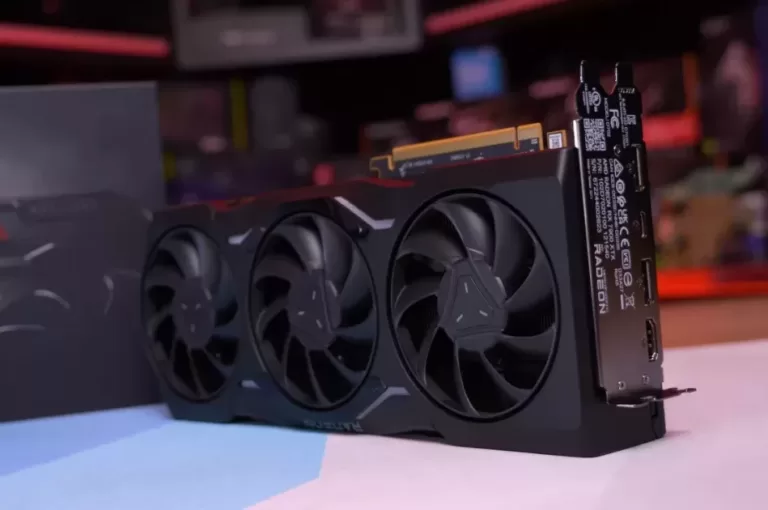
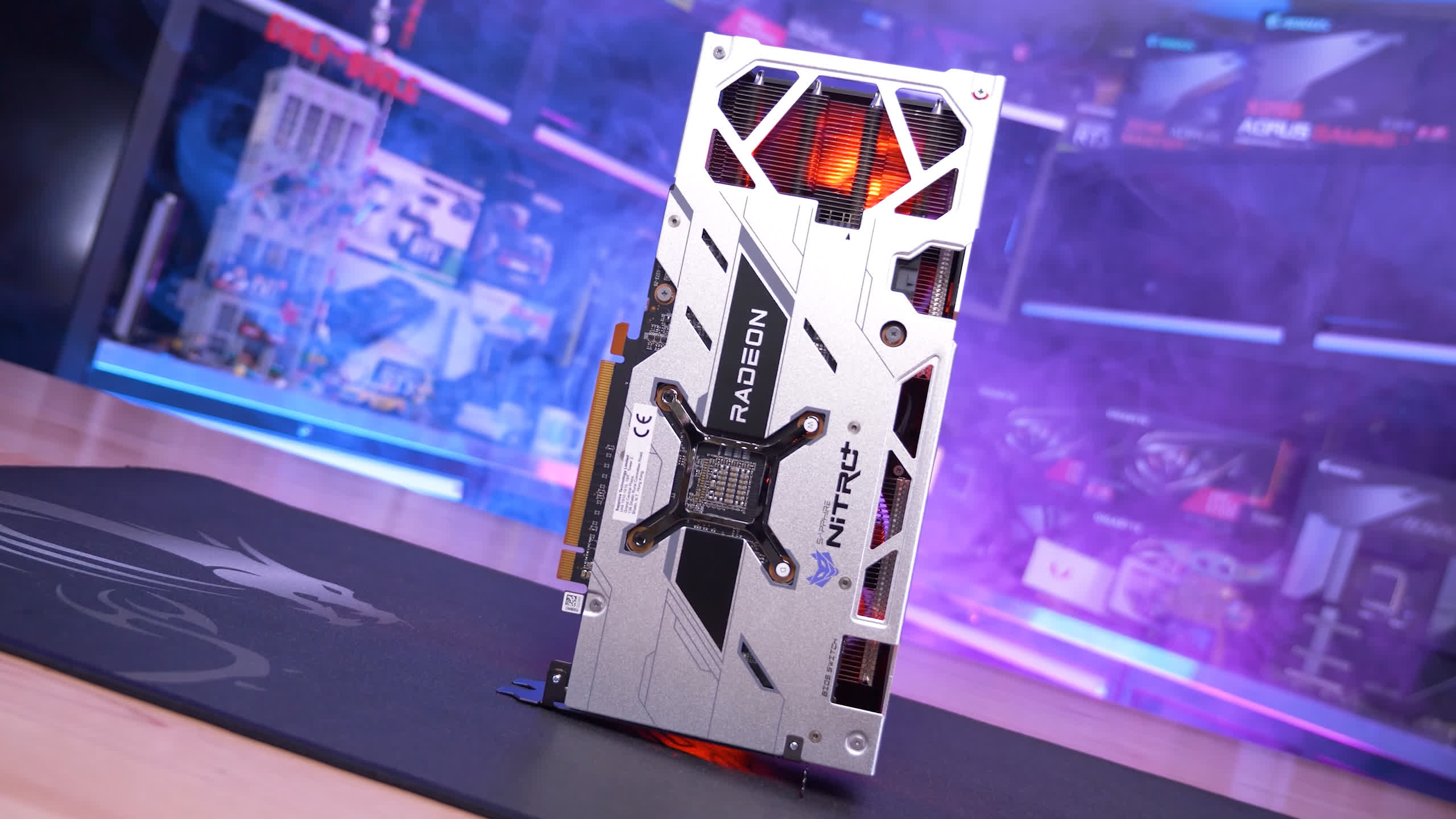
A (very) hot potato Are AMD’s Radeon RX 7900 XTX reference graphics cards heading for a recall? That’s the nightmare scenario team red could be facing after legendary overclocker Roman ‘der8auer’ Hartung discovered a potential reason for the cards’ overheating issues: a faulty vapor chamber.
As a recap, we heard a couple of weeks ago that some AMD Radeon RX 7900 XTX MBA (Made By AMD) reference models are experiencing thermal issues involving GPU hotspot temperatures, or the maximum temperature read by the sensor, reaching as high as 110C.
der8auer hoped to uncover the cause of the high temps, so he purchased four Radeon RX 7900 XTX cards to perform some tests. It was discovered that the installation orientation made a difference, with horizontal setups improving temps by 20 degrees, but the overhearing issue still reared its head after just one minute once the burn-in test started.
The overclocker also investigated factors such as cooler weight and gravity to see if they were influencing the high temps. He used a specially designed stand to confirm these were not part of the problem. Mounting pressure was also ruled out as a cause by dismantling the cooler, removing the support bracket, and shortening the standoffs by 1.5mm.
That left one theory remaining: a problem with the vapor chamber, which could be related to the choice of material or a design flaw, possibly preventing the water from traveling back after condensing. der8auer said he is certain this is where the issue lies. He didn’t have time to take the chamber apart for further investigation but may do so in a future video.
The overheating isn’t affecting every Radeon RX 7900 XTX reference card: the one we used in our review didn’t show any unusually high temps. However, a defect within the vapor chamber likely means the problem is more widespread than first realized and likely impacts a higher number of users than Nvidia’s melting 16-pin 12VHPWR adapter issue, which AMD gleefully mocked in a tweet.
AMD last week said that it was aware of the problem with its RX 7900 XTX reference cards. It advised users experiencing unexpected thermal throttling to contact AMD support.
When it comes to graphics cards, we go in-depth. Year in and year out we test dozens of GPUs from Nvidia, AMD (and also Intel) to see which are worth your money, and which are dead on arrival.
To make the process of choosing a new graphics card a little easier, TechSpot’s Best GPUs guide is intended to answer one simple question: Given a specific budget, which is the graphics card you should buy?
In the past year we’ve seen a lot of newgraphicscardreleases, but very few of them have been exciting, resulting in a situation where the product that sucks the least is the winner. There are a few models that have fallen below MSRP to finally become decent deals, while others are still massively overpriced, but, can offer incredible performance.
So depending on your perspective, you could argue you’re getting what you paid for. We’ll start from the bottom and work our way up the food chain…
Entry-level: Around $200
AMD Radeon RX 6600 or Radeon 6650 XT
For $200 or less there aren’t that many GPU options, and certainly very few good ones. A truly bad example would be the Radeon 6500 XT, which launched in January 2022 with a 4GB model that was supposed to be $200, but due to the supply and demand issues began life closer to $300+.
Today it can be had for $160 and sometimes less than that, but in reality this GPU frankly belongs to a sub-$100 segment. That’s because for $60 more you can get yourself an Radeon RX 6600 and although that’s a ~40% price premium, the 6600 is on average 80% faster at 1080p.
The Radeon RX 6600 also supports video encoding, more than two display outputs, twice the PCIe bandwidth, and can produce more than 60 fps in modern AAA titles using reasonable quality settings at 1080p. So for around $200, the Radeon RX 6600 is your best value graphics card option.
If you can push the budget closer to $300, the Radeon 6650 XT is also a great option, for an extra 20% than the vanilla model, you get another 20% more performance.
There’s no GeForce alternative worthy of consideration at this price point. The RTX 3050 still costs at least $260, pricing it closer to the 6650 XT which is an issue considering the plain RX 6600 straight up destroys the 3050, delivering over 20% more performance on average, while costing less.
Mainstream GPUs at $400:
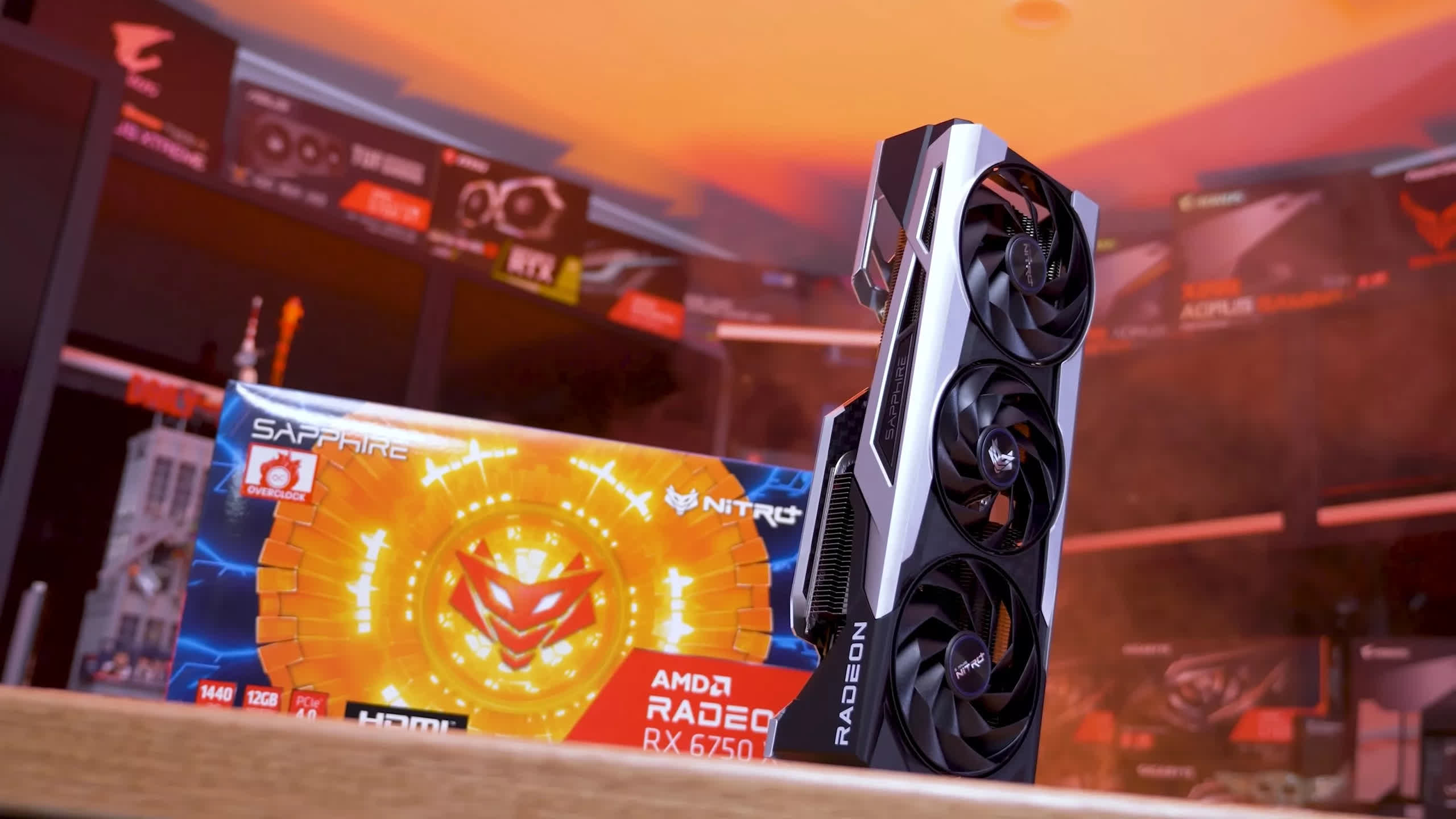
GeForce RTX 3060 Ti or Radeon RX 6750 XT
For those of you with around $400 to spend on a graphics card, Nvidia starts to become competitive. In this price range the best options include the GeForce RTX 3060 Ti and Radeon RX 6700 XT and 6750 XT.
The Radeon 6750 XT is ~5% faster than the 6700 XT, so if pricing is similar you might as well go with the refreshed model. Right now the 6750 XT is typically ~10% more expensive, making the original better value, so our recommendation then would be for the 6700 XT, then you can overclock it and get 6750 XT performance for free.
Alternatively, the GeForce RTX 3060 Ti can be had for a little over $400, which is similar to the 6750 XT in terms of pricing, but worse when it comes to the value equation as it costs 15% more than the 6700 XT and is ~5% slower on average. You’re also looking at around $330 for the standard RTX 3060, resulting in a similar cost per frame as the 3060 Ti. The problem with the RTX 3060 though is that if you spend 10% more on the 6700 XT, you’ll receive around 35% more performance.
In other words, the RTX 3060 Ti is the first GeForce product where we’d start entertaining the idea of purchasing it. The advantage Nvidia has over AMD at these lower performance tiers is limited. In our opinion ray tracing performance isn’t terribly useful here, so the only key selling point would be DLSS, but the upscaling options for Radeon GPUs are improving all the time.
Mid-range Performance: $600+
Radeon RX 6800 XT or ???
The price range between $500 and $800 is a tough one at the moment and the time to buy has temporarily expired. The release of the GeForce RTX 4070 Ti is imminent and this new GPU could break the segment if it becomes available close to $800, potentially driving all older models’ pricing down, which would be great.
By now most of the good deals on Radeon RX 6800 and 6800 XT graphics cards have been snapped up. As of writing, retailers list multiple 6800 XTs for between $540 and $550, but none are in stock, while some local retailers have removed 6800 XT listings entirely. If you can land a Radeon 6800 XT for ~$500, that’s a good deal, but much over that and we wouldn’t bother.
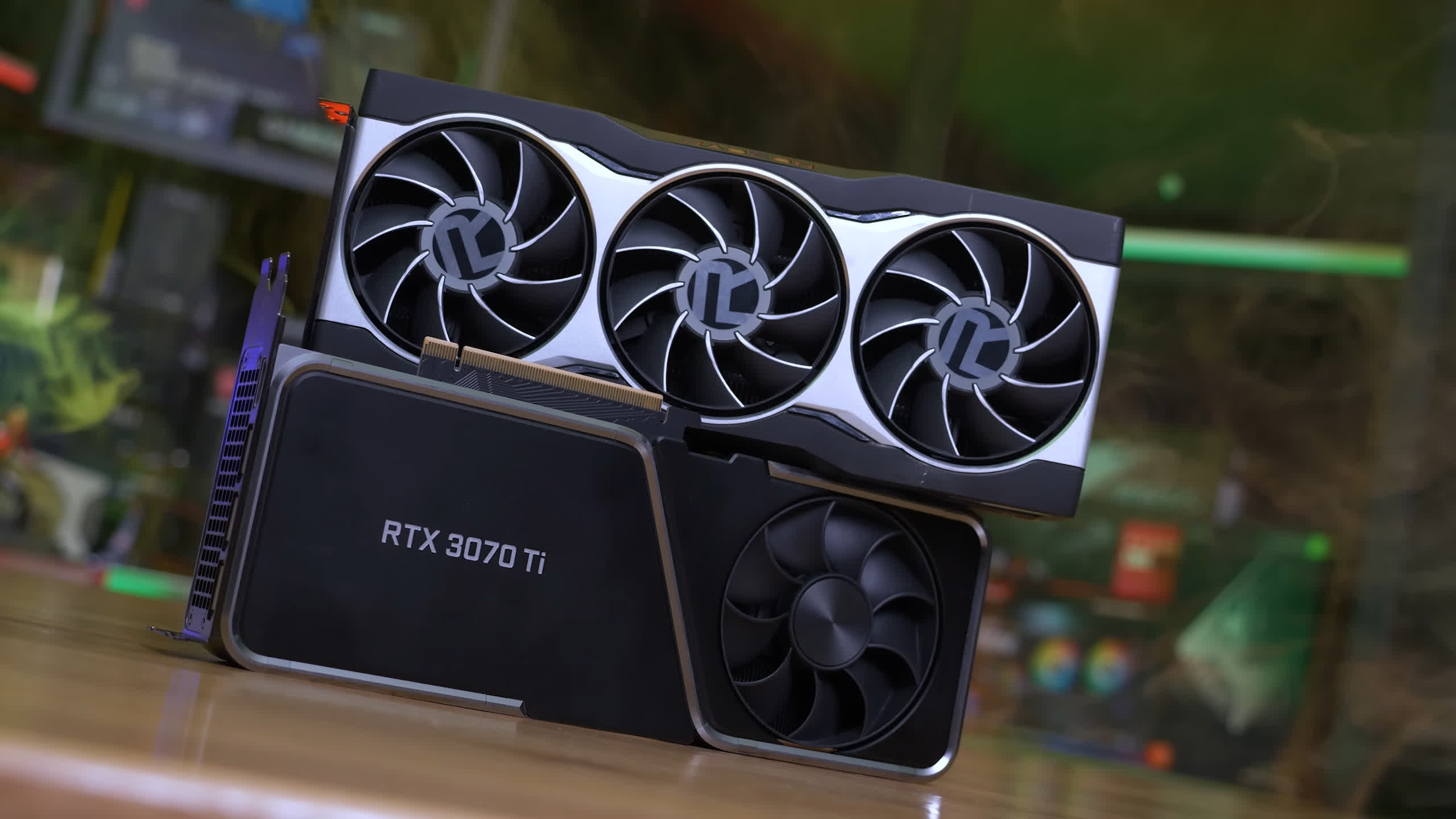
Meanwhile, the GeForce RTX 3070 starts closer to $600 but we’d pass on those. In our opinion, RTX 3070s should be closer to $400 at this point. The same applies to the RTX 3070 Ti, which has an asking price of $700, which makes no sense for a number of reasons — possibly none bigger that the terrible value Radeon RX 7900 XT costs just $200 more — shy of a 30% price premium, for over 60% more performance.
It’s the same story with RTX 3080 — it’s too overpriced, so basically the only GeForce 30 series GPU worth investing in right now is the 3060 Ti, everything else is dead outside of a few limited deals here and there. The best value you could find on a high-end GPU were the 6800 XT, 6900 XT or 6950 XT, but sadly though those deals have run out to make way for next generation GPUs. We just have to hope they don’t suck nearly as much as the 7900 XT and RTX 4080.
The Terrible $1,000+ Mark
GeForce RTX 4080 vs. Radeon RX 7900 XTX
Speaking of next-gen GPUs, if you are willing to spend $1,000, or a bit more than that, here are your options: the Radeon RX 7900 XT at $900, a price that isn’t currently in stock at, the Radeon RX 7900 XTX at $1,000 which would be kind of decent but can’t be found outside of scalper prices, and the GeForce RTX 4080 which can sometimes be found at the $1,200 MSRP, but is often closer to $1,300.
We tend to believe the Radeon RX 7900 XTX is the best deal here, assuming you can find it at the $1,000 MSRP. Frankly, we’re not terribly impressed with any of the options… the RTX 4080 is poor value and the 7900 XTX might seem like a better deal — and depending on your preferences it might be — but the weaker RT performance, inferior upscaling in terms of image quality and game support, along with the higher power consumption and numerous driver bugs means the XTX has to cost at least $200 less.
What you do here is hard to say. You can’t really buy the 7900 XTX anyway and the RTX 4080 is above MSRP, so you might as well wait. Let the early adopters and fanboys snap these up, let the market cool off and then nab yourself a deal. We don’t feel strongly about any of these GPUs at the current prices and don’t care to argue which is the best out of the bad bunch.
$1,600+ for a Flagship GPU
Nvidia GeForce RTX 4090
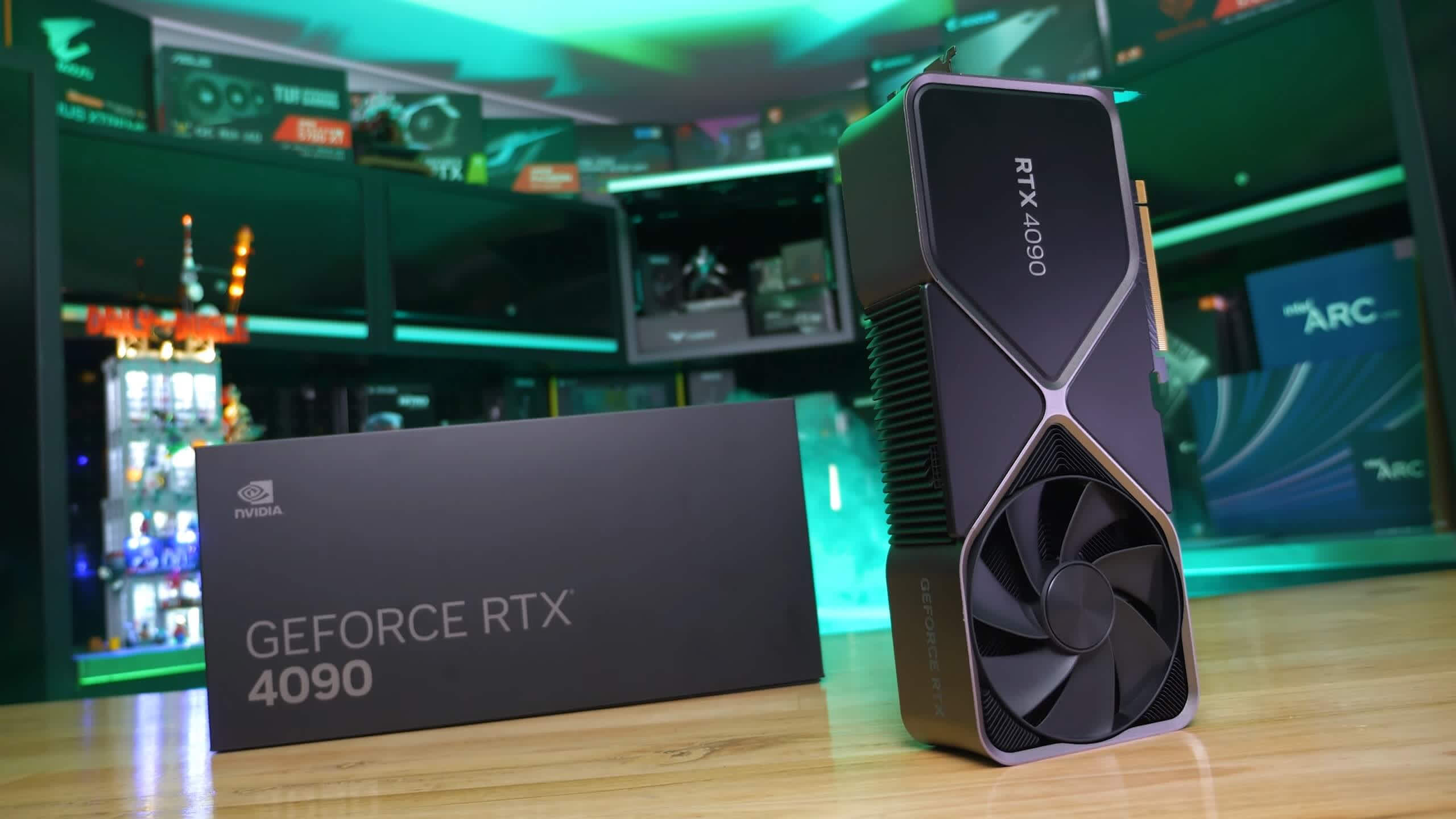
The king of the bad bunch is the GeForce RTX 4090, a product we can’t decide if we love or hate. Yes, at $1,600 it’s super expensive, but the market sets the price and Nvidia has worked out gamers are willing to pay that and more for top end performance, so here we are…
We can complain about the price of high-end GPUs all day, but ultimately it’s going to change nothing if people keep buying them, and buying them they are, on mass it seems. Right now there isn’t a single RTX 4090 to be found at most retailers, with most stores showing several different makes and models and none of them are in stock — even the Asus ROG Strix one that sells for $2,000.
The RTX 4090 wins the ultimate high-end GPU category by default. There’s no competition from AMD, it does offer ~25% more performance than the 7900 XTX, and while it might cost 60% more at MSRP, gamers who want the best there is appear more than happy to pay the premium. With both the 4090 and 7900 XTX out of stock right now, it’s hard to imagine top GPU pricing tumbling any time soon.
|||
As we begin a new year, we are coming off from a period where gamers rejoiced over the fact they could finally buy graphics cards again, only to end up disappointed once they could.
At least that’s the story of the mid to high-end value conscious shopper. For those seeking the best of the best, then it was a pretty exciting one with the release of the breathtakingly fast RTX 4090.
We’ve also seen a number of affordable Radeon GPUs such as the Radeon RX 6600 drop well below their MSRP as a positive takeaway. In the coming weeks and months we’re expecting to see next generation mid-range to high-end parts arrive, such as the heavilyleaked RTX 4070 Ti and hopefully AMD’s counter with something like a Radeon RX 7800 XT, so the GPU war looks set to heat up in 2023.
In the spring of 2022, before some of the most volatile events to hit the crypto world last year, an NFT artist named Micah Johnson set out to hold a new auction of his drawings. Johnson is well known in crypto circles for images featuring his character Aku, a young Black boy who dreams of being an astronaut. Collectors lined up for the new release. On the day of the auction, they spent $34 million on the NFTs.
Then tragedy (or, depending on your point of view, comedy) struck. The “smart contract” code that Johnson’s software team wrote to run the crypto auction contained a critical bug. All $34 million worth of Johnson’s sales was locked on the Ethereum blockchain. Johnson couldn’t withdraw the funds; nor could he refund money to people who’d bid on an NFT but lost their auction. The virtual money was frozen, untouchable—“locked on chain,” as they say.
Johnson might wish he’d hired Ronghui Gu.
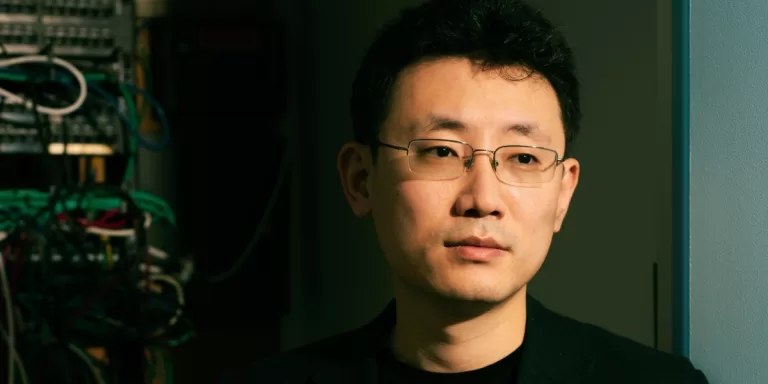
Gu is the cofounder of CertiK, the largest smart-contract auditor in the fizzy and unpredictable world of cryptocurrencies and Web3. An affable and talkative computer science professor at Columbia University, Gu leads a team of more than 250 that pores over crypto code to try to make sure it isn’t filled with bugs.
CertiK’s work won’t prevent you from losing your money when a cryptocurrency collapses. Nor will it stop a crypto exchange from using your funds inappropriately. But it could help prevent an overlooked software issue from doing irreparable damage. The company’s clients include some of crypto’s biggest players, like the Bored Ape Yacht Club and the Ronin Network, which runs a blockchain used in games. Clients sometimes come to Gu after they’ve lost hundreds of millions—hoping he can make sure it doesn’t happen again.
“This is a real wild world,” Gu says with a laugh.
Crypto code is much more unforgiving than traditional software. Silicon Valley engineers generally try to make their programs as bug-free as possible before they ship, but if a problem or bug is later found, the code can be updated.
That’s not possible with many crypto projects. They run using smart contracts—computer code that governs the transactions. (Say you want to pay an artist 1 ETH for an NFT; a smart contract can be coded to automatically send you the NFT token once the money arrives in the artist’s wallet.) The thing is, once smart-contract code is live on a blockchain, you can’t update it. If you discover a bug, it’s too late: the whole point of blockchains is that you can’t alter stuff that’s been written to them. Worse, code that’s hosted on a blockchain is publicly visible—so black-hat hackers can study it at their leisure and look for mistakes to exploit.
The sheer number of hacks is dizzying, and they are wildly lucrative. Early last year, the Wormhole network had more than $320 million worth of crypto stolen. Then the Ronin Network lost upwards of $600 million in crypto.
“The most expensive hack in history,” Gu says, shaking his head in near disbelief. “They say Web3 is eating the world—but hackers are eating Web3.”
A bustling field of auditors has emerged in recent years, and Gu’s CertiK is the biggest: the company, which has been valued at $2 billion, figures it has done an estimated 70% of all smart-contract audits. It also runs a system that monitors smart contracts to detect in real time if any are being hacked.
Not bad for someone who stumbled into the field sideways. Gu didn’t start off in crypto; he did his PhD in provable and verifiable software, exploring ways to write code that behaves in a mathematically predictable fashion. But this subject turned out to be highly applicable to the unforgiving world of smart contracts; he cofounded CertiK with his PhD supervisor in 2018. Gu now straddles the worlds of academia and crypto. He still teaches Columbia courses on compilers and the formal verification of system software, and manages several grad students (one of whom is researching compilers for quantum computing)—while also jetting around to Davos and Morgan Stanley events, clad in his habitual black shirt and black jacket as he attempts to convince crypto and financial bigwigs to take blockchain hacks seriously.
Crypto famously runs in boom-bust cycles; the collapse of the FTX exchange in November was just a recent blow. Gu, however, believes he’ll have work to do for years to come. Mainstream firms like banks and, he says, “a major search engine” are beginning to launch their own blockchain products and hiring CertiK to help keep their ships tight. If established businesses start pushing more code onto blockchains, it’ll attract ever more hackers, including nation-state actors. “The threats we have been facing,” he says, “are more and more tough.”
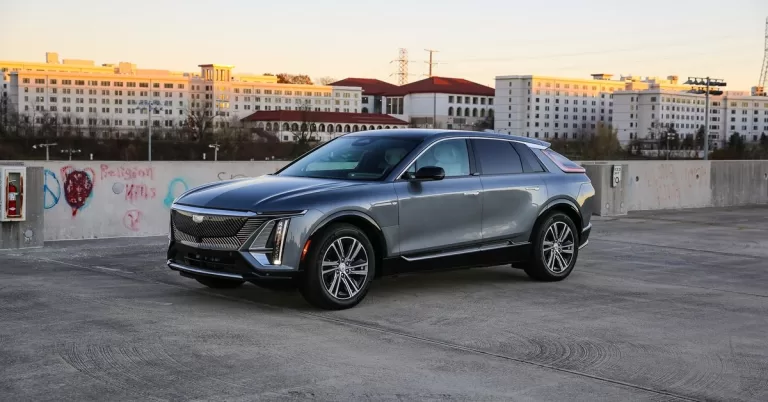
As of January 1st, 2023, a bunch of electric vehicles became newly eligible for the $7,500 tax credit, which passed into law as part of the $430 billion Inflation Reduction Act a year ago.
Some models new to the list had lost their eligibility when their manufacturer hit the previous credit’s sales cap of 200,000 vehicles (Tesla models, Chevy Bolts). Others have recently shifted their production to North America, meeting one of the crucial requirements (VW ID.4).
There’s still a lot in the air right now
There’s also a limit on how much income you can earn in order to be eligible for the credit. Households with an adjusted gross income up to $300,000 will still qualify for the credit, while heads of household must earn below $225,000 and individual filers below $150,000.
There’s still a lot in the air right now — the Treasury Department has set a March deadline for releasing guidance on some of the thornier issues surrounding battery material sourcing and other rules that could drastically reduce the eligibility list if enacted — but for now, these are the EVs that qualify.
Foreign automakers are pressuring the Biden administration to give them a piece of the action, while Senator Joe Manchin (D-WV) is threatening to block the implementation in an effort to prevent companies from exploiting loopholes. And Tesla CEO Elon Musk is whining about how it’s “messed up” that certain versions of the Tesla Model Y that exceed the $80,000 price cap don’t qualify, while a bunch of hybrid Jeeps do.
Bottom line: if you’re unsure whether the new EV you’re eyeing qualifies for the credit, talk to an accountant. Every state has at least a few CPAs that are familiar with the EV tax credit craziness and can help you navigate the murky waters ahead. They can also tell you what state incentives, if any, may be available.
This list is a good start, but don’t consider the last word.
Telegram’s latest update includes an overhauled media editor outfitted with a bunch of new tools to decorate — or conceal — parts of your image or videos. In an update on its blog, Telegram says it’s introducing a new blur tool that lets you block out certain areas of a photo or video, allowing you to hide sensitive information, or blur the faces of passersby who appear in the background.
To make the blurred portion of your photo blend in, Telegram says you can use the eyedropper tool to match the color of the blur brush to your image. Additionally, Telegram’s adding a way to change the size, font, and background of text (sort of like Instagram or Snapchat) when adding it to photos or videos.
Telegram’s overhauled media editor lets you change the font, color, and background of text.
Image: Telegram
It says its revamped drawing tools “dynamically change width” depending on how fast you’re drawing and automatically smooths out lines. Telegram also added a way to quickly add shapes, such as rectangles, circles, arrows, stars, and chat bubbles by tapping the “plus” icon in the editor. And if you don’t want your recipient to see what you’re sending right away, you can now apply a spoiler effect that adds a “shimmering layer” to an image or video that hides its contents until your recipient taps it.
Outside of image editing tools, Telegram’s latest update includes new storage options that let you automatically remove cached data in private chats, groups, and channels after a certain period of time, all while excluding the chats of your choosing. While Telegram previously let you clear your cache across all chats, this should make it easier to free up space automatically without affecting important conversations. It’s introducing a handy new pie chart as well, which shows how much storage different types of files, like videos, documents, music, and photos, are taking up.
The spoiler effect lets you hide the contents of a photo or video until your recipient taps on it.
Image: Telegram
There are also some other new settings that allow you to choose profile pictures for contacts that only you’ll see — perfect if you have a certain unflattering picture you’d like to be reminded of each time someone messages you. You can even suggest profile pictures for specific contacts, which they can then swap out if they like what you’ve chosen. And if you already limit the visibility of your profile picture to your contacts only, Telegram now gives you the option to set a public profile picture that everyone can see. On the other hand, you can now set the visibility of your profile picture to “nobody” if you don’t want anyone on the app to see your picture, not even your contacts.
Other minor features include new animated and interactive emoji, a new progress animation on Android, and the ability for group admins to hide their member lists. This package of updates adds to the list of several other features Telegram added over the course of the last few months, including a way for Telegram users to sign up without a phone number and video transcription for Premium users.
There’s only so much that really needs to be said about Sony’s A7R V mirrorless camera. Sony made so many right decisions with this new model, that it’s easily one of the best cameras money can buy right now. The new AI autofocus system is an excellent jump forward. The improved built-in image stabilization is excellent for hand-holding slower shots. The new articulating display is so good it should just be copied by all other manufacturers as soon as possible. And the 61-megapixel sensor yields some of the best image quality you can get today without jumping to medium format — trusting your computer and storage are up to the task of processing these beefy files.
But while Sony has made some recent strides to offer quality-of-life improvements like a better menu system in recent cameras (which is only marginally better, if I’m being candid), why are its latest cameras still stuck with such bad ergonomics?
I know what you’re thinking: “Oh he’s just reaching to find something to complain about.” But camera ergonomics, physical handling, and grip quality are important. They really, really matter, especially for anyone in situations where they’re going to use a camera continuously for many hours. I know this first-hand from photographing weddings, where I use a camera (usually two) for anywhere from nine to 12 hours straight. And I know this exceptionally well with regards to the A7R V, because its body is nearly identical to one of my personal cameras, the Sony A7 IV.
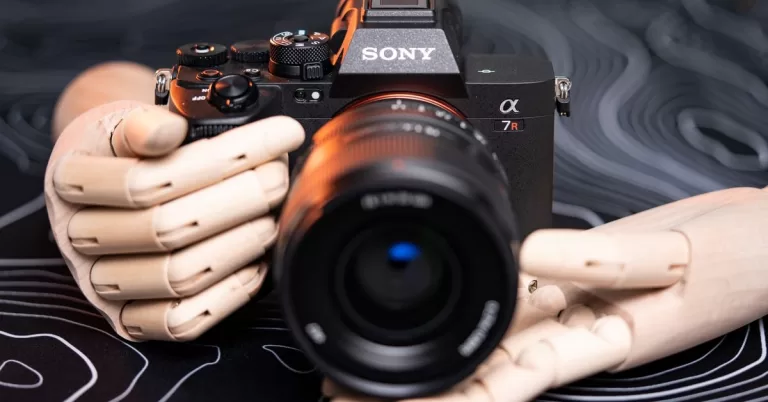
This grip (which is just about identical on all current Sony full-frame models) looks contoured and comfy at first glance. But put your hand on it and it’s a different story. And then keep it in your hand for a long time and it’s a very different story.
Sony does this thing where it establishes something new with one of its cameras (a control layout, an autofocus system, etc.) and then slowly trickles out the same, or nearly the same feature, to a bunch of other models in its line. On one hand, this is great, because you may get an exceptionally advanced feature from a pricey model added to a much more affordable camera. But if there’s something about a design that doesn’t jive with you — like poorly contoured grips that aren’t tall enough — sadly, you’re going to be stuck with that for a while.
So how bad are these Sony ergonomics? Bad enough that I feel compelled to write about it. Bad enough that last year, while talking shop with other photographers, I began jokingly coining a phrase to describe what these grips do to your hand: The Sony Knuckle.
Ergonomics, handling, and comfort matter
The Sony Knuckle is the pain and irritation you get about halfway up your middle-finger, on the side of the PIP joint, from the pressure point of the camera’s grip under the shutter button. Just about any Sony Alpha full-frame camera that’s been manufactured over the last five years has this oddly short, outward projection under the shutter that’s contoured for your middle finger. But it’s not contoured well, or enough. It either needs more height or a softer curve, or perhaps both. When you initially hold the camera it feels okay, but once you use it a lot you realize how uncomfortable it gets. Magnify that by a full day or back-to-back days of heavy usage, and — well, more than once I’ve felt a small blister forming. The handful of pros that I work with who also use Sony cameras have experienced the same thing, so while I can’t say it will happen to everyone, I can say with confidence that the Sony Knuckle is not an isolated condition.
But this isn’t the only reason Sony’s ergonomics need improvement. The grips themselves are also too short. Like many other camera bodies out there that focus on small, compact sizing, the A7R V — again, like every other camera in Sony’s current lineup — left my pinky finger hanging off the bottom. I think this is part of why the Sony Knuckle gets so bad — because my pinky finger is not able to help support the camera, leaving more pressure on that middle-finger knuckle.
I’ve actually tried to remedy this by buying a small add-on base plate for the bottom of my A7 IV (which I’ve also been using on the A7R V), and while I appreciate that the base plate gives my pinky much more room at the bottom, it creates its own issue by causing a spot of pain in the middle of my palm. I’m not surprised that this little add-on bottom plate can’t fix this ergonomic SNAFU all on its own, but what is the solution?
This third-party grip I got for my A7 IV also works on the A7R V, and it helps a little. But the real fix needs to come from Sony on future models.
It’s time Sony completely rethinks the grips on all of its cameras. They need to be slightly taller, and they desperately need to be made of a higher quality, softer grip material. We can knock Canon and Nikon all we want for being so late to the mirrorless party and taking forever to get their acts together, but goddamn, these legacy camera brands know a thing or two about the grips that go on cameras. My old Nikon D700 and D3 cameras were easy to hold and use all day, even if they were much larger and heavier than what we’re using today. Even the Canon EOS R that I owned for a while, which is a much cheaper camera than the A7R V, has a grip that’s miles ahead of anything Sony is currently making. It’s roomy enough for your whole hand and soft enough that it has a tiny bit of give when you squeeze.
Still one of the best cameras money can buy right now, just with this unfortunate downside
As full-size cameras become more and more technically capable, with automated or assisted features that were inconceivable years ago, the human interface cannot be forgotten or left on the wayside. Nearly every time I use the A7R V, I am blown away by how exceptional a picture-taking device it is. The way its improved autofocus identifies subjects and continues tracking even when they turn away or get temporarily obstructed is really a small triumph. It’s something that is greatly appreciated in my line of photography — whether I’m photographing a bride or capturing some silly snaps of my weirdo house cats — because it gives me confidence that I’m going to get the shot tack-sharp as soon as my subject turns around.
But we can’t forget that these devices must be designed for humans. Just like every camera has a diopter control to allow the viewfinder to be adjusted to our squishy, inefficient eyeballs, all cameras need a grip that’s going to be comfortable to hold and not feel like a torture device after extended use. Sony, if you can make a camera that can automatically distinguish between birds and bees, you should be more than capable of building one that doesn’t feel crappy to hold.
Photography by Antonio G. Di Benedetto / The Verge
On the surface, Kaleidoscope is a straightforward, albeit generic, heist story. It hits all of the beats you’d expect: the revenge-filled backstory, the complex process of finding a team and forming a plan, and the satisfaction of watching that plan unfold. And since Kaleidoscope’s story spans around 25 years, you get plenty of all of those things over the course of its eight episodes. But that’s not what makes the show interesting. Kaleidoscope is also a fascinating experiment, an attempt to tell the kind of drama most viewers are familiar with — but designed so that you can watch episodes in any order. As a nonlinear story, it’s a success — but as a fun crime caper, Kaleidoscope leaves a lot to be desired.
The series is centered on Leo (Giancarlo Esposito), a career criminal and the mastermind behind a plan to steal $7 billion in bonds from a seemingly impenetrable vault in New York. To do that, he assembles a seven-person team of experts (meaning the bounty splits into an even $1 billion each) to steal the money as part of a long-running revenge plot. Because the show covers such a large span of time, you get to see Leo and the rest of the crew — which includes everyone from a hot-headed safecracker (Jai Courtney) to a chemist who loves to experiment with new concoctions (Rosaline Elbay) — at various points in their lives.
Peter Mark Kendall, Paz Vega, Jai Courtney, and Rosaline Elbay in Kaleidoscope.
Image: Netflix
But how you approach that story is largely up to you. There’s a specific episode you’re meant to watch as the finale, which covers the actual events of the heist. But the rest of the episodes are meant to be watched in any order. I started out chronologically, seeing Leo as an up-and-coming jewel thief and later, as he ages inside a prison. Then I chose to jump around a bit: I watched the prep for the heist, then the day after it took place, and rounded it out with the day before. Then I jumped into the finale.
The order you watch the episodes doesn’t change how the story plays out. There’s no interactive element here. But the order does change how you perceive each episode. Because I started chronologically, I already understood the history between Leo and Roger (Rufus Sewell), the security expert he’s trying to rob; if I had watched it the other way around, their backstory would have been a major reveal. At least in the order I happened to watch it in, the nonlinear structure worked quite well. The heist itself is the center, with all of the other stories orbiting around it, providing all the necessary detail so you can understand just went down and why certain events are important.
The problem with Kaleidoscope isn’t the structure; it’s with the show itself. It’s very uneven. There are some fun action-filled heist moments; the finale in particular is a highlight. And I really enjoyed the ridiculously convoluted plan, which involves not only strange high-tech gadgets but also some low-tech solutions like actual bees (seeing how they get used might be my favorite part). But the storyline is packed with cliches to the point that none of the big reveals — at least in the order I watched it in — felt like much of a shock. The cast does its best with the material in front of them, and the criminal gang is often a charming bunch, but they’re saddled with drab dialogue and, in some cases, some of the worst de-aging makeup I can recall seeing. (It’s so bad that the actors struggle to emote with their faces.)
Giancarlo Esposito (he’s behind the mask, I swear) in Kaleidoscope.
Image: Netflix
There are other elements that feel not particularly well thought-out. For instance, each episode is named after a color, and the story is related to that in some way. The “Violet” episode connects to a specific piece of jewelry, while “Pink” relates to a cherished childhood object. It’s a nice idea, but the connections between color and theme often feel tenuous and unimportant. And on the technical side, Netflix’s insistence on automatically playing the next episode was a little annoying when I was trying to plot my own particular journey through this story.
While I wish the show itself were more thrilling, Kaleidoscope does work as a proof of concept. And it’s especially interesting as Netflix continues to experiment with nonlinear and interactive storytelling, from the “choose your own adventure” style of Black Mirror: Bandersnatch to live-action video games like Immortality (which is available on mobile exclusively through Netflix’s app). Kaleidoscope isn’t the future of TV — but it does hint at one direction that future might go in.
Prior to becoming CMO at Hum Capital, Scott Brown led marketing for Sapphire Ventures, a $6 billion VC firm based in the U.S. and Europe. He has had a 20+-year career in enterprise technology, holding senior marketing roles at Facebook, Google, Cisco and several startups.
Late-stage startups are facing major fundraising headwinds, but early-stage investing is still a bright spot for startups until they hit Series B rounds.
Traditional venture capital dollars are harder to come by these days, but institutional investors are still looking for smart investments, and industry watchers are hungry for the good news a new round of financing suggests. While the market is uncertain, founders need to be ready to use their capital infusions as an asset that extends beyond the cash it represents.
In any market environment, a fundraising event can act as a vote of confidence or validation from investors, supporting your company’s growth via talent acquisition and brand awareness. No matter the size of the round, securing external investment is a key milestone in many companies’ journeys, and it often takes a tremendous amount of effort. However, after putting all that work in, many founders make the mistake of letting a funding moment pass by without extracting all the value they could have.
Over the course of my 20+ years as a marketing leader at startups, venture capital firms and large tech companies, I’ve helped dozens of companies announce funding news, ranging from $1 million pre-seed rounds to $50 million raises.
Here’s my playbook for founders looking to make their “big money” moments go farther:
Rethink assumptions about fundraising news
Publicizing funding news lets you create incremental value beyond the capital investment by highlighting your momentum and driving brand awareness.
Founders may overlook the value of announcing funding news for several reasons, but the biggest one is assuming the round isn’t “big enough” to warrant attention. When you see other companies raising hundreds of millions of dollars, it can be easy to think no one will be interested in hearing about your startup’s much smaller round.
Fortunately, that isn’t true. While big numbers may draw splashy headlines, smaller rounds can still drive interest if the announcement is executed well and you can connect the news with some larger industry/technology/societal trend.
Another reason founders hesitate is if all or part of the new capital is through a debt investment. Though it’s becoming more common, especially as VC investors pump the breaks, there is still some stigma around debt funding, and founders may worry they’ll be penalized for adding debt to their balance sheets.
However, securing a debt investment often requires even more rigor than an equity investment, so highlighting a debt raise can actually indicate your business’ fundamentals and revenue numbers are strong enough to support repayment.
Founders may also worry about giving competitors too much information about their business and prefer to make progress while flying under the radar. There are benefits to keeping certain information under wraps, but it’s important not to get so focused on building behind closed doors that you miss the opportunity to get more visibility with the prospects and partners that will drive revenue.
Finally, funding announcements are sometimes just not at the top of a founder’s long to-do list, largely because they are either unsure of how to run an announcement or lack the marketing expertise to execute it effectively. This next section should help on that front.
Three steps to maximize the marketing value of your fundraise
The future is unknown, so when you have a funding round locked up and cash in the bank, you have the opportunity to make the biggest impact you can with the news you have in hand.
To leverage this moment and be successful you need to:
Step 1: Plan ahead
Preparing for a fundraising announcement takes time and strategic thinking. As soon as you’ve reached the point in your investor conversations where term sheets are a likely next step, you should assemble your marketing team to start working on a plan. This includes aligning with your investors early about their ability to participate in a news announcement.
Some key questions your marketing lead should consider include:
Who can offer public quotes or commentary on the investment?
What are the key messages you would like to communicate about this round and what messages would you like your investors to amplify?
When is the investor available to review announcement materials and participate in potential media interviews?
India set an “incredibly important precedent” by banning TikTok two and a half years ago, FCC Commissioner said, as he projected a similar fate for the Chinese giant Bytedance app in the U.S.
Brendan Carr, Commissioner of the FCC, warned that TikTok “operates as a sophisticated surveillance tool,” and told the Indian daily Economic Times that banning the social app is a “natural next step in our efforts to secure communication network.”
The senior Republican on the Federal Communications Commission said he is worried that China could use sensitive and non-public data gleaned from TikTok to “blackmail, espionage, foreign influence campaigns and surveillance.”
“We need to follow India’s lead more broadly to weed out other nefarious apps as well,” he said.
Carr’s remarks further illustrates a growing push among U.S. states and lawmakers that are increasingly growing cautious of TikTok, which has amassed over 100 million users in the nation.
India has banned hundreds of apps, including TikTok, PUBG Mobile, Battlegrounds Mobile India and UC Browser, with affiliation to China in the past two years amid skirmishes at the border of the two neighboring nations.
New Delhi said it had banned the apps because they posed threats to the “national security and defence of India, which ultimately impinges upon the sovereignty and integrity of India.”
TikTok had over 200 million monthly active users in India and counted the South Asian nation as its largest international market by users prior to the ban.
“India’s strong leadership has been informative and helpful as we have debated banning TikTok in the US,” Carr told the Indian paper (paywalled). “For those who argue that there is no way to ban an app, India is an example of a country that has done it and done it successfully.”
The U.S. House banned TikTok on all House-managed devices last week, citing a “high risk due to a number of security issues.” The move followed nearly two dozen states at least partially blocking the app from state-managed devices over concern that China could use it to track Americans and censor content.
“If you look at the history of TikTok’s malign data flows and its misleading representations, I don’t see a path forward for anything other than a blanket ban working,” he told the newspaper.






:no_upscale():format(webp)/cdn.vox-cdn.com/uploads/chorus_asset/file/24329560/telegram_image_editing_options.gif)
:no_upscale():format(webp)/cdn.vox-cdn.com/uploads/chorus_asset/file/24329451/telegram_spoiler_images.gif)
:format(webp)/cdn.vox-cdn.com/uploads/chorus_asset/file/24319652/Sony_A7RV_camera_ADiBenedetto_0006.jpg)
:format(webp)/cdn.vox-cdn.com/uploads/chorus_asset/file/24319653/Sony_A7RV_camera_ADiBenedetto_0007.jpg)

:format(webp)/cdn.vox-cdn.com/uploads/chorus_asset/file/24309231/Kaleidoscope_S1_Blue_00_06_31_03R.JPG)
:format(webp)/cdn.vox-cdn.com/uploads/chorus_asset/file/24309352/Kaleidoscope_S1_White_00_10_07_17R.jpg)