Walking the halls of CES 2023, a lot feels the same as ever. Packed spaces, big TVs, lots of new laptops. But in the three years since I was last here in person, a lot has changed, and I’d argue some of the biggest and most consequential changes are to how we work.
It may take a little digging under the surface, but this year’s CES show has a lot to say about the great shift toward hybrid and remote work, in everything from better video conference tools to attempts at building a metaverse-infused, mixed-reality workspace.
Meetings in the metaverse
The metaverse office concept, at least according to one definition, is a shared collaborative space where one can participate via several means: virtual or augmented reality, 3D displays, standard laptop, tablet and phone screens; or in-person through things like smart whiteboards that work across all these different experiences.
CNET/Josh Goldman
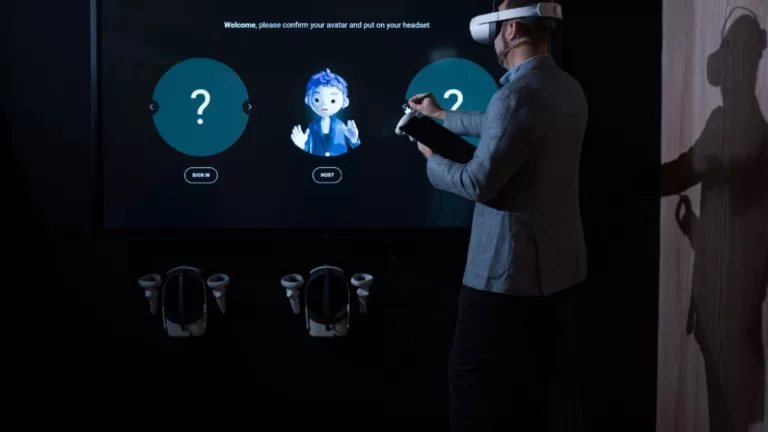
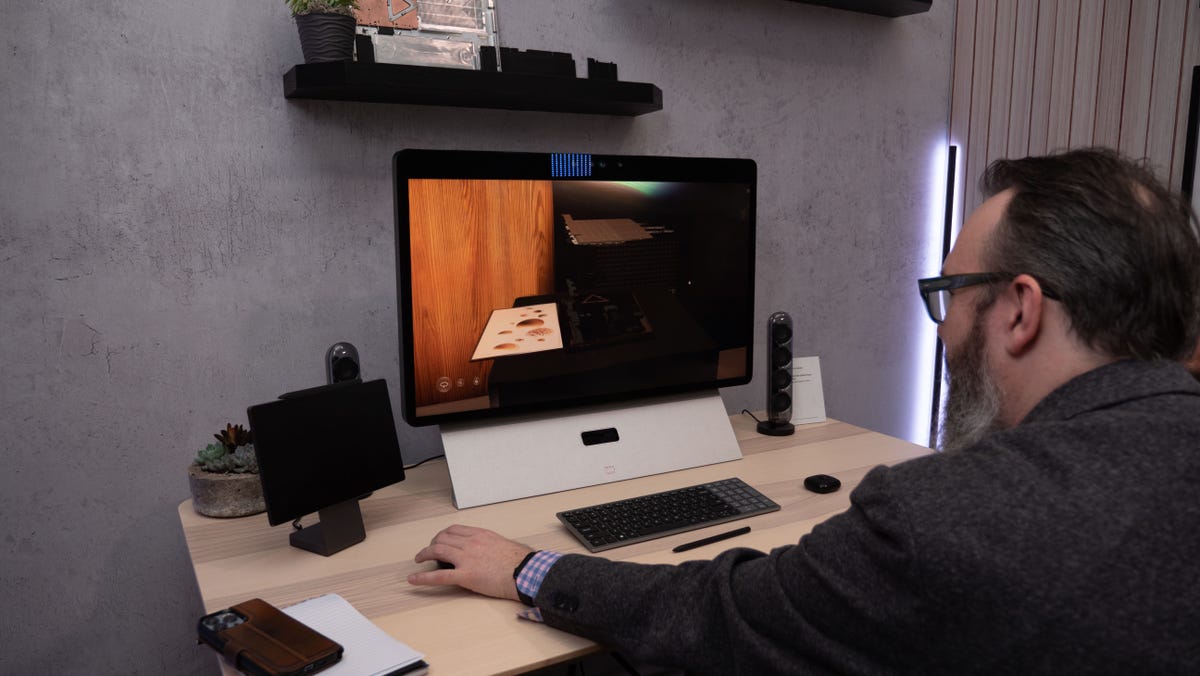
Dell has become a leader in showing off concept pieces and prototypes during CES, and this year, its Concept Nyx (the same name Dell uses for gaming prototypes) tackles that version of the metaverse head on. At a pre-CES preview, I was able to participate in a faux meeting by creating a 3D avatar for others to see, and also by sitting in front of an autostereoscopic display (allowing you to see in 3D without special glasses) that gave me a 3D view of a project. After that, I donned a VR headset to feel like I (or my avatar) was actually in that shared space and writing on a whiteboard with my VR controller. And after that, I was able to use a slate-style tablet to interact with the real-world version of that same whiteboard, but without wearing a headset.
None of this is close to being a shipping product anytime soon, and like many things at and around CES, the hardware is carefully labeled as “conceptual.” Of that batch of products and experiences, the oversize, glasses-free 3D display, using eye-tracking hardware to make the 3D image actually look decent, seemed like the part with the most workplace potential.
Gamers go first
Much new PC technology is driven first by the gaming audience, which has a tolerance for gear that can be both expensive and experimental. That’s why ideas like VR and autostereoscopic 3D often show up in gaming hardware first, before moving into more practical products for your nongaming hours.
For example, this CES saw several new 18-inch gaming laptops, a screen size that’s been virtually extinct since the early 2010s. The first of these bigger screens are in gaming laptops from Dell, Razer, Asus and Acer, but there’s obvious crossover appeal for hybrid and remote workers who want the flexibility of a laptop but with a larger screen that feels more desktop-like. Razer laptops, with their minimalist styling, are especially popular with gamers and creative pros alike. I would not be surprised to see more professionally pitched laptops eventually grow into that new 18-inch size.
The 18-inch Alienware M18.
Josh Goldman/CNET
Asus also leaned into glasses-free 3D with its new ProArt Studiobook and Vivobook Pro laptops. Both, similar to Dell’s display prototype, use eye tracking to make 3D viable. And those devices are aimed at artists and designers, not gamers. Acer also has a similar eye-tracking 3D laptop aimed at gamers, called the Predator Helios 300, as well as a professional display from 2022 called the Acer SpatialLabs View with that same technology.
Laptops with glasses-free 3D were first tried back in 2012 and never made it to a second generation. The eye tracking in these new versions, however, makes the experience miles better.
Now playing: Watch this:
Lenovo Goes All-In on OLED and E Ink Laptops and Tablets…
4:32
More, and different, screens
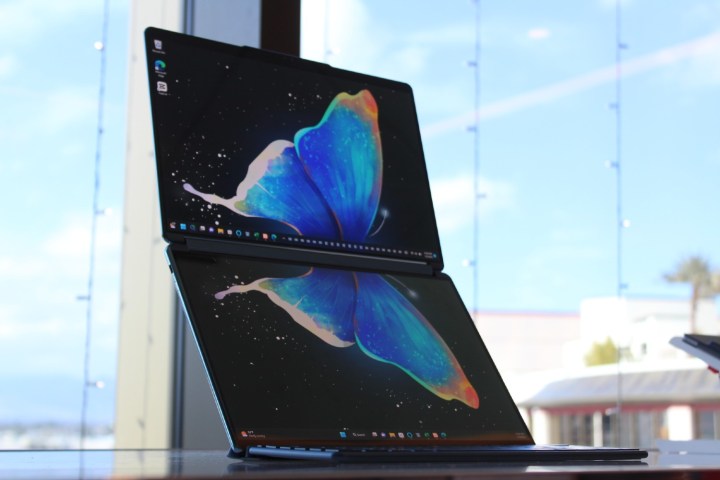
Other experiments, like Lenovo’s twin-OLED-screen Yoga Book 9i and color E Ink/OLED combo, the ThinkBook Plus Twist, might eventually offer some new features that will bleed into more staid work laptops, but it’s far from a sure thing. That said, new E Ink devices like the 10.3-inch Yoga Paper could have more practical work applications, and I only say that because I’ve been using a similar-feeling new Amazon Kindle Scribe while walking the floor at CES 2023 to great effect.
The Yoga Book 9i from Lenovo.
Josh Goldman/CNET
The most welcome trend in both consumer and commercial laptops from the past two years continues unabated, I’m pleased to say. Nearly every new laptop we saw defaulted to a full-HD 1,080-resolution webcam, rather than the wimpy low-res versions that were common prepandemic.
Even better, it’s considered such a standard feature that PC makers hardly feel the need to call it out anymore. It was way too long in coming, and low-res webcams made that first year of remote work in 2020 more difficult than it needed to be for many. But now that we’ve normalized the hybrid workplace and accept video meetings as equal to in-person ones, I’d call it one of those subtle but important changes to how we work that’s making life just a little bit easier.
Something to look forward to: When Apple unveiled the iPhone 14 last fall, its signature feature was a satellite-based communication service for emergency calls beyond the reach of wireless networks. At CES this week, Qualcomm announced plans to bring similar functionality to future Android phones.
Premium Android smartphones based on Qualcomm’s Snapdragon 8 Gen 2 Mobile Platform will gain access to a satellite-based two-way messaging system in certain regions starting in the second half of this year. The company made the announcement this week at CES 2023.
Qualcomm’s Snapdragon Satellite is a response to the Emergency SOS system Apple launched last year for the iPhone 14. Through a network of satellites and ground relay stations Apple helped fund, iPhone 14 users traveling outside traditional wireless network range can transmit their locations if they become lost.
The system works by directing users to point their phones toward a satellite which will then relay to a ground station and the appropriate emergency services. Emergency SOS is paid, but newly purchased iPhones include a free two-year subscription. It isn’t clear whether users will need to pay for Snapdragon Satellite. T-Mobile announced a similar feature using Starlink last summer, supporting SMS, MMS, and participating messaging apps.
Snapdragon Satellite will use Snapdragon 5G Modem-RF Systems in concert with the Iridium satellite constellation’s weather-resistant L-band spectrum. Apple’s system uses the L and S-band, which ITU Radio Regulations designated for mobile satellite communication. The Qualcomm counterpart will support 5G Non-Terrestrial Networks as they become available.
In addition to emergency services, Qualcomm intends to use Snapdragon Satellite for SMS texting and other recreational and professional applications, allowing OEMs and third-party developers to build software leveraging it. The two-way communication system will eventually come to devices other than smartphones, like tablets, laptops, vehicles, and IoT devices.
Qualcomm revealed Snapdragon 8 Gen 2 last November as a new chip platform to power the latest flagship Android phones. The SoC’s 4nm-based Kryo CPU features a 3.2GHz core, four 2.8GHz cores, and three 2.0GHz cores. The Adreno GPU supports Vulkan 1.3, OpenGL ES 3.2, OpenCL 2.0 FP, Unreal Engine 5, and hardware-accelerated ray tracing.
Currently-available models with Snapdragon 8 Gen 2 include the Xiaomi 13 series, Moto X40, and Vivo X90 Pro+, while more are on the way from Asus, OnePlus, and Sony. Qualcomm hasn’t revealed precisely which phones would first receive Snapdragon Satellite.
A hot potato: Security researchers discovered severe vulnerabilities last fall that would let hackers steal vehicles and customer data from multiple manufacturers. In a new update, one of the researchers writes that the vulnerabilities are more wide-reaching and can even affect law enforcement and emergency services vehicles.
Multiple vulnerabilities could have let attackers remotely track and control police vehicles, ambulances, and consumer vehicles from various manufacturers, according to researcher Sam Curry’s latest report. The update follows a similar notice from November.
The weak point for the emergency services rigs is the website for the company controlling the GPS and Telematics for over 15 million devices, most of them vehicles –Spireon Systems. The researchers described Spireon’s website as outdated and could log into it with an administrator account with some ingenuity.
From there, they could remotely track and control fleets of police vehicles, ambulances, and business vehicles. Attackers could unlock the cars, start their engines, disable their ignition switches, dispatch navigation commands to entire fleets, and control firmware updates to potentially deliver malware.
Last year, Curry said that SiriusXM’s remote systems vulnerabilities could let hackers steal Acura, Honda, Infiniti, and Nissan vehicles using only each car’s Vehicle Identification Number. They could also access customers’ personal information. The new report reveals similar dangers with Kia, Hyundai, and Genesis models.
Furthermore, misconfigured single sign-on systems let the researchers access BMW, Mercedes Benz, and Rolls Royce internal corporate systems. The flaws didn’t grant direct vehicle access. Still, attackers could have breached internal communications at Mercedes Benz, accessed BMW dealership information, and hijacked any BMW or Rolls Royce employee account. Security holes at Ferrari’s websites also let researchers access administrative privileges and delete all customer information.
The researchers also found that most, if not all, California digital license plates were vulnerable to attackers. After the state legalized digital plates last year, a company called Reviver handled possibly all of them, and security faults emerged in Reviver’s internal systems. Digital license plate holders can use Reviver to update their plates and report them as stolen remotely. However, vulnerabilities allowed attackers to give ordinary Reviver accounts elevated privileges that could track, change, and delete any registrationo in the system.
Curry’s latest blog post extensively details the methodology behind these and other hacks for those interested in the nitty gritty. His team reported the vulnerabilities to the affected companies before disclosure. At least some of them confirmed issuing security patches.
Before you ask: No. The robot didn’t pass the bar exam, so it’s not a licensed lawyer. However, that is not a requirement for arguing a legal case. People represent themselves and hire paralegals in court proceedings all the time. It’s not a stretch for a judge to agree to hear a case from an AI. In fact, most judges would probably be very interested to see a machine-generated legal argument, especially one presented in real-time.
Several years ago, we covered how a machine-learning algorithm bested 20 human lawyers when analyzing risks in nondisclosure agreements. The AI tied the highest-scoring lawyer with 94 percent accuracy. At the time, we predicted that it probably wouldn’t go much further than that.
“Are lawyers at risk of being replaced? Probably not, at least not for things such as arguing case law,” yours truly posited. Well, now I stand corrected.
NewScientist reports that an AI will argue the first legal case ever in a court of law in February. The hearing won’t be anything too exciting. It’s just a routine speeding ticket, which is probably why the court agreed to allow the unprecedented counsel request. The defendant’s life is not hanging in the balance, just a relatively inexpensive fine.
Of course, there won’t be an Android walking around the courtroom addressing the judge and jury — AI has come a long way since 2018, but not that far. Instead, an iPhone will be in the defendant’s pocket. A phone equipped with an AI app and earpiece will provide the user with the appropriate responses to arguments during the hearing.
Early version of DoNotPay’s chatbot from six years ago.
Do not be mistaken. The AI used in this case is not the same as the NDA-analyzing bot from 2018. Consumer advocate organization DoNotPay developed this algorithm to help users get out of fines, fees, and subscriptions. It can also aid in procuring refunds from businesses that want to make it appear you have no choice but to eat the costs of their mistakes.
“The DoNotPay app is the home of the world’s first robot lawyer,” it boasts. “Fight corporations, beat bureaucracy, and sue anyone at the press of a button.”
The company has not disclosed the court’s location or the defendant’s name to ensure a controlled environment for the experiment. The defendant has been instructed only to say what the bot tells him. Should the judge rule against the defendant, NoNotPay agreed to cover any fines and fees associated with the case.
DoNotPay’s “robot lawyer” started life as a chatbot in 2015, similar to the types that annoy you on tech support sites. You know, the ones that are dumb as rocks and can never satisfactorily answer a simple question. In 2020, DoNotPay incorporated more sophisticated AI that it hopes is good enough to argue an actual legal case in real-time successfully.
DoNotPay’s founder and CEO, Josh Browder, said he wants to use the case to make his AI accurate and honest.
“We’re trying to minimize our legal liability,” Browder told NewScientist. “And it’s not good if it actually twists facts and is too manipulative.”
Ultimately Browder would like to see his app become good enough to replace an attorney but at a substantially lower fee.
“It’s all about language, and that’s what lawyers charge hundreds or thousands of dollars an hour to do,” he said. “There’ll still be a lot of good lawyers out there who may be arguing in the European Court of Human Rights, but a lot of lawyers are just charging way too much money to copy and paste documents, and I think they will definitely be replaced, and they should be replaced.”
It should be fascinating to see how this case turns out. We’ll be looking forward to a verdict sometime after February.
In brief: Cybersecurity firm Bitdefender has released a new tool to help MegaCortex ransomware victims unlock their files, which is great news for those that have had files locked down for years.
MegaCortex surfaced in 2019 as a purpose-built ransomware targeting corporate networks that used domain controllers to spread. According to The Malware Wiki, MegaCortex encrypted user files with AES encryption. A read-me file accompanying infections indicated that the only way to restore access to locked data is with a private key that victims would need to purchase from the hackers.
Fast-forward to October 2021 when authorities arrested a dozen individuals linked to more than 1,800 ransomware attacks across 71 countries. According to TechCrunch, police spent months combing through data collected during the arrests. They ultimately found individual decryption keys that were used to create and release a tool last September to unlock files impacted by the LockerGoga ransomware.
Additional keys discovered by law enforcement led to the development of this new tool for the MegaCortex ransomware.
Interested parties can grab the MegaCortex unlocker over on Bitdefender’s website. They have also published a step by step tutorial on how to use it in both single-computer and network modes. Notably, if your files are encrypted with versions 2-4 of the ransomware, you will need to make sure the system contains a copy of the ransom note. If you were hit with V1, you will need the note and the TSV log file created by the ransomware to use the unlocking tool.
Optionally, the tool is also available from No More Ransom. The site plays host to unlocking tools for more than 170 pieces of ransomware and variants including well-known examples like REvil and Ragnarok.
Most security experts advise victims not to pay a ransom. Sending money only confirms that the ransomware works and there is no guarantee that you will get the decryption key in return for payment or that you won’t be hit again by a tweaked variant requiring a different key (and more money). Australia is even considering a ban on ransom payments to hackers.
PSA: Stop what you are doing and go turn your PlayStation 5 on its side. It’s been discovered that the liquid metal used for cooling can potentially leak and fry the motherboard. There have only been a handful of cases reported, so should you take the chance, or is there not enough evidence for this to become a real problem?
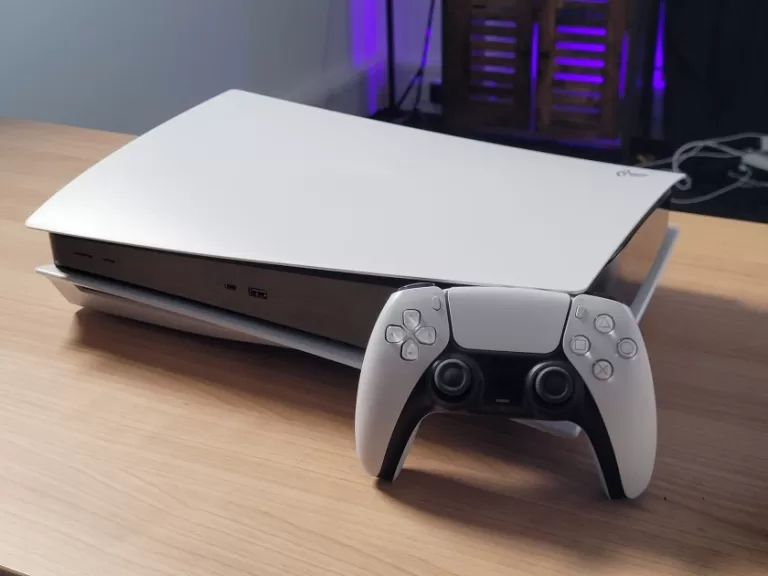
The PlayStation 5 is vastly different than any other PlayStation to date. It’s white, which we haven’t seen since the miniaturized PS one, and of course, it’s much more powerful. It is also comparatively colossal in size. But one thing has remained consistent since the PS2. Users can orient it horizontally or vertically — or so they were told.
Sony’s stand that comes in the package and their marketing materials display the PS5 in both orientations, so it’s more than safe to assume either mounting position is acceptable. The console is so large that the most practical position, for me at least, is vertical. I know I’m not alone, too.
A quick Google image search shows that most images posted to the internet have the behemoth in its towered position. So it may shock many users that this may be the risky way to orient your PS5…
A console repair tech who goes by the YouTube handle TheCod3r posted a video (above) last September showing a PlayStation 5 he received for repair. The console would not power on, so he opened it up, removed the motherboard, and checked each component to see how the voltage was flowing.
He was getting bad readings, but physically, everything looked fine. He decided to pull up the shroud around the APU (accelerated processing unit) to check for damage, and that’s where he found liquid metal had leaked from its enclosure and shorted the contacts on the bottom (relative to vertical orientation) of the APU.
At that time, it seemed like an isolated incident. TheCod3r had not seen a case like this before, and neither had anyone else. However, since then, at least one other instance of a leaking APU has been reported.
TheCod3r calls it a major faux pas by Sony’s design team. It would seem that when mounted vertically, the indium/gallium alloy between the APU and the heatsink, which remains liquid at room temperature, can dribble out over time due to gravity pulling it all to one side of the housing. Horizontally mounting the console alleviates this issue since the liquid metal is allowed to rest uniformly across the APU.
It’s fair to point out that this is not the first time vertical orientation has caused problems for PlayStation users. Somewhere around mid-lifecycle, the PlayStation 2 began exhibiting disk-read errors. The problem was related to users having their PS2s set upright — again, something Sony said it was designed to do.
Unfortunately, the vertical orientation caused the CD laser head to shift out of alignment. However, the DIY fix was as simple as opening the housing and readjusting the CD head, which just about anybody not afraid to open their console could do. As for the PS5’s problem, fixing the APU is not a DIY project for the weekend unless you are a trained professional and can access the parts.
Sony has not officially acknowledged the flaw yet. The company heavily marketed the PS5 in its vertical position, even as shown on the packaging (above). They also included a stand since the PS5 does not have a flat side and it uses the separate stand to facilitate horizontal or upright mounting (a first). One could reasonably expect Sony to offer free repairs to out-of-warranty users over such a fiasco, but don’t hold your breath. Since the failure can ruin the motherboard, it’s likely to be a full replacement situation. If it were a car, this would require a full recall.
The good news is that as long as your PlayStation 5 is in good working order right now, you should be safe. However, we’d like to at least acknowledge the potential issue and maybe decide to reorient your PS5 to horizontal as soon as possible, no matter how inconvenient that may be.
Federal Trade Commission chair Lina Khan is ringing in the new year with another step in her effort to reinterpret or reapply the agency’s rules to stop what she sees as systemic anti-labor and anti-competitive actions. This time, she’s going after noncompete clauses, framing them as anti-competitive and therefore under the agency’s purview.
The FTC announced on Thursday that it proposed a rule that would ban the practice of forcing workers to sign noncompete clauses, which forbid employees from working for their employer’s competitors for a certain amount of time after they leave.
“The freedom to change jobs is core to economic liberty and to a competitive, thriving economy,” Khan said in a statement. “Noncompetes block workers from freely switching jobs, depriving them of higher wages and better working conditions, and depriving businesses of a talent pool that they need to build and expand. By ending this practice, the FTC’s proposed rule would promote greater dynamism, innovation, and healthy competition.”
If enacted, the proposed rule would give Americans more choice in where they work and, by extension, higher pay. They could more easily work for rival companies or start their own companies with less fear of being sued. Such mobility could make what’s already a tight hiring economy even tighter, as workers have even more options of which open jobs they can take.
The notice of proposed rulemaking comes a day after the FTC sued three companies over their noncompete clauses, the first time the agency has done so in its history. It also comes after numerous other efforts the agency has taken to protect competition, including lawsuits to block or unwind mergers and an effort to modernize the commission and the Department of Justice’s merger rules.
The agency will have a 60-day public comment period, after which it will decide to make changes to the proposed rule or, much less likely, abandon it altogether. It will then issue the final rule. Congress can review and disapprove of the rule, which would void it, but that rarely happens and is especially unlikely to happen with a Democratic-majority Senate. Once the rule becomes final, its legality will likely be tested in court.
The proposed rule also follows calls from advocacy groups and the Biden administration to ban the practice of noncompetes. President Biden’s 2021 pro-competition executive order asked the FTC to use its authority to ban noncompetes, and consumer rights group Public Citizen made the same request in a letter to the FTC last month. Several pro-consumer and pro-labor groups petitioned the FTC for such a rule during the Trump administration as well. Noncompete clauses are already banned in several states, including California, where some — but not all — of the notoriously noncompete-heavy tech companies are based.
The FTC estimates the proposed rule could increase wages by $300 billion a year and impact 30 million Americans. A 2014 survey of economists found that nearly 20 percent of workers have noncompete clauses in their contracts. That number is more likely 50 percent for people in high-skilled and high-tech jobs, according to Matt Marx, a professor at Cornell University’s economics and management school, who has been studying noncompete agreements for 15 years.
“I signed my first noncompete in 1995 and didn’t realize what I was doing — and that’s the case for many if not most workers,” he said.
Marx added that these agreements don’t just specify that you can’t share a specific company’s secrets, but are often interpreted more broadly so that a person can’t use skills they had prior to working at that company — something he said can be debilitating to high-skilled workers and entrepreneurs.
One person Marx interviewed, a woman with a PhD in speech recognition who had worked at Bell Labs for nearly two decades, said she had to get a “random computer programming” job outside her field after working for 18 months at a startup where she’d signed a noncompete agreement.
“You’ve been working in this industry for 20 years? Oh, well, sorry, you can’t do that anymore because you worked for us for two years,” Marx explained. “Tough luck, you have to find something else to do.”
Detractors of noncompete clauses say the agreements prohibit workers from getting jobs with competitors or even within the same industry. In doing so, they restrict job mobility and prevent workers from being able to push for higher wages, since changing jobs is often how workers get higher pay. These clauses can send them on lengthy job searches or even “career detours.”
Pro-consumer and pro-labor groups applauded the FTC’s move, as well as the agency itself.
“The FTC’s action today to ban noncompete clauses will also provide a major boost to small businesses and entrepreneurship,” Stacy Mitchell, co-director of the Institute for Local Self-Reliance, told Recode. She added that noncompetes can make it harder for workers to leave employers to start their own businesses that might compete with them.
Sen. Elizabeth Warren (D-MA) commended the FTC’s actions to “protect workers” from “harmful contracts.” She tweeted, “Noncompete clauses give companies unfair power over workers, enabling them to cut wages and benefits without fear of workers finding a new job or starting their own business.”
Pro-employer groups like the US Chamber of Commerce have argued that noncompete clauses can actually be pro-competitive because they protect an “employer’s special investment in, training of, and disclosure of sensitive business information to its employees.” In a statement released on Thursday, the organization called the rulemaking “blatantly unlawful” since it says the FTC doesn’t have the authority to promote the rule. “When appropriately used, noncompete agreements are an important tool in fostering innovation and preserving competition,” the Chamber said in an emailed statement.
sa***********@****de.net“},{“id”:4280187,”name”:”Rani Molla”,”url”:”https://www.vox.com/authors/rani-molla”,”twitter_handle”:”ranimolla”,”profile_image_url”:”https://cdn.vox-cdn.com/thumbor/0N8nVBSrxQ-A-oWkYcc76PsCgE4=/512×512/cdn.vox-cdn.com/author_profile_images/194762/Screen_Shot_2020-10-23_at_4.17.49_PM.0.png”,”title”:””,”email”:””}],”byline_enabled”:true,”byline_credit_text”:”By”,”byline_serial_comma_enabled”:true,”comment_count”:0,”comments_enabled”:false,”legacy_comments_enabled”:false,”coral_comments_enabled”:false,”coral_comment_counts_enabled”:false,”commerce_disclosure”:null,”community_name”:”Vox”,”community_url”:”https://www.vox.com/”,”community_logo”:”rn“,”cross_community”:false,”groups”:[{“base_type”:”EntryGroup”,”id”:80301,”timestamp”:1672948805,”title”:”Recode”,”type”:”SiteGroup”,”url”:”https://www.vox.com/recode”,”slug”:”recode”,”community_logo”:”rn“,”community_name”:”Vox”,”community_url”:”https://www.vox.com/”,”cross_community”:false,”entry_count”:22861,”always_show”:false,”description”:”Uncovering and explaining how our digital world is changing — and changing us.”,”disclosure”:””,”cover_image_url”:””,”cover_image”:null,”title_image_url”:”https://cdn.vox-cdn.com/uploads/chorus_asset/file/16201674/REC_Wordmark_Red_RGB.0.png”,”intro_image”:null,”four_up_see_more_text”:”View All”,”primary”:true},{“base_type”:”EntryGroup”,”id”:30770,”timestamp”:1673126384,”title”:”Politics & Policy”,”type”:”SiteGroup”,”url”:”https://www.vox.com/policy-and-politics”,”slug”:”policy-and-politics”,”community_logo”:”rn“,”community_name”:”Vox”,”community_url”:”https://www.vox.com/”,”cross_community”:false,”entry_count”:27736,”always_show”:false,”description”:”Vox’s policy and politics team explains everything you need to know about what’s going on in Washington and what it means for your life.”,”disclosure”:””,”cover_image_url”:””,”cover_image”:null,”title_image_url”:””,”intro_image”:null,”four_up_see_more_text”:”View All”,”primary”:false}],”internal_groups”:[{“base_type”:”EntryGroup”,”id”:72749,”timestamp”:1673099256,”title”:”Category—News”,”type”:”SiteGroup”,”url”:””,”slug”:”category-news”,”community_logo”:”rn“,”community_name”:”Vox”,”community_url”:”https://www.vox.com/”,”cross_community”:false,”entry_count”:12127,”always_show”:false,”description”:””,”disclosure”:””,”cover_image_url”:””,”cover_image”:null,”title_image_url”:””,”intro_image”:null,”four_up_see_more_text”:”View All”}],”image”:{“ratio”:”*”,”original_url”:”https://cdn.vox-cdn.com/uploads/chorus_image/image/71828325/1232440194.0.jpg”,”network”:”unison”,”bgcolor”:”white”,”pinterest_enabled”:false,”caption”:”FTC Commissioner Lina Khan, speaking at her confirmation hearing on Capitol Hill on April 21, 2021, in Washington, DC.”,”credit”:”Saul Loeb/Getty Images”,”focal_area”:{“top_left_x”:2132,”top_left_y”:1040,”bottom_right_x”:2956,”bottom_right_y”:1864},”bounds”:[0,0,5162,3393],”uploaded_size”:{“width”:5162,”height”:3393},”focal_point”:null,”image_id”:71828325,”alt_text”:””},”hub_image”:{“ratio”:”*”,”original_url”:”https://cdn.vox-cdn.com/uploads/chorus_image/image/71828325/1232440194.0.jpg”,”network”:”unison”,”bgcolor”:”white”,”pinterest_enabled”:false,”caption”:”FTC Commissioner Lina Khan, speaking at her confirmation hearing on Capitol Hill on April 21, 2021, in Washington, DC.”,”credit”:”Saul Loeb/Getty Images”,”focal_area”:{“top_left_x”:2132,”top_left_y”:1040,”bottom_right_x”:2956,”bottom_right_y”:1864},”bounds”:[0,0,5162,3393],”uploaded_size”:{“width”:5162,”height”:3393},”focal_point”:null,”image_id”:71828325,”alt_text”:””},”lede_image”:{“ratio”:”*”,”original_url”:”https://cdn.vox-cdn.com/uploads/chorus_image/image/71828327/1232440194.0.jpg”,”network”:”unison”,”bgcolor”:”white”,”pinterest_enabled”:false,”caption”:”FTC Commissioner Lina Khan, speaking at her confirmation hearing on Capitol Hill on April 21, 2021, in Washington, DC.”,”credit”:”Saul Loeb/Getty Images”,”focal_area”:{“top_left_x”:2132,”top_left_y”:1040,”bottom_right_x”:2956,”bottom_right_y”:1864},”bounds”:[0,0,5162,3393],”uploaded_size”:{“width”:5162,”height”:3393},”focal_point”:null,”image_id”:71828327,”alt_text”:””},”group_cover_image”:null,”picture_standard_lead_image”:{“ratio”:”*”,”original_url”:”https://cdn.vox-cdn.com/uploads/chorus_image/image/71828327/1232440194.0.jpg”,”network”:”unison”,”bgcolor”:”white”,”pinterest_enabled”:false,”caption”:”FTC Commissioner Lina Khan, speaking at her confirmation hearing on Capitol Hill on April 21, 2021, in Washington, DC.”,”credit”:”Saul Loeb/Getty Images”,”focal_area”:{“top_left_x”:2132,”top_left_y”:1040,”bottom_right_x”:2956,”bottom_right_y”:1864},”bounds”:[0,0,5162,3393],”uploaded_size”:{“width”:5162,”height”:3393},”focal_point”:null,”image_id”:71828327,”alt_text”:””,”picture_element”:{“html”:{},”alt”:””,”default”:{“srcset”:”https://cdn.vox-cdn.com/thumbor/9S7FkzQUujICJyT2p4hLSj9o30M=/0x0:5162×3393/320×240/filters:focal(2132×1040:2956×1864)/cdn.vox-cdn.com/uploads/chorus_image/image/71828327/1232440194.0.jpg 320w, https://cdn.vox-cdn.com/thumbor/7kwGQ4Gwx7t9OTOMH21SDwkGpfg=/0x0:5162×3393/620×465/filters:focal(2132×1040:2956×1864)/cdn.vox-cdn.com/uploads/chorus_image/image/71828327/1232440194.0.jpg 620w, https://cdn.vox-cdn.com/thumbor/kmR07KnIvxn1qHeI46cliQNxxPY=/0x0:5162×3393/920×690/filters:focal(2132×1040:2956×1864)/cdn.vox-cdn.com/uploads/chorus_image/image/71828327/1232440194.0.jpg 920w, https://cdn.vox-cdn.com/thumbor/I8kxwEdC76tbEnon-0MhI0FzKpA=/0x0:5162×3393/1220×915/filters:focal(2132×1040:2956×1864)/cdn.vox-cdn.com/uploads/chorus_image/image/71828327/1232440194.0.jpg 1220w, https://cdn.vox-cdn.com/thumbor/9wBxxvJfuIhgOVWnL8UrUcZb1YA=/0x0:5162×3393/1520×1140/filters:focal(2132×1040:2956×1864)/cdn.vox-cdn.com/uploads/chorus_image/image/71828327/1232440194.0.jpg 1520w”,”webp_srcset”:”https://cdn.vox-cdn.com/thumbor/44L9zAj2uhHBpcZ4Gxp35eWZWYo=/0x0:5162×3393/320×240/filters:focal(2132×1040:2956×1864):format(webp)/cdn.vox-cdn.com/uploads/chorus_image/image/71828327/1232440194.0.jpg 320w, https://cdn.vox-cdn.com/thumbor/66-4QSguNrGgz09J4alBQTpuOUQ=/0x0:5162×3393/620×465/filters:focal(2132×1040:2956×1864):format(webp)/cdn.vox-cdn.com/uploads/chorus_image/image/71828327/1232440194.0.jpg 620w, https://cdn.vox-cdn.com/thumbor/ubZyEcqefnydkA9s5Jt1u4o5uuc=/0x0:5162×3393/920×690/filters:focal(2132×1040:2956×1864):format(webp)/cdn.vox-cdn.com/uploads/chorus_image/image/71828327/1232440194.0.jpg 920w, https://cdn.vox-cdn.com/thumbor/Urhf0igZ8Ndrc0gFouB7ed7_fOg=/0x0:5162×3393/1220×915/filters:focal(2132×1040:2956×1864):format(webp)/cdn.vox-cdn.com/uploads/chorus_image/image/71828327/1232440194.0.jpg 1220w, https://cdn.vox-cdn.com/thumbor/l0l9RJI9k16sdUxroFIBSNV14EE=/0x0:5162×3393/1520×1140/filters:focal(2132×1040:2956×1864):format(webp)/cdn.vox-cdn.com/uploads/chorus_image/image/71828327/1232440194.0.jpg 1520w”,”media”:null,”sizes”:”(min-width: 809px) 485px, (min-width: 600px) 60vw, 100vw”,”fallback”:”https://cdn.vox-cdn.com/thumbor/BhLkguv0gonxcw7Vh_X2ysJhX9E=/0x0:5162×3393/1200×900/filters:focal(2132×1040:2956×1864)/cdn.vox-cdn.com/uploads/chorus_image/image/71828327/1232440194.0.jpg”},”art_directed”:[]}},”image_is_placeholder”:false,”image_is_hidden”:false,”network”:”vox”,”omits_labels”:true,”optimizable”:false,”promo_headline”:”What banning noncompetes could mean for the US workforce”,”recommended_count”:0,”recs_enabled”:false,”slug”:”recode/2023/1/5/23540951/ftc-lina-khan-non-compete-ban”,”dek”:”Lina Khan’s FTC wants to change how we think about anti-competitive behavior.”,”homepage_title”:”What banning noncompetes could mean for the US workforce”,”homepage_description”:”Lina Khan’s FTC wants to change how we think about anti-competitive behavior.”,”show_homepage_description”:false,”title_display”:”What banning noncompetes could mean for the US workforce”,”pull_quote”:null,”voxcreative”:false,”show_entry_time”:true,”show_dates”:true,”paywalled_content”:false,”paywalled_content_box_logo_url”:””,”paywalled_content_page_logo_url”:””,”paywalled_content_main_url”:””,”article_footer_body”:”Millions turn to Vox to educate themselves, their family, and their friends about what’s happening in the world around them, and to learn about things that spark their curiosity. Financial contributions from our readers are a critical part of supporting our resource-intensive work and help us keep our journalism free for all. rn Please consider making a one-time contribution to Vox today.rn“,”article_footer_header”:”Will you support Vox’s explanatory journalism?“,”use_article_footer”:true,”article_footer_cta_annual_plans”:”{rn “default_plan”: 1,rn “plans”: [rn {rn “amount”: 95,rn “plan_id”: 74295rn },rn {rn “amount”: 120,rn “plan_id”: 81108rn },rn {rn “amount”: 250,rn “plan_id”: 77096rn }rn ]rn}”,”article_footer_cta_button_annual_copy”:”year”,”article_footer_cta_button_copy”:”Yes, I’ll give”,”article_footer_cta_button_monthly_copy”:”month”,”article_footer_cta_default_frequency”:”annual”,”article_footer_cta_monthly_plans”:”{rn “default_plan”: 1,rn “plans”: [rn {rn “amount”: 9,rn “plan_id”: 77780rn },rn {rn “amount”: 20,rn “plan_id”: 69279rn },rn {rn “amount”: 50,rn “plan_id”: 46947rn }rn ]rn}”,”article_footer_cta_once_plans”:”{rn “default_plan”: 0,rn “plans”: [rn {rn “amount”: 20,rn “plan_id”: 69278rn },rn {rn “amount”: 50,rn “plan_id”: 48880rn },rn {rn “amount”: 100,rn “plan_id”: 46607rn }rn ]rn}”,”use_article_footer_cta_read_counter”:true,”use_article_footer_cta”:true,”featured_placeable”:false,”video_placeable”:false,”disclaimer”:null,”volume_placement”:”lede”,”video_autoplay”:false,”youtube_url”:”http://bit.ly/voxyoutube”,”facebook_video_url”:””,”play_in_modal”:true,”user_preferences_for_privacy_enabled”:false,”show_branded_logos”:true}”>
As a laptop reviewer, this is the CES 2023 laptop I’m most excited for
Lenovo announced a laptop at CES 2023 that I really want to love. It’s the Yoga Book 9i, the most striking dual-screen laptop I’ve seen yet and the one that holds the most promise for my workflow. My editor, Luke Larsen, wrote a piece comparing the Yoga Book 9i to the Surface Neo, and that’s an apt comparison.
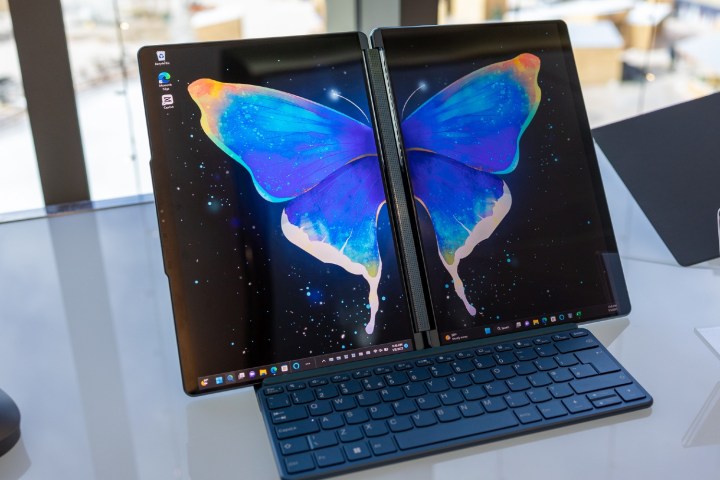
Our opinions are similar, but I’m going to focus on what most excites me about the Yoga Book 9i. And that’s its ability to work side by side with two lovely 2.8K OLED displays.
Multitasking is my thing
I use three 4K displays connected to my desktop PC in my home office, where I do all my work that involves not just writing copy, but also researching and reading other material, creating spreadsheets, and other tasks. Working on one display is what I do when I’m focused exclusively on writing content that doesn’t require a lot of additional research. That is, I can work with one display when I’m OK with using a single full-screen window.
When I’m away from my home office, I sometimes use an LG +view Portable Monitor, along with whichever laptop I’m using. That gives me a second display for multitasking, which is a bit cumbersome, but it works. The LG +view is also a high-quality IPS display that’s just fine for productivity work.
But the Yoga Book 9i has two 2.8K OLED displays. That’s insane. Yes, I’d have preferred 4K+, even on 13.3-inch displays, because I’m a pixel-peeper and demand sharp text. But 2.8K is a sharp enough that I won’t see any pixels, and OLED’s incredible contrast means that black text will jump off white pages. That’s exactly what I look for in a display.
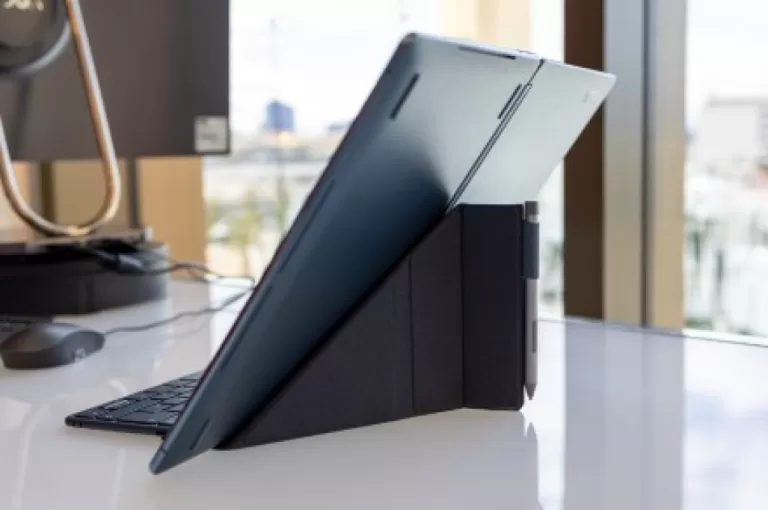
Using the origami stand, which is apparently quite strong and robust, the Yoga Book 9i can be configured with both displays side by side in portrait mode. That provides a ton of both vertical and horizontal space, perfect for a writer. The keyboard sits in front where it belongs, and the only thing missing is a touchpad. But a portable mouse will do just fine instead, and I’m happy to carry one around with me.
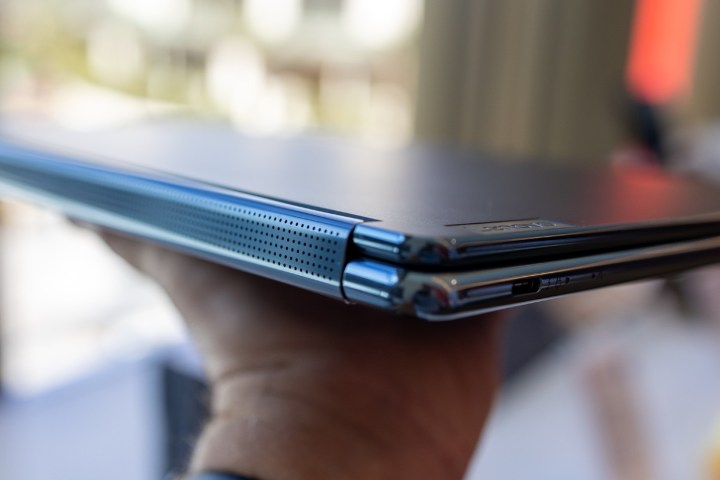
The idea of using both those displays in a relatively small area is downright exciting. Yes, there are a few extra parts to carry around, but again, that’s OK. None of them are huge or heavy, and they’ll fit nicely in a backpack. That includes the Yoga Book 9i itself, which when folded as a standard clamshell, is just 0.63 inches thick and weighs 3.00 pounds. That’s fine for a 13-inch-class laptop.
And that’s not all
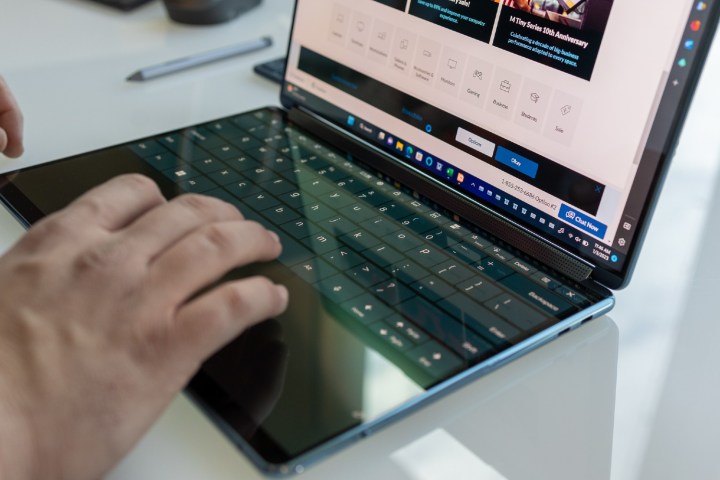
Let’s say I want to use the Yoga Book 9i as a standard clamshell laptop, just for writing copy. Well, it can do that, too. You can either place the physical keyboard on the lower half of the second (bottom) display and use the remaining portion for touch, or go all-digital with a keyboard supporting haptic feedback with a simulated touchpad. That’s a huge difference from some previous digital keyboards without haptics, which provided no feedback when keys were pressed.
I could see myself using the laptop in this configuration, meaning it would be a true dual-purpose machine for me. I love the MacBook Pro 14 for various reasons, but the Yoga Book 9i sounds like it could give that excellent laptop a run for its money.
I’m not sure about the vertical configuration with the two displays on top of each other. First, it looks unwieldy to me, although I trust Lenovo to create a reasonably stable configuration. I’m just not sure I’d be comfortable using the laptop that way. I don’t have vertically oriented displays today and have never felt the need for them, so that mode would likely go unused.
As far as its performance goes, the Yoga Book 9i is built around Intel’s latest 13th-gen Raptor Lake CPUs, with 16 GB of RAM and up to 1TB of storage. That’s plenty for the kind of productivity work the laptop is built for. And with 80 watt-hours of battery, it’s reasonable to assume solid battery life.
The only concern I have is with the price, which starts at $2,100. That’s a lot of money, but it’s not more than I paid for the MacBook Pro 14. It I run into some extra cash, then of all the laptops I saw at CES 2023, the Yoga Book 9i is the one I’d spend it on.
Today’s tech news, curated and condensed for your inbox
Check your inbox!
Please provide a valid email address to continue.
This email address is currently on file. If you are not receiving newsletters, please check your spam folder.
Sorry, an error occurred during subscription. Please try again later.
An old NASA satellite is set to reenter the atmosphere tomorrow, Sunday, January 8. Though most of the satellite is expected to burn up in the atmosphere and pose minimal risk, some debris could reach the surface. NASA satellites launched today are designed to deorbit more gracefully and with less risk of creating space debris, but this satellite was launched in 1984 before guidelines were in place.
The current guidelines, updated in November 2019, require that any risk of a deorbiting satellite impacting people on Earth is less than 1 in 10,000. The old satellite doesn’t quite meet that requirement as there is marginally more risk from its impact. “NASA expects most of the satellite to burn up as it travels through the atmosphere, but some components are expected to survive the reentry,” the agency wrote in a statement. “The risk of harm coming to anyone on Earth is very low – approximately 1 in 9,400.”
NASA’s retired Earth Radiation Budget Satellite (ERBS) is expected to reenter Earth’s atmosphere in early January.NASA
The Department of Defense predicts that the satellite will reenter the atmosphere within a 17-hour window on either side of 6:40 p.m. ET on Sunday. Tracking of the satellite will continue, as it is not yet known where any debris could be expected to land.
The satellite is called Earth Radiation Budget Satellite or ERBS and weighs 5,400 pounds. Launched in 1984, it was an early tool for investigating climate change from space. Among other things, it measured the Earth’s radiative energy budget, which refers to how much energy our planet gets from the sun and how much it emits out into space. This measurement is related to climate factors such as aerosols and greenhouse gases as well as formations such as clouds and surface geography.
Running far beyond its originally planned lifespan of two years, ERBS continued to collect data until 2005 — making it a 21-year mission in total. The satellite was launched from the Space Shuttle Challenger and is notable for having trouble with deploying its solar panels when first launched. Pioneering American astronaut Sally Ride had to use a robotic arm from the Space Shuttle to shake it loose and move the panel into sunlight, allowing it to fully deploy.
Today’s tech news, curated and condensed for your inbox
Check your inbox!
Please provide a valid email address to continue.
This email address is currently on file. If you are not receiving newsletters, please check your spam folder.
Sorry, an error occurred during subscription. Please try again later.
As the James Webb Space Telescope looks back at some of the earliest galaxies, it is helping us learn not only about galaxies very different from our own but also about how galaxies similar to the Milky Way were first formed. Recently astronomers announced they have used Webb to discover some of the earliest galaxies with a feature called stellar bars, making them similar to our barred spiral galaxy seen today.
A galaxy bar refers to a strip of dust and gas that forms a structure across the center of a galaxy, and which is frequently visible as a bright stripe across a galaxy in images. It is thought that these structures develop as a galaxy ages, as dust and gas are drawn toward the galactic center. So it was remarkable to see a bar in a galaxy from a very early period when the universe was 25% of its current age.
Two images of the galaxy EGS23205, seen as it was about 11 billion years ago. In the HST image (left, taken in the near-infrared filter), the galaxy is little more than a disk-shaped smudge obscured by dust and impacted by the glare of young stars, but in the corresponding JWST mid-infrared image (taken this past summer), it’s a beautiful spiral galaxy with a clear stellar bar.NASA/CEERS/University of Texas at Austin
An earlier image of galaxy EGS23205 taken by Hubble was smudgy and hard to see any structure in, but the new image from Webb shows a bright bar structure much more clearly.
“I took one look at these data, and I said, ‘We are dropping everything else!’” said one of the researchers, Shardha Jogee of the University of Texas at Austin, in a statement. “The bars hardly visible in Hubble data just popped out in the JWST image, showing the tremendous power of JWST to see the underlying structure in galaxies.”
Another galaxy, EGS-24268, was also imaged by Webb and is thought to be from 11 billion years ago. Finding these structures in very early galaxies is intriguing as it suggests astronomers will have to adjust their models of how galaxies evolve.
Bars are thought to be important for the development of galaxies as they move gas around and help to provide the building materials for new stars to form.
“Bars solve the supply chain problem in galaxies,” Jogee said. “Just like we need to bring raw material from the harbor to inland factories that make new products, a bar powerfully transports gas into the central region where the gas is rapidly converted into new stars at a rate typically 10 to 100 times faster than in the rest of the galaxy.”
Today’s tech news, curated and condensed for your inbox
Check your inbox!
Please provide a valid email address to continue.
This email address is currently on file. If you are not receiving newsletters, please check your spam folder.
Sorry, an error occurred during subscription. Please try again later.