Staffers at the UK’s Guardian newspaper have been informed that their offices will remain shut for at least a month, following the 20 December 2022 suspected ransomware attack on the media organisation’s systems.
According to an internal notice seen by media sector publication Press Gazette, Guardian Media Group (GMG) chief executive Anna Bateson said at the beginning of the week that journalists and other staff would have to continue to work from home.
“To reduce strain on our networks and help the enterprise tech, ESD and other involved teams focus on the most essential fixes, everyone must work from home until at least Monday 23 January in the UK, US and Australia, unless you are specifically asked to work from our offices,” said Bateson.
Other reporting described a “total nightmare”, with problems supposedly affecting print production, financial systems including payroll and expenses, and even the on-site canteen at GMG’s London office.
The incident is understood to have begun on the evening of Tuesday 20 December and. according to the Guardian, which broke the news of the incident itself the following day, affected unspecified parts of its infrastructure, although its online publishing systems were not affected, meaning the newspaper was able to continue to publish stories online.
Two weeks on, confirmed details on the incident remain sparse and GMG has not made any further statements as to the precise nature of the incident, although its online subscriber help centre appears to have acknowledged that it was indeed a ransomware attack.
Although it cannot be stated for certain that the attack on GMG was a targeted incident, what can be said with relative confidence is that media outlets are increasingly targeted by threat actors as such incidents can prove highly disruptive and are likely to resonate with a far wider audience.
It can also be fairly said that reporting on major international incidents such as Russia’s war on Ukraine may leave a title exposed to malicious actions by Russia-backed or aligned groups. Additionally, any publisher of titles that skew to the different ends of the political spectrum – in GMG’s case, its titles lean to the liberal centre and left wings – may also find themselves the targets of politically motivated hacktivism.
“The media industry is often targeted because of the influence it holds. Media companies get high-volume traffic and are trusted by their audience,” Vasile told Computer Weekly in emailed comments.
“This puts a target squarely on the backs of news organisations. The domino effect is in full force: Thomson Reuters, The New York Post, Fast Company, and now The Guardian, among countless previously reported breaches.
“Generally speaking, large media organisations have structured cyber security programs in place, but as companies’ digital estates become well defended, malicious actors turn their attention to the supply chain, opening up a whole new attack surface,” he said.
The BlueVoyant research – which was published in August 2022 – said there were material security failings across the media sector’s supplier ecosystem, compounding the issue.
The incident at GMG also demonstrates a firmly established trend of executing large-scale cyber attacks around major holiday periods – the 2021 attack on Kaseya that unfolded over the US 4 July holiday being an excellent example – with IT and security teams stretched thinly due to holiday cover, the chances of a successful attack can slightly increase.
Read more on Data breach incident management and recovery
There were no bank robberies in Denmark last year, as a result of better security and the fact that the banks in the largely cashless society don’t hold large amounts of cash on-premise.
But the figures from Danish bank association Finans Danmark also revealed that online banking fraud has increased as criminals change their strategies.
For comparison, there were 221 bank robberies in 2000, 121 in 2004, and recent years have seen single figures, with just one in 2021.
Steen Lund Olsen, deputy chair at financial sector trade union Finansforbundet, said: “It’s nothing less than fantastic, because it’s a very extreme burden on staff every time it happens.”
However, the figures reveal that criminals are now changing their methods and moving to less risky cyber crimes.
“The physical robberies have largely been replaced by online banking fraud and other forms of digital crime, which are considerably less risky for the criminals but unfortunately pay great dividends,” said a Finans Danmark statement.
Denmark and its Nordic neighbours have been leading the charge towards a cashless society. Nordic advances with digital currencies are being made against a backdrop of cash usage across Scandinavia falling to below 10%, and where digital mobile payment alternatives, provided by Nordic fintech actors such as Swish, MobilePay and Vipps, are increasingly popular with consumers.
The arrival of Covid-19 and the limitations on the movement of people imposed to reduce its spread also accelerated the take-up of digital payments, as physical shopping reduced and many businesses moved to contactless payments only to limit contact between people.
“The pandemic not only led to a reduction in the total number of payments made in the UK – it also led to changes in the types of payment that were used,” said the report summary document. “People made greater use of contactless payments, online banking and mobile wallet channels, largely at the expense of cash payments.”
In the UK, like in Denmark, there has also been a surge in APP fraud, also known as bank transfer fraud. This sees criminals use fake websites and emails to trick consumers into authorising payments to them as the scammers attempt to avoid the security embedded into the banking system. It’s a growing problem which, according to banking trade body UK Finance, increased by 70% in the first six months of this year, reaching a value of £355m.
Read more on Application security and coding requirements
If you wanted to come up with the one-liner about investing most likely to make my head explode, you might try, “The way to choose investments is to just jump on whatever’s done the best over the past three to five years.” Or, getting more creative: “Hey, did you know Cathie Wood is still getting inflows?” Yet more creative: “The war in Ukraine was caused by stock buybacks.” But you couldn’t do much better than “Interim valuations don’t really matter,” as Christopher Schelling says in reference to private equity investing. If exploding my cranium was the goal, then well played, sir. Otherwise, oh, hell no.
Although not alone, I have, IMHO, become one of the chief gadflies of the PE industry. But I’m a selective gadfly. I’m certainly not negative on the whole idea of private investing. Some companies aren’t ready to be public (I’m lumping in venture now). Some need active outside restructuring expertise. Some are just being misvalued by the public markets (more on this later). Private investing serves a vital economic purpose. Furthermore, though to what degree and how much the premium has diminished over time can be debated, there’s little doubt PE has been a historical success (of course, adjusting for factor risk, there are still some cynics). And I live in Greenwich, Connecticut, where the slightly modified cliché that “some of my best friends are PE managers” is literally true — and these men and women know more about how actual companies work than I could ever dream.
My criticism has been narrowly focused on PE’s lack of mark-to-market valuations and some of the implications this brings. The illiquidity and nonmarking were once implicitly acknowledged, appropriately, as a bug, but are now clearly sold as a feature. The problem is logically you get paid extra expected return for accepting a bug (possibly explaining some of PE’s historical success), but you pay by giving up expected return for being granted a feature. This is a potential problem going forward.
Let me sum up Schelling’s entire argument: It’s okay not to mark things to market — it’s even preferred — as the market is grossly inefficient, with prices that are often wildly wrong, and thus just using PE managers’ own marks is, doggone it, better for everyone.
Schelling and I actually agree on a lot here. I was never a pure efficient marketer, even in the 1980s when I was Gene Fama’s Ph.D. student (my dissertation on the success of price momentum was a hint!). Living through the tech bubble, the global financial crisis, and the insane trouncing of value stocks from 2018 to 2020 led me to drift even further away from pure market efficiency. I still think markets are the best way for society to allocate capital, but that’s as much about how bad nonmarket alternatives are. So although the issues are complex, I am quite sympathetic to the feeling that sometimes market prices are pretty far away from what’s really justified.
Of course, in the public markets we don’t get to not tell our investors the current market valuations of our investments just because we think the markets are wrong. In early 2000 (i.e., the tech bubble peak), after losing a ton on long-short value investing, we didn’t tell our clients, “Your money is all still there; it’s just in a bank we call ‘short the Nasdaq.’” No, we told them, “We’re down X percent, and here’s why we expect to make back more than X percent when you need it most.” (Narrator: “They did.”) Yes, I argued this because I thought market prices were wrong. But I didn’t get to play make-believe.
So why does PE get to? Though some will plead the opposite, it’s not that hard to adjust even private marks in line with the market. If you’re levered long equities (and yep, PE’s “low-risk and low-beta” investments are often levered long) and equities fall by 25 percent, you probably dropped at least that. Perfect estimates are not the point, and shouldn’t be the enemy of good estimates (for instance, some argue private equity betas are near 1.0 even with leverage, but nobody serious argues they are near zero). Sure, sometimes it’s more complicated. But remember, PE managers are among the world’s foremost experts in company valuation. You wouldn’t think the question “Approximately what would we get if we sold in today’s market?” would be particularly tricky for them. That is, of course, if they actually wanted to tell you the answer and if you actually wanted to hear it. It does take two to do the nonmarking tango.
Many retort, “But doesn’t the illiquidity leave investors better off long-term, as they act more rationally?” Sure, maybe, sometimes . . . well, actually, it depends. It certainly induces some behavior we advocate in the public markets, such as taking a true long-term perspective. But a few problems emerge.
First, if investors increasingly value the “PE is easier to stick with as the prices don’t move so much” feature, they’ll invest more and more in PE (sound familiar?), and, as with any asset class or strategy, this can lower future expected returns. Anecdotally (i.e., like you might hear if you got a PE manager a little tipsy on Greenwich Avenue), this is going on through private deal valuations that are higher than they used to be because there are more bidders for the same deal, credit is less investor-friendly than previously (I believe “covenant light” is the term), etc. Maybe this ain’t David Swensen’s PE market anymore.
Unlike Swensen’s PE market, which was primarily about earning extra return, today’s PE market is now seemingly as much about not having to report market prices. That kind of investment should return less over the long term than the appropriate levered public equity benchmark (and I haven’t even gone into the fees on fees on fees). Admittedly, this is educated conjecture. The net of the above could be a smaller return premium for private versus public equity, as opposed to a deficit. But I do stand by my conjecture, and though the magnitude is impossible to be precise about, it’s difficult to imagine the drop-off is not directionally right and nontrivial.
Second, it’s dangerous to understate risk. Many investors use PE to up their overall equity allocations while avoiding the occasional short-term excruciation that accompanies public equity market investing. The only way this increased risk can be justified without simply announcing, “We’re taking it up a notch” is to assume that this ever-growing PE allocation is relatively low-volatility and low-correlation. You can find many examples of these assumptions — people like to tweet them at me! — though whereas some managers are certainly honest or smart enough to avoid them, others lean in, shamelessly bragging that the assets they don’t mark to market outperform in a bear market. Some have taken to calling the understatement of PE risk “volatility laundering.” Okay, that’s mainly me, but it’s catching on, and volatility as a risk measure more generally gets a bad rap from those who erroneously think it means “short-term fluctuation that you definitely get back and shouldn’t worry about.”
Those understated risk assumptions likely become a problem only in a real extended bear market — not a one-to-three-year bear like we’ve occasionally seen in the past few decades, nor, certainly, a super short crash and rebound like the one in spring 2020. PE can ride those out using its patented ostrich technique (though the GFC was starting to get scary). But say we get an ugly ten-to-20-year bear market, not just “end to end” (like 2000–2009, which started out at a bubble peak and ended in a bear market trough, even though both ugly periods were only two-to-three-year affairs). This hasn’t happened in the U.S. in a long time but is well within the realm of possibility. If and when that happens, your starting assumptions of high-single-digit volatility and low correlation to public equity markets for your private, levered equity portfolio will not save you. And what is risk management about if it is not concerned with this low-probability but extreme long-term wealth-destroying outcome?
Third, doesn’t admitting what you’re doing break the spell? Once you say out loud, “We know the prices move, but it’s useful to fool ourselves,” doesn’t the fooling yourself part stop working? Well, apparently not! Once you, the investor, admit to yourself, “This may be levered equity exposure likely offering less versus public markets than in the past, but I’m doing it this private way so I can stick with it long-term,” why on earth can’t you be long-term in public markets? Asking for a friend :-). Okay, I do admit part of my motivation here is professional jealousy. For reasons that obviously escape me, many investors can’t be as long-term in public markets as in private ones, and we in the public markets actually have to live with day-to-day market reality. Heck, I was so jealous I once even took my own shot at marketing a private investment fund. It didn’t catch on.
But seriously, run the thought experiment where PE managers actually told investors their best guess of what the portfolio could be sold for (not in a panic sale) today. If they did this but still delivered market-beating returns, would all their investors flee? Would the appeal be gone? If so, isn’t that telling? Now run it backward. If a liquid strategy that had a healthy positive long-term expected return was able to report its returns like PE, would the appeal go way up?
It’s hard to avoid the idea that my confusion over “Why be long-term only in privates?” is resolved by noting a principal–agent problem where the PE managers get paid a ton so intermediaries can then report unrealistically rosy assumptions and unrealistically calm returns. The chickens come home to roost only if long-term returns no longer beat public markets (i.e., no bear market needed here, just a reversal of the historical illiquidity premium) or, even scarier, a real long-term bear hits and the portfolio’s risk was seriously underestimated. But both parties involved, principal and agent, may be assuming that in ten-plus years that’ll be someone else’s problem. With this bare-knuckles truth-telling, I’m running a real risk of upsetting my clients, many of which have healthy PE allocations. But I am truly trying to help, and, as usual, I will let the chips fall where they may. Truth be told, it’s whoever the agents report to who really need to improve here (i.e., understanding that asset prices actually move and not needing to be fed imaginary unchanging numbers) — not the agents themselves, who are just responding to incentives.
So basically, Schelling is right about one important thing. Markets aren’t perfectly efficient, and sometimes they’re grossly inefficient. We both heartily endorse leaning against this in your portfolio while taking a truly long-term perspective, as inefficiencies can be a hard thing to fight short-term. Where we differ: I don’t endorse (1) doing so by making up prices and returns you think are more metaphysically accurate than the market’s current prices; (2) quite possibly today, unlike in the past, accepting a lower expected return on privates versus truly comparable public markets for this volatility-smoothing “feature”; and (3) seriously understating the true long-term risks to client portfolios if a real long-term bear market hits. I do endorse valuing your portfolio at where you think you could sell it today in a reasonably orderly fashion — and if you think that’s too low, making that case to your investors, as the rest of us have to do in the real world.
Given the massive popularity of private investing today, it may very well be true that, as a great man once almost said, “Never have so many paid so much to so few for the privilege of being told so little.”
Cliff Asness is the co-founder of AQR Capital Management.
Every time I hear about software maintenance as a distinct activity, I cringe. That’s because it is based on the outdated notion that first software is developed, then it is maintained. But that is not how software development works today. Software development does not have the two phases development and maintenance – it is a continuous process. Software maintenance is simply software development.
It is fairly common to come across the concept of software maintenance. Recently I have seen it in posts on LinkedIn (how developers leave if they have to do maintenance), in books (“it is well known that the majority of the cost of software is not in its initial development, but in its ongoing maintenance”), and in surveys (do you develop new features, or do you maintain existing features). But this is based on the false premise of the software project.
Project vs. Product
In the project model, you set out to develop a system. So you create a project, gather requirements, develop the software, and deliver the result. Any changes after this delivery are considered maintenance, be it changes to functionality or bug fixes. This is how I was taught software development works when I went to university a long time ago.
There are two big problems with the project view of software development. The first is that it is almost impossible to decide how the system should work before you try it. As soon as you start using the system, you learn more about how it should work. This inevitably leads to changed requirements. Secondly, once the system works, you start to think of additional uses for it. In other words, the problem you are solving is open-ended (expanding uses), rather than clearly defined. In a sense, you are never finished, because what you want the system to do keeps expanding. This may seem counterintuitive, but for all systems I have worked on, I have been surprised at how we never ran out of features to add. The expansion is also fractal – you add new big features, but you also keep tweaking and expanding the behavior of existing features.
So, the project model (build the system once and for all, the rest is maintenance) does not match how software systems evolve.
A better model for software development is the product model. Here you consider the software system to be a product that is continually developed. There is a permanent team of developers working on the system, and you continuously add features to it. In the product model it doesn’t make sense to distinguish between development and maintenance, because you are constantly changing and developing the system. This includes fixing bugs. Over my career in software development, I have seen a shift from project to product. This makes sense, since the product model aligns much better with how systems are used.
There are other advantages with the product model too. The developers working on the product stay with the same product. They see how it is used, and understand how it has evolved. In the project model it is more common to have people develop the initial system, then leave for the next project. They don’t have to live with the decisions they made, and they don’t get the benefit of learning how the customers are using the system.
Happily, many (or most) companies have realized that the product model is better than the project model for software development. This means that it doesn’t make sense to talk about software maintenance. Changing and improving the systems is software development.
What About “Pure” Maintenance?
Maintenance in the traditional sense includes lubricating moving parts, changing filters, or mending broken pieces (like sewing on a loose button). In software, fixing bugs is the equivalent of repairing broken parts. What about preventing wear and tear? Well, in this sense software is the opposite of physical objects. The more you use it (if by that we also include bug fixing), the better it gets. I like this quote:
“Hardware eventually fails. Software eventually works.” – Michael Hartung
However, if you consider that the environment the program works in can change (library or OS upgrades for example), then you could compare this to handling wear and tear.
There are systems that are maintained only in this sense: fixing bugs, and making sure that it can keep running. But I would argue that this is a very small part of all software development work being done. Furthermore, when it comes to fixing bugs, there can be ambiguity. Is this really a bug, or is it in fact a request for new functionality? And why fix the bug at all, if it has worked up until now, and the only objective is to keep the system running. So, in some sense, this form of maintenance is also just ordinary software development.
Conclusion
In any form of software development, you always have to read and understand existing code, even when you mostly add new features. As the system grows, this becomes even more common. Newly written code becomes “legacy” very quickly. Furthermore, you always have to fix bugs. So, let’s stop talking about software maintenance is if it were a separate activity. It is not. It is just software development.
The Qt Company changed Qt licensing in February 2022. All the separate commercial packages – including Qt for MCU, Qt Safe Renderer, Qt Automotive Suite and Qt Automation – were folded into two Qt for Device Creation licenses: Professional and Enterprise. The Qt Marketplace license for modules like CoAP, MQTT, Charts and for the design tool bridges was discontinued. My post helps you answer the crucial question: Shall you use Qt Commercial or Qt LGPL-3.0?
The Three Qt License Offerings
The Qt Company offers Qt for embedded devices under three licenses: Qt for Device Creation, LGPL-3.0 and GPL. Qt for Device Creation is the commercial offering, whereas LGPL-3.0 and GPL are the free and open-source offerings. I often use Qt Commercial as a short hand for Qt for Device Creation. GPL means GPL-2.0 or GPL-3.0.
The Qt Company updated their commercial offering the last time in February 2022. They introduced it in the post The new simplified Qt commercial licensing: what’s in it for you? on their company blog. My analysis of the new licensing from my February 2022 newsletter holds up very well. It has been confirmed in many conversations with executives, managers and developers from companies using Qt or planning to use Qt.
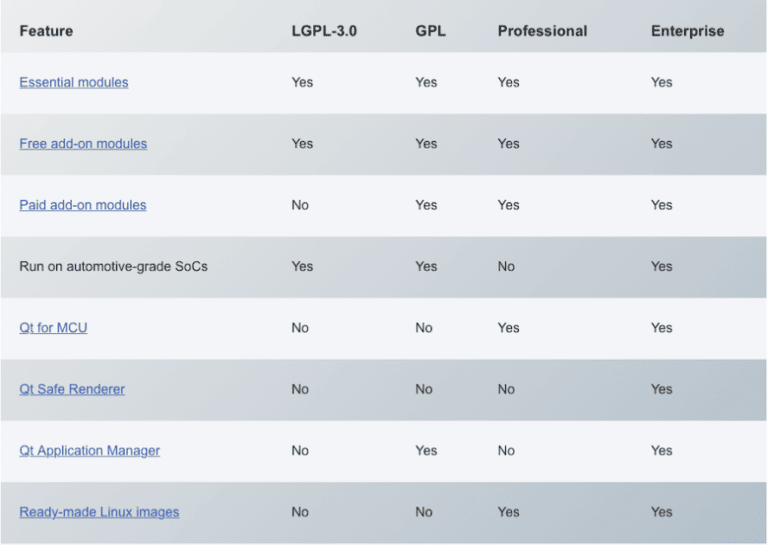
The Qt for Device Creation license comes in two editions: the Professional and the Enterprise edition. Here is the feature comparison table for LGPL-3.0, GPL, Professional and Enterprise.
Table 1: Feature comparison between LGPL-3.0, GPL, Professional and Enterprise editions
Qt for MCU is the offering for running Qt on microcontrollers (MCUs). It provides the code to bring-up Qt on bare-metal systems or on RTOSs. It also provides the Ultralite version of Qt Quick. The firmware with Qt can fit into 6MB of RAM and flash. Before the license change in February 2022, Qt for MCU was a separately licensed product with costs in the upper 5-digit USD range per customer project. Now, it is included in both Qt Professional and Qt Enterprise.
Before the license change in February 2022, Qt Safe Renderer was a separately licensed product with costs in the upper 5-digit USD range per customer project. Now, it is included in Qt Enterprise but not in Qt Professional. Qt Safe Renderer allows us to show some indicators (icons or text) inside an otherwise unsafe GUI application. Even if the GUI application crashes, the indicators are guaranteed to be shown on the screen. This guarantee is possible, because the safe renderer is certified to SIL 3 and ASIL D for road vehicles, SIL 4 for railway vehicles and “fit-for-use” in medical devices.
The Qt Application Manager is a window and application manager licensed under Qt Enterprise or GPL. The window manager is based on the Qt Wayland Compositor. It integrates Qt Virtual Keyboard as a window running in its own process. Every application can use the keyboard for input. The Qt Application Manager can run any applications like Qt, HTML and OpenGL applications and display them, as long as they support the client-side Wayland protocol.
The application manager controls the lifetime of the applications. If the system is low on memory, it can terminate some applications. It can quick-launch QML applications by loading the QML into a running QML engine and install signed third-party applications. The applications can communicate with each other over D-BUS – not over Qt Remote Objects.
Qt for Device Creation provides ready-made Linux images for many widely used SoCs, system-on-modules (SoMs) and SBCs made by NXP, Nvidia, Intel, Texas Instruments, Raspberry Pi Foundation, ST, Toradex, Boundary Devices, Kontron and many others. The installation of a commercial Boot2Qt image sets up QtCreator for cross-compilation, for deploying your Qt application to the device, for running it on the device and for remote debugging. So, we can immediately start developing our Qt application.
Qt Creator is an excellent IDE for developing embedded software using QML, Qt, C++, C, CMake and Python. When we press Ctrl+R (Run), Qt Creator cross-builds our software for the embedded device, installs it on the device and runs it. This gives us early and frequent feedback how our software behaves on the device. If an issue arises, we can do remote debugging or run static analysis tools on the device.
I have been using Qt Creator since 2006 for my daily development. In my TDD legacy workshops, I sometimes use Visual Studio Code or CLion IDE. They are better than Qt Creator in some respects (e.g., automated refactorings) and worse in others (e.g., navigation of QML code, unit testing, CMake support). I never felt the need to say good-bye to Qt Creator, my trusted coding companion. Choosing an IDE is a very personal decision. Developers should choose the IDE with which they feel most comfortable and productive.
Although Qt Creator is only available under GPL besides Qt Commercial, we can use it for developing commercial software with Qt LGPL-3.0. The code we write in Qt Creator is not under GPL but under any license we choose. It’s similar to the g++ compiler. The compiler is under GPL, but its output is not.
Qt Design Studio Professional is a tool for designing 2D and 3D user interfaces. It is only available with the commercial licenses. Importing designs from Adobe XD, Figma, Sketch, Maya, Modo, Blender and other 3rd party tools is not available in Qt Design Studio Professional. These bridges are only available in Qt Design Studio Enterprise (see this comparison chart), which is neither included in Qt for Device Creation Professional nor Enterprise.
The new Qt licensing from February 2022 introduced some more changes:
Qt for Automation, which included the modules Qt MQTT and Qt CoAP, was folded into Qt Professional and hence into Qt Enterprise.
The additional features of Qt Automotive Suite are now part of Qt Enterprise.
The bridges from design tools like Adobe XD, Figma and Sketch to Qt Design Studio were available through the now discontinued Qt Marketplace License. They are not included in any Qt for Device Creation offering.
If you need help with answering the question “Shall you use Qt Commercial or Qt LGPL-3.0?” and with checking the license compliance of an embedded Linux system, have a look at my service or send me a short e-mail.
Qt for Device Creation
The Qt for Device Creation license comes in two editions: the Professional and the Enterprise edition. The main differentiator is, whether our embedded software runs on automotive-grade SoCs (systems on chip) or not. A SoC is automotive-grade, if it works fine in the temperature range from -40°C to +125°C. All machines and devices used outdoors like cars, trucks, agricultural machines, construction machines, ships, e-bikes, sports watches and GPS handhelds fall in this category. Their manufacturers must buy the license Qt for Device Creation Enterprise.
Industrial-grade SoCs work fine in temperature range from 0°C to +70°C and consumer-grade SoCs in the range from 0°C to +40°C. Embedded software running on industrial-grade or consumer-grade SoCs is covered by the license Qt for Device Creation Professional. Example devices are medical devices, TVs, STBs, home and professional appliances, phones and all industrial machinery located indoors.
Guessing the Qt Licensing Costs
For both licenses, we must pay both per-developer fees and per-device fees. The license fees depend on the number of developers and the number of devices. There are discounts, if we pay the license fees for 3 or 5 years in advance and if we buy licenses for more devices. I would assume that the per-developer and per-unit fees for Qt Enterprise are higher than the fees of Qt Professional.
Warning: I don’t know the prices. The prices are my best guesses based on what I hear from the Qt community. You should talk to Qt Sales to learn the exact prices. The prices from Qt Sales should be the basis for the cost comparison between Qt Commercial and Qt LGPL-3.0. However, I believe that a price indication – if not the actual price – is an important part of treating customers fairly. That’s why I am trying to give you an idea of the Qt license fees.
The Qt Company doesn’t publish any pricing information for the Qt for Device Creation licenses. However, they give the per-developer fees for the Qt for Application Development license (Qt for Desktop). The Professional edition clocks in at 3,620 USD per year and per developer, and the Enterprise edition at 4,090 USD.
Qt for Device Creation Professional includes everything from Qt for Application Development Enterprise. It’s fair to assume that the per-developer fee for both Qt for Device Creation licenses is higher than 4,090 USD, when paid on a yearly basis. 4,500 USD seems like a good guess.
The Qt Company gives big discounts, if we pay for the licenses 3 or 5 years in advance and if buy for a bigger number of developers. If we got a 20% discount for 3 years and a 35% discount for 5 years, we would end up with yearly per-developers fees of 3,600 USD and 2,900 USD, respectively.
In addition to the per-developer fee, the Qt for Device Creation licenses also come with a per-device fee (a.k.a. royalties). We must buy distribution licenses in minimum batches of 2,000 units. We pay for the distribution licenses in advance for the complete licensing period (3-5 years). What I hear from the Qt community, the per-unit fee could be roughly 8 USD. Again, The Qt Company gives generous discounts, if we order distribution licenses in higher volumes.
Year 1-5
Year 6-10
Year 11-15
Year 1-15
#Developers
3
4
5
Developer fees (USD)
45,000
60,000
75,000
180,000
#Devices
4,000
6,000
8,000
Device fees (USD)
32,000
48,000
64,000
144,000
Total (USD)
77,000
108,000
139,000
324,000
Table 2: Typical Qt license costs over 15 years
The table shows the typical costs for a company building driver terminals for construction machines. The lifetime of the terminals is 15 years. Per year, the company pays 3,000 USD per developer and 8 USD per device.
For the first 5 years, 3 developers build 800 devices per year.
For the second 5 years, 4 developers build 1,200 devices per year.
For the third 5 years, 5 developers build 1,600 devices per year.
The license fees are always due at the beginning of a 5-year licensing period. Upfront costs around 100,000 USD for each 5-year period and total costs of more than 300,000 USD over 15 years is a considerable investment for such a company. These companies want good value for their investment. They want shorter development times and earlier time to market. Providing more than anecdotal evidence for that is hard. And it’s even harder, because Qt Commercial competes with an excellent free product: Qt LGPL-3.0.
Combining Commercial and Free Qt Licenses
The Qt License Agreement forbids combining commercial and free open-source Qt licenses during development and on devices.
“Prohibited Combination” shall mean any effort to use, combine, incorporate, link or integrate Licensed Software with any software created with or incorporating Open Source Qt, or use Licensed Software for creation of any such software.
The meaning of “use”, “combine”, “incorporate”, “link” and “integrate” is not defined any further. It’s vague. So, we must tread very carefully. Let met spell out what we must not do, if we hold a commercial Qt license.
Software using Qt Commercial must not link against libraries using Qt LGPL-3.0 or being written with non-commercial Qt tools (e.g., Qt Creator). This includes the following cases:
We must not use any libraries that a completely independent third party developed using Qt LGPL-3.0 or Qt GPL. Any embedded Linux system contains a couple of these libraries.
We must not use any software written with Qt Creator under GPL – even if this software doesn’t use Qt at all. It is impossible to check whether any third-party developer uses Qt Creator to develop software for embedded Linux systems.
An application using Qt Commercial must not communicate with any another application using Qt LGPL-3.0 or Qt GPL, if both applications run on the same device. This is more restrictive than GPL.
An application using Qt Commercial must not start another application using Qt LGPL-3.0 or Qt GPL, if both applications run on the same device. This is more restrictive than GPL.
We must not use software developed by a contractor or affiliate with Qt tools or libraries under GPL or LGPL-3.0 (see clause 3.4.ix).
We must not use any Qt tools like Qt Creator, Qt Design Studio, QML compiler extensions and QML Live to build software using Qt LGPL-3.0 or Qt GPL. It doesn’t matter whether these tools are also available under a non-commercial Qt license.
“Permitted Software” shall mean (i) third party open source software products that are generally available for public in source code form and free of any charge under any of the licenses approved by Open Source Initiative as listed on https://opensource.org/licenses, which may include parts of Open Source Qt or be developed using Open Source Qt; and (ii) software The Qt Company has made available via its Qt Marketplace online distribution channel.
The definition of “Permitted Software” above contradicts the definition of “Prohibited Combination”. It would, indeed, rule out the fairly absurd consequences of the first bullet point above. But – which interpretation should we apply?
If we take the license obligations seriously and we better do, we should at least renegotiate the License Agreement or even walk away from it. Some obligations are impossible to satisfy, some are contradictory and the sensible ones are harder to satisfy than those of LGPL-3.0.
I’d urge The Qt Company to rewrite their License Agreement along the following objectives:
The license holder must pay the license fee for every developer, who writes Qt code used in software running on an embedded device.
The license holder must pay the license fee for every produced embedded device with Qt code written by its developers.
If the license holder cheats with the numbers of developers or devices, The Qt Company has the right to suspend or cancel the License Agreement. This implies that the customers of the license holder must not use the embedded device any more. This is a temporary or permanent sales stop – and definitely not a situation companies want to be in.
Qt LGPL-3.0
Clause 4. Combined Works of the LGPL-3.0 lays down our obligations. Here is my translation from legalese (see my talk Using Qt under LGPLv3 for more details).
We may release our combined work – our software combined with the Qt libraries under LGPL-3.0 – under a license of our choice, if we satisfy the following obligations.
(4a) We give prominent notice (e.g., in the user manual) that our software uses Qt under LGPL-3.0.
(4b) We provide copies of the LGPL-3.0 and GPL-3.0 to the buyers of the software, where buyers are businesses or consumers (private persons).
(4c) We display the copyright notices of Qt and the license texts of LGPL-3.0 and GPL-3.0 prominently in the user interface.
(4d) We provide the mechanism of either (4d0) or (4d1) to link our software with a potentially modified but interface-compatible version of the Qt libraries.
(4d0) We use any mechanism for linking – including static linking.
(4d1) We use dynamic linking to combine our software with the shared Qt libraries.
(4e) We provide installation information (according to clause “6. Conveying Non-Source Forms” of the GPL-3.0) how to build a modified version of Qt, how to install Qt on the device, and how to run the software with Qt on the device. This clause only applies to Consumer products.
Let me spell out the ramifications of the above clause in plain English.
We can keep the source code of our software secret (see the first sentence).
We can link our software with shared or static Qt libraries (see (4d0) and (4d1)). If we use static linking, we must provide the object files of our software. We don’t have to do that for dynamic linking.
Clause (4e) – a.k.a. the anti-tivoisation clause – only applies to Consumer products like phones, TVs, STBs, game consoles, home appliances and cars. When consumers use their right and install modified Qt libraries on their devices, we can void the warranty. We could even forbid consumers to drive their cars. Conversely, we do not have to provide any way to install modified Qt libraries on B2B products like most medical devices, all professional appliances and all industrial, construction and agricultural machines. B2B products are those that we sell to businesses only.
Using Qt under LGPL-3.0 is a perfectly viable option for businesses. In the last three years alone, more than 60 companies inquired about using Qt LGPL-3.0, 16 bought a license assessment and 8 bought a full-blown license compliance check of their embedded Linux systems from me. Through my consulting work, I know of many more companies using Qt LGPL-3.0 including very well-known manufacturers of agricultural, construction and industrial machines, cars and home appliances.
Qt GPL-2.0 and GPL-3.0
In constrast to LGPL-3.0, GPL requires us to release our combined work – our software combined with the Qt libraries or any source code under GPL – under the GPL. This implies that we must make the source of our software publicly available. Businesses usually don’t want that, as they would lose their competitive advantage. Publishing the source code is typically OK or even required from universities and government agencies.
Even businesses frequently use software under GPL: as tools or applications running in their own process. For example, Git and BusyBox are GPL-2.0-only, GCC is GPL-3.0-or-later with GCC Runtime Library Exception, Qt Creator is GPL-2.0-or-later. Proprietary software may call tools under GPL or communicate with other applications or services under GPL – and we can keep the source code of the proprietary software secret.
This gives us a way to use Qt modules like Qt Wayland Compositor, Qt Application Manager and Qt Virtual Keyboard that are under Qt Commercial and GPL but not under LGPL-3.0. We run these modules as separate applications in their own processes. Our proprietary software communicate with them over Qt Remote Objects, D-Bus or gRPC. The Wayland compositor shows client applications under GPL (e.g., the virtual keyboard) or any other license with the right size at the right position.
Of course, we must publish the source code of all the applications under GPL (e.g., Wayland compositor, virtual keyboard, application manager) including our modifications. This should not be a problem, as these modifications are hardly ever a competitive advantage. We can keep the the source code of our proprietary applications and libraries secret, as they do not link against any libraries under GPL and do not integrate any source code under GPL.
Some of the essential and add-on Qt modules are under GPL-2.0-only and some under GPL-3.0-only. As GPL-2.0 and GPL-3.0 are not compatible, software must not mix these modules. For example, software using both Spatial Audio (GPL-3.0-only) and TextToSpeech (GPL-2.0-only) violates GPL-3.0. We must not release such software.
Licensing of Qt Modules
Essential Qt Modules
Qt Module
LGPL
GPL
Commercial
Core
3
2, 3
Pro, Enterprise
D-Bus
3
2, 3
Pro, Enterprise
GUI
3
2, 3
Pro, Enterprise
Network
3
2, 3
Pro, Enterprise
QML
3
2, 3
Pro, Enterprise
Quick
3
2, 3
Pro, Enterprise
Quick Controls
3
2, 3
Pro, Enterprise
Quick Dialogs
3
2, 3
Pro, Enterprise
Quick Layouts
3
2, 3
Pro, Enterprise
Quick Test
3
2, 3
Pro, Enterprise
Test
3
2, 3
Pro, Enterprise
Widgets
3
2, 3
Pro, Enterprise
Table 3: Licensing of modules in Qt Essentials
All essential Qt modules are available under LGPLv3 and additionally under GPLv2, GPLv3, Qt for Device Creation Professional (Pro) and Qt for Device Creation Enterprise (Enterprise). The essential Qt modules are guaranteed to be binary and source compliant throughout Qt 6 and to run on all platforms supported by Qt.
Add-On Qt Modules under LGPLv3
Qt Module
LGPL
GPL
Commercial
3D
3
2, 3
Pro, Enterprise
Qt5 Core Compatiblity
3
2, 3
Pro, Enterprise
Bluetooth
3
2, 3
Pro, Enterprise
Concurrent
3
2, 3
Pro, Enterprise
Help
3
2, 3
Pro, Enterprise
Image Formats
3
2, 3
Pro, Enterprise
Multimedia
3
2, 3
Pro, Enterprise
NFC
3
2, 3
Pro, Enterprise
OPC UA
3
2, 3
Pro, Enterprise
OpenGL
3
2, 3
Pro, Enterprise
PDF
3
2, 3
Pro, Enterprise
Positioning
3
2, 3
Pro, Enterprise
Print Support
3
2, 3
Pro, Enterprise
Quick Widgets
3
2, 3
Pro, Enterprise
Remote Objects
3
2, 3
Pro, Enterprise
SCXML
3
2, 3
Pro, Enterprise
Serial Bus
3
2, 3
Pro, Enterprise
Serial Port
3
2, 3
Pro, Enterprise
Shader Tools
3
2, 3
Pro, Enterprise
Spatial Audio
3
3
Pro, Enterprise
SQL
3
2, 3
Pro, Enterprise
State Machine
3
2, 3
Pro, Enterprise
SVG
3
2, 3
Pro, Enterprise
TextToSpeech
3
2
Pro, Enterprise
UI Tools
3
2, 3
Pro, Enterprise
Wayland Client
3
2, 3
Pro, Enterprise
WebChannel
3
2, 3
Pro, Enterprise
WebEngine
3
2, 3
Pro, Enterprise
WebView
3
2, 3
Pro, Enterprise
XML
3
2, 3
Pro, Enterprise
Table 4: LGPLv3 Modules in Qt Add-Ons
All the above add-on modules are available under LGPLv3 and additionally under GPLv2 (except Spatial Audio), GPLv3 (except TextToSpeech), Qt for Device Creation Professional (Pro) and Qt for Device Creation Enterprise (Enterprise). Add-on modules are not guaranteed to run on all platforms. Binary and source compatibility differs from module to module.
The licensing of the following modules needs special attention.
Since Qt 6.4, Qt Multimedia comes with two backends: gstreamer and ffmpeg. The section Licenses and Attributions states correctly: “Some optional components of FFmpeg are only available under GPL. The FFmpeg backend shipped with the Qt binary packages is configured to not contain any of the components that are available under GPLv2 only.” I have come across several Yocto BSPs that build the GPL components of ffmpeg by default. I don’t see how Qt Multimedia could ensure that ffmpeg doesn’t load any GPL plugins at runtime. As we want to be on the safe side with licenses, I’d make sure that the BSP build doesn’t use the option --enable-gpl. If the ffmpeg backend used a plugin, a library or just a single source file under GPL, our proprietary application linking against Qt Multimedia would be under GPL. Hence, we would have to publish our proprietary source code – no matter whether we hold a commercial Qt license or not.
Qt OPC UA provides two implementations in the form of plugins. The first plugin uses the free and open-source Open62541 library under the Mozilla Public License v2.0. The second plugin uses the commercial UA CPP library. Hence, we can use the Qt OPC UA with the Open62541 plugin under LGPLv3 but not Qt OPC UA with the UA CPP plugin. The latter combination with UA CPP is only possible under a commercial Qt license.
The module Qt Shader Tools is classified as a commercial Qt add-on on the page All Modules. A look at the source code and at the licensing page reveals that the runtime library is under LGPLv3 and that the command-line tool qsb is under GPL. Hence, our proprietary software can link against the runtime library under the LGPLv3. Calling a tool under GPL like qsb during the build is not a problem. It’s like calling g++ during the build. Therefore, I re-classified the module as an LGPLv3 add-on module.
Qt Wayland Client comprises the libraries that Qt applications need to communicate over the Wayland protocol with a Wayland compositor (e.g., Weston, Qt Wayland Compositor). Qt Wayland Client is available under LGPLv3, whereas Qt Wayland Compositor is not. Qt Wayland compositor is only available under a commercial Qt license or GPLv3.
Qt WebEngine uses more than 200 other components with many different licenses (see QtWebEngine Licensing). In isolation, these licenses – including BSD, MIT, MPL-2.0, Apache-2.0 and LGPL-2.1 – are unproblematic. The combination of some licenses may be prohibitive. We must not combine a component under Apache 2.0 with a component under LGPL-2.1-only. Apache-2.0 components may only be combined with components under LGPL-2.1-or-later or LGPL-3.0. Qt WebEngine uses 60 components under Apache-2.0 and 13 components under LGPL-2.1. 2 of the 13 components under LGPL-2.1 – hunspell and hyphenation-patterns – contain source files that are under LGPL-2.1-only (phonet.cxx and phonet.hxx in hunspell and hyph-hy.hyb in hyphenation-patterns). Qt WebEngine violates LGPL-2.1-only and must not be deployed with the violating components.
To be very clear: Releasing Qt WebEngine with both the Apache 2.0 components and the two components under LGPL-2.1-only (hunspell and hyphenation-patterns) is a license violation. We must not release Qt WebEngine in this configuration to customers. It does not matter whether we use Qt WebEngine under Qt Commercial, Qt LGPLv3 or Qt GPL.
I see two options under our control to remedy this situation.
If we don’t need Qt WebEngine, we don’t install it on the embedded device.
If we need Qt WebEngine, we build it without the components hunspell and hyphenation-patterns.
My request to The Qt Company is to ask the developers of the hunspell and hyphenation-patterns components to change LGPL-2.1into LGPL-2.1-or-later everywhere. I think that this is the intention of the component developers anyway. This change should be possible for the Qt 6.5 release at the end of March 2023.
We only looked for LGPL-2.1-only components in Qt WebEngine. We must also look for such components in other Qt modules. If, for example, Qt Multimedia depends on an LGPLv2.1-only library and our application uses Qt Multimedia and Qt WebEngine, we have a license violation, too.
The discussions of Qt Multimedia, Qt Wayland Client and Qt WebEngine should show one thing. Even if we buy a commercial Qt license, we are not safe from license violations.
The source code of the following modules may be a bit hard to find.
Qt PDF is part of Qt WebEngine. Its source code is in the directory qtwebengine/src/pdf of the Qt repository.
The source code of Qt TextToSpeech can be found in the directory qtspeech of the Qt repository.
Commercial Add-On Qt Modules
Qt Module
LGPL
GPL
Commercial
Charts
No
3
Pro, Enterprise
CoAP
No
3
Pro, Enterprise
Data Visualization 3D
No
3
Pro, Enterprise
Http Server
No
3
Pro, Enterprise
Lottie Animation
No
3
Pro, Enterprise
MQTT
No
3
Pro, Enterprise
Network Authorization
No
3
Pro, Enterprise
Quick 3D
No
3
Pro, Enterprise
Quick 3D Physics
No
3
Pro, Enterprise
Quick Timeline
No
3
Pro, Enterprise
Virtual Keyboard
No
3
Pro, Enterprise
Wayland Compositor
No
2, 3
Pro, Enterprise
Table 5: Commercial Modules in Qt Add-Ons
From Qt 5.15 to Qt 6.2, The Qt Company offered the modules Charts, CoAP, MQTT, OPC UA with UA CPP plugin, KNX and PDF under the Qt Marketplace License for yearly prices between 50 and 200 USD. This offering was discontinued silently some time after the release of Qt 6.2. I couldn’t find any announcement.
The modules Charts, CoAP, MQTT and OPC UA with UA CPP plugin are now only available under the commercial Qt for Device Creation licenses. The PDF module is now available under LGPLv3. The KNX module was discontinued.
The Crucial Question: Qt LGPLv3 or Qt Commercial?
Early in the project, we must ask the crucial question: “Shall we use Qt LGPL-3.0 or Qt Commercial?” The answer depends on the specific project.
We ask Qt Sales for a quote and create a table for the license costs over the lifetime of our product similar to Table 2.
We go through the list of Step 2, enumerate some alternatives for each item in the list, estimate the costs for the different alternatives, and choose the best alternative.
We sum up the costs for the alternatives needed for using Qt LGPL-3.0.
If the costs for Qt LGPL-3.0 (Step 4) are lower than the costs for Qt Commercial (Step 1), we use Qt LGPL-3.0. Otherwise, we use Qt Commercial.
This is an objective way to reach a decision. The initial question “Shall we use Qt LGPL-3.0 or Qt Commercial?” boils down to “How can we save development efforts worth the cost of Qt Commercial (e.g., 324,000 USD)?” or “How can we earn the costs for Qt Commercial (e.g., 324,000 USD)by launching our product earlier?”
Business analysts, product managers, system architects and experienced developers discuss the alternatives and their costs in Step 3. Here are some typical considerations from my experience.
Qt for MCU being part of Qt Professional and Qt Enterprise seems like a big advantage over Qt LGPL-3.0. I have my doubts.
MCUs powerful enough to run Qt GUIs smoothly are more expensive than, say, an i.MX6ULL with a Cortex-A7 application processor and Linux. It’s a lot easier to find developers for an embedded Linux system running on a microprocessor than for a bare-metal or RTOS system running on a microcontroller.
As soon as the firmware of a microcontroller controls a machine, the control code is most likely safety-critical. Then, it’s advisable to separate the safety-critical code from the non-safety-critical code, that is, the GUI code. The separation reduces the certification efforts significantly. You get this separation naturally when you use hybrid SoCs like the NXP Vybrid, i.MX7 or i.MX8. The GUI runs on the microprocessor and the control code on the microcontroller.
Many GUI frameworks have a much smaller memory footprint than Qt and are better suited for microcontrollers.
Many companies developing embedded systems with Qt have no idea how to use the Cortex-M microcontroller on their iMX8 SoCs. In other words, they don’t need the microcontroller.
Currently, Qt Safe Renderer does not support any interaction. If we need, say, a safety-critical button, we realise it in hardware. Similarly, we could realise indicator lamps in hardware. Manufacturers of agricultural and construction machines are used to realise safety-critical buttons and indicators in hardware and can buy them off the shelf. So can manufacturers of medical devices. As with Qt for MCU, I am skeptical whether Qt Safe Renderer compels purchasers to buy Qt Enterprise.
Qt Application Manager is a pretty good window and application manager. Although it is licensed under GPL and Qt Enterprise only, we can still use it with client-side applications using Qt under LGPL-3.0. As applications running in different processes and communicating over inter-process communication never constitute a combination in the sense of the GPL or LGPL, we are on the safe side (see Qt GPL-2.0 and Qt GPL-3.0 for more details).
The window and application managers of most embedded systems are fairly simple. The Qt Application Manager would often be too much of a good thing. We could write a simple window manager in QML based on Qt Wayland Compositor, add some basic application life-cycle management and some inter-application communication with Qt Remote Objects. Nothing fancy. Again, the window manager is licensed under GPL-3.0, whereas the applications are under a proprietary license of our choice and use Qt LGPL-3.0. We need to figure out which approach suits our needs better.
Qt for Device Creation provides ready-made Linux images for many widely used SoCs, SoMs and SBCs. The Linux images contain all the Qt modules, some Qt example applications (auto-starting at boot time) and a Wayland-based window manager. If we work with one of the hardware platforms supported by Qt Commercial, we can save quite a bit of time – especially if we have never built a Linux system with Yocto. We can start from a working Linux image. Qt Creator is set up for building, deploying, running and debugging for the target device right out of the box.
Pretty soon, however, we must tailor the Linux images to our needs. We must remove unwanted packages, change and create Yocto recipes, and build the images ourselves. That’s when we must go through the steep learning curve of Yocto – no matter which Qt license we use. Fortunately, the image and SDK builds run smoothly most of the time – especially when we follow descriptions like Setting Up Yocto Projects with kas, Building a Linux Image with Yocto and Building a Qt SDK with Yocto.
Need Help with License Compliance?
A typical Qt embedded Linux system built with Yocto is made up of 500 packages. The 500 packages easily come with 100 different FOSS licenses (e.g., MIT, BSD-2, BSD-3, LGPL-2.1, LGPL-3.0, GPL-2.0, GPL-3.0, MPL-2.0, EPL, Apache-2.0) and some commercial licenses. For every package, we must ensure that we comply with its license. Moreover, every application and library may only be built from source files with compatible licenses.
If some files are under Apache-2.0 and some are under LGPL-2.0-only as for Qt WebEngine, the combined work violates LGPL-2.0-only and must not be released. If some files are under EPL (e.g., Mosquitto) and others under LGPL-3.0 (e.g. Qt), the combined work violates LGPL-3.0 and must not be released. If one of the libraries, against which our proprietary application links, contains a source file under GPL directly or indirectly, the combined work and hence our proprietary application must be licensed under GPL.
As a business, we want neither license violations nor proprietary code under GPL. Finding these issues is pretty tricky and costs extra time and money. We incur the costs for checking the compliance of an embedded Linux system no matter which of the three Qt licenses we use or whether we use Qt at all.
I have done license assessments and full license compliance checks many times. I have a tool and a compliance database to automate large parts of compliance check. I offer license compliance as a service at a fixed price. The service is divided into three options.
My proposal has the following three options:
Option 1. I educate clients about the obligations of permissive licenses (e.g., MIT, BSD), weak copyleft licenses (e.g., LGPL) and copyleft licenses (e.g., GPL). I guide clients through the decision whether to use Qt LGPLv3 or Qt Commercial in their project.
Option 2. I check that all the packages in the clients’ embedded Linux system comply with their licenses. The report lists all packages with problematic licenses. Clients receive a compliance archive with all the license texts and source files that they must pass to the end user. They also receive a license checker and a license database so that they can update the compliance check for the next release.
Option 3. I train my clients’ staff how to perform the license compliance check on their own. With the information and tools from Options 1 and 2, they can do this in less than half a day for every release of their embedded Linux system.
It was shocking when researchers earlier this year revealed a river that originated from one of the largest glaciers in Canada abruptly disappeared over four days in 2016. The vanishing of the Slims river, however, was the result of global warming as the intense melting of the glacier led the river to redirect its waters to the Gulf of Alaska.
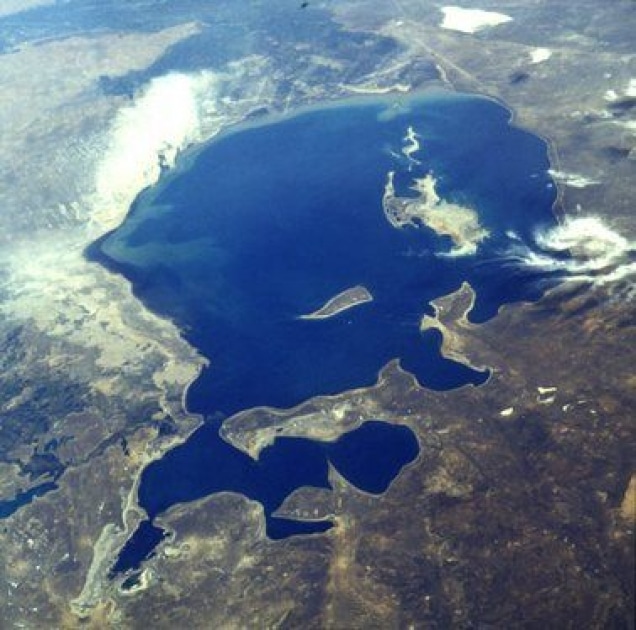
But, the Aral Sea, similar to the river in Canada, was known as “one of the planet’s worst environmental disasters” because of human interventions more than geographical and climate changes. Once the world’s fourth largest lake, which has been called a sea due to its size, it has now shrunk by more than 90 per cent of its size over fifty years ago, mainly because of the re-routing of its source rivers.
Location and History of Aral Sea
Located between Kazakhstan in the north and Karakalpakstan, an independent area of Uzbekistan, in the south lies the Aral Sea. The Sea of Islands referred to the existence of more than 1500 islands as a wonder in itself. The two rivers that feed the Aral Sea are the Amu Darya and Syr Darya rivers, where the first one reaches the body of water through the South, while the second reaches through the North. If the map of a Greek Scholar Claudius is anything to go by, then the Caspian and the Aral Sea were joined and formed a vast inland sea earlier.
However, according to Geographer Dr Nick Middleton, the Amu Darya did not flow to create the Aral Sea until the beginning of the Holocene, and it was flowing into the Caspian Sea until then. He also noted that the Syr Darya led to the formation of a large lake called the Mynbulak depression in the Kyzyl Kum during the Pliocene.
The Aral Sea area is characterised by a desert-continental climate, hot summers, cold winters and scanty rainfall, only 100 mm annually.
Beginning of the catastrophe
According to historical documents, the Aral sea region was inhabited by desert nomads and used to support a booming fishing industry in the region. In the 20th century, the Aral Sea was reported to be the world’s fourth-largest inland water body, with an approximate area of 68 000 sq. km. Moreover, the rivers that fed the lake also offered water to nearby towns, giving birth to the historic Silk Route.
However, It was only in the 1930s that the Aral Sea Disaster started taking shape. With the increased agricultural land to further enhance the flourishing cotton industry, water consumption also increased dramatically. Following the Soviet government’s plan to irrigate the desert by undertaking a diversion project to cultivate rice, melons, cereals, and cotton, many irrigational dams and canals were built on the arteries of the Aral Sea. Moreover, the poorly built channels also led to the wastage of water at a severe level. The wastage of water from the largest canal in Central Asia, the Qaraqum Canal, was reportedly from 30 to 70 per cent.
In the 1960s, the water level in the Aral sea was drastically going down as up to 60 cubic kilometres of water was going to the farmlands instead of the sea. The amount of redirected water increased heavily as cotton production in the farmlands doubled between 1960 and 2000. As a result, the shrinking of the sea occurred at a maximum pace, at an average of 20cm in a year between 1961 to 1970, 50-60cm in the 1970s and 80–90cm in the 1980s. The latest data reveals that the water level in the Aral sea drops by an average of 31-35 inches yearly.
In line with the reduction of water level, the sea’s surface area also shrank by about 60% between 1960 to 1998. While the Aral sea had an area of around 68,000km2 in 1960, the area recorded in 1998 was 28,687km2. Its position among the largest lakes also went down from fourth to eighth during this period. In 1987, the continuous shrinkage caused the Aral Sea to be divided into two parts. The North Aral Sea was the smaller part (known as the Lesser Sea), and the South Aral Sea became the larger part of the lake( the Greater Sea).
Damaged Ecosystem and Human Health Hazard
Despite geographical changes, this disaster also impacted the flourishing fishing economy. The fishing industry that once reportedly produced one-sixth of the catch in the Soviet Union and employed around 40,000 has been destroyed. The use of pesticides also increased at an alarming rate. With the gradual increase of industrialization and the high water level dropping, the Relic sea became too salty even for aquatic animals to survive.
Marine life suffered greatly, and gradually the fishing industry went through an all-time low, one of the major consequences of the dying Aral Sea. The abandoned fishing trawlers in the sandy wastelands are the living memories of the catastrophe.
The ecosystem of the Aral Sea was destroyed mainly as a result of the increased salinity as well as the testing of weapons and other fertilizer run-offs. The saltiness of the water in the Aral sea was around 376 g/l by 1990 compared to the 35 g/l salinity of ordinary seawater. In addition to using pesticides, activities like weapon testing have also resulted in the formation of huge plains covered with salt and toxic chemicals.
The land around the Aral Sea is also highly polluted, and the people living in the surrounding areas have been suffering from many health-related problems along with the lack of fresh drinking water. Reports suggest that there are high rates of certain kinds of cancer and lung diseases in the surrounding area. The region has also reported a high rate of respiratory illnesses, digestive disorders, and infectious diseases.
Health hazards emerged as water levels dropped and portions of the seabed became visible to the naked eye. The Karakalpaks, a community, living in the southern region, suffered a lot. The wind blew across the seabed, producing dust storms that engulfed the area. Toxic dust particles contaminated with salts, fertilisers and pesticides were everywhere. Many people in the region experienced serious health problems, respiratory infections, breathing problems, throat cancers, kidney diseases, and even anemia. The infant mortality rate in the region is still one of the highest in the world.
Revival of the Aral Sea
It was in 1991 that Uzbekistan gained independence from the Soviet Union and decided to improve the situation of the Dying Aral Sea. The first two attempts of the Kazakh Government failed, and it was only in 2005 that it tasted success with the increase in the water level and the fish stocks in the sea. In 1994, the countries such as Kazakhstan, Uzbekistan, Tajikistan, Kyrgyzstan, and Turkmenistan adopted the Aral Sea Basin Program to revive the sea.
The program aimed to stabilise the environment and rehabilitate the disaster area around the Aral sea. Phase one of the program was launched in 1992 with the help of the World Bank and ran until 1997. The second phase started in 1998 and ran for the next five years, while the third phase ran simultaneously and focussed on the enhancement of the irrigation systems currently in place.
It was only then that the Aral Sea disaster saw a little improvement, with the depth increased to 30 feet after rigorous tries of Kazakhstan. The construction of the Dike Kokaral in 2005, a concrete dam that divides the two halves of the Aral Sea, was an important milestone as it helped the water level of the North Aral to rise and bring down the salinity. The government is now ready to build another dike, and the rehabilitation work continues even today.
Recent reports from the region have suggested an increase in the water level, the reappearance of fish, and the expansion of fishing production. As these restoration efforts started drawing international attention, former U.N. Secretary-General Ban Ki-moon also asked Central Asian leaders to step up efforts to resolve the problem. Though the North Aral sea has been revived to a large extent, the bits and pieces of the South Aral Sea continue to disappear, forming the Aralkum desert on the lake bed. As experts argue, there is more to do to bring back the sea, such as a serious cross-country method with collective responsibility.
Frequently Asked Questions
1. Why did the Aral Sea dry up?
The Aral Sea dried up as the waters of its source rivers were diverted for irrigation. The waters of two main rivers, the Syr Darya and the Amu Darya, were used for cotton cultivation, decreasing the sea’s water level over the years.
2. Will the Aral Sea come back?
It is not possible, given the circumstances and erosion of the seabed. According to Scientists, if present trends continue, the Aral Sea will completely disappear in 20 years. The exposed seabed covers 33,000 square kilometres and is like a vast sandy desert being eroded daily.
3. When did the Aral Sea start shrinking?
Aral Sea’s eastern basin began shrinking in the 1960s. In 2000, Asia’s the Aral Sea had already shrunk to a fraction of its 1960 extent. Extensive irrigation and dry weather caused her eastern lobe to completely dry in 2014, for the time in 600 years.
4. When was the Aral Sea formed?
The depression of the Aral Sea was formed towards the end of the Neogene period, about 23 to 2.6 million years ago. During that time, this depression was gradually filled with water, most of which came from the Syr Darya.
5. What was the original size of the Aral Sea?
The Aral Sea was the fourth largest lake in the world and covered around 68,000 square kilometres. It is the worst environmental disaster prompted by human interference, which destroyed the region’s ecosystem, economy and livelihood of thousands of people.
Disclaimer: The author’s views expressed in this article do not necessarily reflect the views of Marine Insight. Data and charts, if used in the article, have been sourced from available information and have not been authenticated by any statutory authority. The author and Marine Insight do not claim it to be accurate nor accept any responsibility for the same. The views constitute only the opinions and do not constitute any guidelines or recommendations on any course of action to be followed by the reader.
The article or images cannot be reproduced, copied, shared or used in any form without the permission of the author and Marine Insight.
Are foldable phones and tablets cool again? That’ll be up to Samsung, LG, TCL and the other device makers.
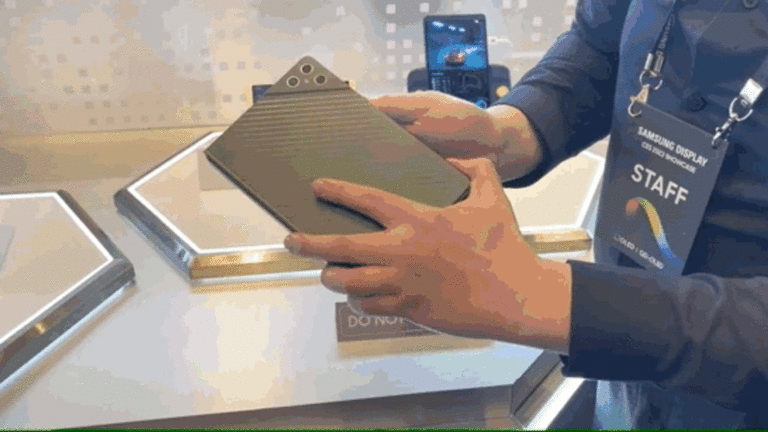
But after seeing the Samsung Flex Hybrid, which folds and slides, this week at CES 2023, I’m starting to once again feel excited about the cutting-edge tech that has yet to catch on in a serious way. While the concept model remained in the hands of a Samsung staffer, seeing it for myself renewed my hope in the possibilities we have yet to explore with screens that can fold, bend, slide and roll.
There were slideables, foldables and even some devices that used multiple technologies, and any of them could show up in the not-too-distant future. The Flex Hybrid is a foldable tablet that has an additional display that pulls out, with the demo giving an example of watching a football game on the full tablet screen before pulling out the additional display real estate to see stats and other information.
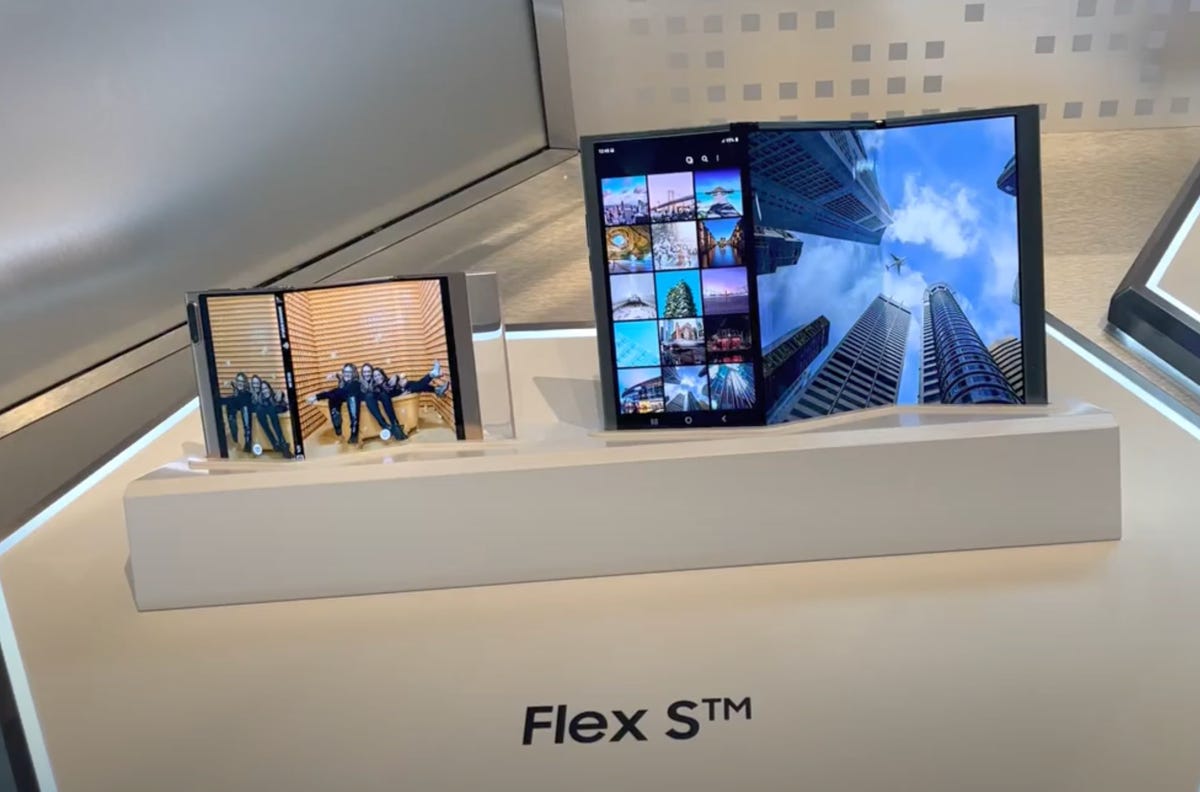
Other prototype models, like the Flex S, can fold over multiple times, giving you a smartphone-size screen when closed and a large tablet when open. This is something straight out of HBO’s Westworld.
Samsung Display’s Flex S looks like a tablet display straight out of HBO’s Westworld.
David Katzmaier/CNET
The new displays look to give life to the foldable era, which got off to a rocky start with an original Samsung Galaxy Fold that had well-documented issues in 2019. Subsequent models like the recent Z Flip 4 and Z Fold 4 have shown a lot of promise and panache, but neither has caught on despite being pretty excellent devices — we’re talking about 1.1% of the global smartphone market share for foldables, according to research firm IDC.
Yet the appeal of foldable devices is growing among buyers as prices gradually come down and refinements are made, with IDC expecting foldable phone shipments to hit 41.5 million units in 2026, up from 13.5 million units in 2022.
Again, these prototypes aren’t meant to be finished products but rather showcases of technology that the company has been working on. It also is being developed by Samsung Display, which is a different part of Samsung than the Samsung Electronics unit that produces and sells phones, tablets, computers, TVs and other electronic devices (though the two also work together).
Samsung Display is a supplier, and its screens are found in a host of products not made by the South Korean tech giant. So while Samsung is crafting the screens, it is very possible a different company could bring some of these to market.
“These are all prototypes, concept devices, obviously,” says John Jacobs, vice president of sales and marketing at Samsung Display. “We’re not gonna go out and build millions [of these displays] until we have customers.” Jacobs is hoping that those customers, from phone or PC companies to automakers looking for screens for their upcoming cars, will see the concepts and be inspired.
“That’s what we want to do here is help, if you will… enable creativity and imagination.”
The burden is on other companies to take these screens and build working products around them. While Samsung is demoing the technology at CES, it wasn’t letting media attendees pick up and use the prototypes on their own. Instead, the company had staff members handling the demos.
But unlike so many products and concepts at CES, Samsung seems ready for these displays to take that next step towards becoming a real product. In fact, Jacobs doesn’t think we’ll have to wait too long.
“I think [in] 2024, especially multifold devices, become much more of a possibility.”
A lot more work needs to be done by Samsung and others to get us there, but I can’t wait.
In the weeks following the insurrection of Jan. 6, 2021, Harvard Law School professor Alan Jenkins struggled to sleep.
“I was waking up in a cold sweat at 3 a.m. morning after morning worrying about our democracy,” he says.
Jenkins believes the violent breach at the US Capitol represented an existential threat to America and its democratic institutions, and almost immediately, he knew he wanted to explore and amplify what he saw as the far-reaching implications. He also knew exactly how he wanted to do it: through a graphic novel that could, potentially, reach those who don’t track politics beyond the immediate news cycle.
One chilling scenario in the graphic novel sees armed officers raiding a news station to stop a story from airing. “Under the authority of the Fair and Balanced Media Act of 2021, this network has been declared an enemy of freedom,” they shout. “Turn off those cameras.”
Shawn Martinbrough
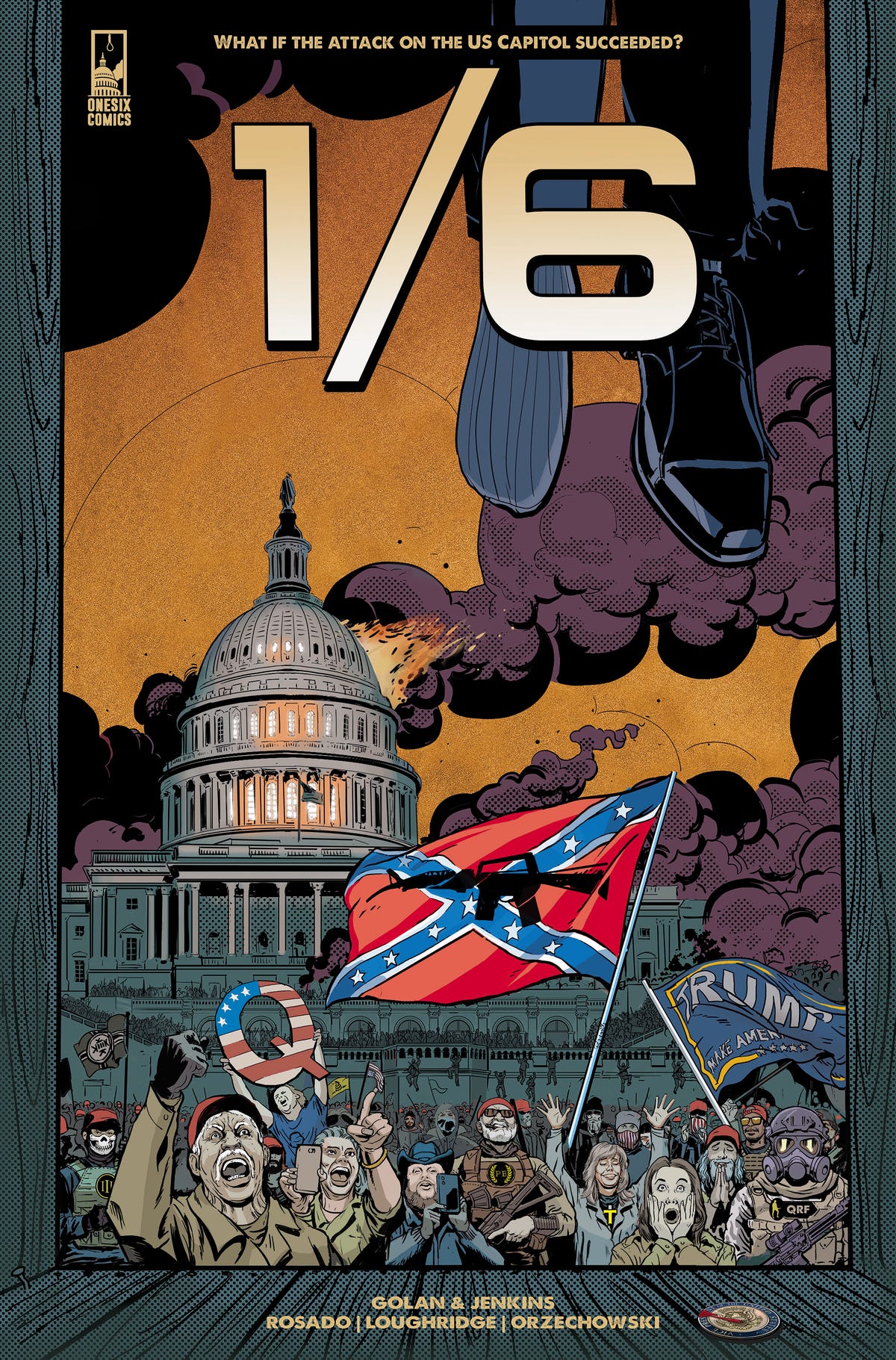
So he teamed with artist and New York Times best-selling author Gan Golan to co-write the narrative for 1/6: The Graphic Novel, a four-part partially crowdfunded series that imagines what could have happened had the insurrectionists succeeded. Jenkins and Golan call their character-based graphic novel “a tale of what was, what could have been and what still might be.”
The first chapter became available for download, appropriately, on Friday, Jan. 6, the second anniversary of the attack. It’s titled Remember This Day Forever and can be purchased on Amazon or Issuu for $2.99.
“Comic books can be a way of saying the things that are not being spoken and bringing the stories that are under the surface into public conversation,” Golan says. “And that’s one of our main goals in doing this in such an accessible and entertaining art form.”
Expect the three remaining chapters of 1/6 to be published about once a quarter — the authors are still assimilating the copious amounts of information from the televised Jan. 6 congressional committee hearings. The bipartisan panel issued its 845-page final report in late December, making the case that former President Donald Trump was responsible for the riot and should be barred from holding office again.
The graphic novel combines speculative fiction and carefully researched verified events, and the first chapter presents chilling scenarios. Armed militia regiments patrol the streets and storm a news station about to go live with a blockbuster story about the 2020 election. “Under the authority of the Fair and Balanced Media Act of 2021, this network has been declared an enemy of freedom,” the officers shout, weapons drawn. “Turn off those cameras.”
Art by veteran comic book artist Will Rosado adds to the uneasiness through engaging visual storytelling. Scenes featuring activists protecting crates of electoral ballots (“the last evidence of our democracy”) unfold in icy blues, grays and greens for a decidedly post-apocalyptic feel. Pages with tanks and militia burst with incendiary oranges and reds that make it feel like bombs are about to explode. Faces across the political spectrum register powerful emotions: terror, rage, shock, worry.
“There are hopeful notes and elements in subsequent chapters,” promises Jenkins, who teaches courses on race and law, communications and Supreme Court jurisprudence. “Part of that hope comes from everyday people who believe in our democracy and are ready to take action to protect it.”
The narrative of 1/6 follows the lives of four characters from across the political spectrum whose lives are forever changed by the events of Jan. 6.
Will Rosado and Gan Golan
Comics, of course, have a long history of tackling themes related to social justice and inequality.
Pulitzer Prize-winning graphic novel Maus, by Art Spiegelman, depicts the horrors of the Holocaust. Captain America famously punched Adolf Hitler in the face when Marvel first introduced the American-flag-clad superhero in 1941. DC Comics powerhouse Superman exposed the secrets of the Ku Klux Klan in the 1940s, and he battled the hate group again a few years ago in a comic targeting young adults. Marvel’s Black Panther has also fought the Klan, and the X-Men’s mutant struggles served as an allegory for racial persecution.
As Jenkins and Golan speak to that comics tradition over Zoom, it’s clear I’m talking to two ardent fans of the genre.
Gan Golan (left) and Alan Jenkins co-wrote the narrative for the graphic novel 1/6. Both trace their love of comic books back to age 10.
One Six Comics
“Collectively, we have a shameful amount of comic book interest and history under our belts,” laughs Jenkins, who first got into comics at age 10 and counts Daredevil, Submariner and Black Panther among his favorite characters.
The authors hope their graphic novel will motivate people to act in the spirit of the pair’s favorite comics heroes. It’s published under the auspices of the Western States Center, a Portland, Oregon-based pro-democracy organization where both are senior fellows. The book comes with a digital toolkit that includes strategies for civic leaders to battle bigoted political violence and for schools to help kids distinguish between reliable information and falsehoods.
Jenkins and Golan constantly rewrote their story during the hearings, investigating new revelations and details and trying to discern what to incorporate and how.
However, “the one part of the story that can’t be told through the January 6 final report is what could have happened and what still might happen, the long-term trajectory of this anti-democratic movement,” says Golan, an architect of the large-scale activist event People’s Climate March and author of the graphic novel The Adventures of Unemployed Man, which is about the adventures of a jobless crusader and his sidekick Plan B.
“Like all dystopian fiction,” Golan adds, “it gives us a picture of the world we need to work very hard to avoid.”
Apple TV Plus is stocked with big names and some hit shows, from the first season of Severance to the heartwarmingly adorable Ted Lasso to Reese Witherspoon’s Emmy-winning drama The Morning Show.
Like rivals Netflix, Hulu and Amazon Prime Video, Apple TV Plus is filled with exclusive, original content. But unlike the other services, Apple streams only content it has made itself. That meant that when the service launched in November 2019, the catalog wasn’t huge, but it’s been filling out fast.
Here’s what’s coming to the streaming service this month, followed by our guide to some of the best TV shows on Apple TV Plus.
Mythic Quest, season 3 finale (2020- ): A comedy about a long-running video game called Mythic Quest and the people who make it.
Jan. 13
Servant, season 4 (2019- ): This series from director M. Night Shyamalan follows a wealthy couple who lose their baby and use an unsettling lifelike doll to cope. The show features Harry Potter’s Rupert Grint.
Jan. 20
Truth Be Told, season 3 (2019- ): This series is about a true crime podcast. Octavia Spencer plays a podcaster trying to bring attention to the disappearance of several young Black girls.
Jan. 27
Shrinking, series debut (2022- ): Jason Segel plays a therapist dealing with the loss of his wife. Harrison Ford also stars.
Best Apple TV Plus series
Apple
Truth Be Told (2019- )
Truth Be Told is a drama for true-crime fans, riding the recent trend of crime podcasts in a fictionalized form. Octavia Spencer and Aaron Paul play a podcaster and a prisoner united by a horrific crime years before, kicking off a whodunit that draws in both their families in an entertaining mix of a character-driven drama like Big Little Lies with true-crime stories like Making a Murderer and The Staircase.
Apple
Loot (2022-)
After Molly Wells (Maya Rudolph) catches her tech billionaire husband (Adam Scott) of 20 years cheating on her, she divorces him and ends up with not only $87 million, but a question of what to do with her life. The answer? Get involved with a philanthropic foundation she didn’t even know she had. Along the way, she finds grounding with her new coworkers — but not without plenty of comedic, out-of-touch-millionaire flaps along the way. The show was co-created by Alan Yang, who was also involved in Parks and Rec and Master of None.
Apple
Ted Lasso (2020- )
You don’t need to like sports to love comedy series Ted Lasso. Produced by the show’s Golden Globe-winning star Jason Sudeikis with Scrubs creator Bill Lawrence, it follows relentlessly upbeat American coach Ted Lasso as he takes charge of an English soccer team. Think of it as Friday Night Lights crossed with Saturday Night Live (in London).
Apple
Little America (2020- )
Ordinary people dream big in Little America. A heavyweight cast tells stories of immigrants living their lives in a heartwarming anthology series packed with a mix of funny, sweet, romantic and often surprising tales.
Apple TV Plus
WeCrashed (2022)
Starring Jared Leto and Anne Hathaway, WeCrashed tells the story of the rise and fall of WeWork founder Adam Neumann and his wife Rebekah, and how their relationship backdropped the company’s peak — and significant valley.
Apple
Servant (2019- )
Sixth Sense director M. Night Shyamalan brings his brand of creepy domestic drama to episodic TV in Servant, created and written by Tony Basgallop. After a devastating loss, two bereaved parents adopt a hyperrealistic baby doll to help them tackle their grief, but danger and deception lurks in the nursery.
Apple
For All Mankind (2019-)
For All Mankind offers an alternate timeline of what would have happened if the Soviets had landed on the moon first. The short answer is the never-ending militarization of space, but the show is so much more expansive than that. If you’re looking for a sci-fi thriller with plenty of interpersonal drama and political intrigue, For All Mankind is solid choice.
Apple
Long Way Up (2020)
Ewan McGregor and Charlie Boorman get back on their bikes and head north from Argentina through South and Central America. In this sequel to the popular travel shows Long Way Round and Long Way Down, the petrolhead duo goes green. They cover 13,000 miles and 13 countries on Harley-Davidson LiveWire electric motorcycles.
Apple TV Plus
Tiny World (2020- )
A nature show, focused on small creatures, narrated by Ant-Man himself, Paul Rudd. Absolute genius.
Like seemingly every single one of these modern nature documentaries, Tiny World is gorgeously shot and brilliantly compelling.
Apple TV Plus
The Mosquito Coast (2021- )
Justin Theroux stars as Allie Fox, an oddball inventor taking his family off the grid in protest against society’s failings. Apple’s heavyweight drama is based on the novel by the actor’s uncle Paul Theroux (previously filmed with Harrison Ford in 1986). Now season 1 has wrapped up, Apple has already renewed this modern version of The Mosquito Coast for a second season.
Apple
Mythic Quest: Raven’s Banquet (2020- )
Mythic Quest: Raven’s Banquet is a must for anyone with even a passing interest in video games or the industry that produces them. It’s unique, funny and earnest in parts. It treads familiar territory but is well worth a watch.
Apple
The Morning Show (2019- )
Reese Witherspoon and Jennifer Aniston produce and star in a timely series tackling office politics in the #MeToo era, as a TV network is rocked by the indiscretions of a host played by Steve Carell. Among the compelling performances, Billy Crudup won Outstanding Supporting Actor in a Drama Series at the 2020 Emmy Awards. The award-winning drama, strong cast and timely themes make The Morning Show worth a watch.
Severance (2022- )
This show has a fascinating premise: People can choose to undergo a procedure called severance, which separates their work-related and personal memories. Adam Scott’s character spends eight hours of the day in a sanitized, strikingly white office space with no recollection of his outside life. Soon, a former co-worker shows up with a warning about the strange company. A mind-bending and suspenseful sci-fi thriller — enjoying Severance is no work at all.
Apple TV Plus
Trying (2020- )
In this British comedy, couple Nikki and Jason want to have a baby but struggle to conceive. They decide to adopt — a process that inevitably throws new challenges their way. Trying offers charm and low-stakes fun, and it also happens to be laugh-out-loud funny. If you’re in need of some lighthearted TV time, this show has you covered.
Apple
Dickinson (2019-2021)
Dickinson takes the story of real-life American poet Emily Dickinson and shoehorns it into a period drama of sorts. It’s hardly historically accurate — Emily and her teenage friends act more like characters from Riverdale — but it is entertaining.
Apple TV Plus
Lisey’s Story (2021)
Adapted by Stephen King from his own novel, Lisey’s Story stars Julianne Moore as a grieving widow spookily revisiting her marriage to her late husband, a famous novelist played by Clive Owen.
Apple
Home Before Dark (2020- )
Inspired by the reporting of real-life journalist Hilde Lysiak, Home Before Dark follows the story of a young girl who moves from Brooklyn to a small lakeside town. It starts slow but features some strong central performances, particularly in the lead role.
Apple TV Plus
The Afterparty (2022- )
A comedic murder mystery in the same vein as Rian Johnson’s 2019 film Knives Out, The Afterparty is a star-packed whodunnit that will keep you guessing and laughing with each episode. Tiffany Haddish, Dave Franco, Ilana Glazer, Ben Schwartz and more lend their talents to the show. If you’re one to opt for a mystery-comedy mixture, The Afterparty should shoot right to the top of your to-stream list.
Apple TV Plus
The Shrink Next Door (2021)
In my book, any show that casts both Will Ferrell and Paul Rudd as its leads is already doing something very right. In the drama miniseries The Shrink Next Door, Ferrell and Rudd play characters on opposite ends of the personality spectrum — Ferrell is a sniffling, timid textile business owner, and his co-star is an egotistic therapist with manipulative tendencies. When the two are together, the result is both unsettling and tantalizing, making The Shrink Next Door something you’ll want to check out for yourself.
Apple
Prehistoric Planet (2022)
Prehistoric Planet gives viewers a look at the world of dinosaurs. Using realistic computer-generated dinos, and structured like a nature documentary series down to the camera shots, it’s easy to forget you’re not watching real footage. To top is off, David Attenborough narrates.
New Movies Coming in 2023 From Marvel, Netflix, DC and More
Netflix doesn’t have a massive collection of fantasy flicks, but you can find several charming (and eclectic) gems. Many combine the fantastical with real-world struggles, including the remarkable Closet Monster. Or dive right into the high fantasy realm with The Golden Compass, based on Philip Pullman’s classic novels.
Hopefully you’ll find an intriguing gem below.
Netflix
The Old Guard (2020)
Technically a superhero film, The Old Guard brings a swath of impressive action scenes, popping off with each of star Charlize Theron’s gunshots. Theron plays Andy, leader of a group of immortal mercenaries, including a knight who fought in the Crusades. The centuries-old warriors head out on a revenge mission, bringing progressive heroes and slick fights, although it can’t dodge every cliché.
Netflix
The Sea Beast (2022)
The Sea Beast joins Netflix’s collection of stellar family-friendly animated adventures. A young girl named Maisie (Zaris-Angel Hator) stows away on the ship of sea monster hunter Captain Crow (Jared Harris), becoming wrapped up in a thrilling journey through uncharted waters. Bringing originality to the high seas and swashbuckling characters, The Sea Beast is a must-watch chapter of enchanting fantasy.
Warner Bros.
The Golden Compass (2007)
Fans of Philip Pullman’s classic fantasy novel series are probably better served by HBO’s TV show adaptation. But The Golden Compass, based on the first book, is a solid chapter with generous doses of fantasy escapism. Follow Lyra Belacqua (Dakota Blue Richards), a young adventurer who embarks on a journey from the esteemed halls of Oxford colleges to the kingdom of the Ice Bears in the frozen north. Nicole Kidman, Daniel Craig and Eva Green round out a rich cast.
Jose Haro
A Monster Calls (2016)
This dark fantasy drama comes from Spanish director J.A. Bayona, who’s since branched off into huge franchise chapters, including Jurassic World: Fallen Kingdom and the first two episodes of Prime Video’s upcoming Lord of the Rings series. But perhaps his best work is centered on coming-of-age tales; A Monster Calls follows a troubled young boy who encounters a tree that promises to tell him three stories, as long as Connor tells him one in return. With roots in darker themes, one of them being death, A Monster Calls is a smart, moving fantasy tale.
Netflix
The Water Man (2020)
The Water Man won’t be for everyone. More drama than pure fantasy, this family friendly adventure deals with themes such as grief, loss and friendship. Eleven-year-old Gunner and his family move to a new town, where the bookworm must deal with not only a lack of friends but also a harsh father and a mother suffering from leukemia. His escapism takes him to a fairy tale forest, where his imagination comes alive. An adventurous tale dealing with bigger issues.
Strand Releasing/YouTube/Screenshot
Closet Monster (2015)
Unlocking multiple genres, Closet Monster uses its fantasy elements to open the door to a fresh and moving coming-of-age tale. Scarred by witnessing a homophobic attack, closeted and imaginative teenager Oscar must grapple with his feelings for Wilder. Be warned, Closet Monster splices David Cronenberg levels of body horror into its bigger picture about internalized homophobia. Capped by Connor Jessup’s superb performance, Closet Monster an indie gem.
Sony Pictures Releasing/YouTube/CNET Screenshot
Big Fish (2003)
Settle in for a fantastical tale that may or may not be true. Will Bloom (Billy Crudup) visits his dying father, whose exciting, impossible stories about his life begin to take on credibility. This sprawling, Tim Burton-directed adventure takes us back to Edward Bloom’s (Ewan McGregor) youth, where we see his stories play out for ourselves. With witches, a circus and bank robberies, Big Fish is a charming prize catch.
Netflix
Nightbooks (2021)
Co-produced by Sam Raimi, this dark fantasy is inscribed with top horror credentials. Still aimed at younger viewers, Nightbooks leafs through a mystery about a young boy who must figure out how to escape a magical apartment owned by Krysten Ritter’s witch Natacha. A tomb of fun.
Netflix
Errementari (2017)
Errementari, translated from Basque as The Blacksmith, is a horror fantasy about a deal with the devil. In northern Spain during the 1830s, a blacksmith holds a demon in captivity, until an orphan girl unwittingly releases it. War, murder, kidnapping, suicide and more await you in the furnace of this hellish horror with surprising lashings of dark comedy.
Warner Bros. Pictures
Dark Shadows (2012)
It’s not the greatest Tim Burton entry, but Dark Shadows offers another opportunity to admire the director’s trademark gothic visual style. Based on the soap opera of the same name, the comedy horror follows a rich playboy who unwisely breaks the heart of a witch (Eva Green). She turns him into a vampire and buries him alive. Two centuries later, Barnabas (Johnny Depp) emerges, discovering the world of the ’70s while harboring a taste for revenge. Though the characters and plot could be fleshed out significantly, Dark Shadows boasts a stellar cast, including Michelle Pfeiffer and Helena Bonham Carter. Plus, it gives you Barnabus’ hilarious fish-out-of-water reactions to ’70s pop culture.
Warner Bros.
Pan (2015)
This 2015 movie dove into the origin of Peter Pan and Captain Hook. It features Garrett Hedlund as Hook, and High Jackman as Blackbeard the pirate.
Netflix
A Boy Called Christmas (2021)
A Christmas cracker delivering heapings of holiday spirit. A Boy Called Christmas won’t win any awards for originality, but it certainly delivers what it says on the tin. Young Nikolas embarks on a quest to find the fabled village of the elves, with his pal Blitzen in tow. No prizes for predicting the gift-giving shenanigans that ensue.
New Movies Coming in 2023 From Marvel, Netflix, DC and More