

As the James Webb Space Telescope looks back at some of the earliest galaxies, it is helping us learn not only about galaxies very different from our own but also about how galaxies similar to the Milky Way were first formed. Recently astronomers announced they have used Webb to discover some of the earliest galaxies with a feature called stellar bars, making them similar to our barred spiral galaxy seen today.
A galaxy bar refers to a strip of dust and gas that forms a structure across the center of a galaxy, and which is frequently visible as a bright stripe across a galaxy in images. It is thought that these structures develop as a galaxy ages, as dust and gas are drawn toward the galactic center. So it was remarkable to see a bar in a galaxy from a very early period when the universe was 25% of its current age.
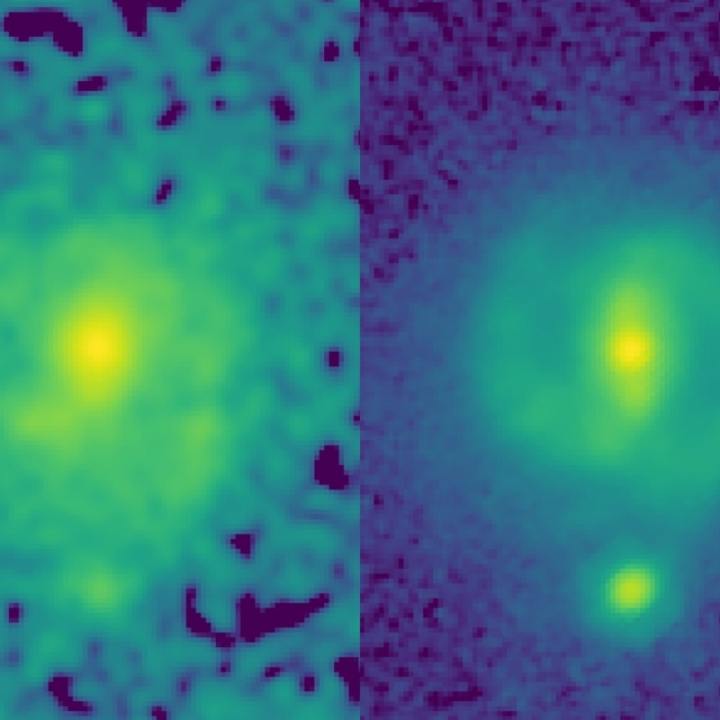
An earlier image of galaxy EGS23205 taken by Hubble was smudgy and hard to see any structure in, but the new image from Webb shows a bright bar structure much more clearly.
“I took one look at these data, and I said, ‘We are dropping everything else!’” said one of the researchers, Shardha Jogee of the University of Texas at Austin, in a statement. “The bars hardly visible in Hubble data just popped out in the JWST image, showing the tremendous power of JWST to see the underlying structure in galaxies.”
Another galaxy, EGS-24268, was also imaged by Webb and is thought to be from 11 billion years ago. Finding these structures in very early galaxies is intriguing as it suggests astronomers will have to adjust their models of how galaxies evolve.
Bars are thought to be important for the development of galaxies as they move gas around and help to provide the building materials for new stars to form.
“Bars solve the supply chain problem in galaxies,” Jogee said. “Just like we need to bring raw material from the harbor to inland factories that make new products, a bar powerfully transports gas into the central region where the gas is rapidly converted into new stars at a rate typically 10 to 100 times faster than in the rest of the galaxy.”

Today’s tech news, curated and condensed for your inbox
Check your inbox!
Please provide a valid email address to continue.
This email address is currently on file. If you are not receiving newsletters, please check your spam folder.
Sorry, an error occurred during subscription. Please try again later.
Editors’ Recommendations
-
Peering into clouds of dust to understand star formation -
Old NASA satellite predicted to reenter the atmosphere tomorrow -
SpaceX smashes its own record for rocket launches in a year -
Listen to the festive sounds of space with new NASA sonification -
NASA and Roscosmos still investigating cause of space station leak
Read More
Georgina Torbet