Home Blog Page 6999

College basketball rankings: UConn slips to No. 5 after first loss, Kentucky hangs on in Coaches Poll

The Huskies dropped after being knocked from the undefeated ranks by Xavier…
Read More Kyle Boone

College basketball rankings: Undefeated Purdue gets all but one vote for No. 1 in AP Top 25 poll

The Boilermakers were the top team on 60 of 61 ballots in this week’s AP Top 25 poll…
Read More Kyle Boone

Purdue tightens grip on No. 1 in men’s basketball AP Top 25

Purdue solidified its No. 1 ranking in The AP Top 25, while No. 23 Charleston moved into the rankings for the first time in 20 years…
Read More Stephania Latson

“DCG, A Criminal Fraud” – 3AC Founder Accuses DCG For Terra Collapse

0
DCG

The year 2022 has been one of the most challenging years for the global markets, especially cryptocurrencies. The crypto world had several unfavorable events like bankruptcy where major companies such as FTX, Three Arrows Capital, Genesis, and Voyager saw their downfall after Terra (LUNA) collapsed in May 2022. It’s just not that, Bitcoin which was selling at around $48,000 in early 2022 has now plummeted towards the $16,000 area.

The bankruptcy series of these high-profile companies started with Three Arrows Capital and Genesis Trading, a cryptocurrency market operator and financing company. As per the sources, Genesis’s losses are connected to over-leveraged fund manager Three Arrows Capital and Hong Kong crypto financier Babel Finance.

Genesis Owe $900M To Gemini Users

Now, the latest updates emerge with Gemini co-founder Cameron Winklevoss’s open letter to Genesis’ owner. The letter claims that Genesis and its parent company Digital Currency Group (DCG) owe $900 million to Gemini customers.

As per the reports, after FTX went bankrupt, Genesis ceased all its withdrawals which left nearly 340,000 Gemini users confused. The letter also mentions a deadline of January 8th, 2023 to solve the issue.

DCG To Blame For Terra Collapse

It looks like DCG has attracted some major trouble as even Three Arrows Capital founder Zhu Su has accused DCG along with FTX for the fall of Terra (LUNA) and STETH. According to Zhu Su DCG, instead of restructuring ignored the issue. 3AC founder believes that DCG and FTX misled the crypto community even when they knew Genesis was collapsing.

5) they, like FTX, proceeded to misdirect for months, using various methods to attack us and also not have anyone ask the hard questions which is how did genesis fill the hole

6) they, like FTX, spent six months taking more deposits while insolvent and hoping mkt goes up

— Zhu Su ???? (@zhusu) January 3, 2023

Zhu Su has formed a strong opinion that Genesis is most likely to face bankruptcy in the coming days. He states that instead of approaching the Department of Justice, creditors are still hoping for help from Barry Silbert, Chief Executive at DCG.

Was this writing helpful?

No Yes

Photo of Elena R

Elena R

Elena is an expert in technical analysis and risk management in cryptocurrency market. She has 10+year experience in writing – accordingly she is avid journalists with a passion towards researching new insights coming into crypto erena.

Read More
Elena R

Aave Price Prediction 2023 – 2025: Will AAVE Moonshot To $1K?

AAVE Price Prediction

The year 2021 had been a game-changer for the broader crypto space. And tokens from Defi space had made most of the bull season of the year. One such crypto asset which made virtues with price gains was Aave (AAVE). 

With the current year 2023, the market is expected to be very stable. As the year began with a stable rise in the chart, much can be expected from crypto this year. Investors are being patient as the market gains back its strength. yet to ignite a bull run, certain sections of marketers are still betting on AAVE. 

The fundamental strengths of the protocol such as borrowing, lending, staking, liquidity pools, and flash loans. Still hold significant prominence in the industry, which could help the digital asset munch higher candles.

Are you one of the many, who are considering Aave Price Prediction? Then look no further as this write-up decodes the plausible price forecast for 2023 and the years to come!   

Overview

CryptocurrencyAAVE.
TokenAAVE.
Price$82.62
Market Cap$1,159,590,074
Trading Volume$175,810,607
Circulating Supply14,093,192.58 AAVE
All-time high$666.86 on May 5th, 2021.
All-time low$27 on November 11th, 2020.
Aave Price Prediction

The presence of Aave coin in renowned markets such as Ethereum, Avalanche, and Polygon, amongst others could turn fruitful for the digital asset. Considering the poised upgrades of each chain.

AAVE Price Forecast 2023

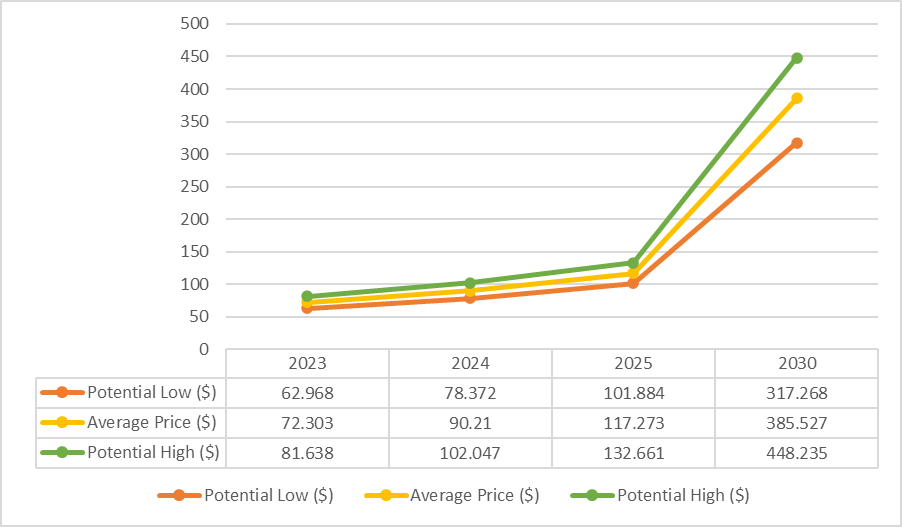
If the protocol manages to attract a wider audience, who could increase the traffic of the network? The price of AAVE could chug up to its potential high of $81.6381. 

However, an ebbing stance and depleting volumes could slash the price down to the low of $62.9680. That said, an equilibrium in buying and selling pressures could land AAVE at $72.3030. 

Price PredictionPotential Low ($)Average Price ($)Potential High ($)
202362.96872.30381.638

Price Prediction Of AAVE 2024

The ecosystem could further thrive if the necessary impetus is given to its hold on dApps, Defis, and DAOs. As these sectors could possibly ignite a bullish run, which has been long due. In such a case, the price of AAVE might hit a maximum of $102.0476. 

On the downside, emerging rivals and depleting stance of the network could sink the price to a minimum of $78.3726. Constrained by the linear momentum, the average price could settle at $90.2101. 

Price PredictionPotential Low ($)Average Price ($)Potential High ($)
202478.37290.210102.047

Aave (AAVE) Price Prediction 2025

As the crypto industry continues to evolve in the future, it may experience growth in the adoption curve and face regulatory restrictions at the same time. However, if it manages to resist the challenges and continues to rise, then AAVE’s price would hit a maximum of $132.6619 by the end of 2025. 

However, the asset would plummet to a bottom of $101.8843 if bears predominate the space. Successively, factoring in the bullish and bearish targets the average price could be at $117.2731.

Price PredictionPotential Low ($)Average Price ($)Potential High ($)
2025101.884117.273132.661

Aave (AAVE) Price Prediction 2026 – 2030

Price PredictionPotential Low ($)Average Price ($)Potential High ($)
2026135.271154.185175.317
2027178.228194.876211.744
2028206.984232.859264.817
2029265.115291.884324.165
2030317.268385.527448.235

CoinPedia’s AAVE Price Prediction

As per the formulated price prediction of CoinPedia’s expert panel. If the protocol comes across bullish events such as major collaborations and adoptions. The price of the altcoin could soar to a maximum of $81.638 by the end of 2023. 

In contrast, possible turbulence resulting from a financial crisis or regulatory clampdowns could clutch the price down to $62.968. This gives us an average trading price of $72.303.

Market Analysis

 202320242025
Wallet Investor$5.506$8.757$9.189
DigitalCoinPrice$62.07$124.27$186.23
Trading Beasts$65.384$90.488$109.785

What Is AAVE?

AAVE is an open-source decentralized and non-custodial liquidity token that thrives to facilitate users to lend and borrow cryptocurrencies. Lenders can earn a substantial interest in depositing assets into specifically established liquidity pools. However, Borrowers can subsequently avail of crypto as collateral to acquire a flash loan through this liquidity. 

The AAVE protocol is open-source and enables interaction with a user interface client. Or establishing communication with the smart contracts on the Ethereum blockchain. However, the interaction cost relies on the transaction’s intricacy and network status. Another fascinating feature of the platform is Flash loans. This allows traders to buy any convenient amount of assets without putting up any collateral. 

The AAVE platform has its own native governance token AAVE. The token could be utilized to vote and determine the product of Aave Improvement Proposals(AIPs) and further upgrades. In addition, AAVE could be staked to earn rewards and fees from the protocol. It can be staked within the protocol Safety Module to facilitate security or insurance to the lenders. 

Company Details

Fundamental Analysis

AAVE was previously known as ETHLend and was launched in November 2017 by Stani Kulechov. However, the rebranding of the platform was done a year later in September 2018. DeFi was not so popular at the time of AAVE’s launch. Realizing the scarcity of lending platforms on the ETH blockchain, the founder came up with this project. 

The founder of the platform accumulated a vast knowledge of programming when he was young. He was an early entrant to the blockchain space. In order to make capable of AAVE enabling a broad range of services, he rebranded ETHLend to AAVE. The central goal of the platform is to target the audience who are already occupied in the cryptocurrency space.

Furthermore, the Initial Coin Offering (ICO) was completed in November 2017 where it managed to raise $16.2 million in funds. Whilst in September 2018, the platform was rebranded from ETHLend to AAVE. The mainnet launch was completed in January 2020.

Historic Market Sentiments 2020 – 2021

  • Though Initial Coin Offering (ICO) was done in November 2017, the protocol went live on the main net in January 2020. Interestingly, starting from the initial days, AAVE price has thrived to exhibit a sort of volatility. However, with certain fluctuations, the asset plummeted to the bottom support from $42 to $28 by the year’s end.
  • In the first two months, the asset underwent two supercycles where it surged by over 500%. After clinching an ATH of $666.86 on 5th May, the asset woefully fell prey to a Chinese financial crisis. 
  • With continued bearish dominance the AAVE price tumbled to the bottom support of $180.86 by late June. The second bull session of the asset was triggered in July. With consecutive supercycles, the asset managed to hit an upper resistance of $415 in August. The asset almost fell by 50% from $325 to the low of $175 by mid-December, posing a rebound the year was closed at $276.9.

FAQs

Is Aave (AAVE) a good investment?

Considering the fundamentals of the protocol, AAVE is a profitable investment, if considered for the long term. 

What is the circulation count of AAVE?

The circulating supply of AAVE is 14,093,192.58 AAVE. 

What will the maximum price of AAVE be by the end of 2023?

The price of AAVE could surge to a maximum of $81.638 by the end of 2023.

How high will AAVE’s price rise by the end of 2025?

The price of the altcoin could escalate as high as $132.661 by the end of 2025. With a potential surge the price may go as high as $448.235 by the end of 2030.

Where can I buy AAVE?

AAVE is available for trade across prominent cryptocurrency exchange platforms such as Binance, Huobi Global, FTX, KuCoin, etc…

Was this writing helpful?

No Yes

Photo of Elena R

Elena R

Elena is an expert in technical analysis and risk management in cryptocurrency market. She has 10+year experience in writing – accordingly she is avid journalists with a passion towards researching new insights coming into crypto erena.

Read More
Elena R

Will XRP Price Hit $0.36 In the Next 24 Hours?

0
XRP Price

In the last 24 hours, XRP has made a minuscule increase, moving closer to the $0.35 threshold. At the time of this writing, one token is worth $0.3452, representing a 2% increase over the course of the last twenty-four hours.

The little uptick takes place after the token’s price saw a severe drop earlier in the day. The price fell from $0.3394 to $0.2998 in less than half an hour, which means that XRP saw a decline of an astounding 12% over that time period.

After recovering a significant portion of the unexpected price drop, XRP is now up against a price barrier of around $0.3444, which has not been broken through as of yet. The release of one billion XRP from Ripple’s escrow account, which took place yesterday, Sunday, is one event that often attracts the attention of XRP investors on the first of the month.

It seems quite doubtful that this was the reason for the dramatic drop in price, given the circumstances. Although the community has been aware of the activity for many years, there was still an element of surprise when it occurred this time.

In a related development, on the first day of the new year, WhaleAlert published a report stating that a total of one billion Ripple (XRP) tokens were freed from escrow accounts. Instead of being released straight from Ripple’s escrow accounts, the tokens were released from unidentified accounts. This is an anomaly.

The coins that were previously frozen are reportedly being stored at addresses that are controlled by Ripple. This information comes from Bithomp. The tokens have not been transferred to any exchanges or other on-demand liquidity (ODL) platforms; they are still stored in the wallets that were previously mentioned.

If XRP’s price rises steadily, the next barrier to look out for is around $0.3664, which is the second big resistance level. It may find support around $0.3333 if it can’t break over $0.3454. It seems unlikely that the price of Ripple’s token will drop below $0.3250 without a substantial decline in value.

However, the aforementioned support and resistance levels may change depending on the outcome of the SEC’s legal lawsuit against Ripple. However, the court’s decision might render these thresholds irrelevant or cause them to change. Let’s see what happens next!

Was this writing helpful?

No Yes

Read More
Sohrab Khawas

Court Document Reveals New Startling Details About Alameda and FTX

0
SBF

Recent revelations have shed light on how the problems that Sam Bankman-Fried “SBF”’s crypto trading firm Alameda has been having began a long time before the difficult year that we all experienced in 2021; in part due to its sister company FTX’s meltdown.

Looking more closely, we see that Alameda was never great at investing and that SBF’s involvement in the company remained substantial even after his departure as CEO in October 2021.

The trading company risked a lot of money and won part of it back, but it also lost a lot. And SBF sought over and over to borrow money and cryptocurrency to fuel those wagers, even offering double-digit interest rates to its lenders.

Uncovering It All

Alameda, as it expanded, invested billions of dollars into bets on the future success of the cryptocurrency industry, billions that federal prosecutors have just said were stolen from FTX clients. It placed wagers on obscure cryptocurrency exchanges and a slew of blockchain technology companies, and it also made political contributions and real estate purchases.

When it finally collapsed in 2022, it was a massive event. Both firms filed for bankruptcy protection in November, leaving their consumers owed billions of dollars and weakening trust in the cryptocurrency sector as a whole.

SBF claims that poor record keeping and a banking problem led to the theft of client monies and enabled Alameda to cover huge losses with funds intended for FTX. It was reported last week by The Wall Street Journal that during a hearing on January 3 he would most likely enter a not guilty plea to fraud charges.

The disgraced crypto figure seems to have established Alameda with the intention of donating a portion of its income to effective altruism, a movement whose stated goal is to channel charitable contributions to causes that will have the greatest impact.

He borrowed money from affluent people who were already involved in the trade sector in order to expand his business. The co-founder of Skype, Jaan Tallinn, lent him a substantial amount of Ethereum, over $100 million, and he returned with a stash of cryptocurrency.

Binance Blockchain Week kicked up in January 2019 with around 1,500 attendees in Singapore. The symposium, which Alameda sponsored for $150,000, was meant to be a forum for planning the development of the emerging crypto sector. Attendees stated SBF’s goal during the meeting was to network with potential new lenders for Alameda.

The firm handed out pamphlets to potential lenders claiming it had $55 million in assets under management; nevertheless, the vast majority of those funds were borrowed in order to finance the company’s operations.

For SBF, Alameda was a means to expand FTX. The company was the principal market maker at the exchange, meaning it was always willing to buy and sell at any time. People familiar with the hedge fund’s tactics say it sometimes took the losing side of a transaction in order to draw clients to the exchange.

Recent complaints filed by the Securities and Exchange Commission and the Commodity Futures Trading Commission, the nation’s leading market regulators, allege that SBF hatched a scheme for Alameda to borrow cash from the exchange.

He instructed his co-CEO, Gary Wang, to create programming that would enable the firm to maintain a negative balance on FTX regardless of the amount of collateral it posted with the exchange.

In addition, SBF prevented the sale of Alameda’s FTX collateral in the event that its value dropped below a certain threshold. That amounted to a line of credit extended by FTX to the hedge fund.

The criminal also directed his former flame Caroline Ellison to inflate the value of a cryptocurrency used by Alameda as collateral by increasing its purchases of that asset.
Note that SBF has said in an interview that,

“FTX was a full-time job. I didn’t have enough brain cycles left to understand everything going on at Alameda if I wanted to.”

Was this writing helpful?

No Yes

Photo of Elena R

Elena R

Elena is an expert in technical analysis and risk management in cryptocurrency market. She has 10+year experience in writing – accordingly she is avid journalists with a passion towards researching new insights coming into crypto erena.

Read More
Elena R

Global Recession Is Coming, Warns IMF Chief – What is Means For Cryptocurrency Market

Bitcoin price

The International Monetary Fund (IMF) is an international organization with 190 member countries. They cooperate in an effort to stabilize the world economy. By tracking economic and financial events, the IMF monitors and supports the economy. It keeps track of how countries are functioning and possible threats, such as trade conflicts or uncertainties. Offering its members with economic guidance,  providing aid and short-term loans to struggling nations. 

Kristalina Georgieva is the managing director of IMF and has been so since 2019. Ms Georgieva is the first Bulgarian to lead the IMF. 

In an interview aired on CBS’s Face The Nation on January 1st, International Monetary Fund Managing Director Kristalina Georgieva declared, “we expect one-third of the global economy to be in recession.” The cause for this will be the slowing of the world’s three largest economies, the United States, the European Union, and China.

She also stated that the United States can avoid a recession, but the European Union has already slowed. The nations have been greatly impacted by the outbreak of war between Ukraine and Russia. The slowing of major economies would have a significant influence on emerging markets, Georgieva added. The slowdown becomes a global trend, bringing the entire global market down with it. 

The crisis in China 

Following the enormous number of Covid positive cases in December, China compelled its people to remain at home, and business operations came to a halt. The country’s economic activity has been at its slowest since 2020, when the pandemic first struck.

More than a third of the economies in the world will be impacted by a global recession, and there is a 25% chance that the global GDP would only grow by 2% or less through 2023.

Impact on the crypto markets

Recessions can have a significant impact on the cryptocurrency industry. During times of economic downturn, people may be more inclined to invest in safe-haven assets such as Bitcoin, which has a history of being relatively stable during times of economic uncertainty.

On the other hand, the prices of many cryptocurrencies can be highly volatile, and the value of a particular cryptocurrency may be influenced by a variety of factors, including market demand, government regulations, and overall economic conditions. As a result, it is difficult to predict how the cryptocurrency market will react to a recession. 

Was this writing helpful?

No Yes

Photo of Elena R

Elena R

Elena is an expert in technical analysis and risk management in cryptocurrency market. She has 10+year experience in writing – accordingly she is avid journalists with a passion towards researching new insights coming into crypto erena.

Read More
Elena R

A fan boycott forced a Kpop label to reconsider its album release plans

0

Kpop girl group LOONA’s plans for a comeback have been shelved after a fan boycott capped months of drama between its record label Blockberry Creative and one of the ensemble’s former members, Chuu, exposing a dark side to the Korean music business.

The rumblings of trouble began last spring, when it was reported that Chuu had filed a lawsuit (link in Korean) against Blockberry Creative in December 2021, seeking to suspend her contract. According to news website Korea JoongAng Daily, the court partially approved her suit, ruling she could be granted a preliminary injunction.

But Chuu’s victory may have also been the writing on the wall. On Nov. 25, Blockberry Creative announced that she was being dropped from the group for “violent language and misuse of power toward our staff,” an abusive workplace behavior known in Korea as gapjil, where higher ups abuse lower-level staff. The allegations against Chuu were met with raised eyebrows amongst fans and industry professionals alike.

On Nov. 29, days after Chuu’s removal, JTBC reported (link in Korean) that nine of the remaining LOONA members had filed an injunction against the label to suspend their exclusive contracts, citing a dissolution of trust between them and the company. Blockberry Creative denied the report.

Then the group’s fandom, known as Orbits, stepped into the ring. They proclaimed a boycott of LOONA’s upcoming album, The Original Album: 0, originally set for release on Jan. 3. As prospective sales started to dive, Blockberry Creative declared the album release indefinitely postponed.

How the LOONA fan boycott works

On Dec. 5, LOONA Union, one of the group’s largest online fanclubs, issued an open letter demanding Blockberry Creative give an explanation for the alleged mistreatment of LOONA members. It gave the company a Dec. 7 deadline to answer, threatening a boycott in the event of no response.

The fandom’s demands were threefold: that allegations against Chuu be retracted, an apology be made towards the group, and LOONA members be offered the option to terminate their contracts. The label kept mum, and a boycott of LOONA’s new album pre-sales, coordinated mostly over Twitter and Tumblr, began on Dec. 8.

Fans were told to cease all purchase of Blockberry Creative merchandise, albums, and event tickets. According to Twitter account @loona_stats, preorders for the new album dropped by 98% compared with the previous album. An extensive list of Kpop stores around the globe also joined the boycott, committing to no longer stock LOONA products.

Instead of the usual number-pumping goals of Kpop fandoms, the new target for The Original Album: 0 literally became zero. On Dec. 22, Blockberry Creative announced its suspension of the group’s album release in January, saying the comeback would be “meaningless” amid outstanding issues. The boycott is still ongoing.

What’s going on with LOONA’s contracts?

The big sticking point for boycotting fans are LOONA’s reportedly exploitative contracts, which may be shorting the group members on pay while strapping them with ever-mounting volumes of debt.

On Dec. 19, a bombshell exposé published by Dispatch, a Korean celebrity gossip site, revealed the terms (link in Korean) of Chuu’s exclusive contract that she signed in December 2017, when she was just 18 years old. The contract reportedly set an earnings ratio between the record label and Chuu at 7:3, where Blockberry Creative would scoop up 70% of the profits, while Chuu would be left with 30%. The contract also reportedly split expenses between the two parties at 5:5, where each side would be responsible for 50% of costs.

According to Dispatch, the contract structure has saddled each LOONA member with approximately 200 million won ($153,500) of debt, calculated from the group’s cumulative earnings since 2016—18.6 billion won ($14.3 million)—and cumulative expenses over that same period—16.9 billion won (nearly $13 million).

Orbits have said the contracts are trapping LOONA members in a cycle of “perpetual debt.”

South Korea’s Kpop industry has a history of exploitative contracts

The controversy has put a spotlight on the industry greed behind Kpop’s glitz and glamor. In the cutthroat business, where many aspiring stars begin training as children, exploitation is a familiar theme. So-called slave contracts, as they are known within the Kpop industry, have locked many a trainee into long-term, extractive agreements with record labels, leading to some cases where they never see a single paycheck despite years of work.

Notably, in 2008, former boy group TVXQ took their management company SM Entertainment (SME) to court over 13-year-long contracts their parents had signed on their behalf when they were children, and in 2014, three members of group EXO ended up exiting the same company, citing exploitative treatment and unfair profit distribution. All three sued SME over their contracts—one lost his case, and two settled. In 2020, the four members of indie rock band The Rose terminated their contracts with J&Star Company, claiming they had not been paid since their debut in 2017. Other instances of unpaid labor in the industry abound.

Over the years, South Korea’s Federal Trade Commission has introduced more regulations to protect artists, including a seven-year limit on contracts and the prohibition of several penalties record labels often slap onto signees.

Still, behind the bubbly dance numbers, artists remain vulnerable to exploitative practices. The LOONA saga has shown that, in the absence of industry unionization, fandom can play a crucial role in negotiating working conditions where labor protections may fail.


Read More
Julia Malleck

4 New Year’s Resolutions Every Landlord Should Consider

Opinions expressed by Entrepreneur contributors are their own.

As we swiftly turn the corner into 2023, there are many considerations on the minds of those in the real estate industry, including landlords. The past year has been one of change, and experts predict more challenges in the general real estate market and the rental landscape. If you’ve been in the game for a while, you probably realize that what is happening right now is part of a cycle, and things will eventually even out and stabilize once again. But if you’re like me, you want to experience more short-term success as a landlord today. Here are a few suggestions on resolutions to consider to make 2023 a successful year.

Related: The 5 Types of Landlords Businesses Will Encounter

Invest in technology to advance your business and properties

As a business founder and owner, I am acutely aware of just how crucial it is to make investments to experience ongoing success. As an investment property owner, upgrading technological devices within your rental properties is a great place to begin. Whether it is upgrading kitchen appliances, installing security systems such as a Ring doorbell, upgrading in-unit laundry machines, offering fiber optic internet connection (if available) or installing AI technology that can ease the life of your tenants, current and future tenants will appreciate the investments in the property and will likely choose to stay put with these upgraded amenities.

Also consider investing in a technology platform to help you manage your rental properties. This investment can make your life and job easier as a landlord or property manager and allow you to have all documents on file electronically.

Depending on the technology platform you decide to invest in, additional benefits could include accepting online rent payments, scheduling maintenance and property inspections, marketing vacant properties with a single click and streamlining security deposit or surcharge features.

Your time is valuable — invest in a platform that will make your life and your tenants’ lives easy and headache-free. Do your research and find the best platform that fits your unique needs.

Related: 6 Tech Challenges Facing Remote Real Estate Companies

Offer tenants easily accessible information

Whether you are considering investing in technology and upgrading your rental management system, having information readily available for your tenants is a goodwill gesture. If the technology route is not for you, having a good filing system for important documents regarding each tenant is important in general. If a tenant has questions about their lease or a simple question, you will have easy access to that information.

Better yet, some systems offer tenant portals so that they can access their own information at will. Over my years as a landlord and rental property owner, I’ve found that the easier you can make things for your tenants, the more likely they will continue to rent from you. And turnover is one of the most significant expenses for rental properties, so it is worth the investment.

Related: 5 Major Deal Points to Know Before Signing a Lease

Prep for continued increases in rental and property prices

This past year taught us that the housing market could be volatile. Due to the increasing cost of rent, mortgage rates and inflated housing prices, many landlords and property managers across the country have struggled to keep properties filled and struggled to collect rent payments. As inflation increases, a plan must be implemented to avoid struggles, such as late or unpaid rent payments.

Seek advice from veterans in the industry and research ways you can improve your proactive business plan to avoid hardships to the best of your ability. Creating a plan or improving on a preexisting one can be done over time and learned and improved upon through personal experiences or others’ experiences in the industry.

Retain employees in current economic conditions

At Rentec, we’ve been fortunate to have a high employee retention rate, even after 13 years of growth. I can’t emphasize enough how important it is to retain talent, especially in the current economic climate. Make sure to create a plan to keep employees and ensure they are happy with their job for the next year. Small gestures go a long way. A simple thank you card after a long week or hard project is appreciated and valued by many.

If possible and on budget, set aside funds to treat your employees. Providing a meal or small work retreat at a local park strengthens the bond between employees and is one good way to have an environment encouraging people to work hard. Combining gestures like this with fair compensation, including competitive salaries and benefits packages, can contribute to higher retention and overall satisfaction rates. I’ve found that one of the most vital actions on this front is to create open, two-way communication channels among leadership and staff, creating an environment of collaboration and teamwork.

Related: 10 Strategies for Hiring and Retaining New Employees

While none of us can know what the coming year will bring, there are a few steps you can take to reach all your goals as a landlord or property manager or any other business owner. Investing in technology, creating efficient processes, watching market trends and focusing on employee satisfaction can help.

Remember, resolutions do not always have to be immediate; instead they can be implemented over time, on your best schedule. Even small improvements can go a long way in any business. I encourage you to begin creating a plan and consider options best suited for your business and investment properties to make the best of 2023.

Read More
Nathan Miller