Home Blog Page 6994

How ITV built a data team from scratch

Clemence Burnichon, director of data innovation at ITV, describes how the broadcaster has built a data management and analytics team

Clemence  J Burnichon

By

Published: 03 Jan 2023

To compete with Netflix and the other prominent networks and streaming services in the broadcast world, you need to be ahead of the curve. Viewers expect high levels of personalisation, and they are more fickle than ever before with their attention divided between the myriad of streaming platforms contending for space.

To remain a key player, networks need to truly understand who their viewers are and what they want – and that all starts with data. At ITV, we have been able to leverage the power of data to transform the network over the past few years, pulling crucial insights about viewer behaviour to make decisions across the business.

Data is at the heart of the digital transformation journey at ITV and has always been part of our DNA. We strive to be more than just TV – we want to become a digital-led entertainment company that provides high-quality content to people wherever, and however, they choose. This intention was at the forefront of our minds when we decided to grow our team – and grow we certainly did.

In 2021, ITV had a tiny team of just two data engineers. Today, our data innovation team has more than 60 people across all disciplines. As someone who has been at the helm of this data team as its growth exploded, I have some advice for others who are looking to build up their data teams.

1. Finding the right technology

The first step is figuring out how to manage and interpret data in a way that is most useful for the business. Finding the right technology to support the company’s goals is essential. An important question for us in the beginning was, “Do we build it or do we buy it?”. That’s where Databricks’ Lakehouse came in. This was the right technology for us. 

Using the Lakehouse gave us the opportunity to create a platform that was suited exactly to our needs and worked for a variety of use cases across the company. Using a modern data architecture, such as Lakehouse, removes some of the complexity typically associated with sharing data between departments. We were able to give different access levels to people with different job roles, as well as enable more productive collaboration by giving team members access to real-time analysis and insights.

After adopting the Lakehouse at ITV, projects that used to take months now take minutes. We can switch focus to thinking about more advanced capabilities, such as machine learning. This has been a game changer, as data scientists and engineers within the team now have time to innovate and scale up – working on projects that are more engaging and valuable to the business. 

Once the right technology is chosen, it is easier to train new team members on how to access and use the data. You can begin to think long term about how data can be converted into actionable insights that will transform services and create a better experience for users.  

2. Create a vision and shape stakeholder expectations

After the first big phase is completed, it’s important to create a vision with data that motivates people to do their best work. When other departments start to see the amazing things that are being done with data, it inspires them to join in. 

Data at ITV covers a wider area of the organisation than you would think, cutting across all business areas including finance, advertising, viewer/product, human resources and marketing – all of which have unique needs that need to be considered.

For our data team, the biggest internal stakeholder was marketing, so it was critical to understand what they needed from us and how we can use the data that we have to tell a story. The goal is to inspire the marketing team by presenting the art of the possible to them, and providing the right skill sets, technology and data insights to make their marketing strategy come alive.

3. Focus on building a diverse team

In addition to gaining buy-in from other departments, creating a powerful vision about where the company is going and what it wants to do with the data is a great tool for recruiting and developing new team members. If they believe in the vision, they are more likely to want to take part in it.

The final, if not most important, factor to consider is how to create a unique and diverse team. The most successful teams are the ones that have people with different experiences that can be shared, and so the presence of people from all different backgrounds, races and viewpoints is key. This could also mean bringing people in from different industries, with different educational backgrounds, as well as hiring recent graduates.

There are many different fields of education and career paths outside of the traditional routes that require analytical skills that could be useful for a data team – it’s necessary to keep this in mind during the recruitment process. It’s important to choose the right candidates to complete your skillset, and be transparent with them when it comes to expectations. We’re all human and don’t always have the answer. Making mistakes is an important part of the learning process, particularly for those who are new to their field. 

Importantly, there are more and more women who are choosing data as a career path, which is uplifting to see. Data and technology are still very much male-dominated industries, and as leaders we have a responsibility to challenge those norms and think outside of the box when recruiting candidates. 

Looking forward

Building ITV’s data team has been critical over the past couple of years, and now that our team has grown, we can look to leveraging more advanced capabilities with data such as artificial intelligence and machine learning. We have a lot of incredible optimisations on the horizon, including more personalisation for audiences, and developments in neuro-linguistic programming. This is all a result of carefully selecting the right technology to meet our business needs and building up a team with the right skillset to get the job done. 

Read more on Business applications

Read More
Buffy Drews

CDO interview: Lisa Heneghan, global chief digital officer, KPMG

After 12 years with KPMG, Lisa Heneghan took on her latest and greatest challenge for the consultancy firm when she became its global chief digital officer (CDO) in October 2022. Having been UK CDO for the previous four years, she’s relishing the opportunity to now apply her experience at an international scale.

“As I said to many people, UK CDO was the best job in the firm as far as I was concerned – and now I’ve got the joy of doing that role globally,” says Heneghan. “It’s the opportunity to really change the way we think, the way we operate, the way it feels to be part of KPMG, and it’s been an absolute blast so far.”

In her UK role, Heneghan oversaw a transformation of core back-office technology, built the firm’s go-to-market capability around technology for clients, and worked with line-of-business functions – such as audit, tax, deal advisory and consulting – to think about how employees could use systems and services to transform their business processes.

In her new global role, Heneghan has joined KPMG’s global management team. She will oversee the firm’s $5bn investment in technology, people and innovation, accelerating the organisation’s digital transformation programme, while also finding ways to use innovation to help deliver new products to the consultant’s clients.

As she gets to grips with her new role, Heneghan says the digital efforts she’ll be pursuing will be critical to KPMG’s long-term success: “We all know technology is now consistent through everything that we do as a business – every element. It’s just a very exciting role where we’ve already started to make a difference.”

Taking on a fresh challenge

Heneghan says the opportunity to assume a global remit came about after her predecessor, who headed up technology at the firm, announced he would be retiring. She was keen on the opportunity but wanted to take the leadership role in a new direction.

“I had a couple of conversations where people [asked if I] would be interested,” she says. “My view was that I was interested, but as CDO and not as head of technology. That’s because to me the job title ‘head of technology’ feels internally focused and I felt the opportunity was about changing the way digital feels for our people and for our customers,” she says.

“In my mind, my job is client focused. It’s not just about internal technology. I spend a lot of my time meeting with my equivalents at our big clients and comparing notes and talking about the transformation journey they’re on. I really felt it had to be a CDO role.”

Heneghan reports into the global chief operating officer (COO), overseeing a global CIO and chief information security officer (CISO). So, having assumed the title of global CDO, how does it feel to be the most senior technology executive at KPMG?

“It is a big responsibility,” she says. “On the one hand, it means I get to have visibility across all the different elements of what we’re doing with technology, but it also means that, when anything goes wrong with technology and when there are any concerns, everybody in the room looks at me. I’m very conscious of the two dimensions of the role.”

Given her desire to balance internal requirements with external influence, Heneghan says she’s careful to set expectations: “I tend not to do delivery work, but I spend a lot of time with clients around some of their big transformation activity. And generally, comparing notes – because our internal transformation journey is very similar to other big businesses.”

Assuming new responsibilities

Heneghan breaks her role into three core elements. The first area, she says, is probably the least exciting part, but it’s also a given for any individual heading up technology for a global blue-chip business.  

“That’s all about making sure we have an optimised, customer-centric, safe and secure foundation for technology,” she says. “That part’s focused on providing core, underpinning technology for the whole of the business.”

“Being global CDO is a big responsibility. It means I get to have visibility across all the different elements of what we’re doing with technology, but it also means that when anything goes wrong everybody looks at me”

Lisa Heneghan, KPMG

The second element, and the area Heneghan is most excited about, also involves the biggest challenge – integration. As a longstanding CDO, she looks back on her experiences internally and externally, and says functional silos often constrain organisations from acting in an agile and optimised manner.

Heneghan wants to remove silos and create the “integrated value chain” for the business. As part of this effort, her team is creating a common taxonomy of KPMG’s business activities. Heneghan achieved a similar goal in the UK previously. Now, a large slice of her digital transformation efforts will be centred on how technology can be used to support the firm’s joined-up operations globally.

“When you look at the core things we do, whether that’s audit, tax or advisory, there’s way more commonality than anybody likes to think,” she says.

“Similarly, whatever country you’re in, there’s also commonality. So, for me, the opportunity is about truly trying to create a common taxonomy and then, behind that, to look at the underpinning architecture that we need to support that value chain globally. That’s a big chunk of the transformation effort.”

The third element of her role involves what Heneghan refers to as “shifting” the firm’s brand. She says KPMG does amazing work with technology but feels many people wouldn’t think of the firm as a technology brand. She’s keen to change that perception by ensuring her people have access to great tools and that clients can see this digitisation at first hand.

“That’s about ensuring our people feel they’re enabled through technology, that they use technology and that it reflects into how our clients see us and engage with us, and that they truly see us as a technology-enabled brand,” she says.

Pursuing digital transformation

Heneghan’s priority right now is to hone her technology strategy for the business. She’s working through the core elements of this approach by using something called Connected Enterprise, which is the digital transformation framework that KPMG uses with its clients.

“It’s a business blueprint, not a technology blueprint,” she says. “And that’s a big programme of activity. We’ve got initiatives that are looking at our security architecture and how we evolve that, and how we look at regional versus global versus local issues.”

Another core area of transformation activity, says Heneghan, is around innovation. That work is centred on extending core capabilities to new customers, markets and targets, and thinking about how innovation will play a key role in that process. Emerging technologies, such as the metaverse, will be increasingly important to that effort. Heneghan’s also thinking about how new systems and services will be used to support a shift in approach at KPMG.

“We’re moving away from a model where everything’s about what you charge each day,” she says. “I’ve got a programme of activity where we’re really looking at the evolution of our business models over the next 12 months, built on innovation and the new technologies that are out there.”

Heneghan says driving change is far from straightforward. She says CDO is a complex role that is less about control and more about collaborating and bringing things together. To that end, she says alliances and the firm’s partner ecosystem are critical to innovation.

“It’s through the work we do that you start to see opportunities. Also, we have what we call ignition centres globally, which are our hubs where we collaborate and drive innovation. The work I’m doing on innovation is about bringing those elements together, and then picking out the best opportunities,” she says.

“For me, what’s important is not trying to boil the ocean and do everything. It’s about trying to find enough capability that you can build something, that you can show some success, that you can start to get people understanding what you mean, and to get proof points right the way through.”

Adopting a forward-looking approach

Heneghan says successful CDOs act as enablers – digital chiefs take the best of the technology that’s available on the market and apply it to the challenges they find.

Recent KPMG research shows digital leaders have a wide range of choice when it comes to applying solutions. What’s more, there’s widespread appetite across all businesses for new and emerging technologies – 67% of businesses expect to embrace emerging platforms, such as cryptocurrencies, the metaverse and quantum computing within two years.

In the next 24 months, Heneghan says she’s keen to look at digital opportunities and to find ways to help KPMG make the most of emerging technologies. She says culture will be key and continued digital transformation success will rely on a close relationship between the technology team and the customers they serve.

“It’s about being forward-thinking – having time to look around the corner,” says Heneghan. “I want to create an organisation that isn’t just focused on what needs to be done now. I want us to be customer centric, so everybody has clarity of the value that they’re delivering for our clients. And I want us to be collaborative and for people to feel empowered.”

Heneghan says the systems and services that KPMG implements must make a fundamental difference to the way the firm operates. When that happens – and just like she did in her previous UK-focused role – Heneghan wants to ensure her global technology colleagues get the credit for the digital transformation they enable.

“One of the things I did in the UK when I came into role was to shine a light on to our technology teams. I moved them out of the dark shadows and into the foreground. We have amazing people in our internal technology teams,” she says. “I want those people to be visible. I want them to feel part of the broader business and to not feel that they’re having to do the grind of delivery without getting visibility.” 

Read More
Augustine Drews

Inclusion = everyone: Advice from experts for improving tech diversity

“After quite a long time, there has been a little bit of change in gender diversity in IT,” said Bev White, CEO of recruitment specialist Nash Squared. 

“In the past year, the government’s figures have shown that even more women than ever are entering a career in tech – which is amazing,” she told guests at last year’s Computer Weekly diversity in tech event.

Nash Squared’s Digital leadership report showed similar figures, with White pointing out that women now make up 15% of digital leaderships positions, compared with 13% the year before.

Even with this news, the reality still remains that the number of women in technology has been relatively unchanged in the past 10 years, and other areas of diversity are also lacking.

Despite the work being done to increase diversity in the tech sector, White said that, at current rates of change, it will take until 2060 for gender participation in tech to reach 50-50.

With the theme of the event, hosted jointly by Computer Weekly and Nash Squared – with support from sponsor Tyl by NatWest – being “Inclusion = everyone”, the audience, made up of IT leaders, HR directors and talent officers, contributed a number of suggestions for working towards adopting this mindset in the technology sector. Here, we summarise their recommendations and encourage everyone in tech to take action.

Note that where quotes below are not attributed, this was a comment from an audience member who wished to remain anonymous.

Focus on the early pipeline

“We’re not going to be able to develop at the pace necessary to have an impact in the teams we’ve got now.”

The UK has been focused on trying to encourage young people into the technology sector in many different ways over the past 10 years – without a supply of new people coming into tech roles, the skills and diversity gap will only widen.

Rather than focus on increasing diversity in already-existing tech roles, one suggestion was to focus on diversity and inclusion earlier in the talent pipeline.

By helping young people understand what is involved in technology careers while they’re still in education, a more mixed group of people may end up being interested in the technology sector later on.

Focusing only on hiring in the currently available talent pool will mean the pace of change stays slow, and the same talent circulates around the sector without adding any new minds.

Demystify the tech sector

“We want to do something to rebrand the sector to create a level of belonging for those that work in it and those we want to attract into it. Demystify the sector so that people understand what it is.”

There are lots of reasons people choose not to go into technology, one of which is not having a full understanding of tech careers, what they involve, and what skills are needed.

While people are already aware the technology industry spans most sectors and organisations, people who don’t work in tech often struggle to understand what tech jobs involve and how many different types of roles fall under the tech banner – a large number of people who contribute to the sector do so in non-technical support roles.

Many at Computer Weekly’s event said the technology sector needs to be made more accessible if we want more people to consider technology careers.

Educating people at all points along the pipeline, including non-tech people already in the workplace, about what a tech role looks like may encourage more people to expand their skillset and make the jump into a tech-related role.

Focus on tech culture – reduce competitive nature

“Traditionally we actually have a very competitive landscape. We give extra-hard things at interviews, and the ones who struggle with the work environment get pit against each other.”

Culture in tech teams is not only putting people off joining the technology sector, but is also causing young people to leave the sector early on.

Admitting there are things the technology industry has done wrong in the past, one of the recommendations was to focus on reducing the competitive nature of the technology industry and instead develop the skills the industry will need more of in the future, such as collaboration, communication and teamwork.

Rather than an “aggressive, survival-of-the-fittest” work environment, firms should instead focus on helping people to work together and bring the best of themselves to work.

This might take some level of education, both for teams and for employing managers, around how to change their way of working and interviewing for candidates, to eventually develop a nurturing environment rather than a competitive one, which will in turn develop a more inclusive culture among tech teams, which would be better-suited to more diverse candidates.

Job adverts matter

“Being sensitive to the fact that some people find interviews quite intimidating, maybe starting with verbal-only telephone interviews to start with.”

A job advert can be very reflective of the culture in an organisation, often using biased language which may not be appealing to people who aren’t like those already in a company.

More than half of those involved in tech hiring say there is bias in the process.

A job advert can perpetuate the misconceptions a candidate may have about a role, making attracting diverse candidates extremely unlikely – girls especially are put off technology because they don’t feel they have the right skills.

There are lots of ways organisations can change to attract diverse talent and benefit employees already in the organisation, such as removing core working hours to promote flexibility, focusing on soft skills and personality rather than rigid technical skills, and using a mix of interview styles when looking for new candidates.

Focusing on people rather than exact skillsets, and making this clear in how you fish for and hire new employees, will contribute towards a more inclusive workplace.

Don’t start to push for diversity without laying the groundwork

“Before the organisation gets ready to become inclusive and attract outside talent, we’ve got to get the house in order.”

Having a vision for a diverse workplace is one thing, but implementing it is another. Before aiming to recruit talent from outside of the organisation, make sure they’re coming into a workplace that genuinely does have that culture you’re advertising, and that you don’t hire the people first and think about inclusion later.

In some cases, for example, young people claim not to have had a positive experience in the tech sector, despite so many companies working on making their culture more inclusive.

Work together towards the vision of what employees think inclusion really is – it might take communication, time, and lots of different phases and developments, but make sure that foundation is there before you start.

A holistic approach

“We need a holistic, not a siloed, approach to inclusion, where explicit values are embedded in culture.”

Not every intervention is appropriate for every organisation, situation or person – as explained by Kerensa Jennings, group director of data platforms at BT, in her speech at the event. People are layered, and therefore the approach to inclusion should be, too.

Organisations need to take intersectionality into account, as well as individual and organisational behaviours, when developing an inclusion drive to make sure it works for as many people as possible and fits in with how the company operates.

What do employees want?

“Although ‘inclusion = everyone’, there are very specific things that need to be addressed with different groups of people.”

Keeping with the “one size does not fit all” topic, employees need to be consulted when developing company culture to make sure changes are actually helpful.

It might be impossible for inclusive practices to suit everyone, so flexibility between individuals is important, too.

Experts expressed concerns over organisations creating diversity initiatives as a “checkbox exercise” without considering the people these changes are aimed at.

Make sure the culture comes from the top down

Many organisations understand the importance of having a diverse workforce; implementing initiatives to try to encourage more diverse talent into tech roles.

But these efforts are pointless if newly recruited talent does not want to stay in the organisation.

For example, according to data from Tech Returners, 56% of mid-level women in tech who take a break from their career choose not to come back, and research by Mthree found that 59% of young people in tech roles said their company’s culture has made them so uncomfortable that they have either quit or thought about doing so.

Bryan Glick, editor in chief of Computer Weekly, pointed the finger at those higher up in organisations needing to do more to push forward diversity in the workplace – who more often than not are men.

“Men can and should do more in the workplace for diversity, because all too often men are the ones who are in hiring, promotion and recruitment positions,” he said.

Unless effort has been put into encouraging an inclusive culture in an organisation, any effort to recruit diverse talent will end up being in vain.

This should come from the top of the workforce leading by example, and making decisions to shift businesses as a whole in a more inclusive direction.

Acknowledge people’s challenges, hidden or otherwise

“No one really knows what’s happening under the surface of anyone that you meet, whether that’s an invisible illness, or a broader set of challenges that a person has to deal with.”

Part of having a culture where you can bring your whole self to work is knowing you will not be discriminated against for doing so, either by your peers or the organisation.

Everyone is facing a different set of challenges, and as Joel Gujral, founder and CEO of Myndup, shared in his talk, employers should have solutions available for employees that need them.

This leads to the suggestion that employers offer their workers a toolbox of options where employees can choose from what works best for them.

Networks are powerful

“Networks are very, very powerful, especially for junior members of staff.”

An inclusive tech sector is not necessarily just down to the internal workings of organisations – external networks aimed at helping particular groups of people are also a useful tool in making the tech industry more inclusive.

Whether inside or outside of the organisation, it can be helpful to make sure you have a network of people you can connect with for support or advice.

Going to events and connecting with people outside of the organisation can be very helpful for junior staff new to the sector, to help them find their tribe and develop their sense of belonging.

Ability is more important than qualifications

“Focus on ability rather than credentials. We need to look at the person as a whole when they’re coming into the organisation, get to know them, understand their abilities, and then nurture them through that.”

Sometimes scrapping the need for exact levels of education or particular qualifications can open up the opportunity for someone who has the right skillset and temperament for a role, but who may need a little more attention and on-the-job training at the beginning of their career.

“All labels are barriers in one way, shape or form at some point in our lives,” said one expert. “When it comes to hiring, some CVs are ruled out because of a lack of degree or due to gender, whether that bias is unconscious or conscious.

Some of these barriers to consideration can be removed during the hiring process to give a wider pool of people the chance at the job.

Active allyship

“Taking a stand, being that voice, being someone to advocate for the group.”

Lots of people should be involved in the development of inclusive culture, but this should not fall solely on underrepresented people in the tech space – especially when they don’t have a presence in the spaces where decisions are made.

Because minorities in tech are less likely to be in leadership positions, all people across the business at all different levels need to advocate for each other and act as supports for one another to make the workplace welcome for everyone.

This includes speaking up for others when they aren’t able to.

A diversity treaty

“We would need to make sure that any companies or any people who sign up to this agreement would be held to account.”

Targets have been debated in the diversity in tech space for a while, with some saying they lead to tokenism, while others think they lead to organisations being made more accountable for their decisions and outcomes.

The experts at Computer Weekly’s event said there should be an agreement that firms sign up to with particular diversity targets which they are then held accountable for, much like the IT industry’s Tech Talent Charter.

Described as a “Paris Agreement for diversity” – inspired by the Paris climate change agreement – this treaty would not only involve the recruitment of diverse talent, but also training the next generation of tech workers, whether through school or job movers.

Making sure those who sign up to the treaty are held accountable for not meeting targets will make them more likely to do the work needed to shift the dial for diversity and inclusion in the sector, participants said.

Collaboration is key

“It’s down to relationships.”

It has been said countless times that to truly push for the right skills in the technology sector, collaboration between industry, the education sector and the government is needed to ensure young people are given the skills the future industry needs.

The same could be said about diversity in the sector – there are so many interventions working to improve diversity in the sector, but the dial is not shifting.

Building relationships between firms, school, communities and the government could lead to more success when it comes to pushing forward positive change in the technology space.  

Time is ticking

“Urgency is a problem – how are we thinking ahead?”

Technologies such as artificial intelligence (AI) and automation are spurring forward at a fast pace, but advancing diversity in the technology sector is moving at a glacial speed.

Experts explained we need to be moving faster to solve these problems, keeping up with the pace of change in the sector itself.

Much like AI and automation, the result is only as good as what is fed in, so more needs to be done to train and retain people in the tech sector.

The consensus between all of those in attendance was that there is no magic bullet for the situation – people are different, firms are different and therefore no single thing is going to work.

These suggestions focus on getting people into the sector and keeping them there, especially those currently underrepresented in the sector who could solve many of the problems the industry is currently facing.

Read More
Marquis Mote

Samsung Gaming Hub adds 1,000 cloud games to OLED 4K TVs and Freestyle models

Samsung S95C features the Samsung Gaming Hub.

Samsung S95C features the Samsung Gaming Hub.

Image Credit: Samsung

Connect with gaming and metaverse leaders online at GamesBeat Summit: Into the Metaverse 3 this February 1-2. Register here.


Samsung is doubling down on cloud gaming by adding its Samsung Gaming Hub to its OLED 4K TV and Freestyle televisions.

Announced at CES 2023, the S95C Samsung OLED 4K TV comes with the Gaming Hub which will have more than 1,000 games starting next spring. The TV combines the latest quantum dot and OLED
technologies.

Samsung OLED’s individually self-lit pixels are unobstructed by the TFT layer, increasing brightness and color accuracy. Samsung’s custom-designed Neural Quantum Processor 4K enables Samsung OLED to deliver unrivaled brightness, vivid color mapping and smart 4K upscaling with AI detail restoration. (LG also infuses a lot of AI in its TVs as well).

Focused on gaming, the TVs have a 0.1-millisecond response time and up to 144Hz refresh rate. S95C eliminates ghosting – an artifact where the screen blurs when images fade rather than completely disappear – and offers calibration and visualization options.

Event

GamesBeat Summit: Into the Metaverse 3

Join the GamesBeat community online, February 1-2, to examine the findings and emerging trends within the metaverse.


Register Here

The S95C’s cloud gaming support with Gaming Hub offers 4K support for Nvidia GeForce Now cloud gaming and can also access cloud games on Microsoft Xbox, Utomik, and Amazon Luna. The TVs are less than half an inch thick, and they feature 70W 4.2.2ch Dolby Atmos Top Speakers.

The Freestyle model also comes with the Samsung Gaming Hub and is designed to be a smart TV platform with a portable and interactive entertainment device. Designed to blend into homes, offices, and art galleries, the Freestyle has also been re-engineered to address new use cases, including real-world metaverse applications.

Expanding the visual canvas across large or multiple walls, new Edge Blending technology enables two Freestyles to synchronize their projections into one ultra-wide, immersive display. The Samsung-patented Edge Blending technology automatically keystones and adjusts the picture to deliver an even more immersive cinematic experience.

Samsung Neo QLED 8K TV for CES 2023.

Samsung also showed off a 76-inch Micro LED CX TV at the high end of its product line. And the Samsung Neo QLED 8K has 8K picture quality using Quantum Matrix Technology, which delivers 4,000 nit brightness with 14-bit contrast. And the 2023 Neo QLED 4K TVs will use deep learning AI to analyze content to convert any content to brighter, clearer, and vibrant HDR – even if the source material is SDR.

And Samsung has more than 2,500 pieces of curated by galleries in its art store. The second version of the art store will feature a better experience as well as NFT marketplaces with art from more than 1,000 artists.

Samsung said it will have a new in-home health monitoring tech on its TVs for the first time. Samsung’s camera analysis measures five key vital signs – heart rate, heart rate variability, respiratory rate,
oxygen saturation, and stress index – all from your couch. It does this by using remote photoplethysmography (rPPG), an intelligent computer vision technology that assesses vital signs by detecting changes in facial skin color caused by heartbeats. The system is opt-in, contactless, accurate and easy to use. To go with that, it also has a telemedicine feature.

And Samsung’s Chat Together is a TV-embedded platform that allows real-time communications while watching live TV. It allows you to easily communicate with people outside the home in real time. Moreover, the mobile app, available on both Android and iOS, allows users to quickly respond to both TV and mobile platforms using a single interface. The whole connection process is done simply by downloading the mobile app and tapping the BLE pop-up.

GamesBeat’s creed when covering the game industry is “where passion meets business.” What does this mean? We want to tell you how the news matters to you — not just as a decision-maker at a game studio, but also as a fan of games. Whether you read our articles, listen to our podcasts, or watch our videos, GamesBeat will help you learn about the industry and enjoy engaging with it. Discover our Briefings.

Read More
Dean Takahashi

Owo makes sleeves for its haptic shirt so your arms can feel sensations in VR

Owo now has sleeves for its haptic shirt.

Owo now has sleeves for its haptic shirt.

Image Credit: Owo

Connect with gaming and metaverse leaders online at GamesBeat Summit: Into the Metaverse 3 this February 1-2. Register here.


Owo is taking the sense of immersion in virtual reality up another notch with its new Owo sleeves for its haptic shirt.

The Owo sleeves are a complement for its shirt which helps gamers to interact with their environment. The company made the announcement at the CES 2023 tech trade show in Las Vegas.

The idea is to make you feel not like an outsider looking in on what is happening, but a participant in the action. You can feel the haptic feedback on the sleeves when you engage in VR activities, like playing in a tennis match, casting a fishing line, or fighting with swords.

The Owo Sleeves let you feel haptic touch on your arms.

“Rather than passively experiencing the virtual world, your arms will receive every sensation and, if you want, move involuntarily, adding an immersive component to all virtual environments,” Owo said in a press release.

Event

GamesBeat Summit: Into the Metaverse 3

Join the GamesBeat community online, February 1-2, to examine the findings and emerging trends within the metaverse.


Register Here

You can interact with the environment moving freely thanks to our Bluetooth 5.2, totally wireless and with a battery that lasts up to eight hours. You can customize your Owo Sleeves to any design you like. All games compatible with the Owo Skin haptic shirt will also be compatible with the Owo Sleeves.

It is made out of flexible lycra fabric and weighs less than 6.34 ounces (180 grams).

Jose Fuertes started Wiemspro in 2015 to use full body electro-muscle stimulation (EMS) for fitness. The product debuted in 35 countries. Using that knowledge, Fuertes started Owo in 2019 to develop “sensations technology,” which allows the Owo Skin wearers to feel all kinds of touch sensations.

GamesBeat’s creed when covering the game industry is “where passion meets business.” What does this mean? We want to tell you how the news matters to you — not just as a decision-maker at a game studio, but also as a fan of games. Whether you read our articles, listen to our podcasts, or watch our videos, GamesBeat will help you learn about the industry and enjoy engaging with it. Discover our Briefings.

Read More
Dean Takahashi

Aromajoin brings scents to match the mood of videos with AromaPlayer

Connect with gaming and metaverse leaders online at GamesBeat Summit: Into the Metaverse 3 this February 1-2. Register here.


Japanese tech startup Aromajoin will unveil its scented video platform AromaPlayer at the CES 2023 tech trade show. This brings olfactory sensing while you watch videos.

Powered by Aromajoin’s proprietary Aroma Shooter technology, the device can instantly switch between various scents without any delay – and without any residual effect. AromaPlayer is a web application accessible via Google Chrome.

Kyoto, Japan-based Aromajoin said its AromaPlayer lets people enjoy a more immersive video experience by getting their noses involved. The AromaShooter is also designed to send aromas without any scents’ leakage into the environment.

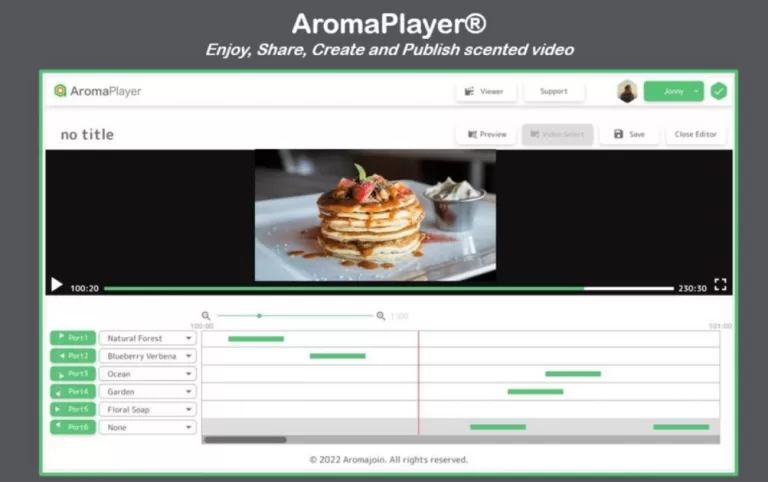
To use the AromaPlayer, you start with a YouTube video link. Then you can start to create by simply
adding a scent like peppermint on the timeline to set up the perfect smell, timing, and duration.

Event

GamesBeat Summit: Into the Metaverse 3

Join the GamesBeat community online, February 1-2, to examine the findings and emerging trends within the metaverse.


Register Here

Previously, the AromaPlayer was only an offline standalone application developed since 2012, and
it was mainly used in digital signage. But with the new AromaPlayer Online, any creators are free to create their own scented content and share them with friends.

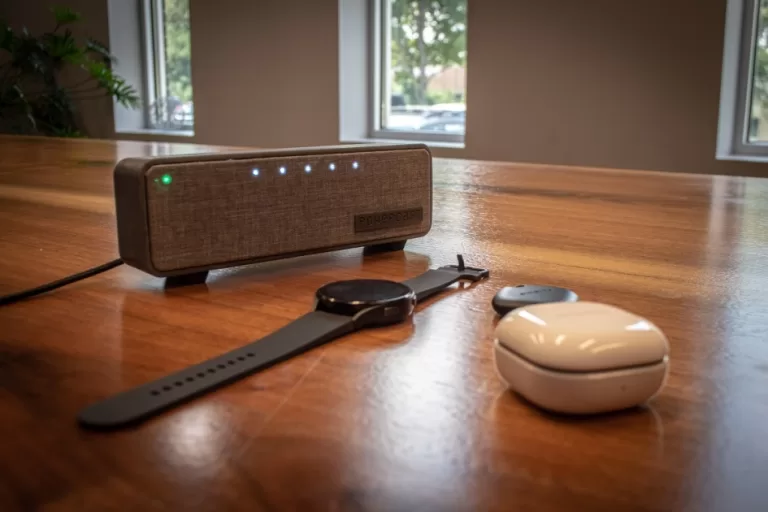
The web application is already on trial here. The scent diffusing device Aroma Shooter 2 is already available on the market and the Aroma Shooter 3 and Aroma Shooter Wearable are expected to be release soon, following a crowdfunding campaign.

AS3 and ASW will be available to both VR/XR developers and consumers. There are currently few
hundred different kinds of scents available, ranging from coffee to orange to shampoo. Aromajoin is
working to expand the scent collection to further enhance virtual and immersive experiences.

The Aroma Shooter device has a holder for individual scent cartridges. It works similarly to the way
printers handle ink. To emit a scent, the device first suctions ambient air, which then passes through
the scent particles released from a cartridge to create the scent. It then sends the scented air directly
toward the user’s nose through its uniquely designed orifices.

Aromajoin was started by CEO Dong Wook Kim, who did research on sscents at the National Institute of Information and Communications Technology in Japan.

GamesBeat’s creed when covering the game industry is “where passion meets business.” What does this mean? We want to tell you how the news matters to you — not just as a decision-maker at a game studio, but also as a fan of games. Whether you read our articles, listen to our podcasts, or watch our videos, GamesBeat will help you learn about the industry and enjoy engaging with it. Discover our Briefings.

Read More
Dean Takahashi

Invoxia unveils smart dog collar to monitor your pet’s heartbeat and location

Invoxia's smart dog collar ships in Q1 2023.

Invoxia’s smart dog collar ships in Q1 2023.

Image Credit: Invoxia

Connect with gaming and metaverse leaders online at GamesBeat Summit: Into the Metaverse 3 this February 1-2. Register here.


Invoxia said its Smart Dog Collar will launch commercially in the first quarter so you can track you dog’s heart rate and location.

The heart-tracking technology that approximates that of human ECG data. Priced at $149, with data subscriptions starting from $8.25 per month, the sensor and AI technology can track and monitor a dog’s respiratory and heart vitals and its activity to provide view of its health, wellbeing, and whereabouts.

Developed alongside veterinary specialists, Invoxia’s biometric smart collar aims to enable preventative pet care. That means the tech can spot problems in a dog’s health before any visible signs surface and alert the owner in advance, increasing the chances of timely treatment and recovery.

It captures and processes health data via miniaturized radar sensors, accelerometers, and edge AI within the collar to measure movement, respiratory and heart rates — without electrodes hooked to a pet.

Event

GamesBeat Summit: Into the Metaverse 3

Join the GamesBeat community online, February 1-2, to examine the findings and emerging trends within the metaverse.


Register Here

Information is tracked, accessible, and can be shared with vets using the Invoxia app.

The company said the device’s Heartprint is made possible by the AI and sensors built inside the collar.  It provides a 2D visual representation of a dog’s cardio-pulmonary system through continuous rather than one-off measurements. It contains valuable information about the state of the heart that changes based on stress, pain, tonus levels and heart diseases.

A Heartprint Signature, like an ECG, provides information on the timings of each individual heartbeat and helps detect and analyze various forms of arrhythmia, as well as other anomalies in the resting beats pattern.   

While an ECG offers a 1D temporal signal that is difficult to interpret over a long period of time, Heartprint Signature is a 2D representation of heartbeats that is shown as a Poincare Plot (used in human cardiovascular measurements) that summarizes rich and valuable information at a glance over a long period of time.

“This visualization has exciting research potential. It embeds important health data that can be analyzed at scale, and used to gain insights into a wide variety of heart health states in dogs, thus becoming a tool to help improve preventative pet care,” said Romain Pariaut,  associate professor at Cornell University College of Veterinary Medicine, in a statement.

The collar offers insights such as early warnings into degenerative heart diseases, congenital heart diseases, stress levels, and the presence of pain or discomfort.

“The ability to continually monitor cardio-pulmonary activity has eluded our four-legged friends for years, but with the Heartprint Signature, it is now possible,” said Amélie Caudron, CEO of Invoxia, in a statement. “It opens the possibility of bringing true preventative care to the pet market, and as more and more data is collected using this breakthrough index, Invoxia will build ever more accurate baselines for canine health parameters across different breeds, health conditions, and doggie life stages.”

The collar weighs a third of a pound, and it will come in five colors. It monitors vital signs, behavior and activity, as well as location. Invoxia is a French startup that launched its AI-powered pet tracker in 2018. It’s being used to gather data on millions of dogs.

GamesBeat’s creed when covering the game industry is “where passion meets business.” What does this mean? We want to tell you how the news matters to you — not just as a decision-maker at a game studio, but also as a fan of games. Whether you read our articles, listen to our podcasts, or watch our videos, GamesBeat will help you learn about the industry and enjoy engaging with it. Discover our Briefings.

Read More
Dean Takahashi

Powercast’s Ubiquity uses RF to charge devices wirelessly

Connect with gaming and metaverse leaders online at GamesBeat Summit: Into the Metaverse 3 this February 1-2. Register here.


Powercast has unveiled its Ubiquity wireless power transmitters, which use radio frequency (RF) power to charge devices over the air.

The Pittsburgh, Pennsylvania-based company showed off its Ubiquity transmitter, an ultra-low-cost RF power transmitter, at CES 2023, the big tech trade show in Las Vegas this week.

If this sounds a little crazy, transferring electricity through the air to power an electronic gadget seems impossible. Nikola Tesla, the radio pioneer, tried unsuccessfully to do it in the early 1900s. Technical hurdles have plagued the attempts to do the same thing ever since.

But Powercast got started on the idea of using radio frequency, which provides its own power upon making a connection between transmitter and receiver, back in 2003. The company said it has shipped over 10 million devices with more than 100 customers. The company has 79 patents. I wrote about wireless power as early as 2008, but all we’ve gotten are induction charging devices.

Event

GamesBeat Summit: Into the Metaverse 3

Join the GamesBeat community online, February 1-2, to examine the findings and emerging trends within the metaverse.


Register Here

Powercast’s Ubiquity demo module.

Designed to be an economical RF wireless transmitter, Powercast has lowered the barrier to entry where RF wireless power can actually become ubiquitous with multiple RF transmitters covering every home, the company said.

“Powercast’s vision is to see a low-cost RF transmitter in every room in every house,” said Charles Goetz,
CEO at Powercast, in a statement. “Much like Wi-Fi routers, a home will need multiple RF transmitters to provide enough RF coverage where convenient, contactless, ‘set it and forget it’ wireless charging becomes a reality. So, we slashed costs and are sharing our Ubiquity design via a reference design with a low $5 bill of material cost, or an embeddable module, that lets manufacturers easily incorporate RF transmitting capability into their own products to accelerate RF transmitter networks in homes.”

Powercast’s over-the-air wireless power architecture has two sides. It has a transmitter that sends RF over the air, and it has a receiver embedded in end devices which harvests that RF from the air and converts it into DC (direct current) to both communicate data, and power devices.

On the transmitter side, Powercast’s Ubiquity will come in several forms, all able to both charge RF-enabled devices and communicate data back and forth with them throughout a home.

Manufacturers have two options to turn their own products – such as home appliances, TVs, game systems, computer monitors or AI-enabled home assistants – into Ubiquity RF transmitters. A licensable reference design lets manufacturers to integrate just the electronics needed onto their own circuit boards for $5 or less bill-of-material (BOM) cost.

And it also has an easy-to-integrate, drop-in embeddable module which contains all the electronics and
hardware needed. Manufacturers will add a power supply and antenna. Powercast will work with manufacturers on an antenna design that best fits their specific product size.

Powercast also created its standalone Ubiquity transmitter combining its embeddable module with an antenna to show at CES. Powercast will produce this portable-speaker-sized transmitter.

On the receiving side, manufacturers can embed Powercast’s tiny Powerharvester PCC110 receiver chip and a small antenna into their end devices for around $1 to enable them to work with an RF transmitter – either Powercast’s standalone Ubiquity, or RF-transmitting products created using the Ubiquity embeddable module or reference design.

Ubiquity standalone RF wireless transmitter.

This wireless power-over-distance architecture can charge low-power devices with continuous, reliable, background trickle charging. End device examples include TV remotes, electric toothbrushes, keyboards and mice, game controllers, earbuds, headphones, smart watches, fitness bands, hearing aids, clocks, electric shavers, home automation devices and many more devices.

Powercast’s Jason Gill, director of R&D, said in a statement, “The volumes are in the consumer electronics market, but it’s also price sensitive. In response to these manufacturers’ requests for a sustainable, ultra-low-cost wireless charging solution, our engineers perfected the highly-efficient, single-antenna Ubiquity design that can both transmit power and communicate data. Manufacturers can create environmentally-friendly, RF-powered ecosystems using either rechargeable batteries or no batteries, both of which eliminate disposable battery e-waste and battery replacement hassles.”

The Ubiquity transmitter can output up to one watt (3W EIRP) and automatically charges multiple RF-enabled devices that come into its charging zone – no charging mats needed. Power-hungry devices charge faster within several feet of the transmitter, while ultra-low-power devices like IoT sensors can charge up to 120 feet.

“The far-field wireless power transmitter semiconductor market will soon see a steep growth trajectory
with most revenue coming from the consumer market,” said Phil Solis, research director at IDC, in a statement. “On the receiver side, the consumer market will be the largest segment by 2024 and the vast majority of revenue by 2025.  Low-cost solutions are necessary to enable the many devices in the home that can benefit from wireless power.”

The licensable Ubiquity reference design is expected in February 2023. The Ubiquity module and transmitter are expected in June 2023.

How it works

A transmitter sends RF energy over the air to a receiver chip embedded in a device, which converts it to DC to recharge its batteries or directly power the device. This remote charging technology behaves like Wi-Fi where enabled devices automatically charge when within range of a power transmitter.

Regulations in the United States and Canada limit the amount of transmittable power. Under the FCC Part 15, power is limited to four watts EIRP, and Powercast broadcasts approximately three watts EIRP.

A tiny Powerharvester receiver, embedded in systems or devices, harvests RF energy sent over the air from either a dedicated transmitter, such as Powercast’s Powercaster or PowerSpot, or from anticipated RF sources such as UHF RFID readers or NFC POS readers. The embedded Powerharvester then converts the RF to DC to either directly power that batteryless device or recharge its batteries.

The company said the charging is safe. A typical mobile phone user will receive far more RF energy from their own mobile phone than they will from a properly installed Powercast transmitter. The charging devices can go through walls.

Typical induction charging solutions like charging pads and electric toothbrushes require that the power source and receiving device be in very close proximity to one another to transfer power efficiently, usually within millimeters, which is essentially zero distance. These types of solutions typically require special alignment and charging pads or cradles. Powercast’s RF-based technology provides power-over distance to one or more devices and does not directly compete with induction-based charging technologies.

GamesBeat’s creed when covering the game industry is “where passion meets business.” What does this mean? We want to tell you how the news matters to you — not just as a decision-maker at a game studio, but also as a fan of games. Whether you read our articles, listen to our podcasts, or watch our videos, GamesBeat will help you learn about the industry and enjoy engaging with it. Discover our Briefings.

Read More
Dean Takahashi

Announcement: AI generated answers are officially banned here

Good luck enforcing it. The problem isn’t attribution however. The AI is trained on patterns. As soon as someone creates their own model, the only way you can tell it might have been generated from AI is because it’s gibberish.

I could absolutely use an AI to help me write a post and you would be unable to prove I did without exerting more effort than it would merit. It’s just a tool. It’s like accusing me of plagiarizing a dictionary because my definition of some word is too similar in content to all the other correct definitions. Knowledge can’t be copyrighted.

Do we not already punish people for repeatedly posting poor quality content? This fear of AI is silly. The problem isn’t the tool, it’s how people use it. There is already a policy against posting nonsense as an answer. Whether that nonsense was computer generated so it looks less like nonsense is irrelevant.

The main point of supporting an answer with citations on SE should be to make it credible, not just to give credit. If I copy text from a website generated by a GPT tool and attribute it correctly, is that OK? It is no different from me pasting generated content and identifying the tool as the writer of it. At some point, we need to address the role people upvoting bad content because it seems like it’s correct play in incentivizing low quality content.

Read More
Christeen Geddes

The MOS 6502 is (mostly) Turing-complete without registers

It is known that

the x86 MOV instruction is Turing-complete

(PDF) all by itself, and is even a compiler target. More usefully,

x86

can be made Turing-complete without the overt use of any registers.

These tricks work primarily because the ISA allows memory-to-memory operations, i.e., altering a memory location without explicitly moving data through a program-visible register, a historical holdover from its roots in the Intel 8086 and its ancestors. (Let’s not even talk about its Turing-complete faults.) Other pre-RISC CPUs of that era also have memory-to-memory addressing, including the MOS 6502, which despite its simplicity being inspiration for the RISC ARM architecture is not itself RISC. It should be no surprise you can make the 6502 do this trick too even with its more constrained instruction set, and we can do it with just four instructions, not counting rts to return to the operating system.

I say the 6502 is “mostly” Turing-complete without using registers because there are two conditions on the 6502 needed to make this true. The first is that self-modifying code is impossible to avoid; the memory-to-memory instructions we will be using don’t support indirect addressing, so to maintain the Turing machine’s data pointer requires altering code inline. Dolan’s paper above considers this cheating but this was so common on CPUs of the time, including the 8086, that I think this requirement is acceptable. The “uses no registers” example above does it too.

The other condition is how a register is defined. Most texts consider the 8-bit accumulator (A) and two 8-bit index registers (X and Y) of more limited function to be the 6502’s canonical registers, but the 6502 also maintains an 8-bit stack pointer (S), a 16-bit program counter (PC) and eight bits of processor status (P, or as individual flags NV-BDIZC). On the x86 examples above, they don’t count the program counter either and they make jumps (including, in the second case, to an indirect memory vector), so we’re only doing the same. We will be making subroutine calls in this demonstration for maintaining the Turing machine’s data pointer, which is definitely using the stack pointer, but this is simply expediency: our forthcoming example also works fine if you alternatively patch every place the data pointer is manipulated instead of encapsulating it in a set of global subroutines, and the stack pointer will be the same value at the conclusion regardless.

However, most 6502 instructions, including memory-to-memory ones, implicitly and mandatorily change flags in P (x86 MOV sets no flags). Additionally, the 8086 has an ALU as wide as its in-segment addresses (16 bits), as do its 32- and 64-bit descendants, so it can compute addresses with single instructions. This property is necessary for the “uses no registers” example, which calculates indirect jumps that way to “read” memory. The 6502’s ALU is 8-bit but it uses 16-bit addressing, and since its memory-to-memory instructions all unavoidably change the zero and negative flags (Z and N) anyway, we might as well use them. If you don’t consider N or Z to be a true register — I’ve chosen not to because P is more impaired than even S, N and Z can’t be set explicitly, and the majority of whatever ad-hoc 6502 calling conventions there are don’t require saving them — then the argument holds. To make this a little less cheating-adjacent, we’ll agree not to use any other processor flag including any memory-to-memory instructions that also modify carry (C), and it turns out we can get away with testing just Z anyway.

I should also parenthetically note that this concept generates absolutely horrid code and the paucity of 6502 registers means you would be much more effective by simply saving and restoring them. That said, if you’re into this sort of Turing tarpit, you’ve already implicitly defenestrated efficiency; here we’re merely throwing it through a couple windows more.

We’ll demonstrate Turing completeness by showing how Corrado Böhm’s six-instruction ????′′ (P”) language, proven Turing-complete, can be written in this constrained set of 6502 instructions. Conveniently and more entertainingly for modern audiences, those six P” instructions directly translate to Brainf*ck operators, hereafter BF (pardon the censoring, but this is after all a family-friendly blog), so we’ll use those operators as shorthand.

Our example will run on the Commodore 64 or any emulator, and emits “HELLO” and a space to the top of the screen. The Commodore 64 has a memory-mapped screen that by default starts at location 1024, so we don’t need to implement BF’s I/O to print anything; we’ll just treat screen memory as the Turing tape. (If you’re adapting this to another 6502-based computer, you’ll need to make analogous changes below.) The basic 6502 instructions we’ll use are inc and dec. Among other addressing modes these two instructions increment and decrement a memory location by 1 respectively. Since these implicitly set N and Z, we’ll allow the use of bne (branch if Z flag is false, i.e., last operation was non-zero) to handle 16-bit addresses and to implement testing zero. As 6502 branches have limited displacements, a jmp may be required, yielding our four instructions. Again, while we’ll use jsr and rts to make this demonstration tractable, if we were willing to simultaneously patch the Turing data register everywhere it occurs we can still make the example work with just those four. That exercise is left to the exceptionally masochistic reader.

To begin, let’s implement BF + and -, which are P” r and r’ and increase or decrease the memory location currently pointed to by 1 respectively. These are the only subroutines we will use. As we rely on self-modifying code we shall make the further (rational) assertion that no part of the program is running in zero page, i.e., below location 256, where special addressing rules and differing instruction lengths apply.

plus:
        inc $0400
        rts
minus:
        dec $0400
        rts

These necessarily have the data pointer encapsulated within them, which is assembled to ee0004 and ce0004 respectively. That makes increment jsr plus and decrement jsr minus.

BF >, which is P” R and increments the data pointer, thus is

        inc plus+1
; skip the next instruction if Z flag false
; it is three bytes long
; include the size of the bne instruction
        bne *+5
        inc plus+2
        inc minus+1
        bne *+5
        inc minus+2

which increases the low byte of both instructions’ operands, and if it overflows to zero, increases their high byte.

Neither inc nor dec set carry, nor did we agree to use it, so that makes BF < (P'' L, decrement the data pointer) slightly more complex. The N flag is appropriately defined as the high bit being set after an operation, but this would occur for any unsigned value from 128 to 255, meaning an initial dec with a result in that range would set this flag. What we want to do is to decrement the high byte of the data pointer only if the low byte started at zero. We can do by incrementing and decrementing first; to wit:

        inc plus+1
        dec plus+1
        bne *+5
        dec plus+2
        dec plus+1
        inc minus+1
        dec minus+1
        bne *+5
        dec minus+2
        dec minus+1

Finally BF’s [ and ], which are P” ( and ). These implement a jump forward to the matching ] if the data pointer is already zero, and a jump backwards to the matching [ if it isn’t. Note that the range for bne‘s single signed byte offset may well be exceeded by even a modestly complex loop, possibly requiring a trampoline jmp. In the general case that potential requirement makes [ into

; test value under data pointer
        jsr plus
        jsr minus
        bne *+5
        jmp loop_end_label
loop_top_label:

where the label name of course differs per loop.

Like we did for L, we do an increment and decrement as a test for zero because we can’t assume that the Z flag is already correctly set for the location the data pointer is currently pointing to. We might be able to reason about that in a more advanced compiler, such as omitting the test if the last instruction was + or -, but I’m lazy and this suffices for pedagogical purposes. Unfortunately we have to assume the same for ], so:

        jsr plus
        jsr minus
        bne *+5
        jmp loop_end_label
        jmp loop_top_label
loop_end_label:

You can see why I’ve used subroutines here because we only have two instructions to patch versus keeping track of a whole bunch and patching them all every single time, but as I said, you can do it that way and I look forward to someone trying to.

That suffices for the operators; now for the runtime environment. We can clear a memory location without the use of A, X or Y with eight asls or shifts left (or lsr shift rights), but this also sets C, and since we agreed not to use that flag we’re gonna do it the hard way. To make our program re-entrant we need to ensure the data pointer is set to 1024 on each run (change this for your system if you’re not running it on a C64). That means we must decrement the low byte of the data pointer to zero and set the high byte to four no matter what those actually started at. Our entry code thus is

        dec plus+1
        bne *-3
        dec minus+1
        bne *-3
        dec plus+2
        bne *-3
        dec minus+2
        bne *-3
        inc plus+2
        inc plus+2
        inc plus+2
        inc plus+2
        inc minus+2
        inc minus+2
        inc minus+2
        inc minus+2

On top of all that, P” assumes the Turing tape is clean, i.e., all symbols are c0. In BF terms, that means the entire memory range defaults to zero, but screen memory on the C64 defaults to byte value 32 (the space character) plus anything else printed by the Kernal or BASIC. We could simply clear the six locations from 1024 to 1029 the same way to run our demonstration program, but this doesn’t suffice in the general case, so in a diversion from spec we’re going to make our job harder by requiring the program itself to clear the memory it uses. The program we’ll be running is, and is valid BF,

[-]>[-]>[-]>[-]>[-]>[-]
<<<<<
++++++++>
+++++>
++++++++++++>
++++++++++++>
+++++++++++++++>
++++++++++++++++++++++++++++++++

This sets memory locations 1024 through 1029 to values 8, 5, 12, 12, 15 and 32 respectively (recall that on the C64, screen codes are neither PETSCII nor ASCII). Again, change these values if you are not running this on a C64 or other Commodore 8-bit.

We now have enough of a specification and a test program to write a minimal compiler (in Perl, because I’m one of those people). I’ve put the compiler, the test program and test output up as a Github gist. Let me say it again: this is an absolutely potty BF-to-6502 compiler, and it is actually non-standard by requiring the programs it compiles assume previously dirtied memory which orthodox BF does not. The innovation here is that the code it emits does not use any of the 6502’s canonical registers, with naturally the exception of PC and the N and Z flags (and for this situation S, which exits the routine unchanged).

You will need a 6502 assembler to compile the output, for which I invariably recommend xa65, which yours truly maintains. Assuming you are using it as well, invoke like so:

perl -s no-reg-6502-bf.pl < test.bf > test.s
xa test.s

I’ve provided the output in the gist so you can look at the generated assembly if you don’t want to actually run the commands. If you choose to do so, though, you’ll get a file named a.o65, assembled to start at 49152 (pass -sa=address to the Perl compiler to use a different location). Load it into your real C64 or emulator of choice:

Thus endeth the demonstration.

Read More
Blythe Wrona