
Home Blog Page 6872

Raspberry Pi’s new camera is the DIY project I’ve been looking for

The Raspberry Pi Camera Module 3 on a green background


The Raspberry Pi Camera Module 3 (above) is larger than its predecessor and has autofocus and HDR.
(Image credit: Raspberry Pi)

I’ve been threatening to start a Raspberry Pi project since buying one of the little computers during the original lockdown. While those plans never came to fruition, Raspberry Pi’s new Camera Module 3 could just be the spark that relights my DIY camera fire.

Raspberry Pi has made camera modules before – in fact, the first one in 2013 was the company’s first official accessory. So why could its third module be the one to convince me to finish a project? Because it’s actually a modern digital camera, with autofocus and HDR powers. And it could be the heart of a personalized digicam that I’d actually use, rather than admire on a shelf.

The Camera Module 3 is based on Sony’s IMX708 sensor, which is the same as the one in the Oppo Find X2 smartphone. You won’t get that phone’s imaging processing pipeline, but this is modern hardware – and it’s the first official Raspberry Pi camera accessory to come with autofocus.

Yes, we’ve seen AF sensors before from third-party accessories like Arducam’s 64MP Autofocus Camera, but not for the impressively low price of the Camera Module 3. The standard one costs just $25 / £26, but you can also buy a wide-angle version (with a 102-degree field of view, compared to the standard one’s 66-degree FOV) for $35 / £36. The latter could be ideal for a homebrewed webcam.

The autofocus looks impressively snappy from the early demos (see below). This is because it uses phase-detection autofocus (PDAF), with contrast-detect AF (usually better for static subjects) offering a handy backup. It would’ve been pretty embarrassing for Panasonic if Raspberry Pi had beaten it to making a phase-detect AF camera. Fortunately, last week’s Panasonic Lumix S5II meant the camera giant got there just in time.

The Camera Module 3’s improvements aren’t just about autofocus – the overall image quality should be pretty solid and certainly better than those 90s digicams that have become bafflingly popular again. Not only does the IMX708 have a 12MP resolution (seemingly pixel-binned from 48MP), but it also has larger 1.40μm pixels than its predecessor. You can also shoot HD video using the entire sensor area, too.

Even shooting HDR (High Dynamic Range) images is possible if you’re prepared to accept a drop to a 3MP resolution. This is because, in challenging lighting, the Camera Module 3 will take simultaneous exposures with different exposure times, then apply tone mapping to get a better-exposed result.

So, that’s the brains of my camera project sorted. The Camera Module 3 is compatible with all Raspberry Pis other than the Pi 400 or original Pi Zero from 2016, which means I can repurpose my Pi 4 Model B – optimistically bought with a HyperPixel screen to be the centerpiece of my Sonos Album Art display – to build a fancy new digital camera. Now it’s time to work out the camera body…  

Return of the digicam

Two Raspberry Pi Camera Module 3s next to a tablet

(Image credit: Raspberry Pi)

The downside of the Camera Module 3’s increased sensor size (it’s a 1/2.43-inch chip versus the 1/4-inch sensor on its predecessor) is that a lot of current cases won’t be compatible with it. For example, it won’t work with the camera lid on the Raspberry Pi Zero Case.

Still, new cases are surely in the pipeline – I’d love to see an equivalent of the Pi HQ Camera Case (opens in new tab). And I could yet be tempted into the ultimate project; building a personalized camera around the Module 3. There are a few 3D printer-friendly designs out there, like the Pikon Camera (opens in new tab), and naturally, a YouTuber by the name of Jeff Geerling (opens in new tab) has already modified it to work with the new Module 3. 

That said, the project does involve 3D printing, soldering, and a boatload of patience that could be too much for me at this time of year. So I will likely hold off and wait for a pre-made case to arrive (perhaps a version of the Naturebytes Wildlife Camera Case (opens in new tab) for a wildlife cam), before I tackle the interface conundrum.
The Raspberry Pi High Quality Camera with new M12 mount on a green background

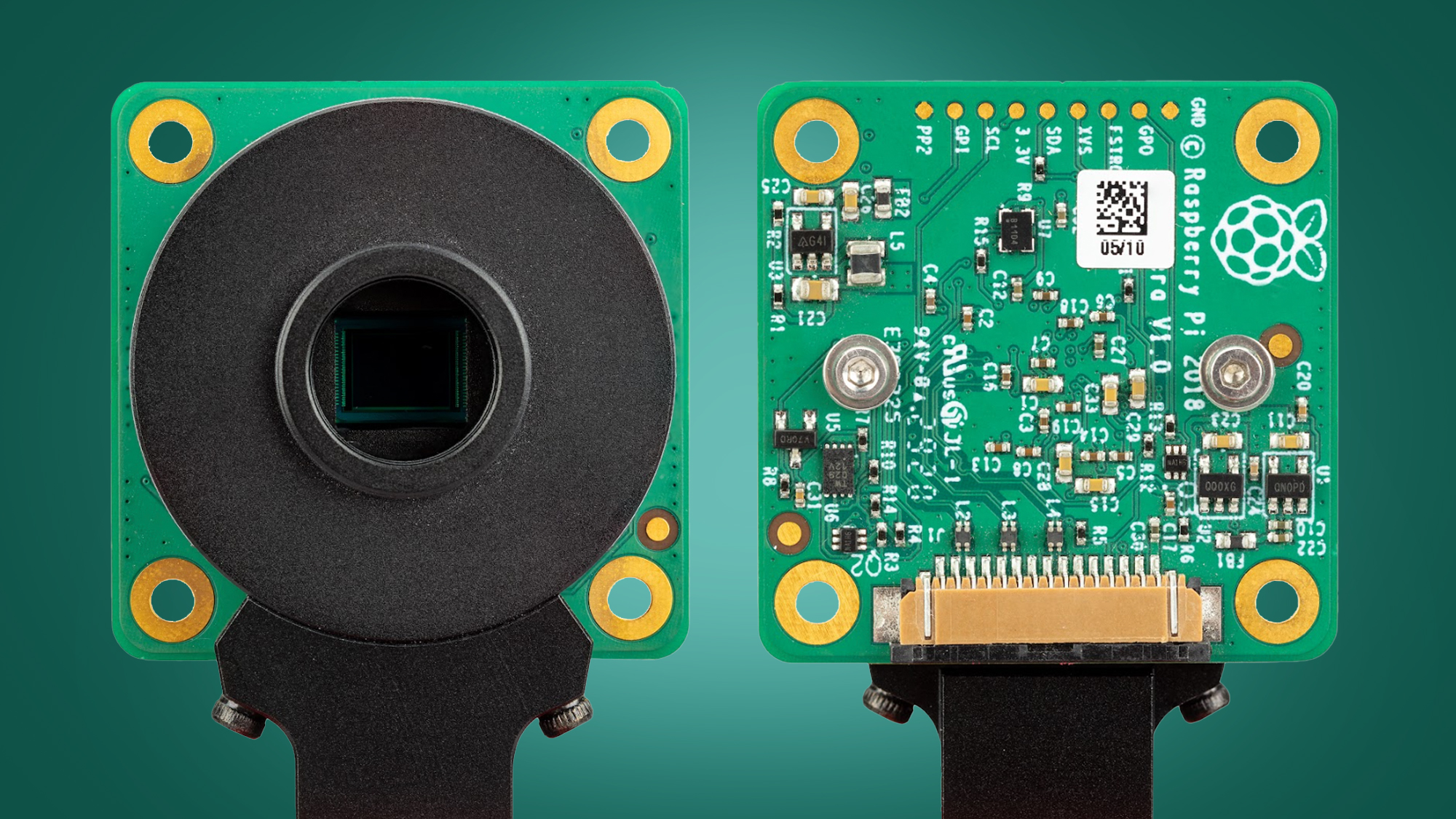
Raspberry Pi’s new High Quality Camera module (above) supports M12-mount lenses but lacks the new Camera Module 3’s new autofocus and HDR powers. (Image credit: Raspberry Pi)

There are a couple of ways to control the Camera Module 3, including the Picamera2 beta that comes as part of Raspberry Pi OS Bullseye. Its latest version delivers autofocus support, but there’ll no doubt be some tinkering (and flicking through Raspberry Pi’s Camera Software guide (opens in new tab)) to get the camera up and running.

For me, it’s the Module 3’s autofocus and HDR powers that give it the edge over Raspberry Pi’s other new announcement: the new High Quality Camera module. This now supports M12-mount lenses alongside the C-mount ones that worked natively with the previous version. 

Unfortunately, as much as building my own interchangeable lens camera appeals, that module is based on the same camera hardware as before, with no autofocus. So I’ll likely stick to the Camera Module 3 and leave the 3D printing for another day – if my previous Raspberry Pi projects have taught me anything, it’s to start small before getting carried away with big ideas.

Sign up to get breaking news, reviews, opinion, analysis and more, plus the hottest tech deals!

Mark is the Cameras Editor at TechRadar. Having worked in tech journalism for a ludicrous 17 years, Mark is now attempting to break the world record for the number of camera bags hoarded by one person. He was previously Cameras Editor at Trusted Reviews, Acting editor on Stuff.tv, as well as Features editor and Reviews editor on Stuff magazine. As a freelancer, he’s contributed to titles including The Sunday Times, FourFourTwo and Arena. And in a former life, he also won The Daily Telegraph’s Young Sportswriter of the Year. But that was before he discovered the strange joys of getting up at 4am for a photo shoot in London’s Square Mile. 

Read More
Buffy Buresh

This fake Pokemon NFT game just wants to take over your Windows PC

Pokemon scarlet starters


(Image credit: Nintendo / The Pokémon Company / GAME FREAK)

Hackers are utilising the continued popularity of the Pokemon universe and the bizarre rise of non-fungible tokens (NFT) to trick people into installing remote access tools (RAT), take over their devices, and steal any valuables they might find.

Cybersecurity researchers from ASEC recently discovered at least two malicious websites – beta-pokemoncards[.]io, and pokemon-go[.]io pretending to host a Pokemon game that also offers NFT cards that can be traded, eventually for profit. 

The websites have since been taken down, but while they were active they had a download button called “Play on PC” that distributed NetSupport.

Distributing NetSupport

In theory, NetSupport is legitimate software. It’s built on Windows, and allows cross-platform remote access, giving IT administrators and technicians a way to remotely access various endpoints and fix any potential problems. The program supports Windows, Windows Mobile, Mac, Linux, and Solaris. 

In practice, NetSupport is being used by threat actors to gain unauthorized access to target systems. The first signs of activity on this campaign were in December last year. Earlier samples from VirusTotal, the publication also found, showed the same operators pushing a fake Visual Studio file instead of the Pokemon game. 

The identity of the threat actor behind the campaign remains unknown.

Non-fungible tokens are part of a wider cryptocurrency market and as such are a major target for fraudsters and hackers. Recent research has shown that the Web3 industry (decentralized internet based on the blockchain, the same tech that powers NFTs) lost almost $4 billion last year to fraud and cybercrime.

As more organizations started building new systems, fraudsters were quick to come out of the woodwork, and now Web3 bug bounty provider Immunefi has claimed exactly $3,948,856,037 worth of cryptocurrencies was lost in the Web3 ecosystem in 2022, to fraud, hacks, and scams. The silver lining, the researchers are saying, is the fact that the overall losses dropped by more than half (51.2%) year-on-year. In 2021, the industry had lost $8,088,338,239.

The constant battle against fraudsters isn’t slowing the industry’s growth, though. Immunefi expects it to grow from $3.2 billion last year, to $81.5 billion in the next seven years, increasing 43.7% CAGR.

Via: BleepingComputer (opens in new tab)

Sign up to theTechRadar Pro newsletter to get all the top news, opinion, features and guidance your business needs to succeed!

Sead is a seasoned freelance journalist based in Sarajevo, Bosnia and Herzegovina. He writes about IT (cloud, IoT, 5G, VPN) and cybersecurity (ransomware, data breaches, laws and regulations). In his career, spanning more than a decade, he’s written for numerous media outlets, including Al Jazeera Balkans. He’s also held several modules on content writing for Represent Communications.

Read More
Qiana Noren

Hisense’s all mini-LED TV lineup for 2023 is topped by its brightest set yet

Hisense ULED EX TV in CES tradeshow booth


(Image credit: Future)

Hisense’s sprawling booth at CES 2023 was packed with TVs – unlike some other brands, it had its full 2023 lineup on display, with detailed specs listed for each series. All sets should all be available in spring, which is the time that manufacturers typically start rolling out new TVs.

Last year saw Hisense introduce its first mini-LED models, the U8H series, which ended up on our list of the best 4K TVs owing to its great performance for the price. For 2023, the company will incorporate mini-LED backlighting throughout its full premium ULED (quantum dot) TV lineup, with prices starting at under $500 / £410 for a 50-inch model. Along with mini-LED backlighting, each series will use the Google TV smart interface and offer gaming-centric features including up to 144Hz refresh rate, VRR, ALLM, and FreeSync Premium Pro on all save the entry-level U6K. All sets will additionally support the Wi-Fi 6E standard for speedy streaming, along with both the Dolby Vision IQ and HDR10+ high dynamic range formats.

Something of interest for US viewers is built-in ATSC 3.0 tuners found throughout the full Hisense line. We expect to see more TVs coming out in 2023 capable of handling this next-gen TV broadcasting standard, which provides support for 4K video with HDR and Dolby Atmos audio, among other features. But of the new TVs announced at CES 2023, so far only LG has confirmed that its flagship G3 4K and Z3 8K models will have built-in ATSC 3.0 tuning capability.

ULED X  

The ULED X (shown at top) is Hisense’s flagship TV for 2023. Available only in an 85-inch screen size, its backlight comprises over 20,000 mini-LED modules. More than 5,000 local dimming zones and a 16-bit light control algorithm are used to enhance contrast and shadow detail, and peak brightness is specced at 2,500 nits. The ULED X also has an ultra low reflection screen and a 30% wider viewing angle than standard LED-backlit TVs – a first for a Hisense set, and something I could appreciate when viewing it in person at CES.

The limited edition ULED X has the most advanced built-in audio system to appear in a Hisense TV: 4.1.2 channels, with over 80 watts used to power the set’s seven speakers.

Hisense U8K TV in CES tradeshow booth

Hisense’s new U8K series for 2023 provides twice the number of local dimming zones as 2022’s U8H models. (Image credit: Future)

U8K Series 

Last year’s U8H series paved the way for Hisense’s expansion into mini-LED, and the new U8K models for 2023 double-down on that tech with over 1,000 local dimming zones. Peak brightness is listed as 1,500 nits, but if the super-bright U8H model we tested in 2022 is any indication, that will prove to be a conservative spec.

Available in screen sizes ranging from 55 up to 85 inches (last year’s U8H series topped out at 75 inches), U8K series TVs will feature an anti-glare, low reflection screen. A built-in 2.1.2 audio system with up-firing speakers is another new addition, making it possible to hear Dolby Atmos soundtracks without a separate soundbar. The U8H series also features IMAX Enhanced and Filmmaker picture modes – two other features found throughout the 2023 Hisense mini-LED TV line.

U7K Series 

Last year’s U7H series featured a standard LED backlight, but that has been fixed this year on the U7K series with mini-LED backlighting on all screen sizes and up to 500 local dimming zones with a specified 1,100 nits peak brightness. U7H series TVs will be available in 55- to 85-inch screen sizes. 

U6K Series 

Available in 50- to 85-inch screen sizes, the U6K series will be Hisense’s high-value quantum dot models. They will also be affordably priced for TVs with a mini-LED backlight, with the 50-inch version selling for under $500. The U6K series will offer many of the same features found higher up the Hisense TV line, with a main difference being a display panel limited to 200-plus local dimming zones and a 60Hz refresh rate. 

Sign up to get breaking news, reviews, opinion, analysis and more, plus the hottest tech deals!

Al Griffin has been writing about and reviewing A/V tech since the days LaserDiscs roamed the earth, and was previously the editor of Sound & Vision magazine. 

When not reviewing the latest and greatest gear or watching movies at home, he can usually be found out and about on a bike.

Read More
Nancie Badon

Russia hacker group hijacks USB attacks by other criminals

Trojan


(Image credit: Iaremenko Sergii / Shutterstock)

Turla, a known Russian threat actor allegedly tied to the Kremlin, was observed recycling a decade-old and defunct malware to gain access to endpoints in Ukraine and spy on its targets.

A report by cybersecurity experts Mandiant found that in mid-2022, Turla was re-registering expired domains of Andromeda, a common banking trojan that was being widely distributed almost a decade ago – in 2013. 

By doing so, the group would take over the malware’s command & control (C2) servers, gaining access to the once-infected endpoints and their sensitive information.

Hiding in plain sight

One of the advantages of this novel approach, the researchers claim, is the ability to stay hidden from cybersecurity researchers. 

“Because the malware already proliferated through USB, Turla can leverage that without exposing themselves. Rather than use their own USB tools like agent.btz, they can sit on someone else’s,” says John Hultquist, lead intelligence analyst at Mandiant. “They’re piggybacking on other people’s operations. It’s a really clever way of doing business.”

But what raised the alarms with Mandiant is the fact that Andromeda deployed two additional pieces of malware – a reconnaissance tool named Kopiluwak, and a backdoor named Quietcanary. It was the former that gave it away, as it’s a tool that was used by Turla in the past, as well.

In total, three expired domains were observed to have been re-registered last year, connecting to “hundreds” of Andromeda infections, all giving Turla access to sensitive data. “By doing this you can basically lay under the radar much better. You’re not spamming a bunch of people, you’re letting someone else spam a bunch of people,” says Hultquist. “Then you started picking and choosing which targets are worth your time and your exposure.”

Turla used this novel approach to target endpoints in Ukraine, the researchers said, adding that, so far, this is the only country being attacked. 

Via: Wired (opens in new tab)

Sign up to theTechRadar Pro newsletter to get all the top news, opinion, features and guidance your business needs to succeed!

Sead is a seasoned freelance journalist based in Sarajevo, Bosnia and Herzegovina. He writes about IT (cloud, IoT, 5G, VPN) and cybersecurity (ransomware, data breaches, laws and regulations). In his career, spanning more than a decade, he’s written for numerous media outlets, including Al Jazeera Balkans. He’s also held several modules on content writing for Represent Communications.

Read More
Luz Haslett

The VSCode Marketplace is pretty easy to hack with malicious extensions

Unlocked padlock on a computer keyboard


(Image credit: Unsplash / Fly:D)

VSCode Marketplace, a repository for Visual Studio Code (VSC) externsions, has poor security defenses, allowing threat actors to abuse it and distribute malicious code among the millions of its users, experts have warned.

A report from AquaSec tested the platform and concluded that abusing it to distribute malware (opens in new tab) was ridiculously easy. 

Furthermore, the researchers claim they weren’t the first to spot the flaws – some threat actors were already active. 

Spoofing important details

In a blog post (opens in new tab), AquaSec’s team outlined how it tried to upload a typosquatted, malicious version of a popular extension with 27 million downloads. 

It realized that the malware needed not even be typosquatted –  the platform has a feature called ‘displayName’ allowing the authors to name their extensions however they like – the name does not need to be unique. So, they named it exactly the same as the legitimate one.

Then, they realized that they could also use the same logo and description as the legitimate project.

Also, the details, while they get pulled from GitHub, can later be edited. That means that the attackers can easily spoof the project details and present the malware as a legitimate tool with a long development history. The only thing that couldn’t be spoofed was the number of downloads and the search ranking. 

“However, over time an increasing pool of unknowing users will have downloaded our faux extension. As these figures grow, the extension will gain credibility,” AquaSec said. “Additionally, since in the dark web it is possible to purchase various services, an extremely determined attacker could potentially manipulate these numbers by buying services which would inflate the number of downloads and stars.”

AquaSec also looked at the verification badge on VSCode Marketplace and concluded that the feature is meaningless, as any published with a purchased domain gets one, regardless of the relevance of the domain to the software project.

While the researchers only made a proof-of-concept, they also found actual malicious code lurking in the store. These are named “API Generator Plugin” and “code tester”.

Visual Studio Code is Microsoft’s source-code editor, used by some 70% of professional software developers worldwide, according to BleepingComputer. The extensions can be used to install additional programs, steal source code, or tamper with it in other ways in the VSCode IDE.

Via: BleepingComputer (opens in new tab)

Sign up to theTechRadar Pro newsletter to get all the top news, opinion, features and guidance your business needs to succeed!

Sead is a seasoned freelance journalist based in Sarajevo, Bosnia and Herzegovina. He writes about IT (cloud, IoT, 5G, VPN) and cybersecurity (ransomware, data breaches, laws and regulations). In his career, spanning more than a decade, he’s written for numerous media outlets, including Al Jazeera Balkans. He’s also held several modules on content writing for Represent Communications.

Read More
Margarett Mcnaught

Monday’s top tech news: an Apple headset this year? Finally?

It’s been rumored for years, but 2023 might finally see Apple launch its long awaited mixed reality headset. That’s according to Bloomberg’s Mark Gurman (and previously reported by Apple analyst Ming-Chi Kuo), who reports that the device could be revealed ahead of this year’s WWDC, ready to ship this fall. There’s no guarantee that Apple will actually hit this internal deadline (it’s apparently having issues with drop testing), but its announcement still seems closer than ever.

In the more immediate future, Raspberry Pi has a new camera module it’s announcing today. The big addition with the Camera Module 3 is autofocus support, which should allow Pi users to take crisper photographs with the diminutive DIY computers. There are also reports that Apple is preparing to open its first stores in India, a country that’s an increasingly important manufacturing hub for the company.

Finally, if you missed out on our CES coverage this year, then I heartily recommend giving our CES awards a read as a nice summary of the biggest announcements of the show. You can find a complete roundup of our coverage here; just be warned that it’s a little… exhaustive.

For now, here’s a silly tweet to start your day:

Stay tuned, as we continue to update this list with the most important news of today: Monday, January 9th, 2023.


  • What kind of person would spend $1,186 on a CRT TV / Dreamcast combo unit, and when can I visit them?

    Cabel Sasser is the co-founder of Panic (maker of the Playdate handheld) and also, apparently, a sucker for trawling Yahoo Japan auctions.

    His annual thread of finds kicks off 2023 with some classic equipment perfect for any retro gamers, an uncle who just woke up from a 17-year coma, or any Sega fanboy / senior news editors you happen to know. And if that’s not rare enough, try this Hitachi Car Navi GPS Sega Saturn with Karaoke.


  • Android’s Switch Access feature, once part of its Accessibility Suite, is now its own app.

    As reported by 9to5Google, Google has pulled its Switch Access feature (which lets you use either physical switches or facial expressions to control your Android phone) from its Accessibility Suite and made it into a separate app. This way, apparently, the feature can be more easily updated. Which is fine, but be aware that you may end up with two separate Switch Access entries in your Accessibility listing — at least, for now.

    Curious about this, and Android’s other accessibility features? We’ve got some info for you.


  • Roblox is coming to Meta Quest.

    That’s one of the scoops in the first edition of my new newsletter for The Verge called Command Line, which hit inboxes last Thursday. Also in the edition: an exclusive on how Meta is attempting to fix the bureaucracy in its Reality Labs vision (who knew “pre-meetings” were a thing?), a chat over DM with Jack Dorsey about the promise of decentralized social media, and an interview with Shopify’s COO about the company’s plan to kill meetings.

    Subscribe to Command Line to get last week’s edition in your inbox and the next one when it arrives this Thursday.


  • Transferring games between PCs (and Steam Decks) is about to get easier.

    Why re-download a game on Steam Deck if you’ve already got it installed on another PC? Valve has been asking itself that question, too! SteamDB noticed it’s working on a feature where you can transfer games directly over LAN, saving time and/or your data cap.

    Steam’s existing vestigial backup feature didn’t work well with Deck; can’t wait to do this instead.


  • Xbox event expected on January 25th.

    Microsoft is rumored to be holding a special Xbox event later this month. Windows Central reports a “Developer_Direct” games show will be held on January 25th with Arkane, Bethesda, and more.

    Games like Redfall, Forza Motorsport, and Minecraft Legends are all expected to appear, but Starfield might be skipping the show entirely. Microsoft is expected to announce this event in the coming days.


  • The Supreme Court won’t block WhatsApp’s lawsuit against the developer of the Pegasus spyware.

    In 2019, WhatsApp sued the Israel-based NSO Group for allegedly accessing its servers and deploying Pegasus spyware, allowing it to surveil 1,400 people on the app. With the Supreme Court’s approval, the case will move forward in a California Northern District court.


  • Netflix’s Inside Job won’t be coming back for a second season, actually.

    Netflix initially renewed Shion Takeuchi’s Inside Job adult animated series for a second season shortly after the first half of its first season debuted back in the fall of 2021. Between Netflix’s ordering more episodes, and the second batch of episodes ending on something of a cliffhanger, it seemed very much like the streamer was serious about keeping Inside Job going.

    But over the weekend, Takeuchi took to her Twitter account to announce that, unfortunately, Inside Job’s going the way of Blockbuster, 1899, and GLOW.


  • Your next customer service complaint could be handled by ChatGPT.

    ChatGPT has sent the web wild with its surprising and eloquent demos — but don’t forget it’s also a business. Forbes reports that ChatGPT will soon be used by customer service automater Ada, which works with companies from Meta to AirAsia. AI is already widely deployed in customer service, so it’s no surprise that ChatGPT’s skills are being recruited, too.


  • Best in show.

    Becca Farsace and The Verge video team will take you through the best tech Las Vegas had to offer over the last week.

    Matter took home our Best in Show award because of its potential for connecting the smart home, but it had plenty of competition on the show floor.


  • Green light.

    And with that, CES 2023 is over.

    Now we wait to see all of those screens, chips, sensors, and cars appear in real life. That is, of course, assuming ever actually ship — on the Vergecast we had some doubts about that Sony sedan.

    See anything we missed? Let me know in the comments (you can click these posts now, right there on the first line.)


  • Samsung makes it easy to set up Matter devices.

    Version 11.1.08.07 of Samsung’s Nearby Device Scanning adds a new ‘Matter EasyPair’ feature (seen via Sammobile), which automatically alerts Galaxy users to nearby Matter-compatible devices for a speedier connection, similar to Fast Pair on Android.

    The update has started rolling out to some users via the Galaxy Store.


Read More
Charles Pulliam-Moore

It’s Kang’s world in Ant-Man and the Wasp: Quantumania’s newest trailer

As silly as Jonathan Majors’ Loki villain was, it’s been kind of hard to imagine how the actor might bring Kang the Conqueror to life in director Peyton Reed’s upcoming Ant-Man and the Wasp: Quantumania. But the movie’s latest trailer makes it crystal clear that while the Avenger Kang’s fighting might be something of a goofball, Kang himself is going to be all business as he tries to tear reality itself apart.

Quantumania’s new trailer re-introduces Paul Rudd’s Scott Lang, Evangeline Lilly’s Hope Van Dyne, and Michelle Pfeiffer’s Janet Van Dyne as they and Scott’s daughter Cassie (Kathryn Newton) are accidentally sucked into the Quantum Realm that Janet first escaped in the second Ant-Man film.

The idea of returning to the Quantum Realm and dealing with the people who live on the subatomic plane of existence immediately seems to alarm Janet in the trailer. But it isn’t until Kang the Conqueror properly reveals himself and the full scale of his power that Scott begins to understand that they’re all dealing with the sort of adversary that would usually take an entire team of superheroes to deal with.

From the brief snippets of plot the trailer highlights, Quantumania’s story’s going to revolve around Scott deciding whether or not to take Kang up on the opportunity to get back time he lost while stuck in the Quantum Realm before Avengers: Endgame.

But judging from the brief glimpse of what seems to be a metallic, live-action version of M.O.D.O.K., the movie’s also going to be one of the weirder entries to the MCU that introduces a surprising number of unexpected characters when it hits theaters on February 17th.

Read More
Charles Pulliam-Moore

Google Docs adds a feature we thought it already had: non-printing characters

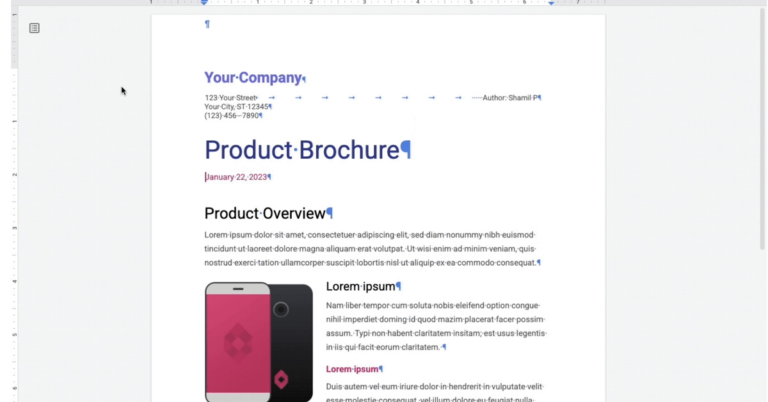
Google is adding a feature to Google Docs that lets you see non-printing characters such as spaces, tabs, and various types of breaks, the company announced in a blog post on Monday. The option, which will be available in the View menu, can help make editing a document easier by showing you exactly how its formatted rather than making you rely purely on what you can see to tell whether something is a tab or a bunch of spaces. It can also be more helpful when troubleshooting messed up formatting.

Before now, people have had to rely on third-party add-ons for Google Docs to see the non-printing characters. While it’s not a feature that many people will have much use for (more on that in a second), there was definitely demand for it. A request on Google’s IssueTracker received over 80 votes from people saying they were impacted by the inability to see the characters. Some also left impassioned comments: “My team agrees that this is a major issue with google docs,” wrote one user in 2019, while someone asked “How has this not been made available yet??” less than a week ago.

Gif showing a document with non-printing characters enabled.

This gif shows what a document looks like with the view mode on and off.

Gif: Google

On the other side of the coin, I, and several of my colleagues, were surprised to hear that the app didn’t have this feature until now. Apparently, none of us had ever come across the need for it or thought to check for it — and yes, that does seem a bit odd in retrospect, given that we’re all writers, but I guess we just assumed it was there.

I was also surprised that Google Docs didn’t have it given that I remember learning about non-printing characters in an elementary school computer class; Microsoft Word has been able to show them for pretty much the entire time I’ve been alive. (One of my co-workers recalled that his parents had the feature on when he was growing up, which made him think that was just how electronic documents worked.)

Still, the addition is better late than never, and I’m sure there are some Google Docs users that are very excited by this announcement. According to the blog post, the feature will be available to all business, educational, and personal accounts, and should be fully rolled out by February 7th.

Read More
Mitchell Clark

Meta’s new ad system addresses allegations that it enabled housing discrimination

Meta’s launching a new ad distribution system in the US as part of the settlement it reached with the US Department of Justice (DOJ) last year. In an announcement on its site, Meta says its new Variance Reduction System (VRS) will create a more “equitable distribution of ads” on the company’s platforms, addressing claims that the platform propagated housing discrimination by letting advertisers exclude protected groups from their marketing campaigns.

Meta has contended with these kinds of accusations for years, dating back to a 2016 report from ProPublica that reveals how advertisers could shut out users based on their race.

Things came to a head when the Department of Housing and Urban Development (HUD) filed a lawsuit against the company in 2019. Last year, the DOJ, which represents the HUD, reached a settlement with Meta that requires the company to develop a new system to “address racial and other disparities caused by its use of personalization algorithms in its ad delivery system.”

In this most recent announcement, Meta explains that its updated system uses “new machine learning technology” when serving ads, ensuring that an ad’s actual audience more accurately reflects the “eligible” target audience.

Once the ad’s been seen by enough people, Meta says the VRS will measure the aggregate age, gender, and estimated race or ethnicity distribution of the group. It will then compare this information with the population of “people who are more broadly eligible to see the ad,” and if there’s too much of a difference in distribution, the system will automatically adjust the pacing of ads to “reduce variance between the audiences.”

The DOJ responded to the change in a press release, noting that Meta will be subject to court oversight until June 27th, 2026. As part of the agreement, a third-party reviewer will evaluate whether Meta’s new VRS meets the terms reached in the settlement. Meta must also meet certain milestones within a specific period of time: by December 31st, 2023, Meta will need to reduce variances to “less than or equal to 10% for 91.7% of those ads for sex and less than or equal to 10% for 81.0% of those ads for estimated race/ethnicity.”

“This groundbreaking resolution sets a new standard for addressing discrimination through machine learning,” US attorney Damian Williams says in a statement. “We appreciate that Meta agreed to work with us toward a resolution of this matter and applaud Meta for taking the first steps towards addressing algorithmic bias.”

According to Meta, the VRS won’t have access to users’ age, gender, or race and will measure estimated race or ethnicity using something a tool called the Bayesian Improved Surname Geocoding. While Meta has already started rolling out the system for housing ads, the company says it will eventually expand it to US employment and credit ads. You can read more about the VRS in this white paper.

Read More
Emma Roth

YouTube will start sharing ad money with Shorts creators on February 1st

YouTube has announced that creators can start making ad revenue on Shorts starting February 1st, following a promise from September that the monetization option was on its way. The change is coming as part of a broader update to YouTube’s Partner Program, which will require everyone who’s currently part of it to sign new agreement terms, whether or not they’re looking to make money from Shorts.

Creators have been able to make some money from the format that rolled out in 2021 for a while via things like Super Chats and shopping integrations, as well as a creator fund that the company had set up, but that model wasn’t all that much better that TikTok’s monetization scheme. What TikTok doesn’t do, though, is directly share ad revenue with creators — something that YouTube has been doing for years for traditional videos and that it’s now bringing to Shorts.

Creators won’t necessarily have to opt in to shorts monetization if they don’t want to. YouTube says it’s introducing a modular system for the partner program’s terms — everyone in the program will have to sign a base agreement that dictates things like what you can post on the site and how payment works. That goes for creators who are already YouTube Partners; the company says they’ll have until July 10th, 2023, to accept the new terms, or else their ability to monetize with the platform will be turned off, and they’ll have to reapply to the program.

Then there are additional agreements for “Watch Page” and Shorts monetization, which you can agree to separately. The Shorts agreement, which will be available on February 1st, is basically what it says on the tin, giving you a cut of the revenue from “ads viewed between videos in the Shorts Feed.” The Watch Page agreement essentially covers the other stuff; livestreams and traditional “long-form” videos on YouTube, YouTube Music, or YouTube Kids.

Basically, content you watch on a page that looks something like this:

Screenshot of a YouTube video page.

The Watch Page agreement covers, as the name implies, videos that use the watch page.

There’s also an addendum for “commerce products” like memberships, Super Chats, Super Stickers, and Super Thanks, though the company says that you won’t have to re-agree to those terms if you’ve already turned the features on for your channel.

YouTube says this modular approach will let it “add new monetization opportunities in the future without having to update or amend the entire monetization agreement.” The company also says that you can opt out of certain monetization modules after you sign up for them, though I’m struggling to come up with reasons why anyone would — it feels like doing so would just arbitrarily limit your monetization options.

The announcement comes as YouTube is revising the requirements to join the YouTube Partner Program. One of the requirements used to be that you had to get 4,000 public watch hours on your content within the past 12 months. Starting in October 2022, Shorts counted toward that number. As of January 2023, though, that’s no longer the case, according to the YouTube Partner Program overview & eligibility support page. Instead, that part of the eligibility requirement has been tweaked; you now have to get the 4,000 hours on non-shorts content or get 10 million views on your public Shorts within the past 90 days. (Either way, you also have to have at least 1,000 subscribers to be eligible.)

Read More
Mitchell Clark