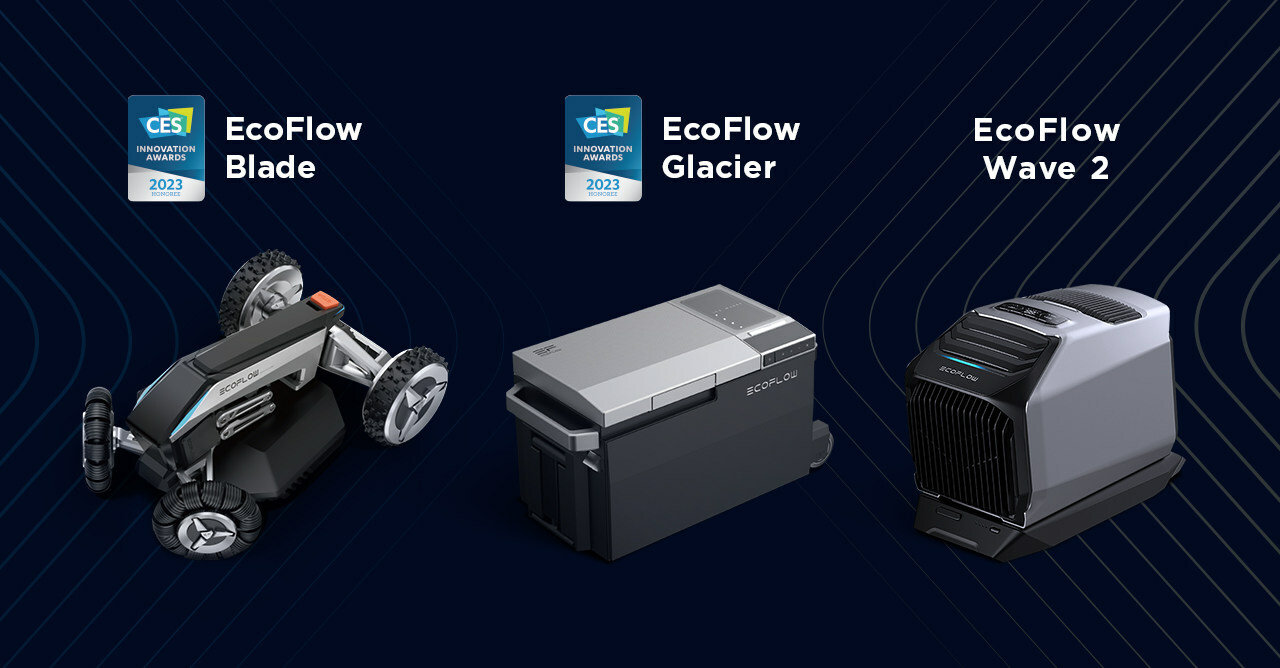
The EcoFlow Blade is an intelligent lawn-sweeping robotic mower. (Image source: EcoFlow)
A new range of smart home products has been unveiled by EcoFlow at CES 2023. The Blade is a smart lawn-sweeping robot that can collect leaves and mow the grass, using GPS rather than a boundary wire for navigation. Also revealed was the Glacier portable fridge with a built-in icemaker and the Wave 2 portable air conditioner.
EcoFlow has announced a range of new smart home products at CES 2023. Included in the line-up is a robotic lawn mower, the Blade. The company claims it is the world’s first lawn-sweeping robot, collecting debris such as leaves and cutting the grass. EcoFlow suggests that the gadget will provide a precise and professional finish on your lawn and help reduce the time you spend tidying your garden.
Like many of the latest robot lawn mowers, the Blade does not require a boundary wire to navigate your lawn, using GPS and LiDAR technologies instead. You can connect the device to your smartphone for app-based controls, such as preset programs. It also appears that you can manually steer the gadget, and the mower’s blade can automatically raise and lower.
Plus, the company unveiled the Glacier, a portable fridge. EcoFlow claims this product is another market first, with an integrated ice maker. It takes the gadget around 12 minutes to produce 18 ice cubes. The device is powered by a 297 Wh battery, which you can recharge via solar panels, providing up to 24 hours of life.
The EcoFlow Wave 2 has also been revealed, a new portable air conditioner which you can use to heat or cool a space. The device lasts up to eight hours on a single charge and is said to have 5,100 BTU cooling and 6,100 BTU heating. The EcoFlow Blade, EcoFlow Glacier and EcoFlow Wave 2 are expected to launch in April; the products’ prices are yet to be announced.
The EcoFlow Blade, Glacier and Wave 2. (Image source: EcoFlow)
Related Articles
Polly Allcock – Tech Writer – 1014 articles published on Notebookcheck since 2021
I’ve been interested in technology for as long as I can remember. From a young age, I have loved gadgets and understanding how things work. Since graduating, I have worked for several technology companies across FinTech, AdTech and Robotics.
Instagram has revealed a home screen refresh, due in February, that axes the Shop tab and moves the Create button back to the center of the bottom navigation bar. The social network’s Adam Mosseri said shopping will still exist in your feed, Reels, Stories and ads – because of course it will – it’s just not a dedicated tab anymore. The change may also be part of a larger strategy shakeup. The Information claims an internal memo in September indicated Instagram would cut many of its shopping features. Instead, the site would concentrate on commerce efforts “more directly tied” to ad revenue. Simply put, the shopping push doesn’t appear to have helped.
Who exactly was browsing the randomized world of Instagram shopping ads for their next purchase, anyway? My shopping tab currently shows me a $10,000 oven, a vegan cheese selection box and stabilizers for a children’s bike. I guess I’d take the fake cheese.
– Mat Smith
The Morning After isn’t just a newsletter – it’s also a daily podcast. Get our daily audio briefings, Monday through Friday, by subscribing right here.
Module 3 variants include standard and wide-angle FOVs as well as autofocus.
Raspberry Pi has launched the Camera Module 3 with big improvements, including higher resolution, infrared, HDR, autofocus, a wide-angle field of view and more. Not counting an interchangeable lens model introduced in 2020, it’s the company’s first new camera module in six years. Where the previous module had fixed autofocus, Module 3 has built-in powered autofocus capability. That makes it a bit thicker (up to 12.4mm compared to 9mm) but more versatile, letting you focus on objects ranging in distance from 5cm (2 inches) to infinity.
A new laptop is an expensive purchase that warrants some thought. Despite continued chip supply woes, companies are still making a ton of new laptops, and there’s plenty of choice. While most laptops with top of the line specs can cost around $1,800 to $2,000 these days, you can still get a good system for under $1,000. Then again, if you do most of your work in a browser (lots of online research, emails and Google Drive), then a Chromebook might be a cheaper alternative. We lay out the best options.
A new deal allows farmers to repair their own equipment.
Jon G. Fuller/VW Pics/Universal Images Group via Getty Images
The right to repair isn’t limited to replacing your smartphone battery. Tractor and farm-vehicle maker John Deere has resisted right-to-repair regulation, but it’s now willing to make some concessions. Deere & Company has signed a memorandum of understanding with the American Farm Bureau Federation (AFBF) that lets US farmers and independent repair shops fix equipment, rather than requiring authorized parts and service centers. Why now? President Biden ordered the Federal Trade Commission to draft right-to-repair regulation in 2021. If Deere didn’t act, it risked legal battles that could limit where and how it does business in the country.
The re-entry comes as officials hope to cut back on space debris.
NASA’s 38-year-old dead satellite has returned to Earth without incident. The Defense Department confirmed the Earth Radiation Budget Satellite (ERBS) re-entered the atmosphere off the Alaskan coast at 11:04 PM ET on January 8th. The ERBS traveled aboard the Space Shuttle Challenger in 1984 and was only expected to collect ozone data for two years. It was actually retired in 2005 — over two decades later.
All products recommended by Engadget are selected by our editorial team, independent of our parent company. Some of our stories include affiliate links. If you buy something through one of these links, we may earn an affiliate commission. All prices are correct at the time of publishing.
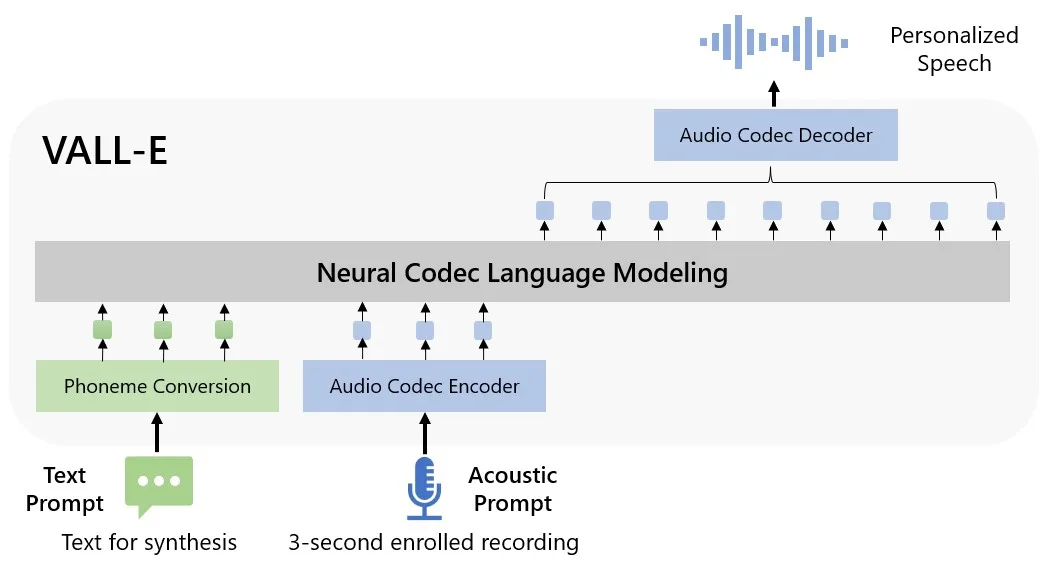
Microsoft has shown off its latest research in text-to-speech AI with a model called VALL-E that can simulate someone’s voice from just a three-second audio sample, Ars Technica has reported. The speech can not only match the timbre but also the emotional tone of the speaker, and even the acoustics of a room. It could one day be used for customized or high-end text-to-speech applications, though like deepfakes, it carries risks of misuse.
VALL-E is what Microsoft calls a “neural codec language model.” It’s derived from Meta’s AI-powered compression neural net Encodec, generating audio from text input and short samples from the target speaker.
In a paper, researchers describe how they trained VALL-E on 60,000 hours of English language speech from 7,000-plus speakers on Meta’s LibriLight audio library. The voice it attempts to mimic must be a close match to a voice in the training data. If that’s the case, it uses the training data to infer what the target speaker would sound like if speaking the desired text input.
Microsoft
The team shows exactly how well this works on the VALL-E Github page. For each phrase they want the AI to “speak,” they have a three-second prompt from the speaker to imitate, a “ground truth” of the same speaker saying another phrase for comparison, a “baseline” conventional text-to-speech synthesis and the VALL-E sample at the end.
The results are mixed, with some sounding machine-like and others being surprisingly realistic. The fact that it retains the emotional tone of the original samples is what sells the ones that work. It also faithfully matches the acoustic environment, so if the speaker recorded their voice in an echo-y hall, the VALL-E output also sounds like it came from the same place.
To improve the model, Microsoft plans to scale up its training data “to improve the model performance across prosody, speaking style, and speaker similarity perspectives.” It’s also exploring ways to reduce words that are unclear or missed.
Microsoft elected to not make the code open source, possibly due to the risks inherent with AI that can put words in someone’s mouth. It added that it would follow its “Microsoft AI Principals” on any further development. “Since VALL-E could synthesize speech that maintains speaker identity, it may carry potential risks in misuse of the model, such as spoofing voice identification or impersonating,” the company wrote in the “Broader impacts” section of its conclusion.
All products recommended by Engadget are selected by our editorial team, independent of our parent company. Some of our stories include affiliate links. If you buy something through one of these links, we may earn an affiliate commission. All prices are correct at the time of publishing.
In an email sent to users, Meta said it will continue supporting Quest 1 with a few — but pretty big — changes. While owners can still use the device and the apps available for it, the Quest 1 will no longer be receiving new features. In addition, Meta will only be rolling out critical bug fixes and security patches to the headset until 2024. As The Verge notes, the device has mainly been getting the same updates as its successor over the past few years, but now Quest 1 owners will have to make do with the features the device already has.
It’s possible that Meta is having difficulties making sure new features are also working on the Quest 1’s aging hardware. The company released the first headset back in 2019, when it was still known as Facebook and the device was still under the Oculus branding. It’s powered by a Snapdragon 835 chip that was released in 2017 and was already two years old at that point. The Quest 2 was a huge upgrade when it came out in 2020, and its Snapdragon XR2 processor provided a significant power boost that enables it to play more complex games and experiences.
That said, the first Quest is also losing access to some abilities it already has: Users will no longer be able to create or join parties going forward. Further, users who have access to Meta Horizon Home’s social features will no longer be able to access them starting on March 5th, 2023. That means they’ll only have a couple of months left to invite other users into their Home or visit someone else’s Home.
All products recommended by Engadget are selected by our editorial team, independent of our parent company. Some of our stories include affiliate links. If you buy something through one of these links, we may earn an affiliate commission. All prices are correct at the time of publishing.
I’ve been captivated by The Last of Us since I first played it shortly after it was released for the PS3 way back in 2013. Its ruined, dangerous but somehow beautiful post-pandemic world was compellingly rendered by developer Naughty Dog, and the tense combat driven by stealth and a need to conserve your resources felt more brutal and realistic than the Uncharted series the developer was known for.
But the relationship between protagonists Joel and Ellie is the true heart of the game. The story of a broken father reluctantly taking responsibility for a child who ends up becoming a surrogate daughter isn’t wildly original, nor is the game’s post-apocalyptic setting. But the development of Joel and Ellie’s relationship is filled with humor, hope, sadness and conflict, and it was brilliantly written by creators Neil Druckmann and Bruce Straley. Performers Troy Baker and Ashley Johnson, along with the entire Naughty Dog team brought it to life, and the game has stuck with me ever since.
It’s the kind of video game that’s been begging for some sort of on-screen adaptation. Now, almost a decade after the game was released, HBO’s The Last of Us series will premiere on January 15th. The first season is led by a deep and talented cast (headlined by Pedro Pascal and Bella Ramsey as Joel and Ellie) and an equally strong creative team, including Druckmann and Craig Mazin (best known for his outstanding Chernobyl mini-series, also on HBO).
Anna Torv (Tess) and Pedro Pascal (Joel)
Photograph by Liane Hentscher/HBO
I’m happy to report that The Last of Us should satisfy fans of the game, and might even bring in a fresh audience. It deftly walks the line between paying loving tribute to the source material while not feeling overly devoted to it. The structure of the show is essentially identical to the game: Joel and Ellie meet in a Boston quarantine zone some 20 years after a fungal infection destroys the world as we know it. Circumstance shoves the pair together on a cross-country journey that spans the better part of a year, as Joel tries to safely get Ellie to the Fireflies, a revolutionary militia that’s been trying to find a cure for the infection.
If you’ve played the game, you’ll be familiar with the season’s nine-episode arc. But in each act of the story, Mazin has smartly identified where to expand the narrative and what to leave out. The biggest thing missing are many of the huge action set-pieces that come up throughout the game. It’s an unsurprising change, as it wouldn’t feel realistic for Joel and Ellie to survive the number of battles they face in the game; it also wouldn’t make for compelling TV. There’s still plenty of action in the show, but it’s meted out more carefully and generally only when it moves the story forward.
Unsurprisingly, everything about The Last of Us reflects the high-budget, flagship status the show seems to have at HBO. Sets and environments are epic in scale and detail, and the combination of prosthetics and digital enhancements bring the Infected to life in terrifying fashion. Although there seems to be less of an emphasis on encounters with these creatures than in the game, seeing them on screen is distressingly memorable. Details like cinematography and music (composed by Oscar-winner Gustavo Santaolalla, who scored the games), are also masterfully executed; this is a show that oozes quality and attention to detail — much like the game itself.
Nico Parker as Sarah Miller in HBO’s The Last of Us
Photograph by Shane Harvey/HBO
More interesting is how The Last of Us expands on the world and its inhabitants. We immediately get a more extensive look at the pre-pandemic life that Joel and his daughter Sarah inhabit. The showrunners give us more backstory and a better understanding of the different ways people survive: cooped up in a dreary Boston quarantine zone, fighting the government in a Kansas City lost to a violent militia group, or a peaceful settlement out west. The world feels a lot more nuanced than the one in the game, where almost everyone is an enemy to be overcome. Don’t get me wrong — most of the inhabitants of HBO’s The Last of Us will shoot first and ask questions later – but most encounters are about tension rather than brutal violence.
A lot has been written about the show’s two stars, Bella Ramsey and Pedro Pascal, both of whom have some big shoes to fill. Finding two performers with on-screen chemistry who could successfully embody their respective characters was surely not an easy task. But Pascal and Ramsey’s performances both immediately connected me with the original characters while also feeling vital and essential on their own. Fans of the game should immediately find things to draw them in, while those new to the series should be quickly won over by the pair.
Photograph by Liane Hentscher/HBO
Pascal’s Joel has a lot more emotional depth than Joel the video game character. Part of that is due to scripts that put more focus on his vulnerabilities and insecurities, but Pascal skillfully portrays a broad range of emotions. He’s able to show the cold, violent and skilled survivor side of Joel who’ll do anything to get what he needs while also embodying the broken spirit of a man who’s spent 20 years doing whatever it takes to stay alive. Watching Ellie bring out Joel’s more vulnerable side, and seeing how that conflicts with the hardened survivor, is at the heart of Joel’s character journey, and Pascal simply nails it. Joel is both more vulnerable than ever — and also more terrifying.
Meanwhile, Ramsey charms from their first moment onscreen as Ellie. We’re afforded a little more of Ellie’s backstory in the first episode, and it’s a great introduction to the character that immediately shows her brazen attitude toward anything that gets in her way. Much of the humor and levity comes from Ellie, and Ramsey’s performance captures the innocent resilience that only a 14-year-old could have in the face of abject horror and seemingly inescapable doom. The weight on Ellie’s shoulders grows throughout the series, and Ramsey is always up to the task of taking Ellie to the brink of breakdown before she comes back to the sense of duty she feels to care for the people she’s chosen to let into her life. Ellie’s naivety and sense of wonder gets bruised time and time again throughout the series, but both Ramsey and the scripts never let her lose it entirely.
Bella Ramsey (Ellie) and Anna Torv (Tess) in The Last of Us.
Photograph by Liane Hentscher/HBO
While both Pascal and Ramsey deliver excellent performances in their own right, the magic really happens when the two are playing off each other. Naturally, the characters start out skeptical of one another, with Joel straight-up calling Ellie “cargo” to her face. But Ellie’s fascination with seeing the world beyond the quarantine zone she’s been stuck in slowly breaks Joel down. Pascal does a great job flipping between those two sides of the character, offering up hints of compassion and concern for Ellie as a person, only to retreat into an emotionally distant protector role.
Meanwhile, Ramsey embodies the spirit of Ellie as she opens up to Joel, and seeing this side of Ellie’s character is a delight. Ramsey’s ability to convincingly show Ellie’s goofy and rebellious exterior is masterfully done; it’s the tool Ellie uses most to try and win over Joel, as if she knows he’s going to give in with a smile or laugh sooner or later. Watching Pascal slowly warm to her brings out a host of different ways for the two actors to play off each other. But Ramsey is also just as convincing when demonstrating Ellie’s drive for survival is just as strong as Joel’s. That leads her to some dark places, and Ramsey shows their range as the series progresses and the challenges facing Ellie and Joel mount.
The rest of the cast doesn’t get as much screen time, but they all contribute to some compelling plot lines. The stories of Bill and Frank (played by Nick Offerman and Murray Bartlett) as well as Keivonn Woodard’s interpretation of Sam are two of the finest examples in the series where Mazin and Druckmann deviate a bit from the original text to do something that might not work in a game but is extremely successful in a show. Their episodes are undeniable standouts, and probably the best examples of why The Last of Us is such a successful adaptation.
Photograph by Liane Hentscher/HBO
The show whiffs a little bit on the pacing, as the back half of the season feels rushed. The pace naturally accelerates throughout the season toward the story’s climax, and the last two episodes are among the shortest in the season. I wish that some of the many dramatic moments near the end had more time to breathe. I don’t think a whole additional episode is necessary, but an extra ten minutes in each of the final episodes might have made things feel less constricted.
Also, it’s worth remembering that The Last of Us was an extremely violent video game, and the show does not shy away from brutality and occasional gore. It’s less overt than I expected, but each episode generally has at least one moment that’s not for the squeamish. That said, much of the human-on-human violence is pared back. With a few exceptions, it’s not too gratuitous or graphic, and a lot is implied. Regardless, I respect that large swaths of people might not be in the mood for a violent and often grim post-pandemic drama after three-plus years dealing with a real-life pandemic.
Despite those concerns, the end result is the best kind of adaptation, one that’s faithful to the spirit of the origin that also makes smart changes to fit the medium. In that way, it reminds me a bit of Peter Jackson’s The Lord of the Rings film trilogy, another personal favorite. While those movies made numerous deviations and changes, Jackson always framed them as a way to make the story work as well as possible in the film medium.
I feel the same way about The Last of Us. It’s not a one-to-one retelling, and I’m thankful for that – it wouldn’t have made for good TV. Instead, Craig Mazin took his love for Druckmann’s story and converted it to a show that many will enjoy, regardless of whether they’ve played the game. And for those of us who already love The Last of Us, this adaptation stands toe-to-toe with the original. There are tons of stunning moments that bring me directly back to what I love, but each episode also has a number of moments that surprised and delighted me, even though I know the overarching plot inside and out. It’s more than I could have hoped for, and I’m very excited that people who don’t play video games will get a chance to experience Joel and Ellie’s story through this excellent series.
All products recommended by Engadget are selected by our editorial team, independent of our parent company. Some of our stories include affiliate links. If you buy something through one of these links, we may earn an affiliate commission. All prices are correct at the time of publishing.
Several gaming veterans announced today the new studio they’re founding: Maverick Games. The studio is currently staffed by several former members of Playground Games, the dev behind the Forza Horizon titles. The studio is already working on its first game, an unnamed open-world title set to launch on consoles and PC.
Maverick’s headquarters is in Leamington Spa in the U.K (also the location of Playground Games). It’s reportedly secured seed funding as it works on its new game and is actively hiring for new roles.
The developer’s founding members including Mike Brown, formerly of Playground Games, as studio head; Harinder Sangha, of Sumo Digital Leamington as COO; and Matt Craven of Playground as CTO. The current studio staff include members of Playground, Sharkmob London and EA.
Brown said in a statement, “Our goal is for Maverick Games to be a studio people will love. For players, we’re already at work on an exciting ultra-high quality title, and for developers, we’re building a home where everyone is encouraged to take risks, be curious, be creative, be innovative, be themselves, and above all – be a Maverick.”
GamesBeat’s creed when covering the game industry is “where passion meets business.” What does this mean? We want to tell you how the news matters to you — not just as a decision-maker at a game studio, but also as a fan of games. Whether you read our articles, listen to our podcasts, or watch our videos, GamesBeat will help you learn about the industry and enjoy engaging with it. Discover our Briefings.
Check out all the on-demand sessions from the Intelligent Security Summit here.
Since CES is owned and produced by the Consumer Technology Association, it makes perfect sense that it is focused on consumer tech. But that doesn’t mean there aren’t significant enterprise business takeaways, particularly around artificial intelligence (AI) and machine learning (ML).
That is particularly true in a year when few technologies are garnering as much hype as AI and ML — particularly when it comes to generative AI, including DALL-E and ChatGPT.
We asked for feedback from vendor experts about the most important AI and ML takeaways they saw coming out of CES 2023.
“With the maturity and performance of edge AI hardware, coupled with the advancements in computer vision, we saw at CES not just innovative consumer products empowered by AI, but also business products that are AI-based to enable automation, scaling-up and improvement of many business processes across market verticals.
Event
Intelligent Security Summit On-Demand
Learn the critical role of AI & ML in cybersecurity and industry specific case studies. Watch on-demand sessions today.
“There were many examples of AI transformation at CES 2023 and its impact on enterprises at large. Examples include autonomous robots handling a wide array of tasks, AI powering agricultural machines for more efficient and sustainable farming, advanced mobility applications, sophisticated smart home devices and more.
“Yet there are still many industries on the verge of AI transformation. AI at the edge can completely overhaul our conception of how the world around us works – by powering devices such as intelligent cameras, smart vehicles, autonomous robots, advanced traffic management tools, smart construction, etc., to run AI at their source. AI at the edge has the power to change anything and everything, enabling new applications to make our world smarter and safer.”
— Orr Danon, CEO, Hailo
2. An AI tipping point for marketers
“CES this year made it clear that AI is at a tipping point – not only in its inclusion in exciting consumer products, but also in how it integrates into the day-to-day workflows of marketers. It’s clear that these tools are quickly shifting from being seen as futuristic nice-to-haves to powerful must-have tools that advertisers need to embrace.
“Already there is an impressive number of tools that can assist with everything from streamlining personalization, to predictive analysis of trends in rapidly changing markets, to ensuring that marketing remains privacy compliant. This year, CES was definitely more compacted than other years and this gave us the opportunity to hone into how these tools can offer companies greater efficiency, effectiveness and transparency, allowing marketers more blue-sky thinking time, and ultimately strengthening their reputation and connections with their customers.”
— Neil Smith, VP, enterprise platforms, TripleLift
3. AI and data governance and IoT
“One key takeaway for business tech leaders from this year’s CES event is the growing importance of data governance in the AI and ML space. With the increasing amount of data being generated and collected by businesses, it is crucial for organizations to have clear policies and procedures in place for managing and protecting that information. To mitigate the risk of sensitive personal data being inadvertently disclosed or misused, robust security and privacy policies are required to ensure that this data is handled responsibly and ethically, and in compliance with relevant laws and regulations.
“Another trend that became evident at CES is the increasing convergence of AI and ML with other emerging technologies such as the internet of things (IoT). This has the potential to unlock a wide range of new use cases and business opportunities for organizations that are able to leverage it effectively. Businesses that are able to use these technologies effectively will be well positioned to drive innovation and gain a competitive advantage in their markets.”
4. Conversational AI will become even more integral to customer experience (CX)
“In the AI space, the technology on show at CES reinforces our belief that conversational AI will become even more integral to great customer service in 2023. We see a continuing move away from talking about products and a greater focus on conversations, whether they be multimodal, chat or voice.
“Multimodal is going to be a big deal as it provides a great self-service option that can guide customers through a flow just like a live agent would via voice and onscreen guidance, but without the need for an agent. It’s a similar engagement, but without needing to wait on hold.
“We are seeing over half of potential customers looking to leverage a multimodal experience as the first implementation. They are also seeing 90% of customers leveraging two or more channels — often starting with voice and then moving to WhatsApp, web chat or SMS. We expect that to grow in 2023.”
— Andrei Papancea, CEO and cofounder, NLX
5. AI and ML was everywhere at CES
“A common thread among much of what I saw this year at CES was a focus on AI and ML. Tech leaders on the showroom floor exhibited everything from the use of AI in advertising and marketing, to autonomous applications for vehicles, drones and deliveries. There were also examples of AI software helping stakeholders in healthcare, consumer technology, digital content moderation and many other industries.
“While tech leaders continue to iterate technologies for specific applications, they should see this AI disruption as an indication of where the industry is headed. AI will be critical in automating solutions and imitating human likeness to enable better user experiences for humans.”
— David Finkelstein, CEO, BDEX
VentureBeat’s mission is to be a digital town square for technical decision-makers to gain knowledge about transformative enterprise technology and transact. Discover our Briefings.
Every day, millions of standard English speakers enjoy the benefits provided by natural language processing (NLP) models.
But for speakers of African American Vernacular English (AAVE), technologies like voice-operated GPS systems, digital assistants, and speech-to-text software are often problematic because large NLP models frequently are unable to understand or generate words in AAVE. Even worse, models are often trained on data scraped from the web and are prone to incorporating the racial bias and stereotypical associations that are rampant online.
When these biased models are used by companies to help make high-stakes decisions, AAVE speakers can find themselves unfairly restricted from social media, inappropriately denied access to housing or loan opportunities, or unjustly treated in the law enforcement or judicial systems.
For the past 18 months, machine learning (ML) specialist Jazmia Henry has focused on finding a way to responsibly incorporate AAVE into language models. As a fellow at the Stanford Institute for Human-Centered Artificial Intelligence (HAI) and the Center for Comparative Studies in Race and Ethnicity (CCSRE), she has created an open-source corpora of more than 141,000 AAVE words to help researchers and builders design models that are both inclusive and less susceptible to bias.
Event
Intelligent Security Summit On-Demand
Learn the critical role of AI & ML in cybersecurity and industry specific case studies. Watch on-demand sessions today.
“My hope with this project is that social and computational linguists, anthropologists, computer scientists, social scientists, and other researchers will poke and prod at this corpora, do research with it, wrestle with it, and test its limits so we can grow this into a true representation of AAVE and provide feedback and insight on our potential next steps algorithmically,” said Henry.
In this interview, she describes the early obstacles in developing this database, its potential to help computational linguistics understand the origins of AAVE, and her plans post-Stanford.
How do you describe African American Vernacular English?
To me, AAVE is a language of perseverance and uplift. It’s the result of African languages thought to have been lost during the slave trade migration that have been incorporated into English to create a new language used by the descendants of those African peoples.
How did you become interested in including AAVE in NLP models?
As a child, both my parents occasionally spoke their native languages. For my Caribbean father, that was Jamaican patois, and for my mother it was Gullah Geechee, found in the coastal areas of the Carolinas and Georgia. Each language was a creole, which is a new language created by blending different languages.
Everyone seemed to understand that my parents were speaking a different language, and no one doubted their intelligence. But when I saw people in my community speaking AAVE, which I believe to be another creole language, I could tell that there was a shame and stigma associated with it — a sense that if we used this language outside, we were going to be judged as being less intelligent. When I began working in data science, I wondered what would happen if I tried to collect data on AAVE and incorporate it into NLP models so we could really begin to understand it and improve the performance of these models.
How did your project evolve, and what obstacles did you encounter?
There were a lot of obstacles, and in the end I had to change my objective. AAVE evolves much more quickly than many languages and often turns standardized English on its head, giving words entirely new meanings. For example, the word “mad” is often defined as meaning “angry.” In AAVE, however, it’s frequently used to mean “very,” as in “mad funny.”
AAVE can also be largely defined by the situation, the speaker, and the tone being used, things that language processing models don’t take into consideration. I eventually decided to create a corpus of AAVE, which is broken down into four collections. The lyric collection includes the words to 15,000 songs by 105 artists ranging from Etta James and Muddy Waters all the way up to Lil Baby and DaBaby.
The leadership collection includes speeches from consequential individuals ranging from Fredrick Douglass and Sojourner Truth to Martin Luther King and Ketanji Brown Jackson. The most difficult to put together has been the book collection, because African Americans are grossly underrepresented in the literary canon, but I’ve included works from historically Black book archive collections from universities.
Finally, the social media collection is the most robust and diverse and includes video transcripts, blog posts, and 15,000 tweets, all collected from Black thought leaders.
How do you hope your project will be used?
I know the corpora is beginning to be used, but I don’t yet know by whom or for what purpose. My hope is that this preliminary work inspires researchers to enter this space, question it, and push it forward to make sure AAVE is represented in the languages used in NLP. Social and computational linguists may be able to use this to help determine if AAVE is in fact its own language or dialect and to look for links between it and other African languages, particularly ones that have not been recorded or preserved in western history.
Growing up, we learned what was taken from our enslaved ancestors and from their descendants. AAVE may be the proof that everything wasn’t taken away and that we were able to retain some of who we were in the way we communicate with each other. That knowledge has the potential to remove shame and inject pride. When I’m saying “What up, my brother?” I’m not being unintelligent; I’m being strategic and calling on our ancestors with that conversation.
Not only does it not reflect the broader community, it also actively discriminates against that community. Large language models that struggle to understand or generate words in AAVE are more likely to exacerbate stereotypes about Black people generally, and these biased associations are being codified within these models. When they’re commercialized, these models — and their biases — can result in companies making unfair decisions that affect the lives of AAVE speakers. This can result in everything from individuals having their social media disproportionately edited or removed from platforms to discrimination in areas such as housing, banking, and the law enforcement and judicial systems.
What should NLP developers be thinking about as they build tools?
There have been some popular NLP models that incorporate a lot of bias. Companies are working to scale back these problematic models, but that’s often followed by a focus on risk mitigation over bias mitigation. Rather than try to find solutions, companies will sometimes take the approach of saying “Let’s not touch AAVE or anything that has to do with Blackness again, because we didn’t do it right the first time.”
Instead, they should be asking how they can do it correctly now. This is the time to build models that are better, that improve on processes, and that come up with new ways to work with languages such as AAVE, so larger companies don’t continue to perpetuate harm.
What are your plans moving forward as you leave Stanford?
I’m starting a new job at Microsoft, where I’ll be working as a senior applied engineer for the autonomous systems team with Project Bonsai. We’re increasing deep reinforcement learning capabilities with something we call “machine teaching,” which is essentially teaching machines how to perform tasks that can make humans more productive, improve safety, and allow for autonomous decision-making using AI. This work gives me the chance to improve people’s lives, and I’m so grateful for the opportunity.
Beth Jensen is a contributing writer for the Stanford Institute for Human-Centered AI.
This story originally appeared on Hai.stanford.edu. Copyright 2023
DataDecisionMakers
Welcome to the VentureBeat community!
DataDecisionMakers is where experts, including the technical people doing data work, can share data-related insights and innovation.
If you want to read about cutting-edge ideas and up-to-date information, best practices, and the future of data and data tech, join us at DataDecisionMakers.
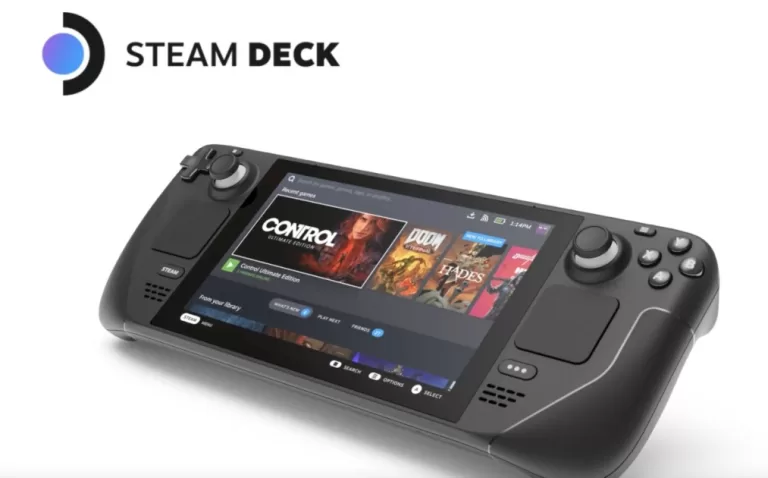
SteamDB revealed via Twitter that the PC gaming platform hsd surpassed its milestone of 10 million players in-game concurrently. On the same day (January 8), it also broke its record of most online users at once, with the new record being just over 33 million.
Specifically, the concurrent in-game player count peaked at 10,284,568 on Sunday after spiking over 10 million on Saturday. This is the number of players actively gaming at the same time. The concurrent player count — the number of gamers online, even those not gaming — hit 33,078,963 on the same day.
The number of concurrent users on Steam has, according to SteamDB, been rising steadily for the last decade. Player count leapt in numbers around the onset of lockdown during the COVID-19 pandemic. Data from Newzoo released late last year suggests all gaming markets experienced a boon during the last few years. Many of those numbers are diminishing as the market corrects, but it seems Steam is still able to keep its high number of new players.
As for why the player count rose so high, that’s a matter of speculation. Multiplayer titles appear to have high player counts on that day, including Counter-Strike: Global Offensive, Dota 2 and newcomer Goose Goose Duck. It’s also possible that many gamers are keeping New Years resolutions to work through their backlogs — given that Steam is legendary for sales, many players using the service boast gigantic libraries.
GamesBeat’s creed when covering the game industry is “where passion meets business.” What does this mean? We want to tell you how the news matters to you — not just as a decision-maker at a game studio, but also as a fan of games. Whether you read our articles, listen to our podcasts, or watch our videos, GamesBeat will help you learn about the industry and enjoy engaging with it. Discover our Briefings.
Check out all the on-demand sessions from the Intelligent Security Summit here.
These days, it’s no exaggeration to say that every company is a data company. And if they’re not, they need to be. That’s why more organizations are investing in the modern data stack (think: Databricks and Snowflake, Amazon EMR, BigQuery, Dataproc).
However, these new technologies and the increasing business-criticality of their data initiatives introduce significant challenges. Not only must today’s data teams deal with the sheer volume of data being ingested on a daily basis from a wide array of sources, but they must also be able to manage and monitor the tangle of thousands of interconnected and interdependent data applications.
The biggest challenge comes down to managing the complexity of the intertwined systems that we call the modern data stack. And as anyone who has spent time in the data trenches knows, deciphering data app performance, getting cloud costs under control and mitigating data quality issues is no small task.
When something breaks down in these Byzantine data pipelines, without a single source of truth to refer back to, the finger-pointing begins with data scientists blaming operations, operations blaming engineering, engineering blaming developers — and so forth and so on in perpetuity.
Event
Intelligent Security Summit On-Demand
Learn the critical role of AI & ML in cybersecurity and industry specific case studies. Watch on-demand sessions today.
Is it the code? Insufficient infrastructure resources? A scheduling coordination problem? Without a single source of truth for everyone to rally around, everybody uses their own tool, working in silos. And different tools give different answers — and untangling the wires to get to the heart of the problem takes hours (even days).
Why modern data teams need a modern approach
Data teams today are facing many of the same challenges that software teams once did: A fractured team working in silos, under the gun to keep up with the accelerated pace of delivering more, faster, without enough people, in an increasingly complex environment.
Software teams successfully tackled those obstacles via the discipline of DevOps. A big part of what enables DevOps teams to succeed is the observability provided by the new generation of application performance management (APM). Software teams are able to accurately and efficiently diagnose the root cause of problems, work collaboratively from a single source of truth, and enable developers to address problems early on — before software goes into production — without having to throw issues over the fence to the Ops team.
So why are data teams struggling when software teams aren’t? They’re using basically the same tools to solve essentially the same problem.
Because, despite the generic similarities, observability for data teams is a completely different animal than observability for software teams.
Cost control is critical
First off, consider that in addition to understanding a data pipeline’s performance and reliability, data teams must also grapple with the question of data quality — how can they be assured that they are feeding their analytics engines with high-quality inputs? And, as more workloads move to an assortment of public clouds, it’s also vital that teams are able to understand their data pipelines through the lens of cost.
Unfortunately, data teams find it difficult to get the information they need. Different teams have different questions they need answered, and everybody is myopically focused on solving their particular piece of the puzzle, using their own particular tool of choice, and different tools yield different answers.
Troubleshooting issues is challenging. The problem could be anywhere along a highly complex and interconnected application/pipeline for any one of a thousand reasons. And, while web app observability tools have their purpose, they were never intended to absorb and correlate the performance details buried within a modern data stack’s components or “untangle the wires” among a data application’s upstream or downstream dependencies.
Moreover, as more data workloads migrate to the cloud, the cost of running data pipelines can quickly spiral out of control. An organization with 100,000-plus data jobs in the cloud has innumerable decisions to make about where, when, and how to run these jobs. And each decision carries a price tag.
As organizations cede centralized control over infrastructure, it’s essential for both data engineers and FinOps to understand where the money is going and identify opportunities to reduce/control costs.
To get fine-grained insight into performance, cost, and data quality, data teams are forced to cobble together information from a variety of tools. And, as organizations scale their data stacks, the vast amount of information (and sources) makes it extraordinarily difficult to see the entirety of the data forest when you’re sitting in the trees.
Most of the granular details needed are available — unfortunately, they’re often hidden in plain sight. Each tool provides some of the information required, but not all. What’s needed is observability that pulls together all these details and presents them in a context that makes sense and speaks the language of data teams.
Observability that is designed from the ground up specifically for data teams allows them to see how everything fits together holistically. And while there is a slew of cloud-vendor-specific, open-source, and proprietary data observability tools that provide details about one layer or system in isolation, ideally, a full-stack observability solution can stitch it all together into a workload-aware context. Solutions that leverage deep AI are further able to show not just where and why an issue exists but how it affects other data pipelines — and, finally, what to do about it.
Just like DevOps observability provides the foundational underpinnings to help improve the speed and reliability of the software development lifecycle, DataOps observability can do the same for the data application/pipeline lifecycle. But — and this is a big but — DataOps observability as a technology has to be designed from the ground up to meet the different needs of data teams.
DataOps observability cuts across multiple domains:
Data application/pipeline/model observability ensures that data analytics applications/pipelines are running on time, every time, without errors.
Operations observability enables data teams to understand how the entire platform is running end to end, offering a unified view of how everything is working together, both horizontally and vertically.
Business observability has two parts: profit and cost.The first is about ROI and monitors and correlates the performance of data applications with business outcomes. The second part is FinOps observability, where organizations use real-time data to govern and control their cloud costs, understand where the money is going, set budget guardrails, and identify opportunities to optimize the environment to reduce costs.
Data observability looks at the datasets themselves, running quality checks to ensure correct results. It tracks lineage, usage, and the integrity and quality of data.
Data teams can’t be singularly focused because problems in the modern data stack are interrelated. Without a unified view of the entire data sphere, the promise of DataOps will go unfulfilled.
Observability for the modern data stack
Extracting, correlating, and analyzing everything at a foundational layer in a data team–centric, workload-aware context delivers five capabilities that are the hallmarks of a mature DataOps observability function:
End-to-end visibility correlates telemetry data and metadata from across the full data stack to give a unified, in-depth understanding of the behavior, performance, cost, and health of your data and data workflows.
Situational awareness puts this aggregated information into a meaningful context.
Actionable intelligence tells you not just what’s happening but why. Next-gen observability platforms go a step further and provide prescriptive AI-powered recommendations on what to do next.
Everything either happens through or enables a high degree of automation.
This proactive capability is governance in action, where the system applies the recommendations automatically — no human intervention is needed.
As more and more innovative technologies make their way into the modern data stack — and ever more workloads migrate to the cloud — it’s increasingly necessary to have a unified DataOps observability platform with the flexibility to comprehend the growing complexity and the intelligence to provide a solution. That’s true DataOps observability.
Chris Santiago is VP of solutions engineering for Unravel.
DataDecisionMakers
Welcome to the VentureBeat community!
DataDecisionMakers is where experts, including the technical people doing data work, can share data-related insights and innovation.
If you want to read about cutting-edge ideas and up-to-date information, best practices, and the future of data and data tech, join us at DataDecisionMakers.