Home Blog Page 27

Bitcoin Difficulty Climbs 3.87% as Hashrate Slips and Next Cut Looms

Bitcoins

After the previous difficulty epoch delivered a 7.76% reduction, Bitcoin’s difficulty moved higher by 3.87% at block height 943488. This latest adjustment represents the third increase recorded so far this year.

Key Takeaways:

  • Bitcoin difficulty rose 3.87% at block 943488 as hashrate fell 60.45 EH/s; a 15.73% cut is projected.
  • Miners face $30.67 PH/s hashprice and 0.56% fees, pushing firms toward AI over BTC mining.
  • Bitcoin network nears April 19, 2026, adjustment as slower 11:51 blocks signal easing difficulty ahead.

Bitcoins Bitcoin Mining Tightens

The Bitcoin network has logged a total of seven adjustments this year, comprising three increases and four decreases. The most recent reduction, two weeks ago, was sizable, arriving after consecutive gains of 14.73% and 0.45% across the prior two epochs.

Following the latest adjustment, the difficulty rating is now 3.87% higher, making blocks that much harder to discover, and it further stands at 138.97 trillion times more difficult than Bitcoin’s launch.

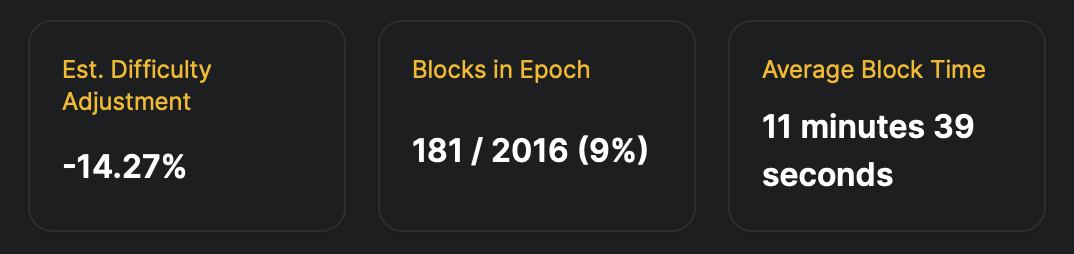
As of 4 p.m. Eastern time, 181 of the 2,016 blocks in the current epoch have been mined, placing the network roughly 9% of the way toward the next adjustment expected on April 19, 2026. While it remains early and conditions can shift considerably between now and then, current estimates point to a projected 14.27% reduction.
bitcoins Bitcoin Difficulty Climbs 3.87% as Hashrate Slips and Next Cut Looms
Image source: hashrateindex.com on April 4, 2026.

This outlook stems from a noticeable slowdown in block intervals over the past day, with data from hashrateindex.com indicating an average block time of 11 minutes 39 seconds, well above the expected 10-minute cadence.
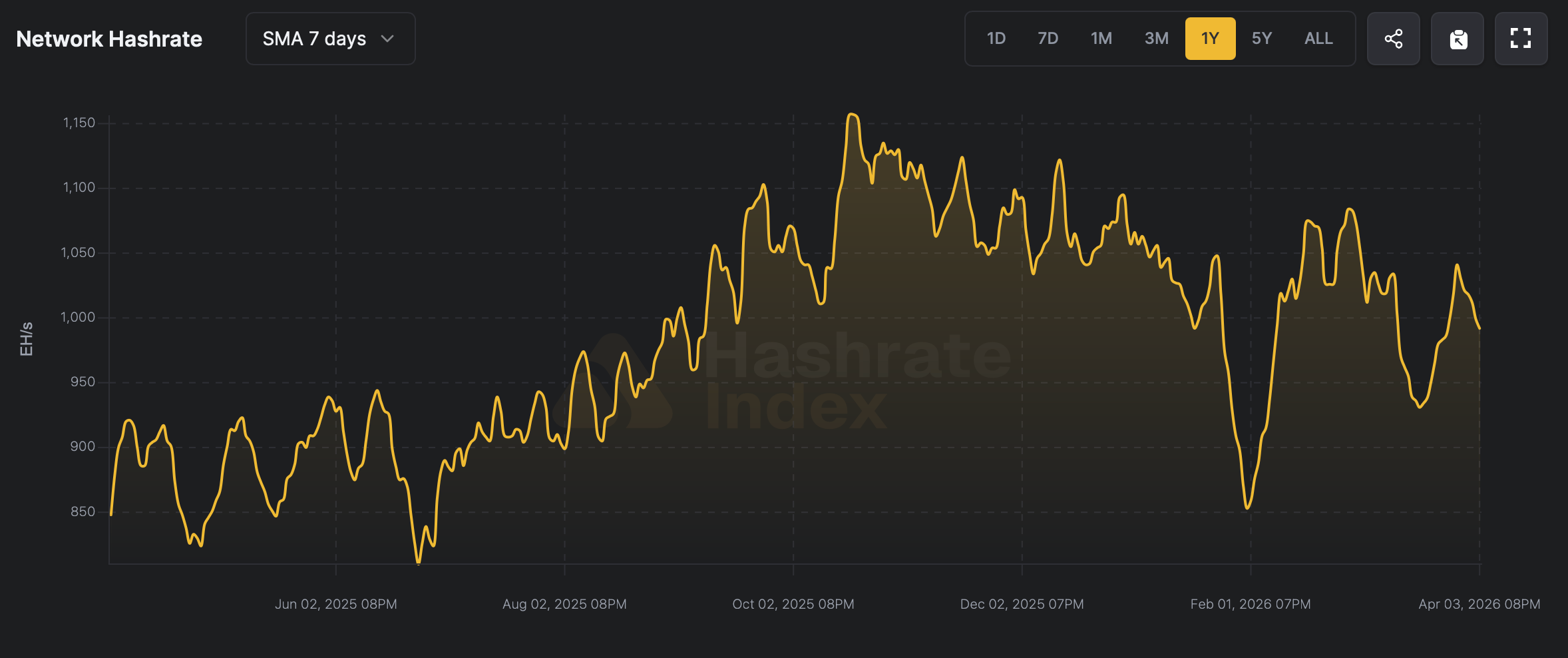
Bitcoin’s total hashrate on Saturday, April 4, 2026, via hashrateindex.com.

What’s behind the shift? A decline in hashrate. Bitcoin.com News reported on March 28 that the Bitcoin network’s total computational power had exceeded 1,000 exahash per second (EH/s), or 1 zettahash per second (ZH/s). On that day, hashpower reached 1,022 EH/s, whereas it now sits 60.45 EH/s lower at 961.55 EH/s.

Bitcoins Revenue Compression Tightens the Squeeze

Compressed revenues are likely a key factor behind the downturn, alongside mining operations opting to allocate resources toward artificial intelligence (AI) infrastructure rather than mining BTC in pursuit of stronger returns. An infrastructure provider deploying its megawatts toward AI rather than mining bitcoin can realize significantly higher returns, a dynamic that has persuaded many of today’s operators to redirect their focus.

A daily hashprice of $30.67 per petahash per second (PH/s) ranks among the lowest revenue levels bitcoin miners have faced since the network’s early years, when bitcoin carried a far smaller valuation. With 106,335 blocks remaining until the next halving, conditions are poised to tighten further.

Adding pressure, miners cannot rely on fees, which account for just 0.56% of the block reward. In effect, the system appears to be approaching a breaking point. Yet Bitcoin’s difficulty adjustment is engineered for precisely this scenario. If miners exit and hashrate declines, difficulty adjusts downward, drawing participants back with more accessible conditions.

Jamie Redman Read More

Rajasthan to host nationwide roadshows ahead of agritech meet

Bitcoins

bitcoins Image used for representational purpose only.

Image used for representational purpose only.
| Photo Credit: Getty Images/iStockphoto

In a push to position Rajasthan as a leading destination for investments in the agriculture sector, the State government on Saturday decided to roll out a series of roadshows in several cities ahead of the Global Rajasthan Agritech Meet (GRAM)-2026, scheduled to be held here from May 23 to 25.

The initiative aims at engaging with investors, agritech firms, research institutions, startups and key stakeholders to ensure participation and attract investments to the agriculture sector. The investors outreach through roadshows has been planned in Jaipur on April 10, and later in New Delhi, Ahmedabad, Hyderabad and Pune.

bitcoins

Principal Agriculture Secretary Manju Rajpal said here that the roadshows would serve as a platform to present Rajasthan’s evolving agricultural landscape, highlight policy support and showcase emerging opportunities in agri-business, food processing and value-added sectors.

“The initiative is also aligned with our broader vision to integrate innovation, advanced technologies and digital solutions into agriculture,” Ms. Rajpal said. The roadshows will facilitate high-level interactions among prospective investors, agritech developers, industry representatives and policymakers, with a focus on finding investment potential in the sector.

GRAM-2026 is expected to connect Rajasthan’s agriculture sector with global investment and innovation. The participants will be provided an overview of the three-day event’s key highlights, including technical sessions, workshops, exhibitions, smart farm and livestock showcases, and dedicated investment dialogues.

The previous edition of GRAM was held in Jaipur in 2016-17. The upcoming edition is expected to witness the participation of about 75,000 farmers from Rajasthan, more than 250 exhibitors, and over 100 companies from India and overseas.

Delegations from regions such as South Asia, Europe, Australia, and North and South America are also likely to participate. Ms. Rajpal said the GRAM-2026 would accelerate the adoption of modern agricultural technologies, foster innovation-led growth and contribute to sustainable agricultural development to enhance farmers’ incomes. (EOM)

Published – April 05, 2026 03:15 am IST

Luz Klemp Read More

Bitcoin Whales and Sharks Record $30.9B Losses Amid Q1 2026 Market Sell-Off

Bitcoins TLDR: Bitcoin whales and sharks recorded over $30.9B in losses, averaging $337M daily in Q1 2026. Early February saw peak capitulation, with realized losses hitting $1.6B in a single day. Large holders led the sell-off, showing institutional-level distribution during market stress. Market stabilized post-February, with reduced losses and BTC trading within a tight range…
Brenda Mary Read More

Record-low retail demand, $18B ETF flows: Is Bitcoin near a supercycle?

Bitcoins

Retail activity is often the clearest gauge of the market’s current mood. 

When we see high retail participation, it points to a risk-on environment, where traders are taking positions, dip buying picks up, and overall conviction remains strong, often signaling a local bottom in a crypto asset. 

Conversely, when retail activity drops, it tends to reflect a risk-off market, where participants are cautious and less willing to chase opportunities. Looking at on-chain data reinforces this point: Bitcoin’s [BTC] “shrimp” inflows (addresses holding less than 1 BTC) have fallen to record lows, highlighting just how subdued retail engagement has become.

bitcoins Bitcoin shrimp flow
Source: CryptoQuant

From a technical perspective, this underscores the lack of dip-buying momentum from smaller investors. Psychologically, these record-low inflows highlight the low risk appetite and reinforce the fear in the market. Put together, it’s clear why BTC’s $65k as a local bottom still feels a bit too ambitious for now.

However, this isn’t the only divergence in play this cycle. The memecoin space is staying mostly quiet too. The gap between new token launches and active traders is at an all-time high. Take Solana [SOL] as an example: At its mid-2025 peak, it had over 30 million active wallets, and now that number has fallen below 5 million, showing just how much engagement has dried up.

Historically, rotations into memecoins during risk-off periods have helped keep capital moving within the crypto market. Right now, with both low Bitcoin retail inflows and minimal memecoin activity, the market clearly remains cautious and far from a full risk-on environment. That said, this quiet setup could be exactly what Bitcoin needs to kick off its next institutional supercycle.

Bitcoins Can Bitcoin’s “buy the fear” approach spark a supercycle?

On the psychological side, both low retail activity and muted memecoin flows point to a low-risk appetite.

As mentioned earlier, low retail inflows show that investors who normally chase hype or macro-driven trends are staying on the sidelines. Similarly, strong memecoin rotation usually signals strategic players taking on higher-risk, quick-gain opportunities.

Right now, with both sides quiet, one thing is clear: ‘Fear’ of a Bitcoin correction is dominating sentiment. That said, the chart below highlights a key development. BlackRock’s IBIT Bitcoin ETF is now trading $16-18 billion daily, nearly matching Binance spot volumes and more than double Coinbase ($6-8 billion).

bitcoins BTC ETF
Source: Kaiko

From a technical perspective, this represents a classic “buy the fear” setup. 

In other words, when high-risk participants such as retail and memecoin traders step back, sentiment remains firmly in the fear zone. Consequently, this creates an opening for institutional investors to step in, accumulate, and reinforce BTC’s floor, setting the stage for a sharp rebound once risk-on sentiment returns.

With this setup unfolding in real time, the possibility of Bitcoin bottoming around $65k can’t be dismissed. If it holds, BTC could be gearing up for a full-blown institutional supercycle.


Bitcoins Final Summary

  • Low retail and memecoin activity signal fear in the market, keeping risk appetite muted and BTC’s $65k bottom still uncertain.
  • Institutional buying, highlighted by BlackRock’s IBIT ETF, creates a “buy the fear” setup that could kickstart Bitcoin’s institutional supercycle.

Ritika Gupta Read More

Grayscale Says 5 Altcoins Are at ‘Buy Zone’ Levels

Bitcoins Grayscale Investments posted consecutive endorsements of Sui (SUI) this week, praising its programming model for institutional use while calling current altcoin prices a potential buying opportunity. The asset manager highlighted SUI alongside Ethereum (ETH), Solana (SOL), Chainlink (LINK), and Avalanche (AVAX) as tokens trading at historically low levels…
Lockridge Okoth Read More

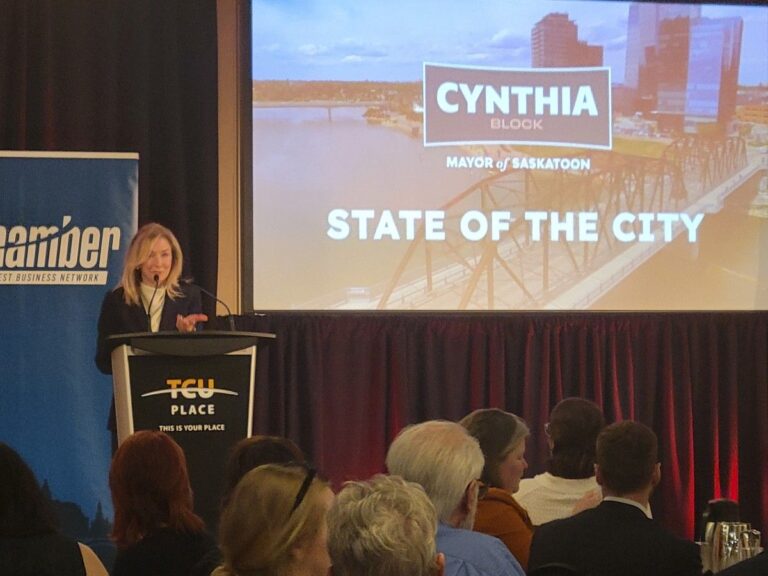
‘Moving boldly’: Mayor discusses homelessness, DEED and funding at State of the City

Mayor Cynthia Block speaking at the State of the City event.
Mayor Cynthia Block discussed homelessness, DEED and funding during the State of the City luncheon at TCU Place on May 14. Photo by Brody Langager /Saskatoon StarPhoenix

Article content

“Moving boldly” is the theme that Saskatoon’s mayor brought to her State of the City event, as she fielded questions from businesses and media on a range of hot topics.

The Star Phoenix

THIS CONTENT IS RESERVED FOR SUBSCRIBERS ONLY

Subscribe now to read the latest news in your city and across Canada.

  • Unlimited online access to articles from across Canada with one account.
  • Get exclusive access to the Saskatoon StarPhoenix ePaper, an electronic replica of the print edition that you can share, download and comment on.
  • Enjoy insights and behind-the-scenes analysis from our award-winning journalists.
  • Support local journalists and the next generation of journalists.
  • Daily puzzles including the New York Times Crossword.

SUBSCRIBE TO UNLOCK MORE ARTICLES

Subscribe now to read the latest news in your city and across Canada.

  • Unlimited online access to articles from across Canada with one account.
  • Get exclusive access to the Saskatoon StarPhoenix ePaper, an electronic replica of the print edition that you can share, download and comment on.
  • Enjoy insights and behind-the-scenes analysis from our award-winning journalists.
  • Support local journalists and the next generation of journalists.
  • Daily puzzles including the New York Times Crossword.

REGISTER / SIGN IN TO UNLOCK MORE ARTICLES

Create an account or sign in to continue with your reading experience.

  • Access articles from across Canada with one account.
  • Share your thoughts and join the conversation in the comments.
  • Enjoy additional articles per month.
  • Get email updates from your favourite authors.

THIS ARTICLE IS FREE TO READ REGISTER TO UNLOCK.

Create an account or sign in to continue with your reading experience.

  • Access articles from across Canada with one account
  • Share your thoughts and join the conversation in the comments
  • Enjoy additional articles per month
  • Get email updates from your favourite authors

Sign In or Create an Account

or

Article content

Here’s a rundown of some of the discussions.

Article content

Article content

Downtown Event and Entertainment District

Article content

“In the 1960s, this building (TCU Place), once the Centennial Auditorium, was the front page of the newspaper and everyone was screaming ‘we don’t want this’,” Cynthia Block told the crowd on Thursday.

Article content

Article content

Now, she said she couldn’t imagine not having TCU Place in downtown Saskatoon.

Article content

By signing up you consent to receive the above newsletter from Postmedia Network Inc.

Article content

The same thing happened in the 1970s, when railroad tracks needed to be moved to make way for Midtown Plaza, Block noted.

Article content

“People were super mad. Could you imagine not having that anchor in our downtown?”

Article content

She said these kinds of public investments bring in tourism — and private investment follows.

Article content

Today’s examples, Block said, include the Link Bus Rapid Transit system and the Downtown Event and Entertainment District.

Article content

She alluded to the possibility of a partnership still being an option for the DEED, despite the previous potential partnership being voted down by city council.

Article content

She stressed that while there isn’t an announcement coming, she hopes there will be one in the future.

Article content

Block acknowledged that public pushback comes from caring, and fear loss, adding that she saw the DEED as a natural evolution of Saskatoon.

Article content

She said it’s not just a “nice to have” project: they are losing business due to less opportunities at the SaskTel Centre.

Article content

Mayor Cynthia Block speaking at the State of the City event.
Mayor Cynthia Block at the State of the City event on May 14. Photo by Brody Langager /Saskatoon StarPhoenix

Article content

Homelessness

Article content

Block said Saskatoon had 1,931 people facing homelessness that were counted in the last point-in-time homelessness count.

Article content

Article content

“That’s up 30 per cent from last year. That is not sustainable, it is unmanageable, and I don’t think there’s a single person in this room that hasn’t been impacted by it and is frustrated.”

Article content

Article content

Block said the only way Saskatoon is improving the state of homelessness is through interim housing.

Article content

“There is no other way out … housing is the foundation to begin recovery in 99.99 per cent of cases.”

Article content

She said housing with wraparound services to support people facing homelessness can be really expensive, but the city is spending much more money doing what it is now to deal with homelessness.

Article content

Funding cities

Article content

Article content

She said cities maintain about 60 per cent of the infrastructure in the country, but only get about eight per cent of the tax revenue.

Article content

Many people are mad about their property assessment increasing, which causes their property taxes to increase, Block noted.

Article content

She said property taxes aren’t the right tool, and the four-year assessment cycle can create “enormous swings in assessment,” creating risk for homes and businesses.

Brody Langager
Read More

CNH Industrial Reports Decline in Q1 Construction Equipment Sales

The Case and New Holland parent says it continues to search for partners to expand its construction equipment business… Ben Thorpe
Read More

Stevie McKenna signs deal with Zuffa Boxing and returns to action on June 6 Bournemouth bill, live on Sky Sports

Stevie McKenna has signed a long-term deal with Zuffa Boxing and will return to action on June 6, live on Sky Sports.

On the Zuffa Boxing 07 bill at the Bournemouth International Centre, headlined by Chris Billam-Smith vs Ryan Rozicki, McKenna will fight American veteran Casey James Streeter.

Irish contender McKenna is always exciting to watch. He delivered thrilling fights in the UK in 2024. A three-round war with Joe Laws saw McKenna hit the canvas but ultimately prevail as he dropped Laws four times in all.

In another tremendous clash, he was edged out by Lee Cutler on a majority decision over 10 rounds in their fight in Liverpool.

Rivals McKenna and Cutler will both fight in separate bouts on the June 6 bill in the latter’s Bournemouth hometown.

Please use Chrome browser for a more accessible video player

Watch new angles of the incredible fight between Joe Laws and Stevie McKenna that had five knockdowns in just three rounds

His loss to Cutler in that all-action classic is the sole defeat McKenna has suffered in his professional career.

McKenna was an amateur standout, winning gold medals at the Haringey Box Cup and Commonwealth Youth Games before turning pro in 2019.

Before he met Cutler he went on a 15 bout winning streak, taking 14 of those victories inside the distance.

He has registered 11 of those knockouts in three rounds or less.

Please use Chrome browser for a more accessible video player

Watch the whole first round between Stephen McKenna and Joe Laws as both fighters suffered knockdowns in the opening three minutes

Streeter, his opponent on June 6, has a 15-3-2 (6) record. From Portland, Maine Streeter makes his UK debut following a stoppage defeat to Leo Ruiz on Zuffa Boxing 03.

Zuffa Boxing 07 will be broadcast live on Sky Sports in the UK and Ireland. As well as the battle between Bournemouth’s hometown hero Billam-Smith and Canadian KO artist Rozicki, an all-British chief support pits long-time cruiserweight contenders Jack Massey and Cheavon Clarke against one another.

Tickets are on sale now and can be purchased via BIC.co.uk.

Anthony Fleishman
Read More

Food, Energy Prices Push Inflation Rate to 15.69% in April – NBS

Food, Energy Prices Push Inflation Rate to 15.69% in April – NBS

Nigeria’s headline inflation rate increased to 15.69 per cent in April 2026, up from 15.38 per cent recorded in March, driven largely by rising food, transport, hospitality and healthcare costs across the country.

The latest figures were released on Friday by the National Bureau of Statistics in its Consumer Price Index report.

According to the report, the inflation rate rose by 0.31 percentage points compared to March 2026, although it remained significantly lower than the 26.82 per cent recorded in April 2025.

The bureau also disclosed that the Consumer Price Index increased to 138.3 points in April from 135.4 points in March, reflecting a 2.9-point increase in overall consumer prices.

Despite the rise in annual inflation, monthly inflationary pressure eased during the review period. On a month-on-month basis, headline inflation slowed to 2.13 per cent in April, compared to 4.18 per cent recorded in March.

The NBS explained that the slower monthly increase indicated that the pace of price growth in April was lower than in the preceding month.

Food and non-alcoholic beverages remained the biggest contributors to inflation, accounting for 6.40 percentage points of the overall rate. Restaurants and accommodation services contributed 3.56 percentage points, while transport added 1.70 percentage points.

Healthcare costs contributed 1.21 percentage points, while housing, water, electricity, gas and other fuels accounted for 0.77 percentage points.

Other contributors included personal care and miscellaneous goods and services at 0.64 percentage points, education services at 0.49 percentage points, clothing and footwear at 0.32 percentage points, and information and communication at 0.28 percentage points.

The report further showed that the average CPI for the 12 months ending April 2026 stood at 19.16 per cent, slightly below the 19.33 per cent recorded in April 2025.

Urban inflation was recorded at 15.40 per cent year-on-year, while monthly urban inflation slowed to 1.86 per cent from 3.16 per cent in March.

In rural areas, year-on-year inflation stood higher at 16.36 per cent, although monthly rural inflation eased to 2.80 per cent from 6.73 per cent in the previous month.

Food inflation also increased on a yearly basis, reaching 16.06 per cent in April 2026, compared to 24.68 per cent in April 2025. However, monthly food inflation slowed to 3.63 per cent from 4.17 per cent in March.

Read Also:

The NBS attributed the increase in food prices to rising costs of staple items such as millet, yam flour, fresh ginger, beef, garri, yam tubers, fresh pepper, crayfish, cassava tubers, beans, Irish potatoes, tomatoes, wheat grain, soybeans, guinea corn, plantain and carrots.

The bureau added that the average annual rate of food inflation for the 12 months ending April 2026 stood at 17.55 per cent, significantly lower than the 34.60 per cent recorded in April 2025.

Core inflation, which excludes volatile agricultural produce and energy prices, stood at 15.86 per cent year-on-year in April, compared to 26.05 per cent in April 2025. On a monthly basis, core inflation slowed sharply to 1.03 per cent from 4.03 per cent in March.

Further analysis showed that farm produce inflation rose by 19.8 per cent year-on-year and six per cent month-on-month, while energy inflation increased by 4.6 per cent annually and eight per cent monthly.

Services inflation stood at 16.7 per cent year-on-year and 2.1 per cent month-on-month, while goods inflation was recorded at 15.7 per cent annually and 3.2 per cent monthly. Imported food inflation stood at 10.5 per cent year-on-year and 4.4 per cent month-on-month.

At the state level, Sokoto recorded the highest year-on-year all-items inflation rate at 25.74 per cent, followed by Bauchi at 22.52 per cent and Zamfara at 22.03 per cent.

Edo recorded the slowest rise in inflation at 5.91 per cent, followed by Borno at 6.72 per cent and Jigawa at 7.04 per cent.

On a month-on-month basis, Niger State posted the highest increase in inflation at 5.66 per cent, followed by Kano at 4.50 per cent and Plateau at 4.39 per cent. Bayelsa recorded the slowest increase at 0.64 per cent, while Enugu and Rivers recorded 0.98 per cent and 1.02 per cent respectively.

For food inflation, Enugu recorded the highest year-on-year increase at 32.67 per cent, followed by Kwara at 30.77 per cent and Adamawa at 30.14 per cent. Borno recorded the slowest food inflation at 1.67 per cent, followed by Jigawa at 6.17 per cent and Taraba at 7.19 per cent.

The NBS cautioned that interstate inflation comparisons should be interpreted carefully due to variations in consumption patterns and household expenditure across states.

Meanwhile, the Financial Market Dealers Association had projected that headline inflation would rise to 16.42 per cent in April 2026 amid sustained pressure from food prices, higher energy costs and elevated global commodity prices.

However, the latest NBS figures showed that inflation settled below the projected level, despite continued pressure from food and energy prices.

By PRNigeria

Prnigeria
Read More

PenCom Inaugurates Free Healthcare Scheme For Low-Income Pensioners

News Investigators/ The National Pension Commission (PenCom) has inaugurated free healthcare scheme for low-income pensioners.

This is contained in a statement issued by the commission in Abuja on Friday.

The commission, therefore, urged retirees under the Contributory Pension Scheme (CPS) to enroll in the free healthcare initiative, the PenCare.

PenCom also said that retirees aged 60 and above, earning monthly pensions below N70,000 from Pension Fund Administrators (PFA), are qualified for the pilot programme.

It added that registration had opened for 30,000 eligible retirees on a first-come, first-served basis nationwide.

PenCom also advised interested retirees to register through its official website or designated PFAs’ platforms.

The commission described PenCare as “a corporate social responsibility initiative aimed at reducing retirees’ medical expenses and improving their wellbeing.”

PenCom reaffirmed commitment to protecting pensioners’ dignity through accessible healthcare support under the initiative.

NAN

Editor

Editor
Read More