
Bitcoins Grayscale Investments posted consecutive endorsements of Sui (SUI) this week, praising its programming model for institutional use while calling current altcoin prices a potential buying opportunity. The asset manager highlighted SUI alongside Ethereum (ETH), Solana (SOL), Chainlink (LINK), and Avalanche (AVAX) as tokens trading at historically low levels…
Lockridge Okoth Read More
Grayscale Says 5 Altcoins Are at ‘Buy Zone’ Levels

‘Moving boldly’: Mayor discusses homelessness, DEED and funding at State of the City

Article content
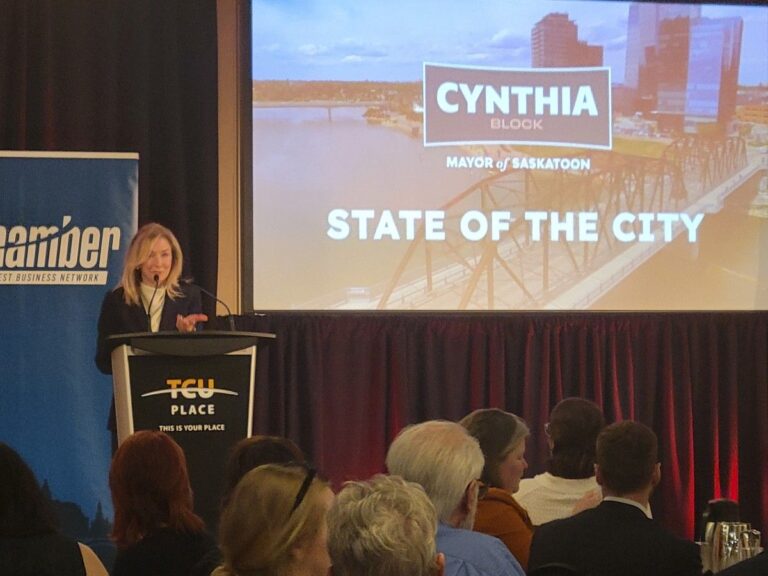
“Moving boldly” is the theme that Saskatoon’s mayor brought to her State of the City event, as she fielded questions from businesses and media on a range of hot topics.

THIS CONTENT IS RESERVED FOR SUBSCRIBERS ONLY
Subscribe now to read the latest news in your city and across Canada.
- Unlimited online access to articles from across Canada with one account.
- Get exclusive access to the Saskatoon StarPhoenix ePaper, an electronic replica of the print edition that you can share, download and comment on.
- Enjoy insights and behind-the-scenes analysis from our award-winning journalists.
- Support local journalists and the next generation of journalists.
- Daily puzzles including the New York Times Crossword.
SUBSCRIBE TO UNLOCK MORE ARTICLES
Subscribe now to read the latest news in your city and across Canada.
- Unlimited online access to articles from across Canada with one account.
- Get exclusive access to the Saskatoon StarPhoenix ePaper, an electronic replica of the print edition that you can share, download and comment on.
- Enjoy insights and behind-the-scenes analysis from our award-winning journalists.
- Support local journalists and the next generation of journalists.
- Daily puzzles including the New York Times Crossword.
REGISTER / SIGN IN TO UNLOCK MORE ARTICLES
Create an account or sign in to continue with your reading experience.
- Access articles from across Canada with one account.
- Share your thoughts and join the conversation in the comments.
- Enjoy additional articles per month.
- Get email updates from your favourite authors.
THIS ARTICLE IS FREE TO READ REGISTER TO UNLOCK.
Create an account or sign in to continue with your reading experience.
- Access articles from across Canada with one account
- Share your thoughts and join the conversation in the comments
- Enjoy additional articles per month
- Get email updates from your favourite authors
Sign In or Create an Account
or
Article content
Here’s a rundown of some of the discussions.
Article content
Article content
Downtown Event and Entertainment District
Article content
“In the 1960s, this building (TCU Place), once the Centennial Auditorium, was the front page of the newspaper and everyone was screaming ‘we don’t want this’,” Cynthia Block told the crowd on Thursday.
Article content
Article content
Now, she said she couldn’t imagine not having TCU Place in downtown Saskatoon.
Article content
By signing up you consent to receive the above newsletter from Postmedia Network Inc.
Article content
The same thing happened in the 1970s, when railroad tracks needed to be moved to make way for Midtown Plaza, Block noted.
Article content
“People were super mad. Could you imagine not having that anchor in our downtown?”
Article content
She said these kinds of public investments bring in tourism — and private investment follows.
Article content
Today’s examples, Block said, include the Link Bus Rapid Transit system and the Downtown Event and Entertainment District.
Article content
She alluded to the possibility of a partnership still being an option for the DEED, despite the previous potential partnership being voted down by city council.
Article content
She stressed that while there isn’t an announcement coming, she hopes there will be one in the future.
Article content
Block acknowledged that public pushback comes from caring, and fear loss, adding that she saw the DEED as a natural evolution of Saskatoon.
Article content
She said it’s not just a “nice to have” project: they are losing business due to less opportunities at the SaskTel Centre.
Article content

Article content
Homelessness
Article content
Block said Saskatoon had 1,931 people facing homelessness that were counted in the last point-in-time homelessness count.
Article content
Article content
“That’s up 30 per cent from last year. That is not sustainable, it is unmanageable, and I don’t think there’s a single person in this room that hasn’t been impacted by it and is frustrated.”
Article content
Article content
Block said the only way Saskatoon is improving the state of homelessness is through interim housing.
Article content
“There is no other way out … housing is the foundation to begin recovery in 99.99 per cent of cases.”
Article content
She said housing with wraparound services to support people facing homelessness can be really expensive, but the city is spending much more money doing what it is now to deal with homelessness.
Article content
Funding cities
Article content
Article content
She said cities maintain about 60 per cent of the infrastructure in the country, but only get about eight per cent of the tax revenue.
Article content
Many people are mad about their property assessment increasing, which causes their property taxes to increase, Block noted.
Article content
She said property taxes aren’t the right tool, and the four-year assessment cycle can create “enormous swings in assessment,” creating risk for homes and businesses.
Brody Langager
Read More
CNH Industrial Reports Decline in Q1 Construction Equipment Sales

The Case and New Holland parent says it continues to search for partners to expand its construction equipment business… Ben Thorpe
Read More
Stevie McKenna signs deal with Zuffa Boxing and returns to action on June 6 Bournemouth bill, live on Sky Sports

Stevie McKenna has signed a long-term deal with Zuffa Boxing and will return to action on June 6, live on Sky Sports.
On the Zuffa Boxing 07 bill at the Bournemouth International Centre, headlined by Chris Billam-Smith vs Ryan Rozicki, McKenna will fight American veteran Casey James Streeter.
Irish contender McKenna is always exciting to watch. He delivered thrilling fights in the UK in 2024. A three-round war with Joe Laws saw McKenna hit the canvas but ultimately prevail as he dropped Laws four times in all.
- Chris Billam-Smith: ‘I want to prove I’m the best in the world’
- Chris Billam-Smith vs Ryan Rozicki tickets available here
- Get Sky Sports or stream with no contract on NOW
- Download the Sky Sports app for expert analysis, best video & more
In another tremendous clash, he was edged out by Lee Cutler on a majority decision over 10 rounds in their fight in Liverpool.
Rivals McKenna and Cutler will both fight in separate bouts on the June 6 bill in the latter’s Bournemouth hometown.
Please use Chrome browser for a more accessible video player
Watch new angles of the incredible fight between Joe Laws and Stevie McKenna that had five knockdowns in just three rounds
His loss to Cutler in that all-action classic is the sole defeat McKenna has suffered in his professional career.
McKenna was an amateur standout, winning gold medals at the Haringey Box Cup and Commonwealth Youth Games before turning pro in 2019.
Before he met Cutler he went on a 15 bout winning streak, taking 14 of those victories inside the distance.
He has registered 11 of those knockouts in three rounds or less.
Please use Chrome browser for a more accessible video player
Watch the whole first round between Stephen McKenna and Joe Laws as both fighters suffered knockdowns in the opening three minutes
Streeter, his opponent on June 6, has a 15-3-2 (6) record. From Portland, Maine Streeter makes his UK debut following a stoppage defeat to Leo Ruiz on Zuffa Boxing 03.
Zuffa Boxing 07 will be broadcast live on Sky Sports in the UK and Ireland. As well as the battle between Bournemouth’s hometown hero Billam-Smith and Canadian KO artist Rozicki, an all-British chief support pits long-time cruiserweight contenders Jack Massey and Cheavon Clarke against one another.
Tickets are on sale now and can be purchased via BIC.co.uk.
Anthony Fleishman
Read More
Food, Energy Prices Push Inflation Rate to 15.69% in April – NBS


Food, Energy Prices Push Inflation Rate to 15.69% in April – NBS
Nigeria’s headline inflation rate increased to 15.69 per cent in April 2026, up from 15.38 per cent recorded in March, driven largely by rising food, transport, hospitality and healthcare costs across the country.
The latest figures were released on Friday by the National Bureau of Statistics in its Consumer Price Index report.
According to the report, the inflation rate rose by 0.31 percentage points compared to March 2026, although it remained significantly lower than the 26.82 per cent recorded in April 2025.
The bureau also disclosed that the Consumer Price Index increased to 138.3 points in April from 135.4 points in March, reflecting a 2.9-point increase in overall consumer prices.
Despite the rise in annual inflation, monthly inflationary pressure eased during the review period. On a month-on-month basis, headline inflation slowed to 2.13 per cent in April, compared to 4.18 per cent recorded in March.
The NBS explained that the slower monthly increase indicated that the pace of price growth in April was lower than in the preceding month.
Food and non-alcoholic beverages remained the biggest contributors to inflation, accounting for 6.40 percentage points of the overall rate. Restaurants and accommodation services contributed 3.56 percentage points, while transport added 1.70 percentage points.
Healthcare costs contributed 1.21 percentage points, while housing, water, electricity, gas and other fuels accounted for 0.77 percentage points.
Other contributors included personal care and miscellaneous goods and services at 0.64 percentage points, education services at 0.49 percentage points, clothing and footwear at 0.32 percentage points, and information and communication at 0.28 percentage points.
The report further showed that the average CPI for the 12 months ending April 2026 stood at 19.16 per cent, slightly below the 19.33 per cent recorded in April 2025.
Urban inflation was recorded at 15.40 per cent year-on-year, while monthly urban inflation slowed to 1.86 per cent from 3.16 per cent in March.
In rural areas, year-on-year inflation stood higher at 16.36 per cent, although monthly rural inflation eased to 2.80 per cent from 6.73 per cent in the previous month.
Food inflation also increased on a yearly basis, reaching 16.06 per cent in April 2026, compared to 24.68 per cent in April 2025. However, monthly food inflation slowed to 3.63 per cent from 4.17 per cent in March.
Read Also:
The NBS attributed the increase in food prices to rising costs of staple items such as millet, yam flour, fresh ginger, beef, garri, yam tubers, fresh pepper, crayfish, cassava tubers, beans, Irish potatoes, tomatoes, wheat grain, soybeans, guinea corn, plantain and carrots.
The bureau added that the average annual rate of food inflation for the 12 months ending April 2026 stood at 17.55 per cent, significantly lower than the 34.60 per cent recorded in April 2025.
Core inflation, which excludes volatile agricultural produce and energy prices, stood at 15.86 per cent year-on-year in April, compared to 26.05 per cent in April 2025. On a monthly basis, core inflation slowed sharply to 1.03 per cent from 4.03 per cent in March.
Further analysis showed that farm produce inflation rose by 19.8 per cent year-on-year and six per cent month-on-month, while energy inflation increased by 4.6 per cent annually and eight per cent monthly.
Services inflation stood at 16.7 per cent year-on-year and 2.1 per cent month-on-month, while goods inflation was recorded at 15.7 per cent annually and 3.2 per cent monthly. Imported food inflation stood at 10.5 per cent year-on-year and 4.4 per cent month-on-month.
At the state level, Sokoto recorded the highest year-on-year all-items inflation rate at 25.74 per cent, followed by Bauchi at 22.52 per cent and Zamfara at 22.03 per cent.
Edo recorded the slowest rise in inflation at 5.91 per cent, followed by Borno at 6.72 per cent and Jigawa at 7.04 per cent.
On a month-on-month basis, Niger State posted the highest increase in inflation at 5.66 per cent, followed by Kano at 4.50 per cent and Plateau at 4.39 per cent. Bayelsa recorded the slowest increase at 0.64 per cent, while Enugu and Rivers recorded 0.98 per cent and 1.02 per cent respectively.
For food inflation, Enugu recorded the highest year-on-year increase at 32.67 per cent, followed by Kwara at 30.77 per cent and Adamawa at 30.14 per cent. Borno recorded the slowest food inflation at 1.67 per cent, followed by Jigawa at 6.17 per cent and Taraba at 7.19 per cent.
The NBS cautioned that interstate inflation comparisons should be interpreted carefully due to variations in consumption patterns and household expenditure across states.
Meanwhile, the Financial Market Dealers Association had projected that headline inflation would rise to 16.42 per cent in April 2026 amid sustained pressure from food prices, higher energy costs and elevated global commodity prices.
However, the latest NBS figures showed that inflation settled below the projected level, despite continued pressure from food and energy prices.
By PRNigeria
Prnigeria
Read More
PenCom Inaugurates Free Healthcare Scheme For Low-Income Pensioners

News Investigators/ The National Pension Commission (PenCom) has inaugurated free healthcare scheme for low-income pensioners.
This is contained in a statement issued by the commission in Abuja on Friday.
The commission, therefore, urged retirees under the Contributory Pension Scheme (CPS) to enroll in the free healthcare initiative, the PenCare.
PenCom also said that retirees aged 60 and above, earning monthly pensions below N70,000 from Pension Fund Administrators (PFA), are qualified for the pilot programme.
It added that registration had opened for 30,000 eligible retirees on a first-come, first-served basis nationwide.
PenCom also advised interested retirees to register through its official website or designated PFAs’ platforms.
The commission described PenCare as “a corporate social responsibility initiative aimed at reducing retirees’ medical expenses and improving their wellbeing.”
PenCom reaffirmed commitment to protecting pensioners’ dignity through accessible healthcare support under the initiative.
NAN

Editor
Read More
US Business Leaders Optimistic About China Cooperation, Emphasize Importance of Chinese Market

© 2026 China Money Network. All Rights Reserved. Disclaimer: The views, opinions, forecasts, and statements made by our hosts and guests are the personal views of those respective individuals and may or may not be either endorsed or accepted by China Money Network Limited or the companies with which these individuals are employed.
Investment Research Team
Read More
UNICEF Moves to Strengthen Health Safety in Borno as New Supplies Reach Over 200 Facilities


(UNICEF Donates Infection Prevention Materials. Photo by Facebook Punchnewspaper)
The United Nations Children’s Fund (UNICEF) has supplied hygiene and infection control materials to more than 200 health facilities spread across all 27 local government areas in Borno State.
The donation was announced on Friday by the UNICEF Chief of the Maiduguri Field Office, Francis Butichi, at a meeting held in Maiduguri with officials from the Borno State Rural Water Supply and Sanitation Agency and the state’s healthcare services.
Butichi explained that the Water, Sanitation, and Hygiene Facility Improvement Tools (WASHFIT) were provided to raise the quality, safety, and long-term sustainability of healthcare services, particularly for women and children in the state.
He noted that the tools are designed to strengthen infection prevention and control, improve access to clean water, encourage proper hygiene practices, and enhance the management of healthcare waste all of which are critical to shielding patients, health workers, and surrounding communities from infections that could otherwise be avoided.
The donated items, which include buckets, sprayers, and detergents, were assessed in line with national standards as well as global guidelines from the World Health Organization and UNICEF.
Butichi also highlighted the urgent need for such intervention, pointing out that maternal deaths during childbirth remain a serious concern in Nigeria, with a woman dying every seven minutes during delivery often due to unsafe environments or poorly managed equipment.
He emphasized that the donation reflects UNICEF’s commitment to helping the government close critical gaps in facilities that fall short of minimum hygiene and infection control standards.
In response, the General Manager of the Borno State Rural Water Supply and Sanitation Agency, Muhammad Aliyu, praised the gesture, describing it as a well-timed intervention for vulnerable women and children in the state, and pledged that the materials would be properly used and maintained.
Tyisha Mcnaught
Read More
News24 | Ebola returns to the DRC: 246 cases, 65 deaths and a war zone blocking containment


A healthcare worker inoculates a man suspected to have Ebola in Butembo, Democratic Republic of the Congo on 27 July 2019.
JC Wenga/Anadolu Agency via Getty Images
- Health officials have reported 246 suspected Ebola cases and 65 deaths in the Ituri province of northeastern DRC.
- The Africa CDC has raised serious concerns about rapid transmission due to heavy population movement and the region’s proximity to the borders of Uganda and South Sudan.
- Controlling the outbreak is made significantly harder by the ongoing armed conflict in eastern DRC, where rebel groups have long fought for control of the mineral-rich region.
Health officials have raised the alarm over an outbreak of the Ebola virus in a remote region of the Democratic Republic of the Congo (DRC).
The Africa Centres for Disease Control and Prevention (CDC), the continent’s top public health body, said on Friday that it has recorded 246 suspected Ebola cases and 65 deaths in the Ituri province in the northeast of the country.
Concern is high regarding the potential spread of the virus, with efforts to control it complicated by a precarious security situation in the affected area, which sits on the border with Uganda and South Sudan.
The DRC government struggles to secure the east of the country due to activity by armed groups seeking control of valuable mineral deposits.
Preliminary laboratory results have reportedly detected the Ebola virus in 13 of 20 samples tested. The outbreak comes about five months after the DRC’s last Ebola bout was declared to be over, leaving 43 people dead.
READ | Democratic Republic of Congo declares end to Ebola outbreak
Africa CDC expressed concern over the risk that the new outbreak could spread rapidly due to intense population movement, the poor security situation in affected areas, and control challenges.
The agency said it is convening an urgent high-level meeting with health authorities from the DRC, Uganda and South Sudan, together with key partners, including UN agencies and other countries, to reinforce cross-border surveillance, preparedness and response efforts.

An Ebola treatment centre in Beni, Democratic Republic of Congo.
Andia/Universal Images Group via Getty Images
Ituri is in a remote eastern part of the DRC with poor road networks, and is more than 1 000km (620 miles) from the capital, Kinshasa.
‘Immediate priorities’
First identified in 1976 and thought to have crossed over from bats, Ebola is a highly contagious and deadly disease spread through direct contact with bodily fluids, causing severe bleeding and organ failure.
“Four deaths have been reported among laboratory-confirmed cases. Suspected cases have also been reported in Bunia, pending confirmation,” Africa CDC said, referring to the capital of Ituri.
It added in its statement:
The meeting will focus on immediate response priorities, cross-border coordination, surveillance, laboratory support, infection prevention and control, risk communication, safe and dignified burials, and resource mobilisation.
The DRC has seen more than a dozen Ebola outbreaks, the deadliest coming between 2018 and 2020, killing nearly 2 300 people.
Security risks make efforts to control such outbreaks highly challenging. The eastern DRC has been plagued for decades by groups seeking control of the mineral-rich region. Last week, an attack by armed rebels in Ituri province killed at least 69 people.
Following a rapid assault by the M23 rebel group, supported by Rwanda, in January last year, the DRC government has struggled to regain control of key cities amid a fragile ceasefire.
news24
Read More
Google built the internet economy. AI is rewriting it.


For the last two decades, most businesses have competed for visibility.
Google rankings, paid search, website traffic, marketplace positioning and social reach became the foundations of modern customer acquisition. Entire industries were built around helping brands climb search results, generate clicks and capture online demand more efficiently than competitors.
That ecosystem created clear winners. Companies learned how to optimise websites, dominate search rankings and engineer discovery at scale. In many sectors, visibility itself became the commercial advantage.
But AI is quietly reshaping that entire model.
A growing debate within the technology and marketing world has focused on how artificial intelligence could compress traditional online sales funnels. Instead of manually filtering through pages of options, consumers increasingly ask AI-driven platforms to recommend outcomes directly.
That is a fundamentally different type of discovery.
Historically, search has largely operated as a filtering exercise. A customer searches broadly, narrows options and gradually works towards a decision. AI changes that dynamic entirely.
Instead of asking “show me serviced offices in London”, the query becomes far more specific and outcome-driven: find me a 30-desk office near Monument with strong breakout space, hospitality-led service, natural light and flexibility to scale over the next 12 months.
The same pattern is emerging across sectors. Consumers are no longer simply searching for products. Increasingly, they are asking systems to identify the best option for a particular outcome. That changes commercial priorities dramatically.
AI becomes less about presenting inventory and more about recommending trusted solutions. Visibility alone becomes less valuable. Recommendation becomes paramount.
Flexible offices may prove one of the clearest real estate examples of this shift because the market already behaves more like a consumer industry than a traditional property one. Faster decision-making, shorter commitment cycles and constant comparison between operators have made digital discovery central to the sector’s growth. And we are already seeing early signs of the transition.
Client satisfaction metrics are becoming increasingly important, with operators investing more heavily into platforms such as Resonate and using Net Promoter Scores alongside structured client feedback not simply as operational tools, but as commercial signals. Google reviews are now actively encouraged throughout the client journey, with many operators integrating review requests directly into customer touchpoints and renewal discussions.
Reputation management has moved beyond marketing. Increasingly, it is becoming part of the sales infrastructure itself. And because recommendation engines naturally favour consistency, satisfaction and trust, that matters. The internet rewarded visibility. AI rewards quality.
This is also why expertise is unlikely to disappear, despite the inevitable predictions that accompany any technological shift. In the office market, there is frequent speculation around whether AI will reduce the role of brokers. The reality is probably the opposite at the top end of the market.
The lower-value parts of the process — filtering options, comparing specifications and narrowing shortlists — will inevitably become more automated. But the best brokers have never simply provided options. They act as advisers, negotiators and market interpreters. They understand growth trajectories, operational requirements and commercial risk in ways algorithms still cannot.
As markets become more complex, that strategic guidance arguably becomes more valuable, not less. In many ways, this mirrors what has already happened across multiple industries, where technology compresses administrative friction while increasing the value of genuine expertise.
What may change more materially is how brands compete for attention in the first place.
For years, much of modern marketing has revolved around lead generation mechanics: search rankings, paid acquisition, conversion funnels and traffic optimisation. Increasingly, businesses may need to think more carefully about trust, recognition and recommendation.
If AI narrows the shortlist before a customer even visits a website, brand becomes significantly more important. Companies consistently referenced, discussed and positively reviewed gain an advantage long before direct engagement begins.
That helps explain why so many businesses are now investing heavily into customer experience, content, hospitality, events and broader brand positioning. Across the flexible office market there has been a noticeable shift away from simply marketing desks and square footage towards building recognisable operator identities with clearer positioning and stronger customer engagement.
At Halkin, we have invested heavily into exactly that over the past year. Not simply because branding looks good in a pitch deck, but because the market increasingly rewards businesses with a recognisable identity and reputation for delivery. Increasingly, the experience around the product becomes part of the product itself.
That may ultimately become one of the defining commercial shifts of the AI era. The last two decades rewarded those best at capturing attention. The next will reward those most trusted by the systems directing it.
Freddie Bailey
Read More