Donald Reflects On His Friendship With AKA In Heartwarming Tribute. A wave of emotion has swept through South Africa’s music community after R&B singer Donald shared a deeply personal tribute to late rap icon AKA, revealing the story behind the nickname “Platinum Donny.”
Donald Reflects On His Friendship With AKA In Heartwarming Tribute
Taking to social media, Donald reflected on the bond he shared with AKA, describing moments of genuine respect and encouragement that left a lasting mark on his career. “This brother showed me so much respect and love, and gave me the nickname ‘Platinum Donny’. I miss you Mega,” he wrote, accompanying the message with a nostalgic image that stirred memories among fans.
The post quickly gained traction, drawing heartfelt reactions from followers who remembered the visible camaraderie between the two artists. Though they operated in different musical lanes, Donald with his smooth R&B sound and AKA with his commanding hip-hop presence, their connection stood as a reminder of the unity that can exist across genres.
“Platinum Donny” carried more weight than a simple nickname. It symbolised recognition of Donald’s commercial success and growing influence at a time when he was dominating airwaves and stages. AKA, known for his sharp confidence and larger-than-life persona, used the title as a stamp of respect. Donald later clarified that while Cassper Nyovest coined the name “Donito,” AKA introduced “Platinum Donny,” highlighting a more personal layer to their friendship.
On the April 24 episode of “Music Bank,” the candidates for first place were TXT’s “Stick With You” and PLAVE’s “Born Savage.” TXT ultimately took the prize with a total of 10,515 points.
Congratulations to TXT! Watch the winner announcement and encore below!
Performers on today’s show included TXT, LE SSERAFIM, NCT WISH, &TEAM, CORTIS, MODYSSEY, B1A4, Kim Jae Hwan, KickFlip, AMPERS&ONE, WJSN’s Dayoung, EVNNE, CLOSE YOUR EYES, UNCHILD, Xdinary Heroes, INI, KEYVITUP, and Lee Ji Hoon.
Watch the performances below:
TXT – “Stick With You”
LE SSERAFIM – “CELEBRATION”
NCT WISH – “Ode to Love”
&TEAM – “We on Fire (Korean Ver.)”
CORTIS – “REDRED”
MODYSSEY – “HOOK”
B1A4 – “Rock Paper Scissors”
Kim Jae Hwan – “I’ll Be There”
KickFlip – “Eye-Poppin’”
AMPERS&ONE – “GOD”
WJSN’s Dayoung – “What’s a girl to do”
EVNNE – “Backtalk”
CLOSE YOUR EYES – “POSE”
UNCHILD – “UNCHILD”
Xdinary Heroes – “Voyager”
INI – “All 4 U (Korean Ver.)”
KEYVITUP – “KEYVITUP”
Lee Ji Hoon – “Good Enough”
Watch full episodes of “Music Bank” with English subtitles below:
Betty Gibbon’s Jan C’est Vrai is on display in the Artists’ Workshop’s annual spring show and sale.Supplied photo
Article content
A variety of events offer entertainment for all ages, with music, art, theatre or educational options to explore.
THIS CONTENT IS RESERVED FOR SUBSCRIBERS ONLY
Subscribe now to read the latest news in your city and across Canada.
Unlimited online access to articles from across Canada with one account.
Get exclusive access to the Saskatoon StarPhoenix ePaper, an electronic replica of the print edition that you can share, download and comment on.
Enjoy insights and behind-the-scenes analysis from our award-winning journalists.
Support local journalists and the next generation of journalists.
Daily puzzles including the New York Times Crossword.
SUBSCRIBE TO UNLOCK MORE ARTICLES
Subscribe now to read the latest news in your city and across Canada.
Unlimited online access to articles from across Canada with one account.
Get exclusive access to the Saskatoon StarPhoenix ePaper, an electronic replica of the print edition that you can share, download and comment on.
Enjoy insights and behind-the-scenes analysis from our award-winning journalists.
Support local journalists and the next generation of journalists.
Daily puzzles including the New York Times Crossword.
REGISTER / SIGN IN TO UNLOCK MORE ARTICLES
Create an account or sign in to continue with your reading experience.
Access articles from across Canada with one account.
Share your thoughts and join the conversation in the comments.
Enjoy additional articles per month.
Get email updates from your favourite authors.
THIS ARTICLE IS FREE TO READ REGISTER TO UNLOCK.
Create an account or sign in to continue with your reading experience.
Access articles from across Canada with one account
Share your thoughts and join the conversation in the comments
Enjoy additional articles per month
Get email updates from your favourite authors
Music Sign In or Create an Account
or
Article content
Music 1. Hear a local music performance
Article content
Article content
Solstice Vocal Jazz performs songs from their gospel and regular repertoires.
Article content
The show is Friday at St. John’s Anglican Cathedral at 7:30 p.m. Funds support the restoration project at the heritage cathedral. Learn more at solsticevocaljazz.com.
Article content
Article content
The Discovering the Amatis series presents its final concert of the season, Echoes of Home with the Frontier String Quartet.
Article content
By signing up you consent to receive the above newsletter from Postmedia Network Inc.
Article content
Violinists Veronique Mathieu and Destiny Mermagen, violist Shah Sadikov and cellist Michael Mermagen perform on University of Saskatchewan’s quartet of Amati string instruments from the 17th century.
Article content
Featured music include works by Antonín Dvořák, Bedřich Smetana, and a commissioned piece by David Raphael Scott.
The Artists’ Workshop presents its annual spring show and sale.
Article content
Featured works by the 12 group artists, in a wide range of mediums, showcase diverse perspectives. Each artist also contributed to a collection of works on the concept of passages.
Article content
Artists include Jean Dudley, Kathleen Slavin, Wendy McLeod, Paige Mortensen, Betty Gibbon, Sharron Schoenfeld, Celeste Dumonceaux-Delahey, Leslie Stadnichuk, Patricia Katz, Annie Simmie, Jill Scott and Val Miles.
Article content
Article content
The show and sale is Friday through Sunday at Grace-Westminster United Church. Learn more at artistsworkshop.ca.
Article content
Article content
The University of Saskatchewan Galleries present Art*Cycled: The Gleaners, the latest installment in an annual series.
Article content
The exhibition features the works of 12 senior sculpture students in the School of the Arts working with recovered and recycled materials.
Article content
Highlighting the tradition of gleaning — gathering and creatively re-framing waste and discarded material — the artists consider consumption, material culture and sustainability through their sculptures.
Article content
A pop-up exhibition and reception run Friday, 6 to 8 p.m., and an open house is Saturday, noon to 5 p.m., at the Caswell Bus Barns. Learn more at kagcag.usask.ca.
Article content
Music 3. Learn about Prairie tree planting
Article content
Friends of the Forestry Farm House present Trees Against the Wind, with author William Schroeder.
Article content
The book explores the history of Prairie shelterbeds, a Canadian program that ran from 1901 to 2013 and distributed 618 million trees to Prairie farmers.
Article content
Schroeder’s presentation focuses on tree planting on the Prairies.
Yung Lean has released his first songs since 2025’s Jonatan, as part of the soundtrack to a new short film starring the Swedish rapper and directed by Romain Gavras. The film, set in 2034, puts Lean back in primary school alongside a cohort of well-dressed, slightly less well-behaved young gentleman. Give it a watch below.
The new songs, both collaborations with French producer Gener8ion, comprise a two-track single that’s also out today on streaming services.
Yung Lean released Jonatan in May of last year, supporting the record with an extensive tour. He announced the dates shortly after the premiere of his Live at Globen concert film, recorded during an arena show in his hometown of Stockholm and complete with Avengers-style Drain Gang appearances from Yung Sherman, Gud, Bladee, Ecco2k, and Thaiboy Digital. In September, Yung Lean also shared the Bladee collaboration “Inferno.”
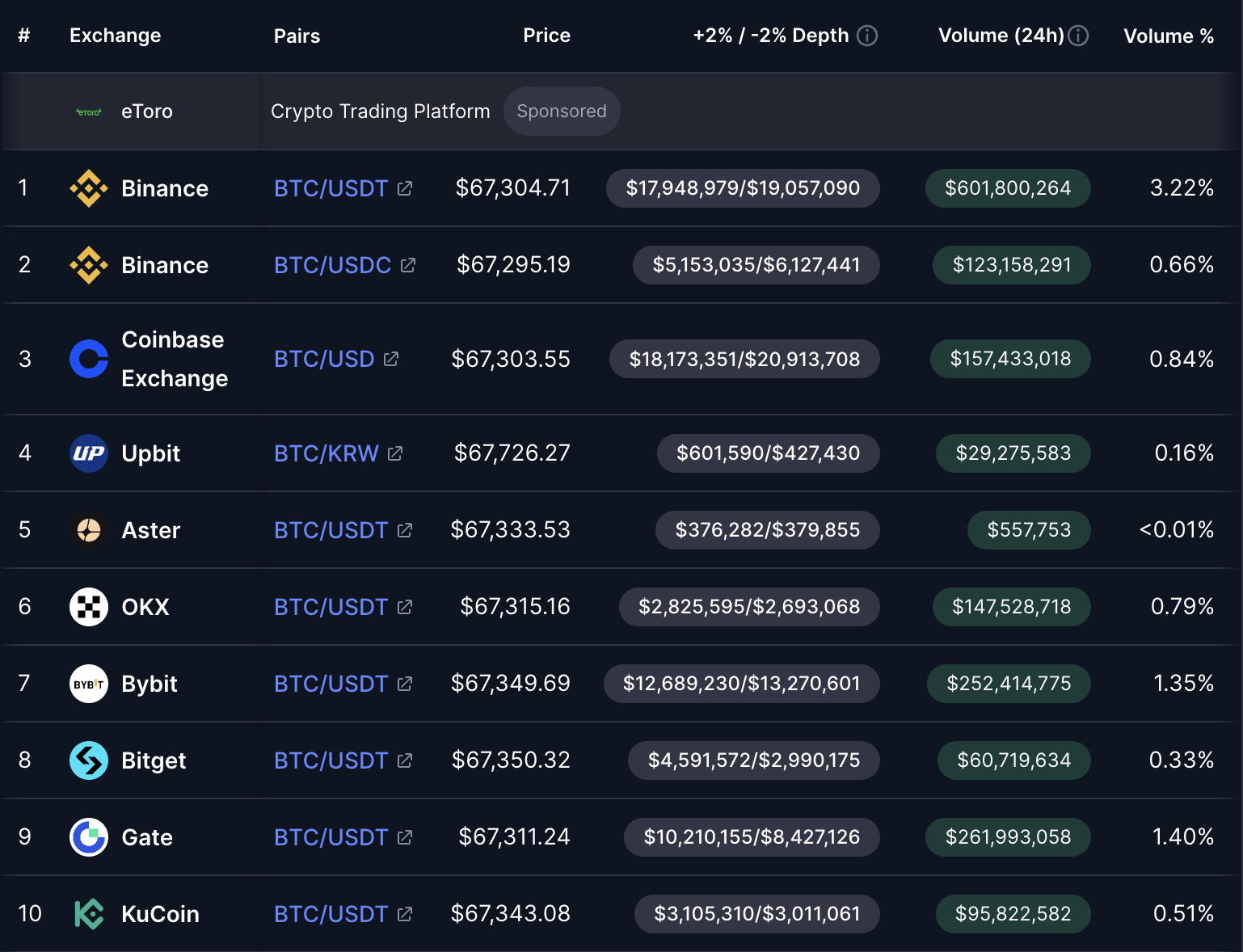
US dollar-pegged stablecoins and Bitcoin (BTC) share a symbiotic relationship, mutually benefiting from increasing adoption, according to Sam Lyman, head of research at Bitcoin Policy Institute (BPI), a Washington DC-based digital asset advocacy organization.
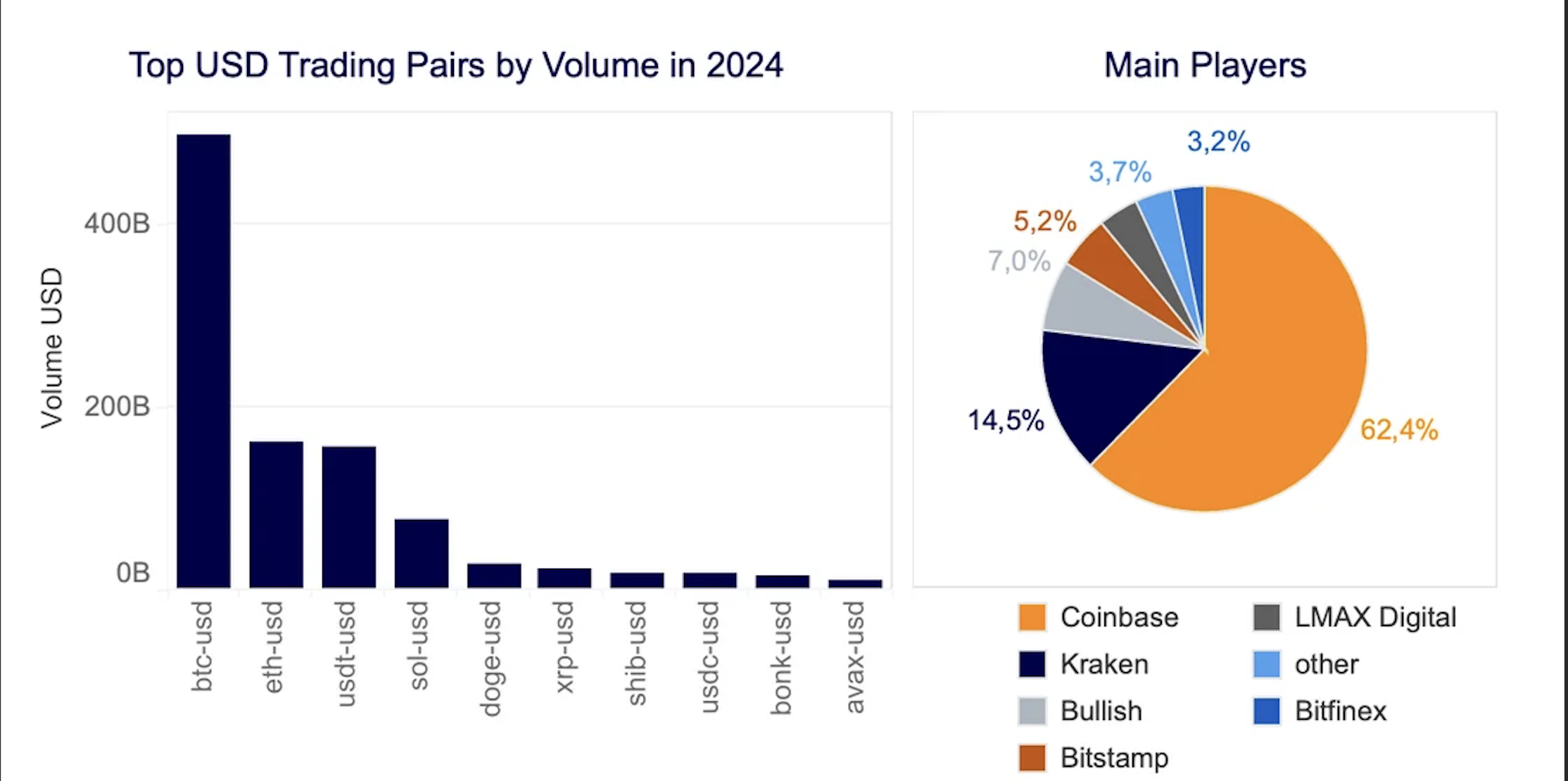
“Bitcoin is beneficial to the US system because the largest Bitcoin trading pair is BTC/USD,” or Tether’s USDt (USDT) stablecoin, which is backed by cash deposits and short-term US government debt, Lyman told Cointelegraph. He added:
“There is a symbiotic relationship between BTC and the dollar system because BTC is most frequently traded in dollars. So, I do see those things as being mutually reinforcing, which runs contrary to the narrative around BTC that it would actually undermine the dollar.”
US dollar-based trading pairs dominate the BTC market. Source: CoinMarketCap
He said Bitcoin and dollar-pegged stablecoins share a similar relationship to the dollar and oil. Under the petrodollar system, which began in the early 1970s, international oil sales are priced in dollars, driving more demand for the currency.
Lyman urged US lawmakers to continue developing stablecoin regulations introduced in the GENIUS regulatory framework, without deviating from its core principles, to strengthen and protect US dollar hegemony and remain competitive in geopolitics.
Data from 2024 also reflects the dominance of the dollar in BTC markets. Source: Kaiko
Bitcoins China clamps down on permissionless blockchain tech to push for CBDC
The People’s Republic of China has “banned” Bitcoin and stablecoins several times, because both are a “tremendous threat” to the government’s capital controls, which are a critical component of the Chinese economy, Lyman told Cointelegraph.
“The entire Chinese economy depends on capital controls. China is able to keep money within the country by preventing its elite from moving money out of the country,” he said.
This is why China reaffirmed its stablecoin ban in 2025, choosing instead to launch the digital yuan, a yield-bearing central bank digital currency (CBDC) to control capital flows and capture a larger portion of the foreign currency exchange market, Lyman said.
CBDCs are fully programmable and controlled by the government or the central bank issuing the digital fiat currency.
However, the bans have failed to actually curtail permissionless crypto activity, including Bitcoin mining and stablecoin flows to and from China, Lyman said.
Despite a blanket ban on Bitcoin mining, Chinese mining pools control more than 36% of the mining pool global hashrate, or the total amount of computing power mining pools are contributing to secure the network, according to Hashrate Index.
Cointelegraph is committed to independent, transparent journalism. This news article is produced in accordance with Cointelegraph’s Editorial Policy and aims to provide accurate and timely information. Readers are encouraged to verify information independently.
MIDAR for Investment and Urban Development, master developer of integrated mega cities in New Cairo, has signed a memorandum of understanding with Gruppo GKSD Italy to establish a landmark medical, educational, and research complex within its Mada project in East Cairo. The project is expected to attract investments ranging between €500m-600m.
Ayman Elkousy, CEO and Managing Director of MIDAR, described the initiative as “the first real step toward building the healthcare core of Mada,” underscoring its role in creating a comprehensive medical hub.
The development will be executed in partnership with GKSD Investment Group, with Hospital Healthcare Holdings serving as the specialized medical and operational partner. Feasibility and technical studies began in 2025, and MIDAR aims to finalize all financial, engineering, and technical studies by the end of 2026 to complete the investment model.
According to Elkousy, the medical city will be “fully integrated,” encompassing specialized hospitals, medical universities, nursing schools, and advanced training centers designed to transfer European expertise to Egyptian doctors. Hospitality and accommodation services will also be included to support patients and residents.
The project is intended to deliver specialized medical services previously unavailable in Egypt, reducing the need for patients to seek treatment abroad. Elkousy emphasized its role as a “medical and investment link” connecting Europe, Egypt, and wider African markets.
He added that MIDAR will announce another major investment within Mada in the coming weeks, following a mixed-use model that combines commercial and hospitality elements, with an investment size comparable to the medical city.
Kamel Ghribi, Chairperson of Gruppo GKSD, reaffirmed the group’s strategic commitment to Egypt, describing the country as a pivotal hub for healthcare innovation in the region. “In line with our mission to foster global health security, GKSD views Egypt not only as a land of immense opportunity but also as a critical partner in advancing quality healthcare infrastructure,” Ghribi said.
Algorand has emerged as an early standout in the crypto market’s latest quantum security debate after a recent Google Quantum AI paper highlighted the blockchain as a live example of post-quantum cryptography being deployed on a network.
The attention came as the paper sharpened concerns around Bitcoin and Ethereum, two networks whose size, age, and design choices could make any future migration to quantum-resistant infrastructure slower and more complicated.
Against that backdrop, Algorand’s quieter work on Falcon digital signatures, state proofs, and key rotation suddenly looked less like a niche technical experiment and more like a practical head start.
The shift in attention helped lift Algorand’s token sharply over the past week, with traders treating the Google paper as validation of work already underway on the network.
According to CryptoSlate’s data, ALGO, the blockchain network’s native token, is one of the top performers over the past week, gaining around 50% to rise to $0.12 as of press time. Notably, the price performance came less than a week after the token fell to an all-time low of $0.08.
Bitcoins Algorand’s quiet quantum computing lead over Bitcoin and Ethereum
Algorand’s advantage over Bitcoin and Ethereum is narrower than the recent enthusiasm suggests, but it is also more concrete than what many larger chains can currently show.
In its paper, Google described Algorand as an example of real-world deployment of post-quantum cryptography on an otherwise quantum-vulnerable blockchain.
The distinction was important. It did not say Algorand had solved the problem end-to-end, but it did point to a network that had moved from theory into live implementation.
Algorand’s core consensus and built-in transactions still rely on Ed25519, which remains vulnerable in a sufficiently advanced quantum scenario.
However, the network has already deployed Falcon digital signatures for smart transactions and state proofs, the cryptographic attestations used to verify blockchain state across chains. It has also made Falcon verification available as a primitive for developers building on the Algorand Virtual Machine, giving the ecosystem a working set of tools rather than just a roadmap.
The network executed its first post-quantum-secured transaction in 2025, a milestone that set it apart from many larger rivals that are still debating design paths, governance trade-offs, and implementation timelines.
Algorand also allows users to rotate the private keys associated with their accounts, a feature that does not eliminate the underlying threat but could make future migrations more manageable.
That combination, live transaction capability, developer tooling, state-proof support, and native key rotation, is what turned Algorand into a focal point as the paper circulated through the market.
In a sector where many conversations around quantum risk remain theoretical, Algorand could point to infrastructure already in production.
Bitcoins Bitcoin and Ethereum face quantum computing risk
For Bitcoin, the concern is not only whether quantum computers will eventually be able to derive private keys from public information, but also how much of the network’s legacy footprint would be difficult to migrate in time.
The paper said a quantum computer with fewer than 500,000 physical qubits could crack the elliptic-curve cryptography protecting Bitcoin wallets, a far lower threshold than earlier estimates that ran into the millions.
Google’s own most advanced chip, Willow, remains far below that level, but the revised estimate has intensified scrutiny of how much Bitcoin could be exposed if the technology advances faster than expected.
CryptoSlate Daily Brief
Daily signals, zero noise.
Market-moving headlines and context delivered every morning in one tight read.
5-minute digest 100k+ readers
Free. No spam. Unsubscribe any time.
You’re subscribed. Welcome aboard.
The burden is particularly acute because some of Bitcoin’s oldest addresses keep public keys visible on-chain.
The paper cited an estimated 6.7 million BTC in older Pay-to-Public-Key addresses, including coins long associated with Bitcoin creator Satoshi Nakamoto.
Even outside those legacy wallets, the migration challenge is politically and technically heavy for a network that prioritizes backward compatibility and moves cautiously on base-layer changes.
Quantum risk, in Bitcoin’s case, is as much a governance and coordination problem as it is a cryptographic one.
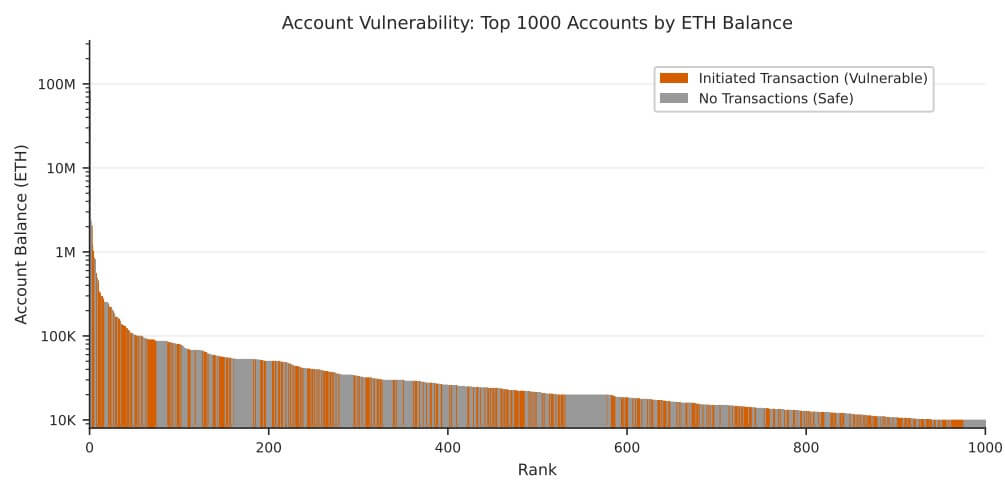
Once an Ethereum user sends a transaction, the public key tied to that account becomes permanently visible on-chain. The paper said that this leaves the top 1,000 Ethereum wallets, holding roughly 20.5 million ETH, exposed under a sufficiently advanced quantum attack.
Vulnerable Ethereum Wallets to Quantum Computing Risks (Source: Google)
It also identified at least 70 major contracts with administrator keys visible on-chain, which ultimately control far more than the ETH they directly hold, including stablecoin minting authority and other system-critical permissions.
Moreover, the attack surface extends beyond wallets and contract administrators.
Ethereum’s proof-of-stake validator set, major Layer 2 networks, and parts of its data-availability architecture all rely on cryptographic components the paper described as vulnerable.
According to the paper, roughly 37 million ETH is staked, and much of Ethereum’s transaction load now flows through rollups and bridges that inherit assumptions from the base layer.
That means any serious post-quantum migration would have to reach not only users and validators, but also the network of applications and scaling systems built around them.
Renewed signals from Strategy’s bitcoin activity hint at another major purchase as Michael Saylor resumes a closely watched “orange dot” posting pattern tied to accumulation cycles.
Key Takeaways:
Michael Saylor’s “orange dot” post revived, fueling anticipation of a massive bitcoin buy announcement.
Strategy holds 762,099 BTC, underscoring its dominant reserve and long-term accumulation model.
SEC filing confirmed Strategy paused bitcoin purchases last week, pausing its steady accumulation streak.
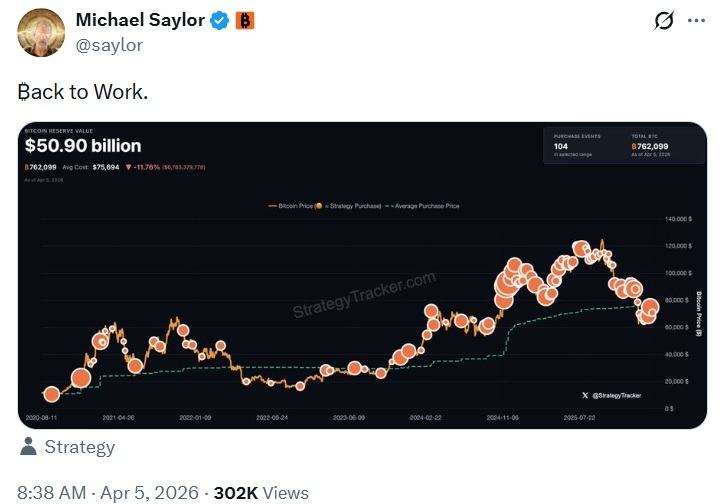
Expectations have intensified that Strategy (Nasdaq: MSTR) could have added a substantial amount of bitcoin after a new post by Michael Saylor. The executive chairman of Strategy shared on social media platform X on April 5 a brief message marking a return to his widely followed “orange dot” updates after skipping the prior week. Market participants closely monitor these posts for signals tied to Strategy’s buying activity.
“Back to Work,” Saylor wrote. The message accompanied a chart summarizing Strategy’s bitcoin reserve trajectory, showing a total of 762,099 BTC. The graphic displayed cumulative buying activity across multiple market cycles, with dots marking each acquisition over time.
The trend line suggests consistent accumulation during both rising and declining price periods. The visualization points to a long-term approach rather than short-term trading behavior. The clustering of purchases during price dips suggests systematic buying rather than reactive decision-making. The return of the orange dot format has historically aligned with purchase disclosures, driving expectations of another update.
Bitcoins SEC Filing Pause and Market Data Frame Strategy Next Move
The post followed a quieter period disclosed in a recent regulatory filing, where Strategy reported no bitcoin purchases or share sales for the week ending March 29. According to the Form 8-K filed with the U.S. Securities and Exchange Commission (SEC), the company maintained its existing position without deploying additional capital. Strategy stated: “On March 30, 2026, Strategy Inc. announced that, during the period between March 23, 2026 and March 29, 2026, Strategy did not sell any shares under its at-the-market offering program and did not purchase any bitcoin.”
Strategy’s dashboard data presented the company’s broader financial position alongside its bitcoin exposure. The firm’s market capitalization was near $41.4 billion, while its enterprise value reached approximately $57.3 billion. The bitcoin reserve totals 762,099 BTC, with an estimated value of around $50.90 billion based on a market price near $67,335. The average acquisition cost stands close to $75,894 per bitcoin, reflecting a large cumulative investment. Other indicators included implied volatility near 66% and annualized historical volatility exceeding 70%. The data also showed significant leverage metrics, dividend coverage, and capital structure alignment tied to bitcoin holdings. These figures reflects how Strategy integrates bitcoin into its corporate treasury model. With Saylor resuming his signature posting style, anticipation has grown that Strategy could announce a new bitcoin purchase on Monday, consistent with its typical disclosure cadence.
Bitcoins Bitcoin’s correlation with global central bank easing has turned strongly negative since 2024, suggesting BTC now leads rather than lags monetary policy signals.
Bitcoin may no longer move in step with Federal Reserve policy, according to a new report from Binance Research, which points to a structural shift driven by spot exchange-traded funds.
For years, crypto markets reacted sharply to interest rate signals, with bitcoin falling when central banks tightened monetary policy.
That pattern now appears to be breaking as Binance data shows bitcoin’s correlation with its Global Easing Breadth Index, which tracks 41 central banks, has turned strongly negative since 2024. Spot bitcoin ETFs were approved by the U.S. Securities and Exchange Commission (SEC) in January 2024.
Before ETFs, the relationship was mildly positive, with BTC tending to follow global easing cycles by several months. Now, the report finds the opposite effect is nearly three times stronger, suggesting the old link has reversed.
The change reflects a shift in who drives prices. Retail investors once dominated crypto trading and reacted to macro news. ETFs allowed institutions to play a bigger role, and these firms often positioned months ahead of policy changes, treating BTC as a forward-looking asset.
“As a result, BTC may have evolved from a macro ‘lagging receiver’ to a ‘leading pricer,” Binance Research wrote. “A peak in easing may already be old news for BTC, and crypto-native drivers—such as policy progress and institutional flows—could matter more than the direction of monetary easing itself.”
The findings come as markets grapple with renewed stagflation fears tied to rising oil prices and growing geopolitical tensions over the war in the Middle East.
Rate expectations have swung from projected cuts to possible hikes, a backdrop that historically pressured risk assets.
Binance argues that the reaction may be overstated. In past cycles, central banks often pivoted to support growth despite inflation spikes. If history repeats itself, central banks are to eventually prioritize growth over inflation, and bitcoin will likely price that pivot earlier than expected.
AI Disclaimer: Parts of this article were generated with the assistance from AI tools and reviewed by our editorial team to ensure accuracy and adherence to our standards. For more information, see CoinDesk’s full AI Policy.
More For You
A hopeful posting on Iran from President Trump helped erase morning losses.
Selling pressure from other market participants is offsetting incremental institutional buying and sustaining the current wave of distribution.
Under the current crypto market conditions, Bitcoin exchange-traded funds (ETFs) and some institutions are still in accumulation mode. However, spot demand remains weak. Market research platform CryptoQuant explained why this contraction has persisted in its latest weekly report.
According to the firm’s findings, spot demand has remained in deep contraction because broader market selling pressure outweighs institutional buying. Selling from retail and other market participants is more than offsetting incremental institutional buying; this trend is sustaining the current wave of distribution.
Bitcoins Spot Demand Remains Contracted
In March, ETF 30-day purchases increased sharply to roughly 50,000 bitcoin (BTC). This was the highest the investment products had recorded since October 2025. On the other hand, the business intelligence entity, Strategy, recorded a 30-day accumulation of approximately 44,000 BTC.
Contrarily, the 30-day apparent demand growth hovered at -63,000 BTC by the end of March. This figure reflected persistent selling pressure in the broader market. Spot demand has witnessed sustained contraction since late November 2025, confirming a distribution phase.
Among other market participants, Bitcoin whales have become net distributors, with the one-year change in their holdings reading -188,000 BTC. This cohort of investors accumulated over 200,000 BTC in 2024, but began distributing aggressively from mid-2025, with an increased pace in the last quarter of the year and early 2026.
“The 365-day SMA remains in a declining trend, confirming that this distribution is structural rather than temporary. Historically, sustained negative whale accumulation has coincided with periods of prolonged price weakness, and the current reading suggests selling remains a significant structural headwind,” CryptoQuant explained.
Bitcoins BTC Faces Possible Relief Rally
Unlike whales, mid-tier holders, also known as dolphins, have remained net accumulators, but at a reduced pace. The one-year change in the holdings of these investors has declined by more than 60% from almost 1 million BTC in October 2025 to 429,000 BTC today.
Furthermore, demand from U.S. investors has also weakened in recent weeks, as seen in the Coinbase Premium turning negative again. The metric turned negative after BTC hit its all-time high of $126,000 in early October and has since been unable to sustain a meaningful positive trajectory.
Given the market’s state, CryptoQuant analysts believe BTC may rebound toward $71,500-$81,200 in the short term if macro conditions, especially the US-Iran conflict, improve. In essence, de-escalating geopolitical tensions may serve as a positive catalyst, triggering a relief rally.
SPECIAL OFFER (Exclusive)
Binance Free $600 (CryptoPotato Exclusive): Use this link to register a new account and receive $600 exclusive welcome offer on Binance (full details).
LIMITED OFFER for CryptoPotato readers at Bybit: Use this link to register and open a $500 FREE position on any coin!