As the new year arrives, this is the perfect time to catch the Quadrantids meteor shower. Along with other skywatching tips for January, this is a great opportunity to enjoy a sight of the night sky which you can view without needing any special equipment.
What to expect from the Quadrantids meteor shower
The Quadrantids meteor shower happens once per year when the Earth passes through a patch of debris in its orbit. This debris includes small chunks of rock that enter the atmosphere and burn up, creating meteor streaks across the night sky. These patches of debris are typically left by comets, though in the case of the Quadrantids it was an asteroid called asteroid 2003 EH1 which caused the debris responsible for the shower.
The Quadrantids is one of the biggest meteor showers of the year, running from December through to January. But the shower will peak next week, so that’s the best time to head out and look up if you’re hoping to catch a meteor or two.
How to watch the Quadrantids meteor shower
The Quadrantids shower will peak over the evening of January 3 to January 4, though you may be able to catch some meteors in the sky in the days before and after as well. But your best chance for a great view will be to go out late in the evening of January 3, or just before dawn on January 4, as there will be a bright moon out which will be nearly full and which will make it harder to spot meteors.
You’ll need clear skies to be able to see the shower, so hope for a cloudless night, and do remember to wrap up warm as you can get very cold when staying still outside. Try to get far away from bright light sources like cities, and try to avoid looking at your phone too much as this will mess with your night vision.
Find a quiet spot and lie on the ground, looking up at the sky. After around 15 to 20 minutes your eyes should have adjusted to the darkness and you should be able to see better. You’ll be able to spot the meteors as streaks of light shooting across the sky, with potentially more than 100 meteors per hour being visible if you’re lucky.
OnePlus started with an intriguing idea: design a smartphone that combines flagship quality and features at a lower price than competing phones from companies like Samsung, Apple, and Google. Its goal is to enhance the customer experience in everyday use without adding a hefty price tag. That price tag may have crept upwards over the years, but so has the quality of OnePlus’ smartphones, and now the manufacturer can easily claim it stands toe to toe with the greats.
OnePlus segments its offerings into two categories, and as you might expect, the more expensive flagships pack the best features. The alternate OnePlus Nord devices are designed as budget models, so prices are lower and features are pared down — but they’re still generally excellent smartphones. OnePlus used to release flagships twice a year: a main flagship in the spring and a T version of the same phone in the fall. But recently, that schedule has become somewhat erratic.
Note some OnePlus phone models may be sold only in Europe and India while not specifically sold in the U.S. Even so, buyers in North America do have the option of purchasing or importing most OnePlus models from Amazon or the OnePlus website.
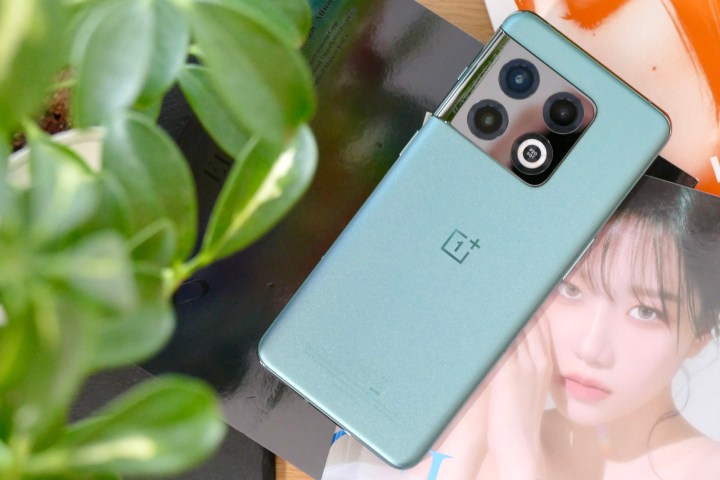
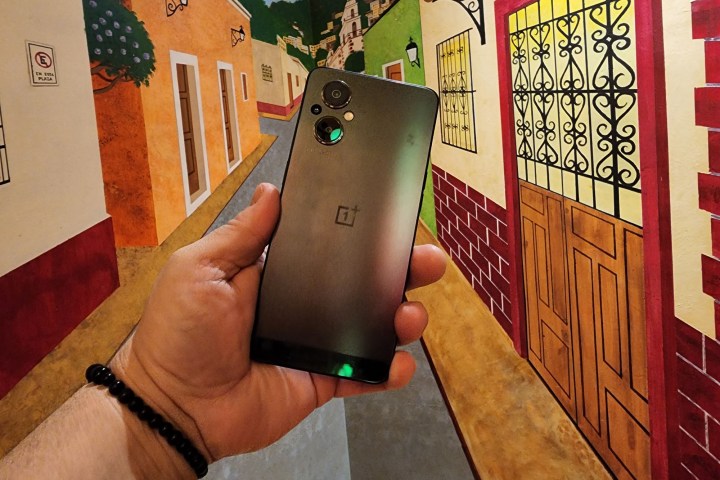
At 8.6mm thick and 200 grams, the OnePlus 10 Pro is an easy-to-live-with, pocketable smartphone with dimensions that reflect its superior build quality and materials. With Gorilla Glass Victus on the screen, paired with Gorilla Glass 5 on the back, both glass modules are joined via a metal chassis that feels and looks great. The top OnePlus 10 Pro has 12GB RAM and 256GB of storage space alongside a Qualcomm Snapdragon 8 Gen 1 processor. An 8GB RAM, 128GB storage model is also available if you want to save a bit of money.
The OnePlus 10 Pro’s 6.7-inch AMOLED screen has a 3216 x 1440 pixel resolution, a sharp 525 pixel-per-inch density, and a dynamic 120Hz refresh rate. The panel is an LTPO 2.0 AMOLED for a faster refresh, and it looks clear and vivid.
The second generation of Hasselblad Camera for Mobile software accompanies a 48-megapixel main camera, a 50MP wide-angle camera with a 110-degree field of view, and an 8MP telephoto for a 3.3x optical zoom. It also offers a 150-degree wide-angle camera mode. Ultimately, this combination offers strong images, and Hasselblad’s expertise can really be felt in some areas of the app. Stills are balanced but still pop. The other lenses are a more mixed bag, with some issues with noise. The OnePlus 10 Pro camera can’t compete with the likes of the iPhone 14 Pro, but it is still a lot of fun to shoot with.
The OnePlus 10 Pro’s battery lasts a day and a half with a full charge and moderate use. After just 15 minutes on the fast charger starting at 40%, the battery rebounds to almost 100%, and OnePlus claims it’ll only take 30 minutes for a completely full recharge.
The OnePlus 10 Pro started at $899 when it launched, but has since seen a price drop to $799 — making it an even more attractive proposition. OnePlus really pulled out all the stops for the OnePlus 10 Pro, and it’s where you should start when looking for the best OnePlus phone.
OnePlus 10 Pro
Best OnePlus phone overall
Andy Boxall/Digital Trends
OnePlus 10T
Best OnePlus phone for fast charging
Pros
Latest Snapdragon 8+ Gen 1 processor
20 minutes to charge the battery
Cons
Plastic chassis
No alert slider
No wireless charging
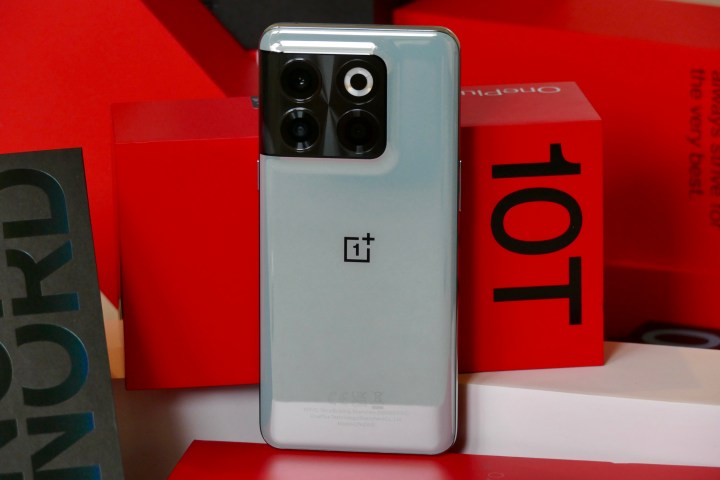
The OnePlus 10T isn’t our favorite OnePlus phone by any metrics, but it is a OnePlus phone with a few special features, which may attract those willing to look past the problems.
We’ll cover those elements first. The OnePlus 10T is the first OnePlus phone to contain the Qualcomm Snapdragon 8+ Gen 1 processor, and this superb chip devours any number of games and apps. It’ll handle the latest and most demanding games with no problems, and when paired with 16GB of RAM, make an exceptionally powerful smartphone. Sure, it’s not a massive upgrade over the 8 Gen 1 in the OnePlus 10 Pro, but it is definitely an upgrade.
Second is the incredible charging speed. The OnePlus 10T is the fastest-charging phone currently available in the U.S., by a good margin. Run the 4,800mAh battery completely flat, and the 125W charging will take it back up to full in about 20 minutes. That’s about a single episode of The Simpsons, which is just staggering. The battery lasts a decent amount of time, roughly a day and a half with normal use. Gaming does knock the battery down a fair amount though, so keep an eye on that.
The rest of the phone isn’t quite so cutting-edge. The body is made from plastic, which isn’t really acceptable in a $650 phone. It’s a good-looking design, which helps a bit, but it’s still not great when the phone feels so cheap. OnePlus has also removed the alert slider in order to make more room inside the phone. This was one of OnePlus’ more unique features, and it looks like it’s already coming back with the OnePlus 11.
There’s a triple-lens camera on the back, but the 2MP macro lens isn’t really worth considering, so really, it’s a dual-lens camera. The 50MP main camera is good enough, taking nice pictures on bright, sunny days. Drop the lights, though, and quality suffers. The 8MP wide-angle lens is disappointing, offering washed-out photos. It’s the same setup as in the Nord 2T, and what’s acceptable in a cheaper phone is less palatable in a more expensive device.
The OnePlus 10T is available in the U.S. for $650, but it’s only really worth buying if you desperately want to experience super-super-fast charging and the Snapdragon 8+ Gen 1.
OnePlus 10T
Best OnePlus phone for fast charging
Andy Boxall/Digital Trends
OnePlus Nord 2T 5G
Best affordable fast charging OnePlus phone
Pros
Competitive price
High refresh rate screen
Software improvements in the camera
Fast battery charging
Cons
No water resistance
Screen isn’t very bright
Tinny speakers
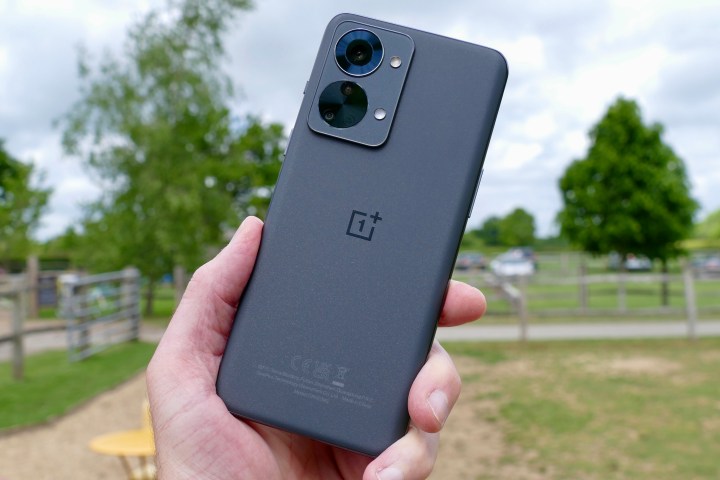
The OnePlus Nord 2T — with a body 8.2mm thick and weighing 190 grams — is solidly built with quality materials, especially the use of Gorilla Glass over the screen and for the back panel. However, it is rather dull, and this detracts from the experience. It’s basically screaming out for a case, which OnePlus helpfully provides.
Performance is derived from the new MediaTek Dimensity 1300 platform, which brings greater AI image processing for low-light photos and when shooting HDR video. In real use, it’s a good performer, and handles our usual demanding games like Asphalt 9: Legends well. It also has a 90Hz refresh rate, which is always very welcome. Oxygen OS is still good, but it’s certainly bloated these days, and we had some software problems with notifications that may be linked to the phone’s aggressive power management.
Inside the camera module sits a 50MP Sony IMX766 camera with optical image stabilization (OIS), an f/1.8 aperture, an 8MP wide-angle camera with a 120-degree field of view and electronic image stabilization (EIS), and a 2MP monochrome camera. It records video up to 4K at 30 frames per second, while up front is a 32MP selfie camera. The results are good but can be a little washed out. It’s a solid camera for the price, though, and we have few real complaints about it.
The OnePlus Nord 2T comes with an 80W SuperVOOC fast charger. Its 4,500mAh battery hits 70% in 15 minutes and full capacity in 25 minutes. The battery runs for two days with average use.
In addition to the U.K., the Nord 2T is sold across Europe, but not in the U.S., though it can be found through imports.
OnePlus Nord 2T 5G
Best affordable fast charging OnePlus phone
Andy Boxall/Digital Trends
OnePlus Nord CE 2 5G
Best value OnePlus phone
Pros
Great, eye-catching design
Battery charges in 30 minutes
Two days use from the battery
Headphone jack on board
Dual 5G SIM and microSD card slot
Cons
Android 11 isn’t the latest version
No IP rating
Poor single speaker
The OnePlus Nord CE 2 5G — made entirely of plastic — is nonetheless pretty to look at and light by modern phone standards at a comfortable 173 grams, 73mm width, and 7.8mm thickness. A 6.43-inch AMOLED screen with a 90Hz refresh rate is the face of the Nord CE 2 5G, with Gorilla Glass 5 over the top. The MediaTek Dimensity 900 processor powers the phone, paired with 8GB of RAM and 128GB storage space.
Android 11 with OxygenOS 11 installed on the phone at launch puts it behind competing phones that have already had an update to Android 12. However, the software performance remains snappy, so it’s still a strong pick.
You get a 64MP main camera with an f/1.7 aperture and electronic image stabilization (EIS), an 8MP wide-angle camera with a 119-degree field of view, and a 2MP macro camera. The selfie camera is 16MP. It includes a night mode, a macro mode, a full-resolution 64MP mode, and the ability to shoot 4K video at 30 frames per second. There’s an AI Mode that adds scene recognition and boosts visual images as well.
The 4,500mAh capacity battery lasts for two days of hard use before needing a recharge. The 65-watt SuperVOOC fast-charging system propels the battery from under 5% to 100% in under 35 minutes.
OnePlus Nord CE 2 5G
Best value OnePlus phone
Adam Doud/Digital Trends
OnePlus Nord N20 5G
Best OnePlus phone under $300
Pros
Beautiful 6.43-inch AMOLED screen
Matte finish always looks clean
Good battery life
Cons
Ships with Android 11
Camera system is inferior
For customers in the U.S., the OnePlus Nord N20 5G is directly available for the American market.
It’s made of polycarbonate with a matte finish that does not show fingerprints. The phone is extremely thin at just 7.5mm with a solid squared-off build. The phone has a beautiful 6.43-inch AMOLED screen with great viewing angles and an FHD+ panel with an aspect ratio of 20:9. It features a Qualcomm Snapdragon 695 processor, 6GB of RAM, and 128GB of storage, expandable up to 512GB via a microSD card. It ships with Android 11 with one year of operating system upgrades and three years of security updates.
The main camera is 64MP with an f/1.79 aperture, a 2MP macro lens, and a 2MP monochrome lens. Video capture tops out at 1080p at 30 fps. On the front, there’s a single 16MP, f/2.4 lens. Sadly, the cameras are inferior. At night, the camera is nearly unusable, though the macro lens can take some decent shots.
Battery life is good, and with light use, you could squeeze two days out of it. With 33W of charging power, we observed about 2% charge rate per minute until about 75%, with the last 20% clocking 25 minutes.
OnePlus’ naming convention may have gone slightly off the rails, but don’t let a confusing name stop you from buying a great value smartphone. The OnePlus Nord N300 5G is a good phone with a lot to offer, especially at this price. While it has some downsides, it’s still worth a look when shopping in the $200 range.
As you might expect for this price, the Nord N300 is made from plastic. It’s a nice feeling plastic, though, with a texture that makes it nice to hold. It has a slight shimmer, too, which means it looks at bit like aluminum from a distance. The display is a 6.56-inch IPS LCD screen that tops out at 1612 x 720 pixels. That’s quite low for a display this size, but it also comes with a 90Hz refresh rate, which is a solid addition at this price, especially when you consider the iPhone 14 still only has a 60Hz refresh rate.
Performance is solid, but don’t expect to play demanding games without a little bit of struggle. The N300 handled Genshin Impact and Diablo Immortal, but we did need to tone down the graphical options in order to run them smoothly. A slight annoyance is that while the phone comes with Android 13 — the latest Android update — it won’t be progressing past that. That’s a disappointment, as it severely impacts the phone’s potential lifespan.
The OnePlus Nord N300 technically has a dual-lens system on the back, but the additional 2MP lens isn’t really up to much. It’s basically just there to assist with depth and focus and is more-or-less a throwback to the original dual-lens camera systems a few years ago. Instead, the meat is in the main 48MP lens. In use, it’s fine. It struggles to match real-life colors and impact, and obviously it’s no match for the best camera phones out there, but for a budget camera phone, the N300 does just fine.
But what you lose on the swings, you gain on the roundabouts: The OnePlus Nord N300 has a great battery. The 5,000mAh cell managed two days between charges (though heavy use might impact this, especially with gaming), and it comes with a 33W fast charging cable and charger in the box. So it should last a good time between charges, and doesn’t take a long time to refill at all. That’s a pretty good slam dunk, in our estimations.
The OnePlus Nord N300 5G is currently only available in the U.S., and only through T-Mobile and Metro. However, the cost of just $228 makes it a tasty morsel indeed, as long as you can live with the downsides of a rubbish display resolution and so-so camera.
NASA is looking for ideas on how to boost the Hubble Space Telescope
The Hubble Space Telescope is now over 30 years old, first launched in 1990. The venerable telescope continues to produce valuable scientific data and beautiful images of space, but it won’t last forever, as sooner or later its orbit will decay which would cause the telescope to break apart in Earth’s atmosphere. But Hubble could keep operating for longer if its orbit were to be raised — a complex but doable operation that NASA is now considering.
NASA is inviting private companies to submit their proposals for boosting the telescope, which would work as a demonstration of how to perform similar operations on satellites.
An astronaut aboard the space shuttle Atlantis captured this image of the Hubble Space Telescope on May 19, 2009.NASA
An initial version of this plan saw discussions between SpaceX and NASA about boosting Hubble at no cost to the government. This involved a feasibility study into whether SpaceX’s Polaris program could be used for a Hubble-boosting mission. This study is non-exclusive and is still ongoing, meaning it could involve other companies as well as SpaceX. Now NASA has released a request for companies to share further ideas for how they would boost satellites and potentially use Hubble as a demonstration.
“This study is an exciting example of the innovative approaches NASA is exploring through private-public partnerships,” said Thomas Zurbuchen, associate administrator for the Science Mission Directorate at NASA, in a statement. “As our fleet grows, we want to explore a wide range of opportunities to support the most robust, superlative science missions possible.”
SpaceX’s Polaris Program is its private human spaceflight program, organized by commercial astronaut Jared Isaacman. Isaacman was part of the Inspiration4 mission which was the first mission to space with an all-civilian crew. The Polaris Program also has plans for further private flights using the SpaceX Crew Dragon and Starship vehicles.
“SpaceX and the Polaris Program want to expand the boundaries of current technology and explore how commercial partnerships can creatively solve challenging, complex problems,” said Jessica Jensen, vice president of Customer Operations & Integration at SpaceX. “Missions such as servicing Hubble would help us expand space capabilities to ultimately help all of us achieve our goals of becoming a space-faring, multiplanetary civilization.”
As additional facets of daily life go digital, it’s more paramount now than ever to be proactive about online security. As 2022 proved, however, staying safe isn’t just a modern concern as vulnerabilities have been around for years – decades, even – and can crop up in the most unexpected places and ways.
The new GPU significantly reduces the time required to obtain or recover user passwords
Security researcher and password cracker Sam Croley posted benchmarks highlighting the RTX 4090’s password-cracking muscle. Nvidia’s newest flagship GPU shattered the RTX 3090’s previous benchmark records and doubled performance across almost every algorithm tested. The cracked passwords adhered to security best practices and included random letter cases, symbols, and numbers.
The CosmicStrand rootkit is the latest indication that UEFI malware may be more common than previously thought
Security firm ESET discovered the first UEFI rootkit that had been used in the wild back in 2018. This type of persistent threat used to be the subject of theoretical discussions among security researchers, but over the past years, it’s become clear that it’s a lot more common than previously thought, despite being relatively hard to develop.
People of the world today, are we looking for a better way of life?” sang Janet Jackson on her 1989 hit Rhythm Nation, not knowing that the better way of life she was talking about didn’t include certain hard drives. It’s just been revealed that the song has the power to crash particular models of laptops, and it has now been recognized as a cybersecurity vulnerability.
It sold secret transcripts to a marketing firm to build profiles using personal information
If it wasn’t stupid enough that GameStop dove headfirst into the NFT and crypto market right before the bubble burst, hang on for a second — the company wants you to hold its beer. It is now being sued for recording customer service chats without consent and selling transcripts to a marketing firm.
Ransomware and brute force attacks from unidentified sources are actively targeting network devices
QNAP issued a security statement urging their NAS users to take immediate action and secure their data against ongoing ransomware and brute force attacks. While the responsible parties have not been identified, the widespread attacks appear to target any vulnerable network devices. The company has provided security setting instructions and mitigation actions that any QNAP NAS users should implement immediately.
Hacking group Lapsus$ claims to still have a copy of the data
Several online security groups are reporting that the South American hacker group Lapsus$ is claiming to have been behind the recent cyberattack on Nvidia. It’s also claiming that Nvidia hacked them in return, encrypted the stolen data, and ransomed back their machines. For now, this is just hearsay, but makes for a great turning-the-tables story.
The government of New South Wales in Australia introduced digital driver’s licenses in late 2019, claiming they were harder to forge than physical identification. A security company recently outlined multiple reasons why this isn’t the case.
The leaks includes Samsung’s encryption data and source code
Lapsus$, a hacking group that leaked confidential information from Nvidia just last week, has reportedly moved to a new target: Samsung. The hackers have claimed an attack that leaked 190GB of confidential information from the South Korean technology giant, including encryption data and source code for Samsung’s most recent devices.
Full control over car doors, security system, and more
This week, a teenager reported that he has gained remote access to around two dozen Tesla cars in multiple countries and is trying to contact their owners. The list of things he can do to the affected vehicles is long and dangerous.
Apparent source code for Alder Lake BIOS has been shared online. It seems to have been leaked in its entirety at 5.9 GB uncompressed, possibly by someone working at a motherboard vendor, or accidentally by a Lenovo manufacturing partner.
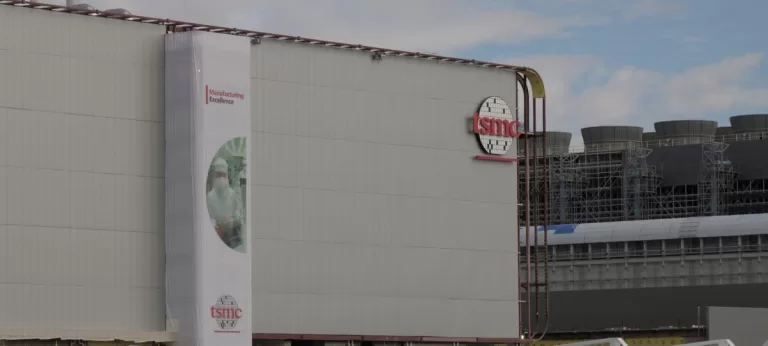
Cutting corners: The Taiwan semiconductor giant seemed to dodge the general malaise in the global tech sector throughout 2022, but falling consumer demand and other macroeconomic factors are finally catching up to it. However, analysts currently expect the company’s fortunes to start turning around later in 2023.
TSMC’s financials in the fourth quarter of 2022 and the first quarter of 2023 are expected to show a decline with the company is reportedly renegotiating contracts as AMD, Nvidia, and MediaTek cut orders due to falling demand for their products.
Sources have told DigiTimes that the utilization rates for TMSC 7nm and 6nm fabs are expected to fall to 50 percent as clients order fewer wafers. The 28nm fabs that remain at capacity as of Q3 2022 will also start to slow down heading into 2023. The company is expected to post a 15 percent quarter-over-quarter revenue drop in Q1 and another decline in Q2 as its inventories grow.
Conditions may start improving around the middle of next year as TSMC ramps up 3nm N3 production, which starts this week. Apple will be the main customer for 3nm as another iPhone could help lift TSMC’s revenue.
While many other industry actors suffered from a slowing global economy, TSMC posted 50 percent revenue growth year-over-year, partly thanks to Apple after supplying them with the A16 processor used in the iPhone 14. The Cupertino giant will again rely on TSMC for the iPhone 15’s 3nm-based chip in 2023.
Moreover, Apple agreed to pay 20 percent more for TSMC’s 3nm wafers than it did for 5nm. The Taiwan company will start charging $20,000 per N3 wafer due to equipment costs. Samsung already manufactures 3nm semiconductors, but yield problems forced clients like Qualcomm to switch to TSMC.
The headwinds TSMC will face in the first half of next year stem from falling demand for products like PCs, graphics cards, tablets, and smartphones as Western countries endure an economic downturn. Additionally, looming Covid waves in China could disrupt manufacturing.
Desktop graphics cards have been particularly hit hard, with one recent analysis showing sales reaching their lowest point since 2005. High prices and the crypto mining crash are the biggest culprits.
Big tech continued to influence the overall tech landscape in 2022. As consumers became more cognizant of personal privacy, so too did the the US government. We also couldn’t help but notice that more big tech players are bringing hardware development in-house to reap the many benefits that such an arrangement affords.
An ominous warning, Zuck says new policies will focus on “ruthless prioritization” and “modified performance standards”
It’s been a tough year for Meta. The tech giant has faced plummeting stocks, hiring freezes, large-scale turnover, and a failed venture into the cryptocurrency space. In a recent Q&A with employees, CEO Mark Zuckerberg discussed changes in the company’s focus, management style, and employee expectations. Unfortunately for Meta employees, the expectation communicated is that many of them may no longer be needed or welcome.
It’s sort of a cross between desktop and mobile hardware
Apple keeps the inner workings of the M1 family of processors secret from the public, but dedicated developers have been reverse-engineering it to create open source drivers and a Linux distro, Asahi Linux, for M1 Macs. In the process, they’ve discovered some cool features.
AWS is pushing customers to run workloads on Graviton CPUs more and more
When it comes to companies rolling their own custom chips, our core thesis is that doing this to save a few dollars on chips is breakeven at best. Instead, companies want to build their own chips when it conveys some form of strategic advantage.
“It’s the children who are wrong,” says old man Facebook
Are you old enough to remember when Facebook usurped Myspace as the cool social media platform everyone should be using? If the answer is yes, you’re probably still on Zuckerberg’s product, unlike almost 70% of teens, who prefer the likes of YouTube, TikTok, and Snapchat.
Not for the first time, a large retailer refused to refund a customer after sending them a useless object instead of the PC component they purchased. On this occasion, Amazon sent a Canada-based buyer an RTX 3060 Ti that turned out to be a fake card stuffed with a putty-like substance. The company said it wouldn’t hand over a refund until the “correct” item had been returned to its warehouse.
Are you yearning for the days when operating systems were simpler and less bloated? If you have fond memories of the early days of Microsoft Windows and want a quick nostalgia fix, instead of pulling that 1995 laptop out of the attic, just download Windows 95.exe.
Addressing the problem will require Apple to work more closely with Google
Apple isn’t the first company to develop a tracking fob. However, the extensive Find My network has made AirTags a very effective tool for criminals. It is a problem the company will have to solve for both iOS users and the three billion Android users who don’t have a phone that can automatically detect rogue AirTags.
“TikTok is not just another video app. That’s the sheep’s clothing”
Brendan Carr, a commissioner of the Federal Communications Commission, has called on Apple and Google to remove TikTok from their respective app stores following new reports that users’ data is being accessed by the Chinese-based employees of its parent company ByteDance.
The shortage is fueled by ongoing hardware availability issues, increased demand, and Azure’s aging infrastructure
Customers are often sold cloud services under the guise of “limitless resources” that can be scaled to meet current demands, similar to other utilities. Azure, like other cloud providers, has experienced a huge surge in resource demands to meet the needs of companies and remote employees for the last several years. Unfortunately for Microsoft, some customers are starting to feel the effects of that surge and learning that capacity may have been an issue all along.
Imagine being promoted and finding out that you’re going to receive considerable compensation, only for the company to inform you that, due to a software error, the new package isn’t as generous as expected. It’s a situation faced by around 40% of Amazon corporate employees who were promoted in the current quarter.
The new AI framework uses context images to generate up to 30 seconds of video
Researchers continue to find new ways to leverage artificial intelligence and machine learning capabilities as the technologies evolve. Earlier this week, Google scientists announced the creation of Transframer, a new framework with the ability to generate short videos based on singular image inputs. The new technology could someday augment traditional rendering solutions, allowing developers to create virtual environments based on machine learning capabilities.
What just happened? Users often overlook Wi-Fi routers when it comes to security, a mistake that can lead to intrusions, snooping, and other kinds of attacks from malicious actors. Fortunately, Netgear has been on top of things recently with an extensive list of models and firmware versions affected by recently-discovered vulnerabilities.
Owners of Netgear routers including Orbi systems and several Nighthawk models should check if their firmware is the latest version available as soon as possible. The company issued two dozen security alerts in a single day this week, warning users about a wide range of patched vulnerabilities affecting many different router models, range extenders, and Wi-Fi systems.
Netgear doesn’t offer detailed information on how attackers exploit the vulnerabilities it patched, but the company’s alerts label the nature of each one. Their level of severity ranges between medium, high, and critical.
Two of the alerts involve pre-authentication buffer overflow vulnerabilities. Bleeping Computer writes that successful pre-authentication buffer overflow attacks could result in crashes or arbitrary code execution. They’re potentially dangerous because they don’t involve tricking a router’s owner into doing anything. Netgear lists one of these vulnerabilities as high-priority.
Almost half of Netgear’s alerts from this week are for post-authentication command injection vulnerabilities. These require an attacker to gain authentication to enter the system but could let them execute root-level commands once they’re in.
The other vulnerabilities could allow authentication bypass, denial of service attacks, and could leak sensitive information. One alert is for security misconfiguration. Netgear rates at least one alert as critical.
In each alert, Netgear has a list of affected firmware versions and devices large enough that just about anyone with recent Netgear equipment should check their firmware. The right side of each page also includes directions for checking each product’s model number.
The easiest way to update a Netgear device’s firmware is through one of the company’s mobile apps: the Nighthawk app for Nighthawk products, the Orbi app for Orbi systems, and the Insight app for some business devices.
To update firmware over the web, head to the Netgear support page. Start typing your model number and a drop-down list should appear. Click on your model number if it appears in the list, then click “downloads.” Under “Current Versions,” click on the download with a title beginning with “Firmware Version,” then click “Download.” Netgear also includes directions in product manuals, product support pages, and firmware release notes.
HandBrake is a free and open source tool for converting video from nearly any format to a selection of modern, widely supported codecs. HandBrake is a cross-platform application, available for Windows, Mac and Linux.
Is HandBrake a video editor?
HandBrake can crop and resize videos as well as restore old and low-quality videos, but for more powerful editing tools you can try DaVinci Resolve, Shotcut or VSDC Free Video Editor, which are great free options.
Can you use HandBrake to rip DVDs?
Yes, HandBrake can rip any DVD or Blu-Ray discs that are not copy protected.
Can HandBrake compress 4K videos?
Yes, HandBrake can compress any 4K video to reduce video size, while converting the video format at the same time.
Is Handbrake better than FFmpeg?
Both HandBrake and FFmpeg are free and open source, both are compatible with Windows, macOS, and Linux, and both can convert video files. The difference is that Handbrake uses a GUI (graphical user interface) to convert media files, while FFmpeg uses the command line to encode or decode video files. In fact, Handbrake uses FFmpeg internally for conversion. Another difference is that Handbrake supports DVD and Blu-Ray video as input, while FFmpeg does not. Also, Handbrake only offers MKV and MP4 output, while FFmpeg supports many video output formats.
Features
One of HandBrake’s strengths is its ability to open a wide variety of video formats. HandBrake uses FFmpeg under the hood and generally can open whatever FFmpeg will, in addition to disc-based formats like DVD and Blu-ray. HandBrake does not defeat or circumvent copy protection of any kind. It does not work with video files employing Digital Rights Management (DRM).
HandBrake’s software video encoders, video filters, audio encoders, and other processes benefit from fast CPU and memory. HandBrake’s hardware video encoders also benefit from modern GPU hardware.
Built-in Device Presets
Get started with HandBrake in seconds by choosing a profile optimised for your device, or choose a universal profile for standard or high quality conversions. Simple, easy, fast. For those that want more choice, tweak many basic and advanced options to improve your encodes.
Supported Input Sources
Handbrake can process most common multimedia files and any DVD or Blu Ray sources that do not contain any kind of copy protection.
Outputs
File Containers: .MP4(.M4V) and .MKV
Video Encoders: H.265 (x265 and QuickSync), H.264(x264 and QuickSync), H.265 MPEG-4 and MPEG-2, VP8, VP9 and Theora
Audio Encoders: AAC / HE-AAC, MP3, Flac, AC3, or Vorbis
The 12.9-inch iPad Pro updated in 2022 (Image credit: Future)
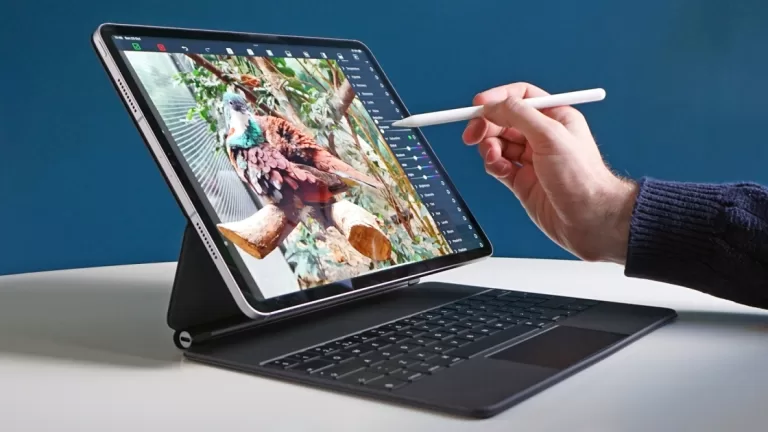
We last got an iPad Pro refresh in October 2022, when the premium 11-inch and 12.9-inch slates were updated with the Apple M2 processor. According to the rumor mill, those screens will be changing in 2024 when the next models are due to appear.
This comes from display analyst Ross Young, speaking to MacRumors (opens in new tab). First, the display technology will apparently be changing from the IPS LCD LED (11-inch) and IPS LCD mini-LED (12.9-inch) of the current iPad Pros to OLED – just like the flagship iPhones.
That should mean even better screens in terms of contrast and darker blacks, though the panels attached to the current iPad Pro range are already impressive. We’ve been hearing rumors that Apple would switch to OLED on its iPads for some time now.
Changing sizes
There’s also going to be a change in the display sizes, Young says. The 11-inch iPad Pro will become an 11.1-inch iPad Pro, while the 12.9-inch iPad Pro will become a 13-inch iPad Pro – not much of a difference then, but one that’s worth noting.
It’s possible that Apple is going to be able to shrink the bezels on these two premium iPads, so the overall dimensions of the slates would stay the same while the displays get slightly bigger. OLED panels can mean thinner and lighter devices as well.
Additionally, despite earlier leaks suggesting that Apple was working on a super-sized iPad Pro, that’s apparently no longer on the way according to Young. It seems that for the next iteration at least, Apple is going to stick to the two sizes we’ve talked about.
Analysis: making the iPad Pros more Pro
The iPad Pros have always been high-end luxury devices for those with big budgets who need as much power as possible: bear in mind that the entry-level iPad (yours for $449 / £499 / AU$749) does basically everything that the more expensive models do.
Once the switch to OLED is made, that will be another differentiator that will help to justify the high price of the iPad Pro models. Whether these slates will cost the same remains to be seen – but we’re assuming that’s what Apple is going to aim for.
The change in size is less interesting, though Apple clearly wants to keep a large iPad Pro in its range. As well as offering more screen space, it helps to give buyers a reason to consider one of the more expensive tablets rather than the iPad Air.
With these updated tablets apparently getting launched in 2024, it could be a quiet 2023 in terms of Apple tablets. That might give its competitors time to catch up, but it also means there should be a substantial performance boost when the new iPad Pros do appear.
Sign up to get breaking news, reviews, opinion, analysis and more, plus the hottest tech deals!
Dave is a freelance tech journalist who has been writing about gadgets, apps and the web for more than two decades. Based out of Stockport, England, on TechRadar you’ll find him covering news, features and reviews, particularly for phones, tablets and wearables. Working to ensure our breaking news coverage is the best in the business over weekends, David also has bylines at Gizmodo, T3, PopSci and a few other places besides, as well as being many years editing the likes of PC Explorer and The Hardware Handbook.
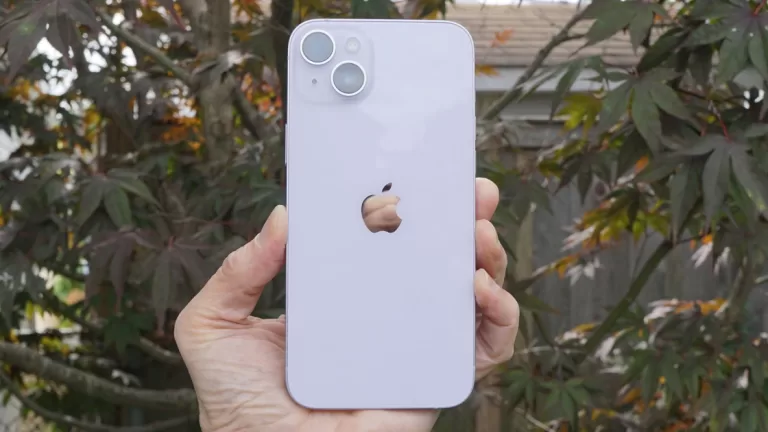
The iPhone 14 Plus hasn’t been selling well (Image credit: Future)
Price cuts on gadgets are always good news for consumers, and it would seem that the iPhone 15 could be in line for one if the latest leak can be believed: apparently Apple is considering cutting the pricing of the iPhone 15 Plus due to launch in September.
This comes from reputable online source Yeux1122 on South Korean social network Naver (via Macworld (opens in new tab)). The move is apparently being given serious consideration, and would be made in response to underwhelming sales of the current Plus model.
The iPhone 14 Plus that was unveiled with the rest of the family earlier this year has a starting price of $899 / £949 / AU$1,579 for the 128GB version, but it doesn’t appear to be attracting buyers in the numbers that Apple would like.
A tale of four phones
While canceling the Plus model would be an option for Apple, it’s likely that development on the iPhone 15 is too far down the line for that to happen. A price cut on the handset that replaced the iPhone 13 mini would be the next most logical step.
It’s worth bearing in mind that the iPhone 14 Pro Max offers the same screen size as the Plus, but adds in features like a faster chip, the Dynamic Island and the always-on display for another $200 / £250 / AU$320 – which makes it the better deal.
As yet there’s no indication of how big the price cut could be, or how it might affect the pricing of the other models in the range. We’ve also been hearing that Apple could introduce a more powerful, more expensive iPhone 15 Ultra next year too.
Analysis: getting the pricing right
Pricing is always key for any smartphone: the best cheap phones may not have the fastest chips or the best screens, but they cost substantially less than the premium flagships on the market, and so still represent good value for money.
As for Apple’s iPhone series, for the last few years the Pro models have been the handsets with the most appeal. That’s even more the case with the iPhone 14 Pro, because the less expensive models come with last year’s A15 Bionic chip inside.
Buyers of the iPhone 14 are getting a phone that’s slower than the Pro, with a camera system that’s not quite as good, and without several other cool features. Okay it’s cheaper, but there aren’t a lot of other reasons to prefer it over the Pro.
We’ll have to wait and see what Apple does in 2023, bearing in mind that it has the budget iPhone SE (2022) on sale as well. Next year could be the year when Apple’s flagship phone gets closer to mid-range pricing than ever before.
Sign up to get breaking news, reviews, opinion, analysis and more, plus the hottest tech deals!
Dave is a freelance tech journalist who has been writing about gadgets, apps and the web for more than two decades. Based out of Stockport, England, on TechRadar you’ll find him covering news, features and reviews, particularly for phones, tablets and wearables. Working to ensure our breaking news coverage is the best in the business over weekends, David also has bylines at Gizmodo, T3, PopSci and a few other places besides, as well as being many years editing the likes of PC Explorer and The Hardware Handbook.