Home Blog Page 7021

Workplace Trends You Need to Know for 2023

Opinions expressed by Entrepreneur contributors are their own.

The New Year always brings a fresh perspective to our lives and work. And as with any fresh start, savvy leaders are identifying strategies to increase productivity, keep their workforce engaged and help take their business to the next level.

A nuanced look at gender equality, closer-knit workforces and unique ways to engage staff through wellbeing are just three trends we’re likely to see in workplaces come 2023. It’s hoped they’ll make corporate culture in the U.S. much more hospitable for employees.

In 2022, the buzzwords included flexible working, prioritizing purpose and increased transparency to help leaders better connect with their staff. So what will 2023 bring?

1. Closer-knit workforces

This time last year, Covid-19 was slowly rearing its head again for a dark and gloomy winter. Some employees had already started returning to the office, but many companies U-turned and sent staff home again. Fast forward to the present; a lot has changed in a year. People are back in offices, hybrid working has solidified and a seismic shift has happened.

Related: Workplace Trends That Will Shape 2022

What has been the result? While many employees are happier, 65% of businesses say it’s been “challenging” to boost morale and create a cohesive company culture while people are remote working.

In 2023, these issues are likely to be addressed head-on: How can we make hybrid working work better for everyone? This could be more full-team meeting days while people are in the office, so their commuting time is productive. It could also mean cultivating a more appealing place to work to ensure when people do come in, they experience the benefits.

2. Meaningful social impact

While many businesses have focused on corporate social responsibility in the past few years, some have fallen into the trap of “greenwashing”: Making others believe their company is doing more to protect the environment than it really is.

Alongside that, the generation now entering the workforce — Generation Z — is prioritizing working in companies that contribute to making the world a better place.

So as the need for corporate social responsibility grows, companies should focus on what meaningful action they are taking now to protect our planet and the people on it.

What are you doing this week, month or year, to make a difference?

Focusing on this will have a desirable effect on your business. In a 2022 Gartner study of more than 30,000 people, 87% said companies should take a public position on societal issues. They found when corporations do take a stand, they can expect an increase in the number of employees who go above and beyond at work: 18% more employees showed high levels of “discretionary effort” at vocal employers compared to those companies that stayed silent.

Related: 6 Signs It’s Time to Make Your First Operations Hire

3. A focus on wellbeing

Mental health and burnout have long been part of the conversation when we discuss improving work and the culture surrounding it — especially since the Covid lockdowns.

But as we near the end of 2022, a shift is happening — for the better. The U.S. Surgeon General reported that 71% of employees believe their employer is more concerned about their mental health and wellbeing than ever before. This is a huge step forward and one we must grasp and run with. In response, the U.S. Surgeon General released a framework that aims to support workplaces in better improving the mental health and wellbeing of their employees. This includes: Ensuring there is an opportunity for growth, valuing employee contributions, enhancing social connections in the workplace and focusing on achieving better work-life integration.

We’re likely to see more mental wellbeing initiatives and strategies employed across businesses that deliver meaningful and practical help to their employees — from self-care days off once a month to increased wellbeing benefits, mental health first aid training and even adaptations to the workplace.

4. A nuanced take on gender equality

In late 2022, Harvard Business Review surveyed high-performing professional women in the U.S. and found that while some women are, on the surface, flying high — they are taking on a set of specific maladaptive behaviors and beliefs to get by, and suffering because of it.

Women reportedly are sacrificing their needs, beliefs and sense of individuality to stay at the top or even simply to “fit in” to get that promotion. One woman said, “Denial is the only way I can survive and do the job I was hired to do.”

While gender equality has been part of workplace discussions for decades, the conversation will become more nuanced this coming year. Companies will aim to not only reduce the gender pay gap and bring more women into senior-level positions but also listen to women. Listen to their voice, their ideas and their creativity. Hiring women for powerful positions while leaving them feeling disempowered will not shift the equality landscape. Ultimately, it’s the understanding that women bring their strengths and ideas to the table and don’t need to adapt to traditional corporate values and structure to be successful.

Related: 3 Ways You Can Brand Your Candidate Experience to Attract Top Talent

5. Leadership investment

It’s never been easy to be in a leadership position, but now more than ever, it can be complex to navigate. Leaders already deal with business pressure, budgets, negotiations, strategy and more. They also have to support and lead on communication, transparency, wellbeing, engagement, inclusion and equality for every single one of their staff. And now? They need to lead change: Prioritizing social impact, their employees’ and customers’ needs and wants and adapting their businesses to a changing social landscape.

In a 2022 HR Insights Survey, CCI Consulting found more than 50% of businesses lack one critical skill that can make a difference: “leading change.” This is why, in 2023, we’re likely to see an investment in leadership through coaching, courses, training and exposure to diverse strategies that could work.

There’s a lot of hope that 2023 will make positive strides for the corporate world, enticing those who left the labor force to reenter it. But to do that, there needs to be a real commitment to the issues discussed above and a belief that things will improve with dedication and effort.

Read More
Dr. Samantha Madhosingh

Tax-Loss Harvesting Platform Unsellable is Building ‘The World’s Largest Collection of Worthless NFTs

Consensus 2023 Logo

Join the most important conversation in crypto and Web3 taking place in Austin, Texas, April 26-28.

CoinDesk - Unknown

Eli is a news reporter for CoinDesk. He holds ETH, SOL and AVAX.

Consensus 2023 Logo

Join the most important conversation in crypto and Web3 taking place in Austin, Texas, April 26-28.

After the boom of 2021, the hype that fueled non-fungible token (NFT) trading has subsided. Cryptocurrency prices have plummeted from their former highs and mainstream interest in digital collectibles has waned, bringing down NFT prices.

But the extended crypto winter has come with a potential silver lining – tax-loss harvesting, where NFT enthusiasts can sell their no longer valuable JPEGs and claim losses to offset their tax bill.

Enter Unsellable, a platform launched last month that acquires “worthless” NFTs for the cost of gas plus a few bucks. The site functions as instant liquidity for otherwise, as the name suggests, unsellable NFTs, providing a quick way for NFT investors to capture their losses.

“Think of us as Web3 junk removal,” it says on the website. At the time of writing, the service has so far purchased over 9,300 NFTs, according to Etherscan.

The most valuable NFT in the Unsellable Collection on OpenSea so far is Army of the Dead #78, a skeleton-themed PFP that sold for over 3.6 wrapped ether (wETH) in January 2022. At the time of sale, when ETH was worth around $3,300, the NFT was valued at about $12,000. Today, as the price of ETH has fallen sharply, that same token is only worth $4,330.

The majority of NFTs purchased by the site are derivative projects – meaning, collections based on other popular projects that are often made worse. These include Lost Nouns, a derivative of Nouns, Anatomy Science Ape Club, a derivative of BAYC and Baby Goblinz, a play on Goblintown.

The platform also allows users to sell their no-longer-wanted NFTs in bulk. One collector sold dozens of NFTs from the GoopGirls collection, along with others, in a single transaction, paying only 0.05 ETH (about $65) plus gas fees.

The platform’s popularity comes as once-profitable traders seek to cut their losses. Prices for most NFTs and cryptocurrencies were at their dollar-value peak last December and January, with NFTs being hit especially hard. The boom in prices for NFTs also coincided with a peak in trading volume, meaning most NFTs purchased at the time were at prices higher than current values.


Sign up for First Mover, our daily newsletter putting the latest moves in crypto markets in context.

By signing up, you will receive emails about CoinDesk product updates, events and marketing and you agree to our terms of services and privacy policy.

DISCLOSURE

Please note that our

privacy policy,

terms of use,

cookies,

and

do not sell my personal information

has been updated

.

The leader in news and information on cryptocurrency, digital assets and the future of money, CoinDesk is a media outlet that strives for the highest journalistic standards and abides by a

strict set of editorial policies.

CoinDesk is an independent operating subsidiary of

Digital Currency Group,

which invests in

cryptocurrencies

and blockchain

startups.

As part of their compensation, certain CoinDesk employees, including editorial employees, may receive exposure to DCG equity in the form of

stock appreciation rights,

which vest over a multi-year period. CoinDesk journalists are not allowed to purchase stock outright in DCG

.

CoinDesk - Unknown

Eli is a news reporter for CoinDesk. He holds ETH, SOL and AVAX.

CoinDesk - Unknown

Eli is a news reporter for CoinDesk. He holds ETH, SOL and AVAX.

Read More
Eli Tan

Crypto Asset Manager Valkyrie Investments Wants to Sponsor, Manage Grayscale Bitcoin Trust

0

Consensus 2023 Logo

Join the most important conversation in crypto and Web3 taking place in Austin, Texas, April 26-28.

CoinDesk - Unknown

Helene is a U.S. markets reporter at CoinDesk, covering the US economy, the Fed, and bitcoin. She is a recent graduate of New York University’s business and economic reporting program.

Consensus 2023 Logo

Join the most important conversation in crypto and Web3 taking place in Austin, Texas, April 26-28.

Crypto asset manager Valkyrie Investments wants to become the sponsor and manager of the Grayscale Bitcoin Trust (GBTC), the company said in a blog post this week.

Valkyrie, one of Grayscale’s rivals, previously launched a bitcoin trust and a bitcoin-related exchange-traded-fund (ETF) in 2021. As part of their plan to sponsor GBTC, the world’s largest bitcoin fund, the Tennessee-based company also announced the launch of a new fund, the Valkyrie Opportunistic Fund, LP that seeks to take advantage of GBTC’s discount to the value of its underlying bitcoin, the company said.

Valkyrie’s plan would be a tall order, considering that GBTC alone has over $10 billion in assets and Valkyrie only handles roughly $180 million in total assets.

“We understand that Grayscale has played an important role in the development and growth of the bitcoin ecosystem with the launch of GBTC, and we respect the team and the work that they have done,” Valkyrie said. “However, in light of recent events involving Grayscale and its family of affiliated companies, it is time for a change.”

Grayscale and CoinDesk are both owned by the Digital Currency Group.

In its proposal, Valkyrie said it wants to facilitate GBTC redemptions at net asset value (NAV) for investors through a Regulation M filing. It also proposes to lower the fees to 75 basis points as opposed to the current 200 basis points, and to offer redemptions in both bitcoin and cash.

Earlier this month, GBTC shares hit a record-high discount rate of over 50% relative to the price of bitcoin (BTC). GBTC’s recent struggles were triggered by the Security and Exchange Commission’s (SEC) reiteration of its reasons for denying Grayscale Investment’s application to convert GBTC into a spot bitcoin ETF. Grayscale called the initial denial “arbitrary, capricious and discriminatory.”

Grayscale did not immediately return a request for comment.


Sign up for The Node, our daily newsletter bringing you the biggest crypto news and ideas.

By signing up, you will receive emails about CoinDesk product updates, events and marketing and you agree to our terms of services and privacy policy.

DISCLOSURE

Please note that our

privacy policy,

terms of use,

cookies,

and

do not sell my personal information

has been updated

.

The leader in news and information on cryptocurrency, digital assets and the future of money, CoinDesk is a media outlet that strives for the highest journalistic standards and abides by a

strict set of editorial policies.

CoinDesk is an independent operating subsidiary of

Digital Currency Group,

which invests in

cryptocurrencies

and blockchain

startups.

As part of their compensation, certain CoinDesk employees, including editorial employees, may receive exposure to DCG equity in the form of

stock appreciation rights,

which vest over a multi-year period. CoinDesk journalists are not allowed to purchase stock outright in DCG

.

CoinDesk - Unknown

Helene is a U.S. markets reporter at CoinDesk, covering the US economy, the Fed, and bitcoin. She is a recent graduate of New York University’s business and economic reporting program.

CoinDesk - Unknown

Helene is a U.S. markets reporter at CoinDesk, covering the US economy, the Fed, and bitcoin. She is a recent graduate of New York University’s business and economic reporting program.

Read More
Helene Braun

Bitcoin Miners Got Crushed by Crypto Winter. 2023 May Bring More Pain

0

CoinDesk - Unknown

Eliza Gkritsi is CoinDesk’s crypto mining reporter based in Asia.

Consensus 2023 Logo

Join the most important conversation in crypto and Web3 taking place in Austin, Texas, April 26-28.

The mining industry started 2022 off strong with what seemed like ample capital to expand, but high energy prices, increasing competition for Bitcoin blocks and a bear market hit miners, knocking out those with high leverage.

The sector was shaken by bankruptcies and loan defaults, and next year will likely bring even more pain, as miners struggle to bolster their balance sheets and operations. But it will also present an opportunity for those in a position to buy assets, as well as for those that can improve their margins with new innovations.

CoinDesk spoke to some of the top executives and analysts in bitcoin mining to review past year and predict trends for 2023. Here’s what they said.

Growth didn’t come

Industry participants say that lots of money was spent over the last year to boost hashrate, a measure of computing power on the Bitcoin network, but that in many cases, those investments didn’t pay off, as companies loaded up on debt to finance the growth only to see the economics of crypto mining break down.

“Many miners acted too deterministically,” projecting bitcoin (BTC) would hit $100,000 and not even considering that the price would drop below $20,000, said Juri Bulovic, head of mining at crypto mining and staking firm Foundry, which is owned by CoinDesk’s parent company, Digital Currency Group.

With falling bitcoin prices, many companies had trouble meeting their debt obligations.

“There aren’t many ways to financially materialize those plans. One either sells bitcoin, borrows debts or issues equity. When selling mined bitcoin was barely enough to cover OpEx (operating expenses), many opted for debt financing as the equity market turned cold,” said Wolfie Zhao, head of research at TheMinerMag, the data and research arm of mining consultancy BlocksBridge.

On the flip slide, lenders were too optimistic.

“Many had not been able to properly assess the risks associated with such mining rigs-backed loans given that this is the first cycle in which such loans were given out,” Bulovic noted.

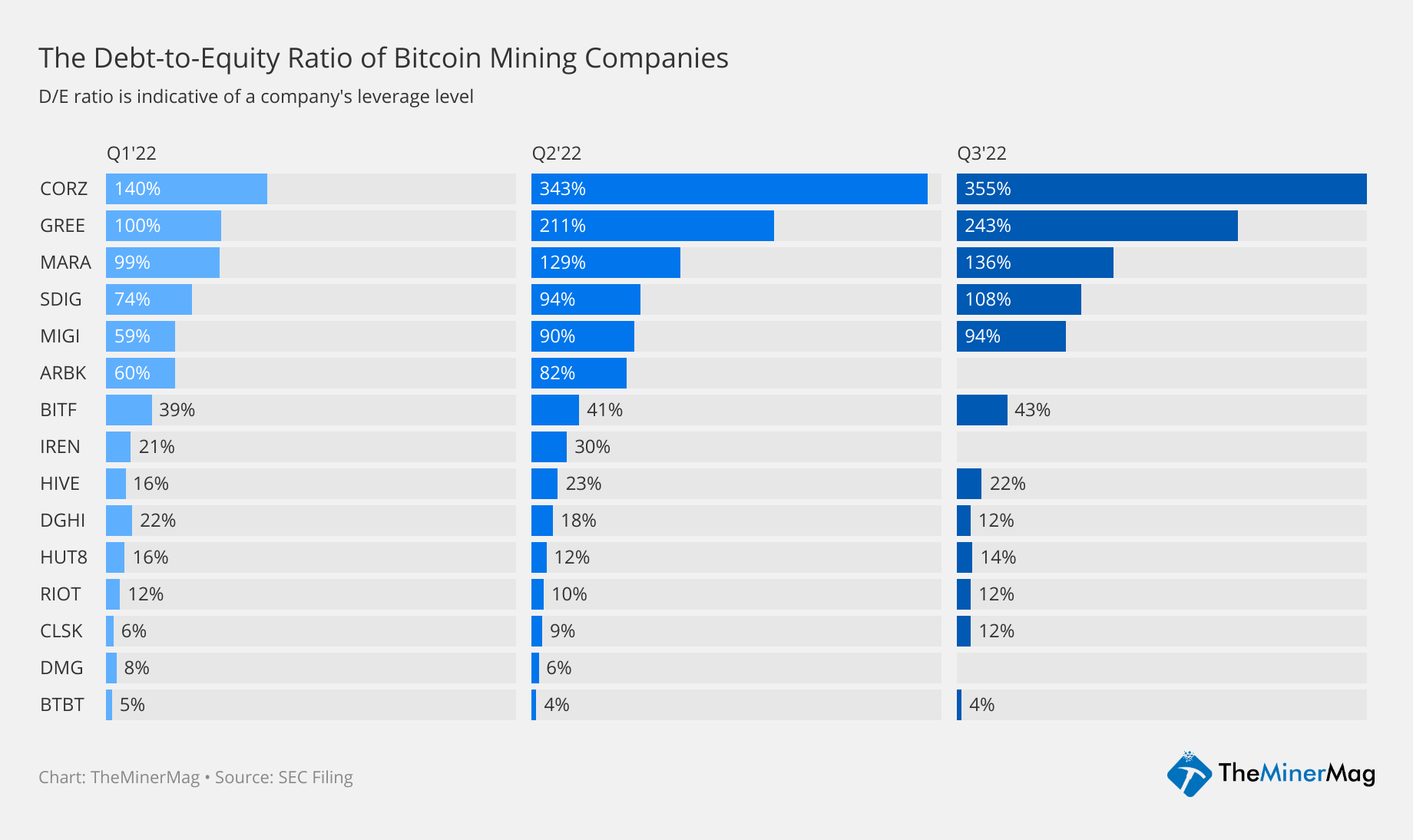
Some miners saw their debt-to-equity ratio, a measure that shows a company’s financial leverage, more than triple in the third quarter, according to TheMinerMag data.

CoinDesk - Unknown

Crypto miners’ debt-to-equity ratio over the last three quarters (TheMinerMag)

Unsurprisingly, miners that had high debt-to-equity ratios, like Core Scientific (CORZ), Greenidge Generation (GREE) and Stronghold Digital Mining have had to either file for bankruptcy or restructure their debt obligations.

Hedging and treasury management

Many miners also failed to hedge their risks against a falling bitcoin price.

“Bitcoin miners have much to learn from traditional commodity-producing industries like oil and gas. Instead of using financial instruments to increase their long oil exposure, oil producers hedge their exposure by selling oil futures. Hopefully, this bear market will inspire miners to decrease their bitcoin price risk through more sophisticated risk management,” Jaran Mellerud, an analyst at Luxor Technologies, a provider of bitcoin-mining services, said. Luxor opened a derivatives desk to sell hedging products to miners in October, although the idea of hedging with derivatives had already started to sow its seeds within the miners as the broader market crumbled.

“I really think investors want two things – they want transparency and they want predictability – and that’s what hedging brings to a miner,” said Chris Bae, founder and CEO of digital-asset trading firm Enhanced Digital Group. Bae’s firm provides hedging products to miners that are trying to implement risk-management strategies. Other companies such as crypto-focused financial-services firm Galaxy Digital and Singapore-based digital-asset management platform Metalpha are also providing hedging services to miners.

TheMinerMag’s Zhao pointed out that it wasn’t only overleverage that has brought some miners to their knees, but also lack of treasury management.

“If Core had been selling half of its mined bitcoin every month and holding the rest since January 2021, it likely won’t be so troubled as it is now while still having a few K [thousands] of BTC on its balance sheet to capture the long-term upside,” he said, referring to Core Scientific, a miner that filed for bankruptcy in December.

Instead, the world’s largest miner by hashrate waited “until May when the market pain started to really kick in” to start selling its accumulated digital assets, Zhao said.

CoinDesk - Unknown

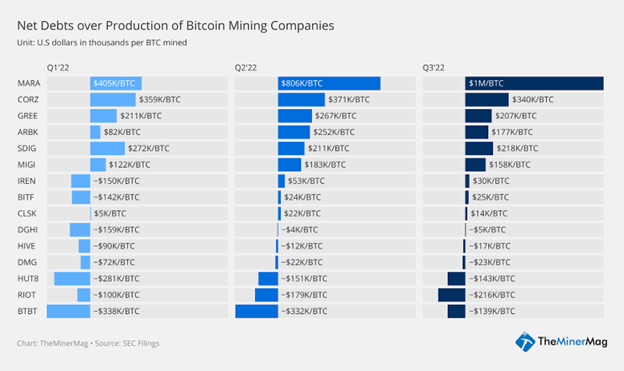
Change of net debt to production of bitcoin miners, over the last three quarters. (TheMinerMag)

Miners that had a high proportion of debt relative to their bitcoin production have found themselves under water.

“Five of the six companies with the largest net debts per BTC mined have had some level of restructure since the second half of this year, with the exception of Marathon Digital Holdings (MARA)],” Zhao said.

The analyst thinks that Marathon has bucked the trend in part because the mining firm raised $750 million last year in unsecured convertible notes with a 1% coupon rate. Core Scientific, by contrast, raised $500 million in secured convertible notes with a 10% rate.

More pain ahead

Still, Jaime Leverton, CEO of Canadian miner Hut 8 (HUT), predicts the worst is yet to come in terms of capitulation and bankruptcies, particularly in the first half of 2023, and she’s not sure that relief will come in the second half.

Luxor’s Vera said he expects many companies to be taken private, saying companies can gain efficiencies by hosting and running machines.

But Fiorenzo Manganiello, founder of Cowa, a mining and venture-funding firm, said buyers may be better off just purchasing bitcoin, rather than dealing with hassles of owning and operating machines.

For the rest of the pack, the year looks like a year of survival and recovery.

“Unless we see a full-scale bull market, which I doubt we will, miners will use 2023 to strengthen their balance sheets and improve their operating efficiencies. The year’s biggest trends will be cost minimization and debt reduction,” Mellerud said.

Power struggle

In 2023, miners will not only have to find the best energy deals, but get creative about how they can lower their costs or bring in revenue by tweaking their power consumption and supply, industry experts say.

As margins continue to compress, miners will have to look at how they can participate in “demand response programs,” meaning selling power back to the grid in times of high demand, as well as recapturing heat from mining rigs and using stranded energy, Bulovic said. “Miners who have a real grasp on the processes, policies, regulations and technical know-how of these adjacent industries will gain an edge over the other miners,” he said.

Crypto mining is becoming a bigger part of the energy industry, and by the end of 2023, more companies will need to be vertically integrated, with their own power source in order “to maintain long-term stable operation, as the halving is just getting closer,” according to Daniel Jogg, CEO of Enerhash, a Hungary-based company that runs blockchain data centers. Halving is when the number of bitcoin mined per block drops by 50%.

Another lesson related to the importance of managing power costs is on hosting, the business model in which firms bring in revenue for owning and operating the infrastructure. “High energy prices and low bitcoin prices have been particularly hard on this model,” Zach Bradford, CEO of crypto miner CleanSpark (CLSK) said.

Compute North, the first big firm in the industry to go bankrupt, was primarily a hosting firm. Core Scientific was also losing money in its hosting business – about $10 million in the third quarter.

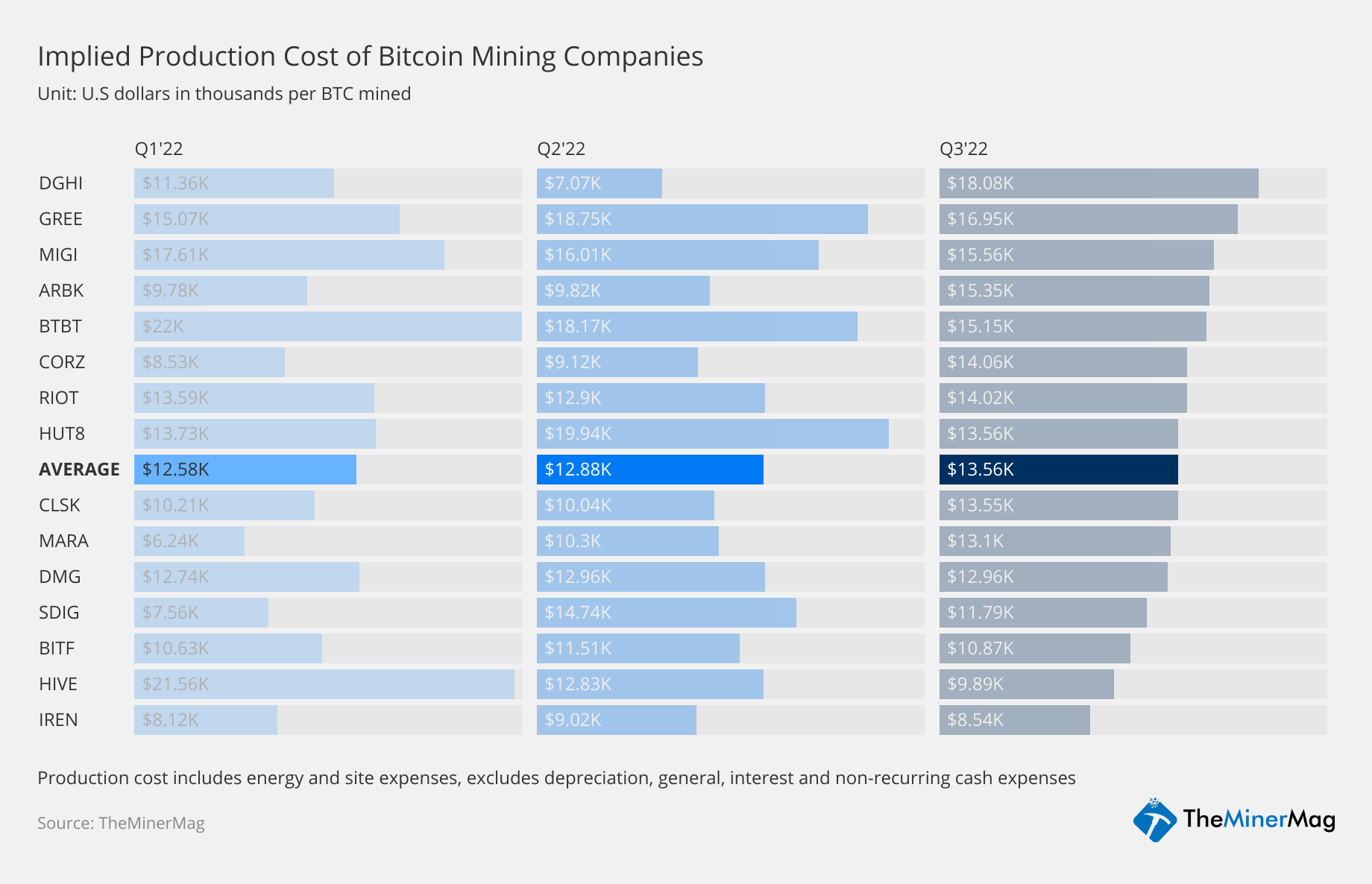
Mining firms like Digihost (DGHI), Greenidge Generation, and Argo Blockchain (ARBK), that relied on natural gas or the electricity grid for their power, saw their costs skyrocket in the third quarter, according to the data from TheMinerMag.

CoinDesk - Unknown

Change in implied production cost of bitcoin miners (TheMinerMag)

The trend of cost per bitcoin produced over the year “looks very similar to the U.S average household energy price increase this year. The average of all the major mining companies’ cost of production per BTC mined has gone up by 7% in Q3 compared to Q1,” Zhao said.

New technology

As miners try to become more efficient and bring down power costs, they might end up taking a counterintuitive path – underclocking mining machines. That’s the practice of “reducing energy consumption and total hashrate to improve energy efficiency,” which is “one of the best and most readily available technologies”to improve efficiencies and control costs, Ben Gagnon, chief mining officer at Canadian miner Bitfarms (BITF), said.

Nascent technologies like immersion and hydro cooling are also becoming more popular, but it is uncertain whether miners will deploy them at scale in the future because of cost concerns.

Immersion cooling entails submerging mining machines in a tank of fluid, whereas hydro cooling entails a new generation of mining rig, which are heavily promoted by Bitmain, the world’s largest mining machine equipment manufacturer. Hydro machines have tubes placed close to the chips. Fluids go through these tubes, taking heat out of the machine. These rigs require a special infrastructure to run, and often to treat the water such that it doesn’t degrade the tubes over time.

“Even though the current mining economics has disincentivized miners from experimenting with these new technologies, we do expect to still see progress being made in 2023 to advance the technology and lower costs,” Foundry’s Bulovic said.

Aydin Kilic, president and chief operating officer at Canadian crypto miner Hive Blockchain (HIVE), touted the Hive Buzzminers, a new mining rig built using Intel’s (INTC) highly anticipated Blocksale chip. These mining machines will be the first ASIC (application-specific integrated circuit) miner deployed by any of the major public crypto mining companies and designed in-house, he said.

The evolving geography of mining

The past year started with a noticeable centralization of the bitcoin mining hashrate in the U.S. In January, the U.S. accounted for about 38% of computing power on the Bitcoin blockchain, and Canada almost 7%, according to the Centre for Alternative Finance at the University of Cambridge. Next year, that trend might be broken. Luxor’s Mellerud and COO Ethan Vera both expect miners to migrate to South America, the Middle East and Southeast Asia due to availability of cheap electricity.

Hut 8’s Leverton said that this decentralization is her “hope,” given that bitcoin is supposed to be a distributed network, not aggregated in one particular jurisdiction, although she noted that political instability could be an obstacle in some countries.

Environmental concerns

Many places are concerned about bitcoin mining’s energy use and its impact on local communities, and in 2022, they started setting limits.

In the past year, New York state enacted a two-year moratorium on new bitcoin mining operations, lawmakers in the U.S. are targeting the industry’s energy use, utilities in three Canadian provinces have stopped approving new bitcoin mining connections to the grid, and a bill is under consideration in Kazakhstan that will cap the energy available to miners.

Industry experts said they don’t expect any regulation on the federal level in the U.S. or Canada in the coming year, but local or state governments might continue to place restrictions on the industry.

Gagnon of Bitfarms sees this small-scale regulation as an important testing ground for any federal laws to come in the years ahead.

Vera, however, cautioned that the moratorium set by New York state “sets a challenging precedent” for the rest of the U.S. for expansion of new mining farms. New site developments across states controlled by Democrats are likely to be targeted by regulation, he said.

Mellerud said that in Europe, the European Union regulators will be “more aggressive toward bitcoin miners in 2023.”

As the continent “struggles with its energy crisis, energy-intensive industries like bitcoin miners become natural scapegoats that regulators could target to score some cheap political point,” he said.


Sign up for The Node, our daily newsletter bringing you the biggest crypto news and ideas.

By signing up, you will receive emails about CoinDesk product updates, events and marketing and you agree to our terms of services and privacy policy.

DISCLOSURE

Please note that our

privacy policy,

terms of use,

cookies,

and

do not sell my personal information

has been updated

.

The leader in news and information on cryptocurrency, digital assets and the future of money, CoinDesk is a media outlet that strives for the highest journalistic standards and abides by a

strict set of editorial policies.

CoinDesk is an independent operating subsidiary of

Digital Currency Group,

which invests in

cryptocurrencies

and blockchain

startups.

As part of their compensation, certain CoinDesk employees, including editorial employees, may receive exposure to DCG equity in the form of

stock appreciation rights,

which vest over a multi-year period. CoinDesk journalists are not allowed to purchase stock outright in DCG

.

CoinDesk - Unknown

Eliza Gkritsi is CoinDesk’s crypto mining reporter based in Asia.

CoinDesk - Unknown

Eliza Gkritsi is CoinDesk’s crypto mining reporter based in Asia.

Read More
Eliza Gkritsi

FTX, Congress, Stablecoins: What 2023 May Bring for Crypto Regulations

CoinDesk - Unknown

Nikhilesh De is CoinDesk’s managing editor for global policy and regulation. He owns marginal amounts of bitcoin and ether.

Consensus 2023 Logo

Join the most important conversation in crypto and Web3 taking place in Austin, Texas, April 26-28.

Can you believe this year started off with U.S. law enforcement officials arresting two individuals in connection with the 2016 Bitfinex hacked funds? For this week’s newsletter, the 102nd since we first launched in 2021, I asked CoinDesk’s Policy Team what they’re looking out for this upcoming year.

You’re reading State of Crypto, a CoinDesk newsletter looking at the intersection of cryptocurrency and government. Click here to sign up for future editions.

What a year

The narrative

CoinDesk’s regulation team lays out what we’re looking at this upcoming year.

Why it matters

Crypto’s growing stature in the world will draw increasing amounts of attention from regulators.

Breaking it down

Nikhilesh De (U.S.): This year did not play out quite as expected. While the idea that the bull market would end and a new crypto winter would hit was understood and expected, the sheer scale of this year’s failures seemed to catch a lot of people by surprise.

Next year will not, I suspect, be pretty. Cheyenne Ligon gets into this as well a bit further down, but as the current bankruptcy cases advance and possible new bankruptcies arise, the industry will have to deal more and more with a lot of questions around user privacy and consumer protections.

Whether crypto exchange customers can expect their personal information to remain redacted, should the provider enter bankruptcy, will continue to be a growing question for courts. This year we saw that question arise with companies like Celsius and FTX. Judges initially allowed the companies to file their creditors’ information under seal, but Celsius later released the names and holdings of all of its customers, while FTX is currently going through hearings about the same issue.

The U.S. Securities and Exchange Commission (SEC) may also be gearing up to force exchanges into compliance with existing rules. SEC Chair Gary Gensler has long said he believes his agency has the authority it needs to regulate crypto companies, and that the law is clear in his view that most cryptocurrencies are securities and therefore more crypto exchanges are securities trading platforms. More recently, the SEC has suggested that it may be moving closer to actually doing something about this; Enforcement Director Gurbir Grewal said the runway for crypto companies is getting shorter, and the collapse of FTX has heightened the pressure for regulators to get a hold of this industry before something else falls apart.

I don’t expect too much in the way of legislative activity. While I know we’ll see additional bills introduced, including the highly anticipated stablecoin legislation from the House Financial Services Committee, the bigger question remains whether there will be enough bipartisan support in both the House and the Senate to actually pass anything into law. Jesse Hamilton provides his own view on legislation further down.

That being said, it’s hard to say this year was anything but a black mark for the industry in the eyes of regulators. The collapse of Terra/Luna, the bankruptcies of basically the entire crypto lender sector (minus Nexo, which still ended up leaving the U.S.), the meltdown of FTX (the largest exchange failure in years) – these are all events that will pressure regulators worldwide. The Facebook (now Meta)-led Libra (later Diem) project and the global backlash to it tells us how regulators may respond as well. It may not be a quick response, but years after Facebook first introduced Libra, lawmakers from different nations developed stablecoin regulations to rein in the sector. I suspect we’ll see a similar response in reaction to this year’s events.

Sandali Handagama (EMEA): This past year did not just test the prowess of global crypto companies and markets, but also the relatively new regulatory frameworks designed to govern the space. As high profile entities from Terraform Labs to FTX fell one after the other, the regulators they were linked to, be it in the Bahamas or Singapore, were also put on the spot.

Singapore, which boasted a sophisticated regulatory regime for crypto firms, faced tough questions on how its central bank decided which platforms were safe for investors after it flagged rival exchange Binance but not the now-bankrupt FTX.

In the European Union, lawmakers questioned if their landmark Markets in Crypto Assets (MiCA) framework, hailed as a global standard for crypto regulation, could really prevent an FTX-style collapse, which had over 100 entities operating in multiple jurisdictions while registered in the Bahamas.

The cross-border nature of crypto warrants global cooperation on regulations, international bodies like the International Monetary Fund and the Financial Stability Board have said. The push for global standards for crypto only intensified as the markets went from bad to worse this year. In 2023, we’ll hear more about a global push for oversight and perhaps watch international leaders tackle a tougher question – are regulations enough?

Jesse Hamilton (U.S.): If crypto has a future as a widespread, commonly exchanged asset, that future could be decided this year in Washington, D.C.

The policy work is coming to a head, including with the U.S. Federal Reserve’s eventual decision on whether the government should step into the field with a digital dollar and a number of legislative efforts that could finally set down national rules for stablecoins and crypto trading that will secure a place for digital assets in the U.S. financial system. That comes with a price, of course, and it may be too high for some in the industry.

This regulatory reckoning comes as many U.S. lawmakers and the heads of agencies such as the Securities and Exchange Commission (SEC) are particularly skeptical about the way things are run in crypto world, and the latest crisis with FTX could mean more stringent oversight than what lawmakers contemplated in the first few bills that started the debate. Meanwhile, if the SEC retains the authority to define what makes a token a security (and so far, Chair Gary Gensler says most of them are), that agency will hold token issuers and exchanges to existing securities law, which never foresaw decentralized crypto assets.

The new Congress may take a while to settle in during 2023, so it could be months before the Senate (still controlled by Democrats) and the House of Representatives (newly piloted by Republicans) will find common ground on crypto. The effort that may be farthest along is the House Financial Services Committee’s bipartisan stablecoin regulation bill, so that relatively narrow legislation could test whether crypto is among the limited range of issues that a divided government can move forward on. The two parties, several committees and a lot of crypto-doubting lawmakers have to be brought together before the industry can finally get more comprehensive regulation.

While Congress works on that, U.S. financial agency chiefs who make up the Financial Stability Oversight Council could use that group’s powers to formally declare crypto activities such as stablecoins as systemically important, which could give the Fed or others some regulatory authority there. And apart from the onset of significant enforcement actions likely coming from the SEC in 2023, lesser-known agencies such as the Consumer Financial Protection Bureau could also start imposing their powers over the financial products offered by crypto firms.

Cheyenne Ligon (U.S.): The spectacular downfall of FTX in November – which saw the world’s second-largest crypto exchange reduced to rubble in little more than a week – was certainly the largest and most shocking failure of 2022, but it was far from this year’s only crypto collapse.

The FTX drama has had the secondary effect of drawing attention away from the failures that came before it – including the depegging and subsequent implosion of algorithmic stablecoin issuer Terra, the $10 billion wipeout of hedge fund Three Arrows Capital and a wave of other crypto bankruptcies including Celsius Network and Voyager Digital.

FTX’s collapse – and the fall from grace of its former CEO, Sam Bankman-Fried, who is now facing criminal fraud charges for his role in the alleged scheme – has also overshadowed subsequent bankruptcies (like BlockFi’s) in the wake of its spreading contagion.

The knock-on effects of that contagion has also caused several other major crypto companies including Nexo, Gemini, and Genesis (a sister company of CoinDesk) to wobble while FTX continues to steal the spotlight.

Though 2022 was a major year for crypto bankruptcies, the momentum shows no signs of slowing in 2023. The bankruptcy process is often slow and painstaking, and the bankruptcies that began in 2023 will stretch well into 2023 and perhaps beyond. And, if the dominoes continue to fall (and they almost certainly will), still more crypto companies will join them.

Camomile Shumba (UK): The U.K. was a big story with the political and regulatory turmoil putting into question the crypto hub plans Prime Minister Rishi Sunak set out when he was finance minister. It’s unclear if the political storm has passed with many calling for an early general election which could result in Labour – the current favorite party to win, who may not be as crypto friendly as the current ruling Tory Party – taking charge.

What also is unclear is whether the country’s crypto hub ambitions have any real standing when its financial regulator, the Financial Conduct Authority (FCA), has a strict stance when it comes to crypto. CEO Nikhil Rathi told lawmakers in a meeting that the FCA had turned away 85% of the crypto companies that tried to register with it to operate in the country.

The Financial Services and Markets bill, which is still being debated in Parliament, will give the FCA powers to regulate crypto and how these companies advertise to U.K. clients. The U.K. government’s finance arm, the Treasury, will set out how best to regulate the industry, beginning with a public consultation. How all this unfolds will indicate how crypto friendly the U.K. will be.

Lavender Au (APAC): Regulatory frameworks are starting to firm up in Asia. This year, Hong Kong passed its licensing regime on exchanges and South Korea put together a bill to govern digital assets. 2022 was also a year of adjustments. Japan committed to relaxing tax regulations, which effectively made it impossible to issue tokens in the country. Singapore considered tightening regulations to reduce risk to retail investors.

Strict regulations in the region also mean there’s business in finding ways to dodge them. Investors in Japan use gray OTC channels to avoid high taxes. China’s investors continue to onramp — an estimated 8% of FTX users were based in the country, according to a chart shown at its first bankruptcy hearing.

As in other regions, the collapses of Luna and FTX added urgency to regulatory efforts. Next year, Asian regulators will issue regulatory frameworks on stablecoins. Soft consultations in Hong Kong will continue on requirements for allowing retail to invest. Both Japan and Singapore have indicated that they are looking into regulating DeFi.

This year, to enter local markets, exchanges with a global presence have snapped up smaller local regulated exchanges (see Binance’s acquisition of Sakura in Japan and Tokocrypto in Indonesia). More mergers and acquisitions are likely in 2023, as larger players look to snap up more local players.

Jack Schickler (EU): The Markets in Crypto Assets law made the European Union the first major jurisdiction with a legal framework for the sector. As various shocks hit in 2022, EU regulators vaunted their new consumer protection and financial stability rules – which, they said, ensure stablecoins have decent reserves (side-eye to terraUSD) and that crypto exchanges are properly governed (I’m looking at you, FTX).

2023 presents a fork in the road for crypto companies. Register with authorities under MiCA, and you get legitimacy: the right to advertise within the bloc, official approval to persuade people you aren’t the next FTX, connections to traditional finance that helps onramp new clients.

But if an exchange or wallet provider doesn’t want to jump through all those regulatory hoops, it can still sell crypto in the EU by a loophole known as reverse solicitation. Offshore providers could also offer less scrupulous clients tempting extra features, like not reporting their holdings to EU tax authorities.

Lately the trend seemed to be in favor of increasing regulatory compliance; Binance, which once boasted that it had no headquarters, has now set up entities in Cyprus, France, Spain and Italy as it prepares for MiCA to take effect in 2024. But crypto companies will all be looking over their shoulders as they take decisions: no company wants its competitors to be getting an unfair advantage. Which way will they jump?

Amitoj Singh (India): In 2023, Indian crypto enthusiasts will have their eyes on three major events.

First, the annual budget announcement, which could see India change its crypto taxation policy. A 30% tax on crypto profits and a 1% tax deducted at source (TDS) on all transactions, among other macroeconomic factors, had a brutal impact on trading in India. The industry has asked the government to reconsider these rules.

Second, India will host the Group of 20 (G-20) nations in September 2023 in New Delhi. When India assumed the G-20 presidency in Dec. 2022, it stated that framing globally coordinated crypto rules would be a priority. Deliberations between the G-20 nations have begun and will culminate during the summit with the expectation that the world’s largest economies settle on a globally acceptable crypto regulation framework.

Third, the nation’s central bank hopes to launch its CBDC on a full scale by the end of 2023. Currently, the Reserve Bank of India (RBI) has commenced its pilot in four cities with the participation of four major cities. The pilot’s progress will determine the future of India’s digital rupee and potentially contribute to the globally acceptable standards around the use cases of CBDCs.

Looking back

A year ago, I asked my team – then the newly created regulatory team at CoinDesk – what everyone would monitor over the course of 2022.

Sandali Handagama highlighted the European Union’s Markets in Crypto Assets framework, which lawmakers advanced this year. Elsewhere, a digital euro is still under discussion but is still a ways from realization.

Cheyenne Ligon said she expected to see “an uptick in the number of criminal probes” tied to crypto, alongside other court cases such as the sentencing of Ethereum developer Virgil Griffith. We did indeed see a rise in the profiles of SEC and CFTC enforcement actions, including the SEC explicitly calling several cryptocurrencies securities in an enforcement action against a former Coinbase employee and the CFTC going so far as to sue an entire DAO in an ongoing matter.

Lavender Au said South Korea’s presidential election could lead to a change in how the country approaches digital assets. Japan is similarly advancing its efforts to better understand and legislate cryptocurrencies, like stablecoins, while Hong Kong’s government is seeking to draw in new crypto businesses.

Amitoj Singh said he would watch for how India tried to mitigate crypto risks and tax rules, just ahead of India implementing a fairly strict tax regime that appears to have actually impacted the entire industry within India.

Last year I said I was looking at stablecoin regulation and the bipartisan infrastructure law, as well as whether regulators would act decisively.

We heard about bipartisan stablecoin legislation that seems almost certain to be debated and discussed in the new Congress, even as it fell short of introduction this year.

I also wrote, “Will one of these agencies issue guidance for startups trying to launch in the U.S.? Or will 2022 be a repeat of 2021 and 2020 and 2019 and so on where we hear speeches and see enforcement actions but not much more.”

I guess we have our answer.

Biden’s rule

Changing of the guard

CoinDesk - Unknown

Outside CoinDesk:

  • (The Verge) Hackers stole customer vault data in a recent breach of password managing service LastPass. If you use it, you may want to look into updating some passwords. Like now.

  • (Politico) Southwest Airlines had a historically awful Christmas, canceling thousands of flights and still dealing with the effects of Winter Storm Elliot. Congress is probably going to have a look.

If you’ve got thoughts or questions on what I should discuss next week or any other feedback you’d like to share, feel free to email me at ni*@******sk.com or find me on Twitter @nikhileshde.

You can also join the group conversation on Telegram.


Sign up for State of Crypto, our weekly newsletter examining the intersection of cryptocurrency and government

By signing up, you will receive emails about CoinDesk product updates, events and marketing and you agree to our terms of services and privacy policy.

DISCLOSURE

Please note that our

privacy policy,

terms of use,

cookies,

and

do not sell my personal information

has been updated

.

The leader in news and information on cryptocurrency, digital assets and the future of money, CoinDesk is a media outlet that strives for the highest journalistic standards and abides by a

strict set of editorial policies.

CoinDesk is an independent operating subsidiary of

Digital Currency Group,

which invests in

cryptocurrencies

and blockchain

startups.

As part of their compensation, certain CoinDesk employees, including editorial employees, may receive exposure to DCG equity in the form of

stock appreciation rights,

which vest over a multi-year period. CoinDesk journalists are not allowed to purchase stock outright in DCG

.

CoinDesk - Unknown

Nikhilesh De is CoinDesk’s managing editor for global policy and regulation. He owns marginal amounts of bitcoin and ether.

CoinDesk - Unknown

Nikhilesh De is CoinDesk’s managing editor for global policy and regulation. He owns marginal amounts of bitcoin and ether.

Read More
Nikhilesh De

Kim Jong Un plans to ring in the new year with an ‘exponential increase’ of North Korea’s nuclear arsenal

North Korean leader Kim Jong Un pledged to increase his nuclear arsenal in the new year to stifle US and South Korean hostile acts, in a policy-setting address where he left almost no opening for a return to long-stalled disarmament talks.

In a speech that came at the end of a nearly weeklong meeting of his ruling Workers Party, Kim said Washington and Seoul are taking aim at his government, which raises his need to produce even more nuclear weapons, the official Korean Central News Agency reported Sunday.

“Now that the south Korean puppet forces who designated the DPRK as their ‘principal army’ and openly trumpet about ‘preparations for war’ have assumed our undoubted enemy, it highlights the importance and necessity of a mass-producing of tactical nuclear weapons and calls for an exponential increase of the country’s nuclear arsenal,” KCNA cited Kim as saying in a report. His state’s official name is the Democratic People’s Republic of Korea and it uses lower case in its media in referring to its neighbor.

Kim’s report to wrap up the plenary meeting of the Central Committee of his ruling Workers’ Party appeared to take the place of his traditional New Year’s Day address. He also pledged that his state would launch its first military satellite and develop a new type of intercontinental ballistic missile, which could be used to deliver a warhead to the US mainland. 

“The prevailing situation calls for making redoubled efforts to overwhelmingly beef up the military muscle to thoroughly guarantee the sovereignty, security and fundamental interests of the Republic in response to the worrying military moves by the US and other hostile forces precisely targeting the DPRK,” KCNA cited Kim as saying in the report.

With little threat of new sanctions and plans already afoot to further develop weapons including drones, submarines and missiles, Kim has been looking to continue honing his ability to deliver a credible nuclear strike against the US and its allies, such as South Korea and Japan.

The North Korea leader has raised tension to levels not seen in years by firing off more than 70 ballistic missiles in 2022, lowering his guardrails for the use of nuclear weapons and saying he sees no need to going back to the bargaining table for talks on winding back his nuclear arsenal in return for relief from sanctions choking his state’s paltry economy.

His state fired three short-range ballistic missiles on the last day of the year and then fired off one more a few hours after the new year started in a defiant show of force that could set the tone for a further ratcheting up of tensions.

Kim in 2022 faced one of the most difficult years of his decade in power on the domestic front, admitting to a Covid outbreak in a country that has refused international vaccine assistance. Severe weather exacerbated a chronic food shortage and his decision to close borders at the start of the pandemic slammed the breaks on the little legal trade his state had — triggering the economy’s worst slump in decades.

Kim also appears ready to conduct his first nuclear test since 2017 as he seeks to miniaturize warheads for tactical weapons to strike South Korea and Japan, which host the bulk of US troops in Asia. An atomic detonation could also help increase the strength of a warhead he could attach to an intercontinental ballistic missile capable of hitting the American mainland.

The US, South Korea and Japan have pledged a stern, coordinated punishment if Kim tests a nuclear weapon. But years of sanctions and isolation have failed to get Kim to change course. Now there’s almost no chance Russia or China, which have veto power at the United Nations Security Council, would support any new measures against North Korea as they did back in 2017 during a flurry of tests that raised global concern.

Kim has ignored US attempts to return to nuclear disarmament talks and brought along his daughter for her state media debut to attend the November launch of an ICBM — signaling there’s another generation ready to take over the Cold War’s last continuous family dynasty and it will depend on nuclear weapons for its survival.

Kim has also shown signs of loosening border restrictions to allow more trade with long-time partners China and Russia, which could weaken the global sanctions regime. The US has accused North Korea of selling weapons to Russia in defiance of UN sanctions to aid Vladimir Putin in his war against Ukraine. Pyongyang has dismissed the allegation as a baseless rumor, but it has also reestablished its sole train link with Russia that was halted almost three years ago due to Covid-19.

North Korea may put on a display of its might in the coming weeks. Specialist service NK News said satellite imagery in December showed thousands of North Korean soldiers have started training for a military parade. 

In his speech a year ago, Kim urged North Korea to focus on easing food shortages and containing Covid, in a downbeat New Year’s policy assessment that suggested nuclear talks with the U.S. were a low priority.

Our new weekly Impact Report newsletter examines how ESG news and trends are shaping the roles and responsibilities of today’s executives. Subscribe here.

Read More
Shinhye Kang, Jon Herskovitz, Bloomberg

The whole world is watching to see if any new COVID variant comes out of China

0

Covid-19 testing requirements for passengers traveling from China highlight mounting concerns about the potential for undetected new strains of the virus spawned by the country’s burgeoning outbreak.

When the US imposed requirements for travelers from China to show negative test results, it also expanded a program that collects voluntary samples from international passengers at airports to help monitor variants entering the country. On Saturday, Canada said travelers from China, Hong Kong and Macau will need to produce a negative covid test, while Morocco went even further with a ban on visitors from China. 

The latest restrictions come after the UK and France on Friday joined the rush of countries testing passengers and sequencing samples from people arriving from China in an effort to identify any dangerous new mutations that could spread rapidly through their populations.

The scenario echoes the pandemic’s early days, when China was criticized for not releasing key genetic data on the virus until weeks after news of the new illness became public. The country’s health officials have said that sentinel hospitals are monitoring mutations in samples taken from patients in emergency rooms and outpatient clinics. However, most of that data hasn’t yet been shared internationally, health experts say. 

“In the absence of comprehensive information from #China, it is understandable that countries around the world are acting in ways that they believe may protect their populations,” World Health Organization Director-General Tedros Adhanom Ghebreyesus said on Twitter. The global health group needs more detailed information from China in order to conduct a comprehensive risk assessment, he said.

Representatives from China’s National Health Commission and the National Disease Control and Prevention Administration briefed WHO officials Friday on their strategy and actions to battle the outbreak. 

“WHO again asked for regular sharing of specific and real-time data on the epidemiological situation — including more genetic sequencing data, data on disease impact including hospitalizations, ICU admissions and deaths,” the organization said in a statement. WHO officials stressed the “importance of monitoring and the timely publication of data to help China and the global community to formulate accurate risk assessments and to inform effective responses.”

Whether China’s outbreak has had any impact on Covid trends in the US isn’t clear, according to Kristen Nordlund, a spokesperson for the Centers for Disease Control and Prevention. But the agency is closely monitoring the situation, she said Friday in an email.

“With China’s lack of population immunity against Covid-19 there is the possibility that a new variant of concern could emerge,” Nordlund said.

Business as Usual

Officials at GISAID, the consortium tracking Covid mutations, said they’re reassured by a spurt of recent submissions from China. The group has received nearly 1,000 genetic sequences in the past week from across the country, provided by provincial health authorities and private health-care facilities.

“The variants continue to circulate without any significant changes that raise any specter of concern,” said Peter Bogner, GISAID’s founder. “You do not have any kind of data that suggest anything but business as usual.”

In other parts of the world outside China where the virus is spreading rapidly, sequencing efforts that could identify new variants are falling off, Bogner said. Chinese health officials say that they’ve promptly shared sequencing data with the WHO. 

“There’s nothing we have kept to ourselves,” Wu Zunyou, chief epidemiologist at the Chinese Center for Disease Control and Prevention, said Thursday. “All of our sequencing work has been shared with the whole world.”

Nine omicron subvariants are dominating in the country’s outbreak, Wu said. Limited sequencing data shared publicly show that the variants are largely the same as strains found elsewhere in the world, such as BF.7 and BA.5.2, according to the data analytics firm Airfinity, and there’s no evidence yet that a new variant of concern has emerged. But it may only be a matter of time and with limited information being shared, it’s difficult for the rest of the world to prepare, experts say. 

“The situation in China makes us very worried,” said Wilbur Lam, who runs the US National Institutes of Health’s RADx Tech Testing Validation Core out of his labs at Emory University and the Georgia Institute of Technology. New requirements for travelers from China to show a negative test no more than two days before flying to the US aren’t “a perfect policy measure,” he said. 

Viruses like Covid are able to mutate each time they reproduce. Sometimes the mutations are insignificant, or even prevent the virus from growing. But in rare cases, new mutations can grant advantages that allow particular strains to spread quickly. 

Keeping up with viral evolution has posed difficult challenges for drugmakers. For example, updated booster shots from Moderna Inc. and the partnership of Pfizer Inc. and BioNTech SE were designed to target early omicron variants B4 and B5. During the time those shots were developed, however, those variants were replaced by faster-spreading BQ.1 and BQ.1.1 variants. 

In recent weeks, another variant called XBB has picked up steam. Health experts are worried that these strains may be better able to evade immune protection from vaccines and prior infections, and perhaps give rise to offspring that are even more elusive. 

‘Serious Threats’

The BQ and XBB subvariants of omicron “present serious threats to current Covid-19 vaccines, render inactive all authorized antibodies, and may have gained dominance in the population because of their advantage in evading antibodies,” researchers from Columbia University wrote in a study published this month in the journal Cell. 

Mutations in XBB, which is prevalent in the US Northeast, have rendered at least one Covid test made by DxTerity Diagnostics Inc. less reliable, US regulators said Thursday. In general, scientists are finding that it takes a bit longer for tests to turn positive when omicron infections are present, Lam said.

Despite the rapid growth of cases there, China may not yet be fertile ground for variants that evade humans’ natural or vaccine-aided immunity, said Sam Scarpino, the director of Artificial Intelligence and Life Sciences at Northeastern University’s Institute for Experiential AI. Relatively few people there have gained immunity conferred by vaccines or previous infections for the virus to genetically dodge.  

However, as infections continue to mount with scant mitigation measures in place to stop the virus from spreading in China, new variants could soon cause problems, Scarpino said. 

“In a month or two, we want to be watching very closely for that,” he said in an interview. 

–With assistance from Immanual John Milton, Dong Lyu, Michelle Fay Cortez, Fiona Rutherford and Jason Gale.

Our new weekly Impact Report newsletter examines how ESG news and trends are shaping the roles and responsibilities of today’s executives. Subscribe here.

Read More
Madison Muller, Bloomberg

Love Your Business at SmallBizFluence “Find Your Freedom” Event

Published: Dec 31, 2022
by Small Business Editor
In Small Business Events
0


Sometimes the love you had when you first started your business can get lost. From finding new customers to marketing, and running the day-to-day operation of your business it can be overwhelming. The goal of SmallBizFluence “Find Your Freedom” is to help you take back your life as well as the love you first had for your business.

event-post-ssmall-business-live-virtual-events-december-31-2022

Click the red button and register now to attend SmallBizFluence “Find Your Freedom” from February 6-10, 2023. Work on your business, not in it.

Register Now


Featured Events, Contests and Awards

SmallBizFluence: SmallBizFluence: “Find Your Freedom” Event
February 06, 2023, Online

The SmallBizFluence “Find Your Freedom” event is days long online event that will enable you take your life back — and love your business. You’ll learn how to get more clients, make more money, and save time so that you can work on your business and not in it. Register today!


Building Business CapabilityBuilding Business Capability
May 08, 2023, Las Vegas, Nevada

Building Business Capability is the only conference that enhances your ability to advance People, Product, Data, and Knowledge, to build your core leadership skills, to create a customer centric organization, and to deliver digital transformation.


Conversion ConferenceConversion Conference
June 19, 2023, Las Vegas, Nevada

The Conversion Conference will leave you knowing how to attract the right audience, align business models with the user experience, optimize the lifetime value of client relationships and introduce you to the right technology to make it all happen.


More Events

More Contests

This weekly listing of small business events, contests and awards is provided as a community service by Small Business Trends.

You can see a full list of events, contests and award listings or post your own events by visiting the Small Business Events Calendar.

Image: BizSugar


Read More
Small Business Editor

Experts Share How to Make Your Content Marketing More Impactful

0

Each business’s content marketing plan is likely to look a bit different. There are many strategies that can boost your impact or get your content in front of more eyes. Here, members of the online small business community share some options to try if you’re ready to improve your marketing efforts.

ways to make your content marketing more impactful


Boost Your Content Performance

Content creation can require a significant time commitment. So you want to get as much benefit from each piece of content as possible. Learn how to boost the performance of your content in this Platter of Gold post by Adeyemi Adisa.

Get Your Content to Rank Without Backlinks

Backlinks can quickly boost the visibility of online content. But you don’t have complete control over the links that point to your content. To get your content to rank anyway, read the tips in this post by Erik Emanuelli. Then head over to BizSugar to see what members are saying.

Use These Link Building Tactics to Promote Your Local Business

Though you cannot control every element of link building, there are a few things you can do to improve in this area. But your strategies likely depend on the type of business you’re trying to promote. For local businesses, read the tips in this Search Engine Watch post by Guy Sheetrit.

Build an Audience by Giving Back

Building an audience is essential for making sure your content is impactful. And there are many ways to accomplish this goal. But one prominent option, especially this time of year, is by giving back in some way. Read more in this Content Marketing Institute post by Ann Gynn.

Drive Results with These ECommerce Marketing Techniques

It’s usually smart to cater your marketing strategies to your industry. Specifically, eCommerce marketers generally focus on strategies that drive quick online sales. Moss Clement dives into several strategies that drive results in this Your Browser Blog post.

Plan a Successful Product Launch

Product-based businesses can get even more specific with their marketing when launching new inventory. The types of content and marketing messages generally shift when new items become available. Learn more about planning a successful product launch in this Poll the People post by Nada Bundalo.

Get People to Click Through Instagram to Your Site

Instagram can serve a powerful marketing purpose for small businesses. But ultimately, most companies want to bring those followers to their website. Get tips for doing just that in this Pixel Productions post by Kelly Bliss.

Include These Essential Elements of Modern Web Design

Once you bring those potential customers to your site, the right design can make a positive impression and showcase your content well. To make your site look modern, integrate the elements included in this Crowdspring post by Rizza DC.

Find the Best Ways to Use BuzzSumo

Benefitting from business tools isn’t just about selecting the right ones; it’s also about finding the best uses for them. BuzzSumo is a popular option for content marketing. And Sandeep Mallya provides tips for using it in this 99signals post. After reading, visit the BizSugar community to read comments from the community.

Use These Technical Trends for Effective Marketing

Effective marketing strategies don’t just include helpful, relevant content. The technical details can also impact how many people see your content or other marketing messages. Read this eAskme post by Guarav Kumar for tips on these elements.

If you’d like to suggest your favorite small business content to be considered for an upcoming community roundup, please send your news tips to: sb****@***il.com.

Image: Envato Elements


Read More
Annie Pilon

In the News: Grants of up to $5,000 to Help Your Community and the Environment

Business grants are established to help entrepreneurs. However, grants can also include measures to help the communities businesses are operating in. Other measures can also include providing grants that have a bigger impact, such as the environment. If your business happens to be in an industry a particular grant is looking to address, it is that much better.

These grants highlight the many different opportunities that are available to small businesses across a range of issues. As an entrepreneur makes sure to keep an eye on all available grants because you never know what you might qualify for. And as always make sure to follow the instructions and always turn them in as soon as possible, but never late.

Supporting communities and the environment by funding small businesses with grants delivers more bang for the buck. From installing renewable energy solutions to renovating storefronts are some of the issues these grants look to help with. Find out more about these grants:


Small Business News December 23, 2022

The last small business news roundup of the year has some timely information, take a look:

IRS Announces 2023 Mileage Reimbursement Rate

The release of the 2023 standard mileage rate from the IRS reveals the rate is going up. The new standard mileage rate for 2023 is 65.5 cents per mile. That is a 0.3-cent increase from the 2022 standard mileage rate adjustment the IRS announced earlier this year as a means of combatting inflation and higher gasoline costs.

SBT in 15 – Year in Review 2022

It’s the final episode of Small Biz in :15 and it’s looking back at the year 2022 Check out this roundup of business experts who chatted with host Shawn Hessinger in the first 7 months of our show. Guests on the show since the beginning have shared some amazing business advice and tips. Check out the full show above or listen to it on the SoundCloud player below.

A Different Kind of Lender Can Get You the Loan You Need

One of the toughest things for small business to find especially in a recession is capital. A lot of fintech organizations will lend money at a very high rate, but then you spend your profits paying the interest off and never get ahead. On The Small Business Radio Show this week, Eleni Delimpaltadaki Janis founded Equivico at the nexus of smart investments and social justice.

IRS Delays $600 Threshold Rule for PayPal, Venmo, CashApp Users

The IRS is delaying the implementation of a new rule that requires companies like PayPal, Venmo, and CashApp to report user transactions that eclipse a $600 threshold. That unpopular new rule is part of the 2021 American Rescue Plan. It will require companies known as third-party settlement organizations (TPSOs) to send users who transact $600 or more in a year a Form 1099-K.

National Day Calendar for Business 2023

Holidays and celebrations can be perfect opportunities for businesses to offer promotions or highlight their offerings. Even if you want to celebrate every day, there are enough national days to accomplish that goal. The following national day calendar can help you plan your marketing materials and bring some fun to your business throughout all of 2023.

19 Businesses to Start With No Money in 2023

You do not always need a lot of money to start a new business, and there are many business ideas you can pursue that do not require a large upfront investment. If you are considering starting a new business venture but do not have a lot of capital, there are still plenty of options available for you.

STARTUP STATISTICS 2023 – The Numbers You Need to Know

The road to startup success is paved with frustration, dejection, and repeated failures. And the latest startup statistics prove this point. Why do startups fail? What is the current startup failure rate? And how do startup owners perform in various industries? To answer questions like these, we have compiled the latest startup stats to help you understand the current startup world.

Become a Better Small Business Leader by Learning from Successful Founders

Leading a business requires many skills, from problem-solving to coming up with creative ideas. Even the most successful entrepreneurs need to continually improve. Read on for lessons from some of the biggest names in business – and members of the online small business community.

For the latest, follow us on Google News.

Image: Depositphotos


More in:


Read More
Small Business Editor