Home Blog Page 7013

Bitcoin Miners Might Suffer More in 2023

0
bitcoin miner

Bitcoin mining, like the rest of the cryptocurrency industry this year, has taken a serious hit. As we approach 2023, with the hope that the market will flip and crypto prices will recover, industry analysts predict that Bitcoin miners will continue to face hardships.

More and more enterprises will need to be vertically integrated by 2023, with their own power supply, in order to ensure long-term steady operation in the face of the halving, as cryptocurrency mining becomes an increasingly significant component of the energy market. For Bitcoin miners, the approaching halving is bad news. After the Bitcoin halving, miners’ block rewards would be drastically decreased.

What Experts Are Saying

Bitcoin mining experts are saying that it’s unlikely for the sector to get relief any time soon. The Chief Executive Officer of the Canadian mining company Hut 8 (HUT), Jaime Leverton, recently said in an interview with the media outlet CoinDesk that the worst is yet to come in terms of capitulation and bankruptcies, especially in the first half of 2023, and that she is unsure whether or not relief will come in the second half of the year.

According to Fiorenzo Manganiello, the founder of Cowa, a mining and venture-funding organization, purchasers would be better off simply acquiring bitcoin rather than dealing with the headaches of owning and managing devices to mine cryptocurrency.

Analyst at bitcoin mining service provider Luxor Technologies Jaran Mellerud believes that miners would utilize 2023 to fortify their financial positions and increase their operational efficiency unless a full-scale bull market occurs, which he also predicts is unlikely.

Glassnode’s numbers show that Bitcoin mining profit has been falling steadily over the previous several weeks. The selling pressure on miners would of course intensify if their income continues to fall.

Source: Glassnode

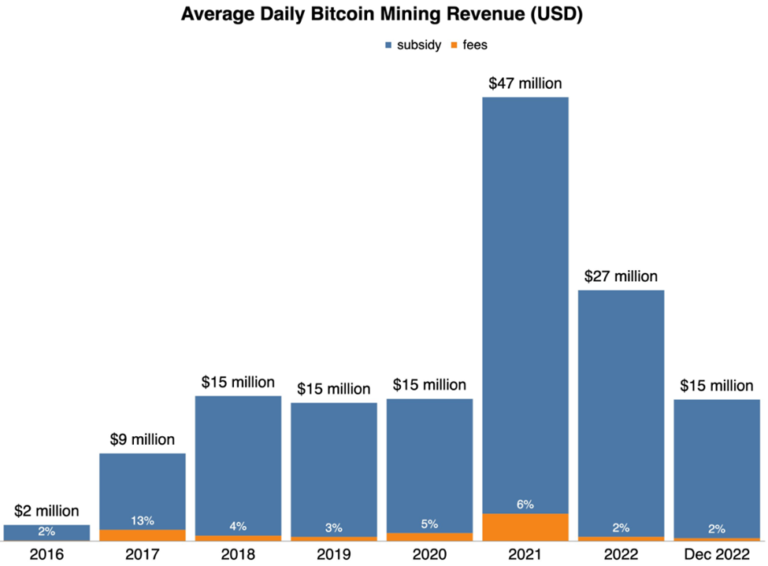
On the other hand, Pierre Rochard, the Bitcoin Strategist at the cryptocurrency exchange Kraken, said not too long ago that the bitcoin mining income of December has returned to the level it usually is before the halving. In his analysis, he presented a chart that showed the daily average income generated by bitcoin mining from 2016 until 2022.

Source: Pierre Rochard

In contrast to prior years, the miners’ income has been quite low. In 2015, bitcoin mining profitability reached an all-time high of roughly $3.00/TH per second. But by 2022, the value has dropped to less than $0.104/TH per second.

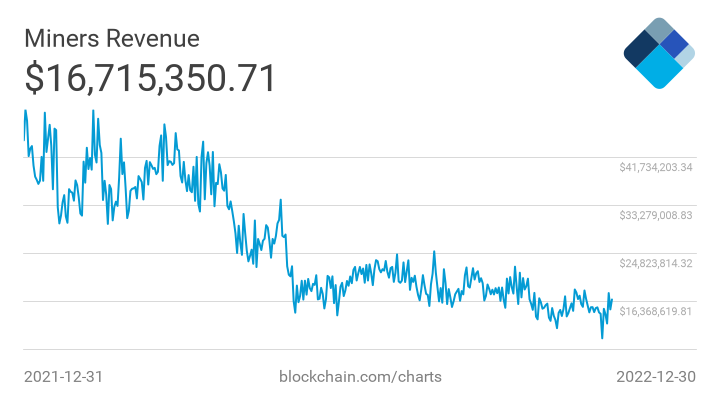
BTC Miners Revenue Chart at press time. Source: Blockchain.com

Given that these experts have predicted no respite for miners in the near future, it seems like it’s going to be a rough year for the sector.

They had the best buckle up for the next twelve months because it’s likely going to be a rough one.

Was this writing helpful?

No Yes

Read More
Sohrab Khawas

Medicaid management: Is cloud the more secure choice?

The pros and cons of cloud have been debated for decades. But as our industry moves away from monolithic Medicaid Management Information Systems to modular Medicaid Enterprise Systems, now is a good time to revisit the debate.

States have two primary choices when it comes to the hosting that will serve as the foundation for their system: move to the cloud, or keep an on-premises (or “on-prem”) architecture. Historically, security has been a big part of the decision — or indecision — to migrate to the cloud due in part to the perceived security benefits of having servers and data stored in an onsite location. But the fact that many of the nation’s healthcare companies — not to mention the CIA and the Pentagon — are actively migrating and publishing to the cloud may be helping to settle the debate.

Changing perspectives

States are right to question the security of cloud implementations. But when looking at security in the cloud, I challenge states to reframe the question from “How secure is my information in the cloud?” to “What innovative things can I do in the cloud that will make my organization even more secure?”

Let’s take a look at cloud security in general.

One traditional argument against moving to the cloud is a perceived lack of control. However, what is lost in control is more than made up for in the level of security, resources and knowledge these large providers bring to a state’s Medicaid operations.

Leveraging investments

States, at their core, are not data center management companies, infrastructure management companies or even security organizations. And it is becoming increasingly difficult for them to manage those capabilities.

Major cloud providers attract top-tier cybersecurity talent and invest billions of dollars into security infrastructure. The faster an organization can adapt to an evolving security landscape, the more secure it is. Cloud provides that agility, and through cloud deployment, states can benefit from all the investments that companies such as Amazon, Azure and Google continuously make to harden their environments.

Protecting data

States are also right to examine data security in the cloud. Federal legislation and frameworks such as HIPAA, Health Information Technology for Economic and Clinical Health (HITECH), and Health Information Trust Alliance (HITRUST) require strict security protocols around protected health information, with some necessitating the physical separation of data. States also face rigorous compliance measures mandated by the Centers for Medicare and Medicaid Services, which, fittingly, is also in the cloud.

Cloud providers can now isolate different systems and functions, as well as implement a variety of controls to increase security. With the click of a button, states can choose to use either a shared or dedicated server.

Of course, states could implement their own controls on premises, but without the same degree of simplicity.

With the cloud, all of this happens essentially at the click of a button.

Reducing complexity

What can the cloud offer in the way of differentiated approaches to security, compliance and resiliency?

One example is cryptographic key rotation — the ability to change the math that encrypts all of a state’s stored data. In the cloud, states can easily direct the key to rotate every day, achieving a much higher level of security with much greater simplicity.

From remediation to prevention

Even more important for states, the cloud offers security and compliance capabilities that are truly out-of-the-box. For instance, states can shift their focus away from remediation to prevention by using “as code” models — Infrastructure as Code, Compliance as Code and Security as Code — to integrate their requirements into the way they develop their products and processes. Through automation, they can embed controls at the very outset to secure a workload as it moves throughout its lifecycle, reducing costly human errors and speeding up the process tremendously.

The cloud opens the door to more security capabilities than ever before, providing a centralized, automated approach to protecting sensitive data and supporting compliance efforts. More than that, the cloud allows states to push the innovation bubble beyond the high-level security that already exists in the cloud, enabling them to weave security and compliance into the fabric of their operations.

About the author
Jacob Sims serves as chief technology officer for Gainwell Technologies, responsible for leading the technology vision, strategy and execution of Gainwell’s data science, advanced analytics and service platform. He brings significant experience leading large-scale healthcare IT organizations and specializes in transformative initiatives and data-centric product cultivation.

Sponsored by
gainwell logo
Gainwell Technologies is the leading provider of cloud technology solutions vital to the administration and operations of health and human services programs. We offer clients scalable and flexible solutions for their most complex challenges. These capabilities make us a trusted partner for organizations seeking reliability, innovation and transformational outcomes. For more information, visit gainwelltechnologies.com.

Read More
Raleigh Mischke

Reducing mental health disparities and advancing health equity: Why culturally centered collaborative integrated care models matter

0

With growing diversity concerning various ethnicities and nationalities, and understanding the significant changes in risk factors that can influence physical and mental health outcomes, healthcare must advance strategic, clinic-based efforts that may improve individuals’ longevity and quality of life.

These issues have relevance for underserved, vulnerable and/or high-risk populations, such as racial and ethnic minorities, that have lower life expectancies compared to the white population in the United States.1,2,3Moreover, individuals with severe mental illness die 10 to 20 years earlier from largely preventable comorbid medical conditions — such as heart disease, diabetes, cancer and pulmonary disease — that occur more frequently and have earlier onset in these vulnerable populations, and low rates of prevention, detection and treatment of comorbid conditions further compound such health disparities.3,4

Addressing the multifaceted physical, mental, and behavioral health needs of ethnic minorities in the U.S. population is a complex issue that warrants attention from clinicians, researchers, scientists, public health professionals and policy makers.

When he was Surgeon General, David Satcher, MD, PhD, promulgated the idea that “There Is No Health Without Mental Health,” and released Mental Health: Culture, Race, and Ethnicity, a report that concluded that minority groups have less access to mental health care, are less likely to receive treatment, and when treated, often receive a poorer quality of care than nonminority populations. As a result, racial and ethnic minority populations often experience a greater burden of disability associated with behavioral disorders.5 In my clinical experience, I’ve found that many of the same deleterious and disjointed systemic issues remain relevant. I suggest that partnership with selected community-based organizations that includes collaboration with Community Health Workers and with primary healthcare facilities (e.g., Federally Qualified Health Care Centers) can help to implement strategies designed to improve health equity and reduce ethnic and racial disparities in mental health through culturally centered collaborative care.

For many individuals, making an appointment with a primary care doctor may be their first step, and in some cases the only way they can get access to a mental healthcare professional for screening for depression or anxiety. The primary care setting may be a critical link to aid in identifying and addressing mental health issues for ethnically and culturally diverse individuals.6,7 There is a significant need to establish comprehensive methods on how to deliver quality and effective mental health services within the context of demonstrating respect for the cultural orientation of the patient.

Black adults in the United States who are seeking mental health care or living with serious mental illness disproportionately lack access to culturally responsive care.8 Only 2% of psychiatrists identify as Black. Integrated collaborative care is a multicomponent, healthcare system–level intervention that uses case managers to link primary care providers, patients and mental health specialists.9, Primary care providers receive consultation and decision-making support for diagnosis and treatment from mental health specialists, who form a supportive network of peers and professionals at the primary care level.9

Integrated collaborative care is designed to (1) improve routine screening and diagnosis of mental health disorders; (2) increase provider use of evidence-based protocols for proactive management of the disorder(s); and (3) improve clinical and community support for active client engagement in treatment goal setting and self-management.10 Collaborative care is effective for improving quality of life and a range of behavioral health conditions. It empowers patients by engaging them to manage their overall healthcare through community linkages and to establish a meaningful connection with their primary care doctor.10

As healthcare reform is implemented, there is an opportunity to improve behavioral health care and support individuals, families and communities with access to culturally centered integrated care.

About the author
Dr. Kisha Holden, PhD, MSCR, has dedicated her career to encouraging mental health and well-being among ethnically and culturally diverse families through research, programmatic initiatives and developing innovative strategies for informing health policies. Dr. Holden is a paid consultant to Janssen Pharmaceuticals, Inc., related to the Community Health Equity Alliance.

About the Community Health Equity Alliance
The Community Health Equity Alliance prioritizes community-informed solutions to meaningfully advance serious mental illness care. It brings together influential organizations, in collaboration with Janssen Neuroscience, in the areas of mental health advocacy, faith, civic, and healthcare professional services to help achieve more equitable mental health care for Black adults.

Sponsored by
Janssen logo

Read More
Michele Mayoral

Filling gaps in care: Improving access to trusted information outside the doctor’s office

Over the past several years, the doctor-patient relationship has undeniably changed around the world. As many have begun to argue that typical touchpoints like the annual physical are becoming obsolete, the moments where a patient has the opportunity to receive guidance on their health from a source they trust become increasingly sporadic.

But during the weeks, months, or years between visits, where do patients go to find answers to their health questions? Online sources, friends, family, social media, and news outlets weave a patchwork of information that guides our health decisions everyday – yet the difficulty lies in understanding which of these sources is credible. This is especially true when we consider people in under-resourced groups who, given several cultural and socioeconomic factors, largely rely on the information available within their existing ecosystems.

More and more, we’re seeing that access to high-quality, helpful information is found to be a social determinant of health, as it impacts outcomes at both the individual and the community level. Not only does it influence one’s decisions around when and where they seek care, but also how they invest in products or choose a health plan, and whether they understand the complex topics related to their wellbeing.

When we consider how exposure to misinformation or falsehoods can misguide patients, it underscores the responsibility that we as providers have to ensure we ourselves understand where these sources lie, and how to use them as part of our practice.

But this is a new way of operating. For years, many of us in healthcare have been resistant to thinking about how people receive information. We take a complicated system and, instead of breaking it down, we ask patients to step into our world filled with jargon and paywalled research. When a patient leaves the emergency department, they are handed a long printout of discharge instructions, but they may not understand the terms or be able to absorb it.

Beyond this, there has also always been a broader need for the shared experiences from patients or caregivers who have navigated a similar health journey. We see this for people across all walks of life – whether it be a woman who receives a cancer diagnosis and doesn’t know who to ask about the treatment experience, or a teenage boy who is silently suffering from depression and feels too nervous to turn to family or friends with his emotions.

One of the lessons that we all learned during the pandemic is that we need to think hard not only about where and how a health message is shared, but who is sharing it. Who do people trust to hear particular pieces of information from, and what format is most effective in making that stick? How can we create an ecosystem that enables patients to find answers, so they know how to take care of themselves and what to watch for as they recover?

As a platform that reaches billions of people each month, we at YouTube understand the opportunity we have to play a role in answering that question. This is particularly important for BIPOC and underrepresented groups, who have been systematically underserved for decades, resulting in a deep-rooted mistrust in America’s medical professionals and institutions. This is why we have spent the last two years prioritizing our efforts around health information. From partnerships to establish guidelines and principles with the world’s leading health organizations and providers, to dedicated teams that ensure the questions that people are searching for are answered in a way that is both engaging and factual, to features that help users differentiate this content from the floods of other videos on the platform – all working towards our goal to rethink the role that our platform has to play in the public health ecosystem.

Further, as the inequities in our global healthcare system were laid bare over the past few years, we’ve worked to determine how we can create a content ecosystem that is tailored towards closing these gaps in care. This year, in partnership with the Kaiser Family Foundation, we brought together three outstanding organizations that are doing the work on the ground in these communities – the Loveland Foundation, the National Birth Equity Collaborative (NBEC) and the Satcher Health Leadership Institute at Morehouse School of Medicine – and have provided each with seed funding and video production expertise, along with data and research, to help them build a presence on YouTube that reaches audiences at-scale.

At a global level, health care systems, providers, government entities, technology companies, non-profit organizations and churches all need to think of how information drives health outcomes, and how we rethink health communications to establish a seamless web of credible information, connecting the dots for all patients.

Read More
Tami Roberie

Removing barriers to advanced practice nursing opens doors to better healthcare for all

As a Certified Registered Nurse Anesthetist (CRNA) and president of the American Association of Nurse Anesthesiology, I proudly represent nearly 59,000 members of one of America’s most trusted professions, according to Gallup: advanced practice nursing.

Advanced practice registered nurses (APRNs), including CRNAs, nurse practitioners, nurse-midwives, and clinical nurse specialists have earned that trust. Americans rely on them for compassionate healthcare services in all settings and geographic areas, especially in rural and underserved community-based facilities.

CRNAs and other APRNs have been trained at the master’s or doctoral level to provide anesthesia and pain management services, treat and diagnose illnesses, advise the public on health issues, manage chronic disease, provide care during pregnancy, childbirth and the postpartum period, order and interpret diagnostic tests, and prescribe medication and non-pharmacologic treatments.

As of 2020, more than 233,000 APRNs treated Medicare patients, and approximately 40% of Medicare beneficiaries received care from an APRN. Despite the critical role that APRNs take on in our healthcare system, some federal statutes and regulations, state practice acts, and institutional rules limit APRN practice.

At a time when communities across the country are facing a shortage of healthcare providers, we must help ensure that everyone who needs access to the high-quality care nurses provide can have it. Unnecessary and redundant laws and regulations that prevent APRNs from practicing to the full extent of their education and clinical training disrupt access to care, increase costs and undermine efforts to improve the quality of care.

Americans rely upon APRNs, and so does America’s healthcare system. That’s why, together with our APRN colleagues and champions in Congress, CRNAs urge the passage of the Improving Care and Access to Nurses (ICAN) Act. This much-needed legislation removes barriers to care and increases access to services provided by APRNs under Medicare and Medicaid.

Recommendations from the experts

Recognizing the importance of APRNs to our healthcare workforce, and for patient access to care, the 2010 Institute of Medicine (IOM) report, “The Future of Nursing: Leading Change, Advancing Health,” called for the removal of laws, regulations and policies that prevent APRNs from practicing to the full scope of their education and training. In 2021, The National Academies of Science, Engineering and Medicine (previously named the IOM) affirmed this position in “The Future of Nursing 2020-2030: Charting a Path to Achieve Health Equity,” which recommended that “all relevant state, federal and private organizations enable nurses to practice to the full extent of their education and training by removing practice barriers that prevent them from more fully addressing social needs and social determinants of health and improve health care access, quality and value.” These recommendations have been echoed by multiple other bipartisan stakeholders such as the American Enterprise Institute, the Brookings Institution, and the Bipartisan Policy Center.

Access to care

Unfortunately, there are still Medicare and Medicaid policies that have not been modernized to reflect the growing and essential role of APRNs. Various federal statutes and regulations remain, preventing APRNs from practicing to the full extent of their education and clinical training.

For example, CRNAs represent more than 80% of the anesthesia providers in rural counties. Rural hospitals and critical access hospitals often rely on independently practicing CRNAs for anesthesia care, enabling those hospitals to provide a wide range of surgical care. Half of U.S. rural hospitals use a CRNA-only model for obstetric care, and CRNAs safely deliver pain management care, particularly where there are no physician providers available, saving patients long drives of 75 miles or more.

Despite their important role in maintaining critical access in communities across the country, CRNAs are hampered by current Medicare restrictions that require physician supervision of CRNAs. This federal requirement creates a barrier to expanding care and worsens the current provider shortage, especially in underserved communities, without improving outcomes.

Looking to the future

The ICAN Act will remove many of the existing barriers between patients and nurses in Medicare and will increase access to care for all Americans. Removing redundant supervision requirements for nurse anesthetists will help to lower healthcare costs in Medicare and Medicaid programs and ensure proper reimbursement for services to maintain the highest standards and quality of care.

Americans relied on APRNs practicing at the top of their scope throughout the COVID-19 public health emergency. For almost three years, we have seen practice barriers removed at the federal level, which has allowed nurses to step up on the front lines of multiple global health challenges. I was inspired to see my fellow CRNAs taking the lead in response to COVID, working to help the sickest patients under the most difficult conditions.

We have seen how much nurses can do when we allow them to reach the full potential of their education and scope of practice. Removing barriers between nurses and our patients is critical for achieving a more compassionate, efficient, affordable and equitable healthcare system for all Americans. This makes it essential that Congress removes barriers to care for APRNs and their patients.

To learn how you support the ICAN Act, visit AnesthesiaFacts.com/TakeAction.

About the author
Angela Mund, DNP, CRNA, is the president of the American Association of Nurse Anesthesiology. Providing diverse and interrelated perspectives of a leader, educator, advocate and clinician, she has testified before state legislative bodies as well as Congress on the important role CRNAs play in providing safe, quality anesthesia care.

Sponsored by
aana
Founded in 1931, the American Association of Nurse Anesthesiology is a professional association representing nearly 60,000 Certified Registered Nurse Anesthetists and student registered nurse anesthetists nationwide. CRNAs are prolific anesthesia professionals who safely administer anesthetics. As advanced practice registered nurses, CRNAs are among the nation’s most trusted professions.

Read More
Maribel Latson

Seth Anderson Commits to Iowa Football

Football

Hawkeyes Add Wide Receiver from Transfer Portal

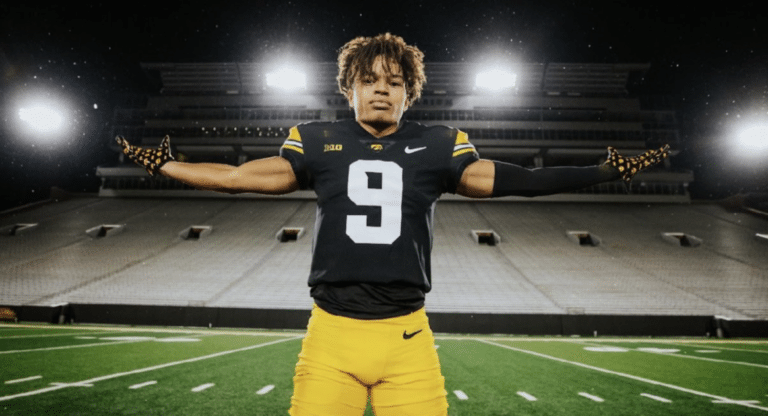
A day after finishing the 2022 season with a victory, Iowa Football celebrated New Year’s Day by adding a new wide receiver. Charleston Southern transfer Seth Anderson announced his commitment via social media. 

“I loved the coaches and the culture there,” Anderson told HN about why he chose the Hawkeyes. “I feel that I can make an impact.” 

Iowa addressed a position of need. It lost receivers Arland Bruce IV and Keagan Johnson to the transfer portal last month. 

Anderson would join veterans Nico Ragaini, Diante Vines, Jacob Bostick, and Brody Brecht, and incoming freshman Alex Mota, Dayton Howard and Jarriett Buie Jr. on the Hawkeyes’ current 2023 roster. They are involved with transfer portal pass catcher Isaac TeSlaa, who officially visited in December

Scroll to Continue

Read More

Anderson (6-0, 178) officially visited Iowa last month as well. He visited Georgia Tech and Appalachian State, too. 

As a freshman at Charleston Southern this fall, Anderson caught 42 passes for 628 Yards and seven touchdowns. He prepped at Suwanee (GA) North Gwinnett High, the alma mater of former Iowa running back Tyler Goodson.

Anderson’s father, Willie “Flipper” Anderson, played receiver at UCLA and for 10 years in the NFL with the Rams, Broncos, Colts and Washington. 

In This Article (1)

Football Iowa Hawkeyes

Iowa Hawkeyes

Read More Arden Latson

NFL scores, schedule, live Week 17 updates: Aaron Rodgers’ Packers control playoff destiny; Bucs in postseason – CBS Sports

It’s Week 17 of the 2022 NFL season, and we’re keeping you updated on all the action and biggest storylines throughout the day. This week’s slate has some fantastic matchups and storylines, and we’re here to help you watch it unfold. Check back often to find out everything you need to know.

Week 17 schedule

Thursday

Cowboys 27, Titans 13 (Takeaways)

Sunday

Patriots 23, Dolphins 21 (Takeaways)
Saints 20, Eagles 10 (Takeaways)
Buccaneers 30, Panthers 24 (Takeaways)
Giants 38, Colts 10 (Recap)
Browns 24, Commanders 10 (Recap)
Chiefs 27, Broncos 24 (Recap)
Jaguars 31, Texans 3 (Recap)
Lions 41, Bears 10 (Recap)
Falcons 20, Cardinals 19 (Recap)
Seahawks 23, Jets 6 (Takeaways)
Packers 41, Vikings 17 (Takeaways)
Chargers 31, Rams 10 (Recap)
49ers 37, Raiders 34 (OT) (Recap)
Steelers 16, Ravens 13 (Takeaways)

Monday

Bills at Bengals, 8:15 p.m. ET (Preview)

Nick Bosa delivers!

Unsurprisingly, NFL Defensive Player of the Year frontrunner Nick Bosa delivered when it mattered most. Facing second-and-10 in overtime, Jarrett Stidham wanted Davante Adams deep down the left side. The only problem was he couldn’t get anything on the throw, because Bosa walked his offensive lineman right into Stidham. Getting bumped by his teammate as he threw, Stidham unloaded a wobbler that floated in the air and came down into the hands of Tashaun Gipson for the interception. Gipson’s return, plus a low-block penalty on Las Vegas, set up the 49ers on the three-yard line. That then set up redemption for Robbie Gould, whose 23-yard field goal lifted the 49ers to their ninth straight victory.

NO GOOD

The legend of Brock Purdy was about to grow after the seventh-round rookie led the 49ers inside the Raiders‘ 25-yard line. But on the final play of regulation, Robbie Gould pushed his 41-yard field goal wide right. The Raiders are alive!

Raiders won’t go away

Somehow clinging to playoff hopes, the Jarrett Stidham-led Raiders are giving the 49ers all they can handle. Thanks in large part because of Davante Adams (seven catches, 153 yards, two touchdowns), Las Vegas has put up 34 points on the NFL’s top defense, the latest coming on a Josh Jacobs one-yard, game-tying touchdown run with 71 seconds to play.

40 burger

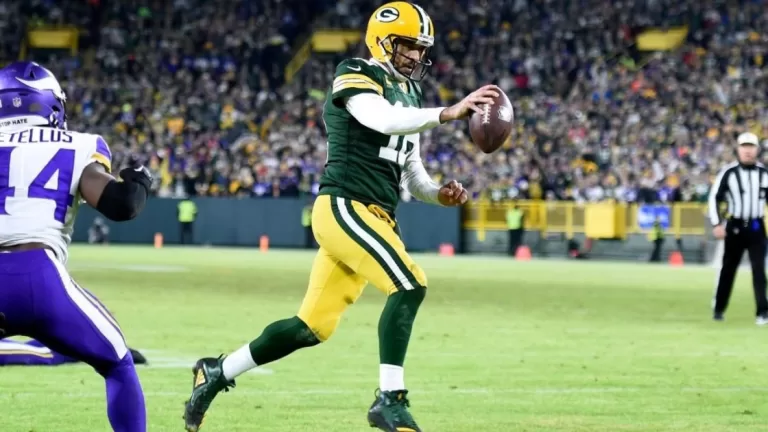
On Thanksgiving weekend, the Packers were 4-8 after giving up 40 points to the Eagles on “Sunday Night Football.” Four games and five weeks later, Green Bay is back at .500 and controls its playoff destiny entering the regular season finale versus the Lions. It’s been a miraculous turnaround for Aaron Rodgers‘ group, which just dismantled the 12-3 Vikings by a score of 41-10.

Bad Kirk Cousins

Kirk Cousins have been objectively very solid this season, but every once in a while the Vikings offense goes completely stagnant. Sunday has been one of those times. For the second time this year, Cousins have thrown three interceptions in a game as Green Bay has dominated its NFC North rival from the jump.

Packers defense delivers again

When the 12-3 Vikings lose, they lose BADLY: 24-7 versus the Eagles in Week 2, 40-3 against the Cowboys in Week 11, and 34-23 in Detroit in Week 14. Week 17 will most likely be the team’s fourth loss this season of at least 10 points, as the Vikings can’t do anything right down 34-3 early in the fourth quarter. Just as it looked like Minnesota would score its first touchdown, Kirk Cousins fumbled the ball back to Green Bay.

CMC x5

Another game, another touchdown for Christian McCaffrey, who has been so important since coming over from Carolina. He’s now got a score in five straight.

Another Mike Williams gem!

This. Guy. Catches, Everything. The Chargers wide receiver is something else.

Jarrett Stidham!

The 49ers have the top defense in the NFL. Jarrett Stidham has attempted 61 career passes and thrown two touchdowns.

Based on these two facts, someone explain Stidham’s first-half stat line: 11-for-14, 145 yards, two touchdowns, no interceptions. He’s been fantastic against the toughest competition, and of course Davante Adams has been a big help.

And if that wasn’t enough, Stidham opened the third quarter with a six-play, 84-yard drive during which he rolled out, waited until the last second for the play to materialize, and then hit a wide-open Davante Adams for what ended up being a 60-yard score.

Catch of the day!

Parris Campbell had the early catch of the day … until Mike Williams put his contested catch to shame. There are only a few players in the league that can make this catch. A thing of beauty.

Mr. Touchdown

Austin Ekeler entered Sunday leading all non-quarterbacks with 16 total touchdowns, and he’s extended that lead with two first-half scores versus the Rams on Sunday. The second score was a beauty, as Ekeler found a crease up the middle, made a defender miss in the secondary and then ran away from everyone else for the 72-yard house call.

Rodgers who? 

Aaron Rodgers was 4-for-9 for 28 yards … and yet the Packers had a two-touchdown lead late in the first half. That’s because the defense and special teams have come to play in a major way. In addition to Keisean Nixon’s 105-yard kickoff return, Green Bay has gotten a 75-yard interception return from Darnell Savage Jr. and then another interception from Adrian Amos off a tipped pass.

Fittingly, as I typed this blurb, Rodgers was leading a five-play, 60-yard drive that he capped with a 21-yard touchdown pass to Robert Tonyan.

Mr. Relevant 

Brock Purdy has been so impressive for the surging 49ers, and he’s showing no signs of slowing down. He’s now thrown multiple touchdowns in each of his first four career starts after finding Brandon Aiyuk and George Kittle in the opening half versus the Raiders.

Kickoff return TD!

Keisean Nixon has been incredible since becoming the Packers’ kickoff return man in late October. The 2019 undrafted free agent entered Sunday leading the NFL in kick return yards (825) and kick return average (27.50), and now he can add kickoff return touchdown to his resume. With the Packers needing to win to stay alive in the playoff hunt, Nixon, after battling a groin injury all week, fielded the ball five yards into his own end zone and was off to the races, weaving his way all the way for the 105-yard score!

Let Geno Cook

Pro Bowler Geno Smith is looking like the QB who earned that honor with his brilliance over the first half of the season. He has not been as good lately, but he’s regained his former against a stout Jets defense. In a quarter and a half, he’s completed seven of his nine passes for 111 yards and touchdowns to Tyler Mabry and Colby Parkinson as Seattle looks to keep its playoff hopes alive.

Jarrett Stidham!

It was about as good of a start as Jarrett Stidham could have asked for in his first start replacing Derek Carr. Despite facing the NFL’s top defense, Stidham carved up the 49ers on the opening drive, marching 70 yards on six plays and connecting with Darren Waller for the 24-yard score.

Bucs punter saves the day!

On fourth-and-10 around midfield, a bad snap left Buccaneers punter Jake Camarda in an awful situation. But with several Panthers chasing him, Camarda not only got off the punt on the run, but the ball landed inside the 5-yard line. The punt didn’t end up counting because there was an ineligible man downfield, but if Camarda never got the punt off, Carolina would have had the ball in great field position with enough time to score the game-winning touchdown. Instead, there was a re-punt, which backed up the Panthers too far to make anything happen before the clock struck zero.

Game-winning FG!

Apologies for the lack of Falcons-Cardinals updates, but it was the only game in the early window without playoff implications. Still, it was a back-and-forth affair that Younghoe Koo won with a chip-shot field goal as time expired to lift Atlanta to the victory.

TOM BRADY

You want something done right? Do it yourself. Tom Brady did just that on the goal line to all but seal the Buccaneers’ victory and another NFC South title in what’s been a disappointing season.

MIKE EVANS

Mike Evans is incredible. Not only does he have an NFL record nine straight seasons with 1,000 yards receiving to start his career, but he’s absolutely carried the Buccaneers with the NFC South title on the line. Just check out this stat line: 10 receptions, 207 yards and three touchdowns — from 30, 57 and 63 yards — to carry the Buccaneers to the win and back-to-back division titles.

Another pick-six!

All the Eagles needed is one win in their final three games to wrap up the No. 1 seed in the NFC and a first-round bye. It’s looking like Philadelphia is going to lose its second game in a row after backup QB Gardner Minshew’s pick-six to Marshon Lattimore put New Orleans up 10 in the final minutes.

Pick-six!

The Patriots defense saving the day once again. Trailing, 14-10, late in the third quarter, Kyle Dugger jumped in front of the Dolphins pass-catcher to snag the interception and take it back 39 yards for the go-ahead score. And to add insult to injury, Duggar’s violent stiff-arm to Teddy Bridgewater near the goal line knocked the Dolphins’ starting quarterback out of the game.

Broncos? Broncos!

The Broncos, who were embarrassed in front of a national audience on Christmas Day, somehow have the lead over the Chiefs entering the fourth quarter. Russell Wilson’s touchdown pass to Albert Okwuegbunam put Denver ahead.

Eagles have life

The Jalen Hurts-less Eagles have done basically nothing offensively against the Saints … until Gardner Minshew just decided to throw it up to A.J. Brown in single coverage. Paulson Adebo got tangled up with Brown, which knocked him out of the play, and then Brown stopped Daniel Sorensen in his tracks as he raced past him. The 78-yard score brings Philadelphia within three.

Lions all over Bears

The Lions are taking out their frustration from last week’s disappointing loss to the Panthers on their NFC North rival. Jared Goff has nearly as many touchdowns (three) as incompletions (four), while D’Andre Swift has found the end zone twice (one rushing, one receiving) as Detroit is beating up on the Bears.

Danny Dimes BALLIN’

What a difference a year makes. Last season, Daniel Jones did not perform well enough for the new Giants brass to pick up his fifth-year option. He’s since had the best campaign of his career, and he’s been superb as New York attempts to beat the Colts and make the playoffs for the first time since 2016. In addition for going 19 of 24 for 177 passing yards and a touchdown, he’s added 91 yards on the ground and another two scores as the rout is on at Metlife Stadium.

Amari Cooper says goodbye

Poor Kendall Fuller. The Commanders cornerback thought Amari Cooper was going to cut inside after catching the quick out. Instead, Cooper stopped on a dime, turned outside and left the diving Fuller in the dust as he galloped down the left sideline for the 46-yard touchdown.

Aidan Hutchinson continues to dominate

Michigan could not get the job done in the College Football Playoff semifinal on Saturday night, but former Wolverine Aidan Hutchinson has been delivering all year for the Lions on Sundays. Not only do his 7.5 sacks lead all rookies, but he’s now tied for the most interceptions among linebackers/defensive ends in the entire NFL after picking off Justin Fields on the last play of the first half. It’s been a dominant rookie campaign for the No. 2 overall pick.

21-play drive!

Two weeks after the Steelers went on a 21-play TD drive versus the Panthers, the Commanders matched that with a 21-play, 96-yard drive that gobbled up MORE THAN 11 MINUTES of game time. On fourth-and-goal, Carson Wentz made up for his two first-half interceptions by reaching the ball over the goal line for the go-ahead score.

Welcome back, Landon Collins

Landon Collins, a former three-time Pro Bowler with the Giants, re-signed with New York in early October and has quickly made his presence felt. No play was more important than this one, as Collins jumped the quick out route, intercepted the pass from Nick Foles and took it 52 yards to the house.

Jags all over Texans

This game means next to nothing for the Jaguars, but they’re still playing as if their playoff lives are on the line. After JaMycal Hasty found the end zone on Jacksonville’s opening drive, fellow running back Travis Etienne doubled that advantage with a 62-yard burst and then Tyson Campbell tacked on six more with his fumble return for a touchdown. It’s been all Jaguars in the opening 30 minutes.

Panthers and Bucs trade TDs

The Panthers jumped out to a two-touchdown lead with Sam Darnold’s touchdown to D.J. Moore, but with their backs against the wall, Tom Brady hooked up with his favorite receiver, Mike Evans, for a 63-yard score that cut the deficit in half.

Chiefs sloppy with the ball

Not often do you see the Chiefs beat themselves, but their sloppiness has allowed the Broncos, who gave up 51 points on Christmas Day against the Rams, to go ahead in the second quarter. First Patrick Mahomes threw a red-zone interception to Justin Simmons, and after the defense forced a punt, Kadarius Toney coughed the ball up to give Denver the ball right back. On the next play, Russell Wilson flipped back the clock five years as his 16-yard scamper put his team ahead.

TDs & backflips

Tyreek Hill is the king of post-touchdown acrobatics, so it’s not surprising he put on a show after taking the bubble screen two yards into the end zone against the Patriots.

But how about Richie James? The Giants WR provided some theatrics of his own after scoring the go-ahead touchdown against the Colts.

Catch of the day nominee

Did not think any Colts would be in contention for this after how Nick Foles looked against the Chargers on “Monday Night Football,” but Parris Campbell showed his contested-catch ability on this fantastic grab with three Giants in close proximity. His 49-yard snag set up an Indianapolis field goal.

Saints (very slowly) march down field

The Saints’ very slim playoff chances start with beating the NFC-leading Eagles, and they’re off to a great start in Philadelphia. New Orleans received the opening kickoff and immediately marched 75 yards in 15 plays, draining nearly nine minutes in the process. Even better, the possession ended with a touchdown from Taysom Hill from one yard out.

Justin Fields can’t be stopped

Fields, already arguably the best running quarterback in the NFL, is once again dominating on the ground. He’s already ripped off runs of 31 and 60 yards and has gone over 100 yards rushing … in the first quarter! Fields’ latest brilliance moves him into second place in single-season rushing yards for a quarterback, trailing only Lamar Jackson (1,206) from 2019.

Rough start for Wentz

Starting his first game since Week 6, Carson Wentz did nothing to suggest he’ll be an upgrade over the errant yet successful Taylor Heinicke. First pass from Wentz, incomplete. Second pass, intercepted by Denzel Ward. Just a late throw from Wentz, which allowed Ward to cut in front of Terry McLaurin to secure the turnover.

Mahomes to Mahomes

When balls get deflected back to quarterbacks, they usually try and knock them down so they don’t get intercepted. Mahomes is not most quarterbacks, so he caught his own deflected pass and ran for six yards on the Chiefs’ opening drive, which ended in a Isiah Pacheco touchdown.

Fields on the … pitch?

Yes, you read that right. On third-and-1 from around midfield, tight end Cole Kmet motioned under center, took the snap and then pitched it to Justin Fields, who looked like a Pro Bowl running back as he navigated his way 31 yards deep into Lions territory. Three plays later, Fields returned the favor by hitting Kmet for a 13-yard touchdown to open the scoring.

Panthers strike first! 

The same Panthers who fired their head coach and traded their star RB are still in the hunt for a playoff spot, and they’re off to a great start against the Buccaneers. Sam Darnold, who has embraced the game-manager role for run-focused Carolina, did some serious damage with his arm on the opening drive, hitting D.J. Moore for 26 yards, Shi Smith for 11 more, Laviska Shenault Jr. for six and finally Tommy Tremble for the 17-yard score.

Unlikely playoff-deciding matchups

Let’s start by saying Bills-Bengals is the game of the weekend — and potentially one of the best of the entire season. And that’s not surprising based on preseason expectations. Buffalo has been the Super Bowl favorite nearly every day since Super Bowl LVI, while Cincinnati brought a ton of momentum into 2022 after its surprising run to nearly hosting the Lombardi Trophy. Cherish this upcoming “Monday Night Football” matchup, because the top games entering the season don’t always pan out. 

Case and point: the rest of Week 17. The three most important games on the slate are Jets-Seahawks, Buccaneers-Panthers and Dolphins-Patriots. By this point, most would have probably thought New York and Seattle were eliminated and Tampa Bay was competing for the No. 1 seed in the NFC — not its own putrid division. Elsewhere, the Giants and Commanders are looking to lock up playoff spots against a pair of preseason playoff hopefuls, the Colts and the Browns, respectively, while the Packers are hoping to keep their postseason hopes alive against the Vikings — a notion that would have sounded backwards in July.

The NFL is great because it’s unpredictable in so many ways, and that unpredictability has yielded some monumental Week 17 showdowns. They’re just not the ones you thought you were going to see.


Read More Margherita Grisby

NFL, Week 17 Analysis: Winners and Losers from Seahawks 23, Jets 6 – Field Gulls

That’s how you start the new year!

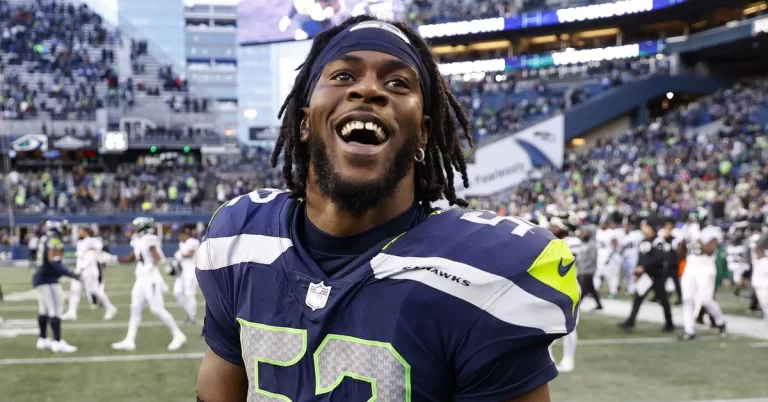
Perhaps this will all be for naught and the Green Bay Packers will get that last playoff spot, but the Seattle Seahawks guaranteed that they will have something to play for in Week 18 against the Los Angeles Rams. Win and some Detroit Lions help and you’ve got yourself a playoff team. At the very least, the Seahawks did play spoiler by eliminating the New York Jets in a comfortable 23-6 victory.

Here’s the first Winners and Losers for 2023!


Winners

Darrell Taylor

It’s been a disappointing year for Taylor, having fallen out of favor for a waiver wire pickup in Darryl Johnson Jr. He balled out today by recording 2.5 sacks, including a strip of Mike White that led to a turnover to end the first half. Quietly he has 8.5 sacks on the season, but as a whole he hadn’t necessarily been impactful on a per snap basis. On this occasion, Taylor played his best ball and looked a lot more like what we saw from him in 2021.

Quinton Jefferson

Haven’t said too much about Q-Jeff this year but he deserves his props. Jefferson finished with 1.5 sacks and was in on some run stops. Believe it or not, Jefferson has 5.5 sacks on the season, which is a career high.

Tariq Woolen and Michael Jackson

Tight coverage just about all day and he got his first interception of the season, which put the game to bed. Tariq Woolen did bail him out on the return, as he fumbled and Woolen had to recover it. Meanwhile, Woolen nearly had a pick of his own and he even teamed up with Boye Mafe for a good run stuff. Did you know Woolen has 4.26 speed in the 40?

Quandre Diggs

The deep middle was just straight up unchallenged, and Diggs picked up his third interception on the season. It’s not been Diggs’ best season but this felt like one of his best games, and that pick prevented the Jets from getting at least a field goal opportunity. A hat tip to Jonathan Abram for his assist on that INT, too.

Cody Barton

I thought Barton played very well, and frankly the fact that he turned a screen pass into a negative play will make him a winner in my book.

Kenneth Walker III

Nothing like starting the game with a 60-yard run to set up a touchdown! He finished with 133 yards rushing and a 9-yard first down grab, with some nifty tackle breaking to earn some tough yards. Walker now has over 1,000 offensive yards and is just 64 yards away from 1,000 rushing.

DeeJay Dallas

Yes, DeeJay Dallas! He was getting in some angry runs and finished with 98 scrimmage yards (55 receiving, 43 rushing). His improvised catch-and-run on the second drive of the game set up a Jason Myers field goal. It’s crazy watching Dallas run the way he does in normal offensive plays compared to his punt return duties.

Colby Parkinson

With Tyler Lockett in and out of the lineup, Will Dissly done for the year, and Marquise Goodwin similarly out on IR, Parkinson got a heavier workload than we’ve seen his entire career. Parkinson caught five passes for 36 yards and the game’s opening touchdown. Here’s to him having an even bigger role as a pass-catcher in this offense in 2023.

Tyler Mabry

First NFL catch, first NFL touchdown! Who had Tyler Mabry getting in the box score? Congrats to him for a great moment in his career and essentially the early dagger considering the ineptitude of the Jets offense.

Geno Smith

The numbers don’t wow: 18/29 for 183 yards, and 2 TDs, but the Jets have an elite pass defense and Seattle was severely undermanned at wide receiver. Smith had a couple of nervy moments (including that ridiculous near-pick at 20-6 and the bizarre fumble that he was able to recover), but outside of that I believe he did as well as he could’ve against a tough defense. In the end he not only gets the win, he knocks out the team that drafted him.

Offensive Line

Yes, Geno was sacked four times but I believe at least two of those were on Smith/coverage sacks. The Jets have a very good run defense and Seattle almost dropped 200 on them, which is the most any team has managed against Robert Saleh’s group. There were some quality run-blocking wins and Quinnen Williams was much quieter than anticipated (while still getting 4 QB hits). Stone Forsythe also generally held his own in the place of Abe Lucas.

Michael Dickson

Michael Dickson.

2nd Half Run Defense

The Jets were kinda sorta pressed into passing with the score situation but they mustered up -1 yards after halftime. Slow start for the run D in the opening half but they have been really good in back to back weeks.

Losers

DK Metcalf

No doubt that D.J. Reed and Sauce Gardner have developed into an elite cornerback tandem, but Metcalf really didn’t make any impact in the passing game. He had just a single catch (on five targets) for 3 yards and he had a drop on a deep 3rd down conversion when he had a step on Gardner. I’ve been vocal about the way Shane Waldron has used Metcalf almost more like a giant possession receiver than heavily spamming his biggest strengths as a gifted speedster, and this includes last season when Russell Wilson was the starter, but some of this is also on DK. There are little mistakes and untimely drops he’s prone to that prevent him from being up there as a Tier 1 elite receiver like Justin Jefferson or Davante Adams.

Maybe having greater wide receiver depth next season can alleviate some of these issues and the obvious attempts by defenses to limit DK. DK has to be better—and he’s already very good—but I think we’ve seen the limitations of Metcalf and the offense as a whole without other WRs worth respecting.

Jason Myers

A MISS?! A MISS?! What is going on?! A 44-yard field goal goes wide right and his streak of made kicks is now over. Blasphemous! Ridiculous! Unacceptable!

(Myers still made all of his other kicks, but I had to be playful here)

NFL television productions and their Pike Place Market fish tossing fixation

We get it. Seattle’s got a place where the fishes get thrown. The city has other interesting landmarks and tourist attractions. At least use recent footage!

Today I learned that they’re not even going out and filming new videos of the guys throwing fish in Seattle for the NFL commercial bumpers pic.twitter.com/3GcgCJAULw

— Rodger Sherman (@rodger) January 1, 2023

Final Notes

  • I don’t want to totally pour water on Seattle’s defensive performance because they had a hand in the destruction, but Mike White almost certainly is the worst quarterback the Seahawks have faced all season. Yes, even worse than John Wolford. That was pretty wretched and wearing that rib protector likely had an impact on some of his throws. He was wildly inaccurate for the entire afternoon.
  • Dareke Young looks like a promising blocker on running plays. No wonder he was used as a fullback last week on one snap! He also downed Michael Dickson’s end of half punt at the 1.
  • Shane Waldron did a reasonably good job getting the tight ends more involved in the offense again, and he really had no other choice. The Jets were really out of sorts to start the game and left them in a hole they never came close to digging themselves out of.
  • Pete Carroll’s punt on 4th and 1 at the Jets 40… not what I would’ve done. But in hindsight, the flow of the game might have justified that decision. He’s still been more aggressive than normal in 4th down situations and that’s a positive.
  • Shoutout to Xavier Crawford for rushing the Jets punter into a shanked punt that everyone thought was deflected. More strong play by the Seahawks special teams.
  • What a bummer for Jordyn Brooks. There’s a really good chance his knee injury is serious and that’s a blow to this defense, which isn’t deep at linebacker to begin with but now loses a team leader. Tanner Muse stepped up admirably but if this injury is worst case scenario there might be a worry for Brooks into next season.
  • It ain’t over ‘til it’s over. The Seahawks have a guaranteed top-5 draft pick in their possession, all while they’re a win and a Lions win away from returning to the playoffs. We’ve had our frustrations in recent weeks but there’s also been plenty of fun. Let’s hope the fun continues for at least one more week. And you know what’s fun? Getting to do Enemy Reaction again.

Read More Alejandro Fleishman

Sunday Night Football: Steelers keep playoff hopes alive with late touchdown, 16-13 win – NBC Sports

Pittsburgh Steelers v Baltimore Ravens

Getty Images

The Steelers were fighting for their playoff lives. The Ravens were fighting to remain alive in the AFC North race.

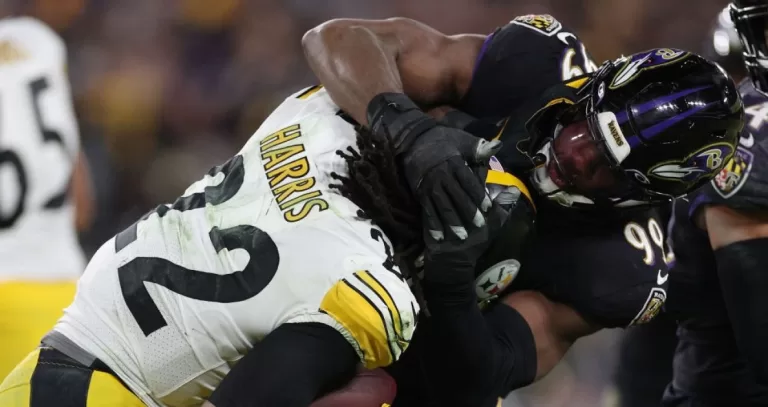
A defensive battle came down to the wire, with Najee Harris catching a 10-yard touchdown pass from Kenny Pickett with 56 seconds left to give the Steelers a 16-13 win.

The Steelers moved to 8-8 and stayed alive, though they will need help to get a wild-card berth. They started the season 2-6. The Ravens fell to 10-6, giving the Bengals a chance to clinch the division with a win Monday.

Ravens edge rusher Jason Pierre-Paul nearly sacked Pickett on third-and-eight from the Baltimore 10, but the Steelers quarterback broke free, rolled left and hit a perfect pass to Harris, who had Roquan Smith covering him. Harris’ touchdown ended a streak of 40 consecutive possessions for the Baltimore defense without allowing a touchdown at home.

Pickett had back-to-back big plays in the 11-play, 80-yard drive, connecting with Pat Freiermuth for 20 yards and Steven Sims for 28 yards to get the Steelers in position for the win.

The Ravens, with the league’s best kicker on their side, had plenty of time to get in field goal range. But Minkah Fitzpatrick intercepted Tyler Huntley on a pass intended for Demarcus Robinson with 13 seconds left.

The Steelers’ first three scores came on Chris Boswell field goals of 21, 51 and 33 yards. He missed a 48-yard try, kicking it off the upright, after missing two last week.

The Ravens led 10-3 at halftime, getting a 7-yard touchdown pass from Huntley to Isaiah Likely with seven seconds left in the second quarter.

It followed Cameron Heyward‘s unnecessary roughness penalty with 11 seconds left. The Steelers had stopped J.K. Dobbins short of the line to gain on third down before Heyward did whatever he did as both teams tussled in the pile.

The Ravens took a 13-3 lead on a 51-yard Justin Tucker field goal with 9:31 remaining in the third quarter, but they didn’t score again.

Pickett went 15-of-27 for 168 yards and a touchdown, while Huntley was 14-of-21 for 130 yards with a touchdown and an interception. Ravens tight end Mark Andrews had nine catches for 100 yards.

Harris had 22 carries for 111 yards and caught two passes for 12 yards and the game-winner.

Read More Yuri Badon

Ohio State’s Ryan Day: Georgia Loss ‘Going to Sit in Our Stomachs for a Long Time’

Mike Chiari@@mikechiariTwitter LogoFeatured Columnist IV

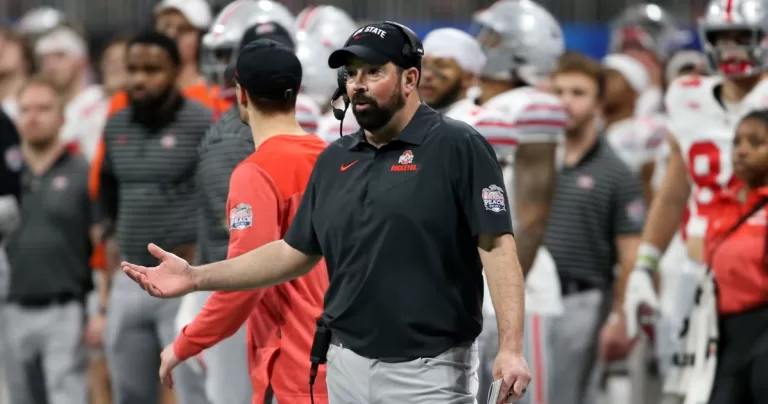
ATLANTA, GA - DECEMBER 31: Ohio State Buckeyes head coach Ryan Day during the college football Playoff Semifinal game at the Chick-fil-a Peach Bowl between the Georgia Bulldogs and the Ohio State Buckeyes on December 31, 2022 at Mercedes-Benz Stadium in Atlanta, Georgia.  (Photo by Michael Wade/Icon Sportswire via Getty Images)

Michael Wade/Icon Sportswire via Getty Images

Ohio State head coach Ryan Day lamented a missed opportunity in Saturday’s 42-41 loss to the No. 1 Georgia Bulldogs in the College Football Playoff semifinal at the Peach Bowl.

According to ESPN’s Alex Scarborough, Day suggested the loss hurts more than most due to the belief that they should have found a way to come out on top: “I don’t think there’s one guy in that locker room who doesn’t feel like we should have won the game. And I think, again, that’s a part of this thing that’s going to sit in our stomachs for a long time.”

The Buckeyes had their opportunities, as they blew 14-point leads in both the first and second halves, and kicker Noah Ruggles missed what would have been a game-winning, 50-yard field goal as time expired.

Ohio State undoubtedly had its chances to put the game away, but it was unable to stop the Georgia offense late in the game.

The Bulldogs scored on each of their final three possessions, including touchdowns on their final two. One was a 76-yard strike from Stetson Bennett to Arian Smith on a busted coverage, and the other was a 10-yard pass from Bennett to Adonai Mitchell with just 54 seconds remaining.

For all intents and purposes, the Buckeyes could have closed it out on their second-to-last drive. They impressively held the ball for nearly six minutes and got into the red zone, but they couldn’t punch it into the end zone and had to settle for a field goal to extend the lead to six with 2:43 left.

Georgia took advantage of the opening by scoring the go-ahead touchdown, and although Stroud got OSU into field goal position, Ruggles’ 50-yard try was nowhere close.

Ohio State clearly came to play after its regular season ended in disappointment with a blowout loss to rival Michigan, but Georgia’s experience in big games and clutch situations ruled the day.

The Buckeyes are 45-6 in parts of five seasons under Day, but they have yet to win a national title under his leadership, and have gone to the CFP National Championship Game only once during his tenure despite their immense talent.

While the sting of the loss to Michigan would have gone away if Ohio State beat Georgia on the same day that Michigan fell to TCU, it wasn’t in the cards for the Buckeyes.

Now, Day and the entire Ohio State program have no choice but to regroup during the offseason and figure out who will replace the key players who are NFL bound, including a star quarterback in Stroud should he declare for the draft as expected.

???? SPORTS NEWS ➡️ YOUR INBOX

The latest in the sports world, emailed daily.

Read More Mike Chiari