Key Program Objectives:
- Expansion Drill Program: The 2026 drilling program at Iska Iska, as part of the Preliminary Economic Assessment (PEA) process, follows the successful completion of the Updated Mineral Resource Estimate (MRE) in late April 2026. Its main objectives are to strategically expand and upgrade the 85.17 million tonnes of Indicated Resources grading 78.38 Ag g/t Eq. and 945.43 million tonnes of Inferred Resources grading 22.04 Ag g/t Eq. in the Updated MRE.
- Indicated Resource Definition:Targeted step-out drilling with 50m spacing within the higher-grade core area of the Potential Starter Pit, aiming to further expand the Initial Indicated Resource.
- Strike and Depth Extensions:Testing the potential down-dip and strike length of known higher-grade Silver-Tin (Ag-Sn)-polymetallic shoots which remain open laterally and vertically.
- Trend Expansion:Follow up on successful 2024-2025 step-out drilling that extended the mineralized envelope down-dip and along a strike length of approximately 1.4 kilometres to the east and west.
- Contractor – Major Drilling Group: Major Drilling Group International Inc. is the process of mobilizing two diamond drill rigs to the Iska Iska project, with a third drill expected to be added in the next three months.
Eloro Resources Ltd. (TSX: ELO; OTCQX: ELRRF; FSE: P2QM) (“Eloro: or the “Company”) is pleased to announce the commencement of its expansion drilling program, which is focused on upgrading and expanding higher grade Silver-Tin (Ag-Sn)-Polymetallic mineralization at its 100% owned Iska Iska Project in Southern Bolivia. Major Drilling Group International Inc. is in the process of mobilizing two diamond drill rigs to the Iska Iska Project, with a third drill expected to be added in the next three months.
The drilling campaign comprises 40,000m of diamond drilling in approximately 75 holes, following the Company’s recent definition drilling program that intersected mineralization over a strike length of approximately 1.4 kilometres. Initially, 40 holes totalling 18,250m will be drilled and then it will be followed up by approximately 45 holes totalling 21,750m.
Tom Larsen, CEO of Eloro, commented: “We are excited to be commencing our expansion drilling program, a major milestone in advancing the Iska Iska Project, after the release of the successful Updated MRE in late April. The next phase of drilling is an opportunity to add additional Indicated Resources to, and further support, our planned PEA.”
Mr. Larsen continued: “This program is the continuation of exploration efforts leading to the highly prospective target areas developed by the exploration work between 2020-2025. In addition, our exploration team has identified compelling targets at other prospective areas such as Central, Porco, Huayra Kasa East, San Juan and Mina 2.”
Dr. Osvaldo Arce, P.Geo., Eloro’s Executive Vice President, Exploration and Latin America Operations added: “It’s been nearly six years since we started exploring and drilling the Iska Iska mineralized system, which is a true grass-root discovery that has now developed into one of the largest silver-tin polymetallic deposits discovered in the prolific Bolivian Tin Belt. We are optimistic about the planned drilling program since we believe that we can continue to expand and upgrade this very large mineralized system which has become a significant discovery for Bolivia.”
EXPANSION DRILLING PROGRAM
The latest Iska Iska Mineral Resource Estimate (“MRE”), the findings of which were reported by Eloro on April 22, 2026, confirms a large-scale polymetallic system with an Indicated Mineral Resource of 85.17 million tonnes grading 40 g/t Ag, containing 109.53 million ounces of silver, 1.03 million tonnes of zinc grading 1.21% Zn, 0.60 million tonnes of lead grading 0.71% Pb (78.38 Ag g/t Eq.) and an Inferred Mineral Resource of 945.43 million tonnes grading 8.5 g/t Ag, containing 248.60 million ounces of silver, 4.72 million tonnes of zinc grading 0.47% Zn, 1.50 million tonnes of lead grading 0.16% Pb, 290,000 tonnes of tin grading 0.03% Sn and 1.21 million ounces of gold grading 0.04 g/t Au (22.04 Ag g/t Eq.).
The expansion drilling program is particularly important to define the full extent of the higher-grade Silver-Tin (Ag-Sn)-Polymetallic Indicated Resource, which has a major influence on overall grade and resources for the Preliminary Economic Assessment (“PEA”).
Detailed geological and engineering work will be carried out to further assess the ground-water quality, contamination risks, predicting geologic hazards, characterizing mineral resources and their extraction costs, producing geotechnical information and waste repository siting for the planned PEA.
While the system contains multiple minerals of silver-tin-zinc-lead (Ag-Sn-Zn-Pb), silver (Ag) represents a key metal in terms of its distribution and economic value. As a result, one of the key objectives of the expansion drilling program is to potentially expand the Indicated Resource in the central part of the Santa Bárbara feeder zone. The actual Indicated Mineral Resource occurs in the central part of the Santa Bárbara feeder zone, and it will continue as the primary target for the 2026 expansion drilling.
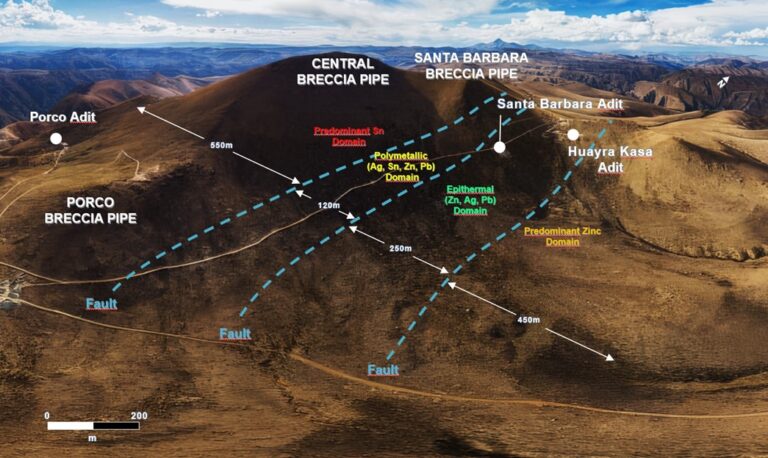
The mineralized system at Iska Iska is zoned from west to east into four principal domains (Figure 1):
- Predominant Tin (Sn) domain is mainly developed in the western portion of the system and comprises both shallow and deeper mineralization.
- The Polymetallic (Ag, Sn, Zn, Pb) domain is located mostly upwards within the central and western sectors of the deposit, with localized extensions of the mineralization toward the east, southeast, and northwest.
- The Epithermal (Zn, Ag, Pb) domain is located between the Polymetallic and Predominant zinc (Zn) domains, and
- The Predominant Zinc (Zn) domain is primarily distributed within the eastern to southeastern sectors of the deposit.
Figure 1: Panoramic view of the Iska Iska project caldera, showing the four main metal domains over a strike length of about 1.4 km

DRILLING STRATEGY
Step-out Drilling (Systematic Controlled Expansion)
The 50m-spacing step-out drilling is focused on enlarging the Indicated Resource and to confirm the continuity of mineralization beyond its current boundaries. The targets are Ag-Sn-Polymetallic mineralization but especially mainly Ag-bearing intervals that were intercepted in previous wider spaced drilling.
Another objective of the 2026 step-out drilling program is to advance towards a planned PEA, which will allow future pit designs to include most of the current Mineral Resources outside the current pit shells.
The 2026 drilling program comprises 40,000m, from which about 85% will be assigned to the Santa Barbara mineralized area with the remaining meterage to other outside potential areas. Drilling will be conducted using a combination of 100m and 50m spacings for Inferred and Indicated Resource categories, respectively, in selected locations of the deposit.
The initial drilling phase comprising a total of 40 planned drill holes, including step-out, infill, and exploratory holes, reaching 18,250m is listed in Table 1 with collar locations shown in Figure 2. Of the planned drill holes, 22 totalling 10,500m are step-outs, primarily targeting silver-dominant mineralization strategically distributed to expand the Indicated Resource. In addition, 4 exploratory drill holes (2,250m) are planned to test for extensions in the underexplored areas surrounding the Santa Barbara mineralized zone.
Table 1 and Figure 2 detail the First phase Expansion Drill Program that includes 40 drill holes totalling 18,250m. The following Phase II drilling will comprise approximately 21,750m, which will be drilled following evaluation of the results from the Expansion Drilling – Phase I.
Table 1: Expansion Drill Program – Phase I
| Hole ID | Easting | Northing | Elevation m.a.s.l. | Planned metres | Target |
| DSB-94 | 205157 | 7656097 | 4322 | 350 | Polymetallic |
| DSB-95 | 205393 | 7656476 | 4186 | 350 | Epithermal |
| DSB-96 | 205269 | 7656070 | 4285 | 350 | Polymetallic |
| DSB-97 | 205605 | 7656123 | 4109 | 500 | Polymetallic |
| DSB-98 | 205303 | 7656039 | 4261 | 350 | Polymetallic |
| DSB-99 | 205747 | 7656193 | 4088 | 550 | Polymetallic |
| DSB-100 | 205677 | 7656157 | 4091 | 550 | Polymetallic |
| DSB-101 | 205359 | 7655980 | 4214 | 550 | Polymetallic |
| DSB-102 | 205676 | 7656051 | 4071 | 600 | Polymetallic |
| DSB-103 | 205149 | 7656161 | 4344 | 500 | Predominant Sn |
| DSB-104 | 205782 | 7656017 | 4045 | 550 | Epithermal |
| DSB-105 | 205216 | 7656193 | 4319 | 500 | Polymetallic |
| DSB-106 | 205748 | 7655945 | 4048 | 550 | Polymetallic |
| DSB-107 | 205251 | 7656268 | 4293 | 400 | Polymetallic |
| DSB-108 | 205676 | 7655981 | 4057 | 500 | Polymetallic |
| DSB-109 | 205291 | 7656233 | 4274 | 450 | Polymetallic |
| DSB-110 | 205623 | 7656033 | 4084 | 200 | Polymetallic |
| DSB-111 | 205305 | 7656351 | 4254 | 450 | Polymetallic |
| DHK-32 | 205987 | 7656434 | 4120 | 500 | Epithermal |
| DSB-112 | 205305 | 7656422 | 4229 | 350 | Epithermal |
| DSB-113 | 205569 | 7656229 | 4138 | 600 | Epithermal |
| DSB-114 | 205416 | 7656210 | 4205 | 550 | Polymetallic |
| DSB-115 | 205428 | 7656016 | 4185 | 350 | Polymetallic |
| DSB-116 | 205517 | 7656316 | 4171 | 450 | Epithermal |
| DSB-117 | 205553 | 7656136 | 4133 | 550 | Polymetallic |
| DSB-118 | 205535 | 7656087 | 4136 | 500 | Polymetallic |
| DSB-119 | 205341 | 7656458 | 4206 | 350 | Epithermal |
| DSB-120 | 205217 | 7655909 | 4250 | 450 | Epithermal |
| DSB-121 | 205393 | 7656406 | 4207 | 500 | Polymetallic |
| DSB-122 | 205218 | 7656264 | 4310 | 650 | Predominant Sn |
| DSB-123 | 205146 | 7656263 | 4336 | 600 | Predominant Sn |
| DSB-124 | 205262 | 7656133 | 4292 | 500 | Polymetallic |
| DSB-125 | 205042 | 7655945 | 4333 | 400 | Polymetallic |
| DSB-126 | 204933 | 7656228 | 4329 | 650 | Predominant Sn |
| DSB-127 | 205296 | 7656100 | 4266 | 450 | Polymetallic |
| DSB-128 | 205340 | 7656069 | 4242 | 150 | Polymetallic |
| DSB-129 | 205570 | 7656016 | 4112 | 500 | Polymetallic |
| DSB-130 | 205606 | 7656086 | 4102 | 500 | Polymetallic |
| DSB-131 | 205288 | 7656122 | 4272 | 100 | Polymetallic |
| DSB-132 | 205323 | 7656016 | 4243 | 350 | Polymetallic |
| TOTAL | 18,250 |
Note. All holes azimuths are 225 degrees and their inclinations vary from 50 to 85 degrees.
Figure 2: Location of the main planned drill holes at Iska Iska compared to the Ag-dominant domain.

Table 2: Summary of Indicated and Inferred Mineral Resources in Optimized Pit (April 2026)
| Classification | Tonnes | Ag | Ag | Ag | Zn | Zn | Pb | Pb | Sn | Sn | Au | Au |
| Millions | g/t Eq. | g/t | Moz | % | Mt | % | Mt | % | Mt | g/t | Moz | |
| Indicated | 85.17 | 78.38 | 40 | 109.53 | 1.21 | 1.03 | 0.71 | 0.60 | N/A | N/A | N/A | N/A |
| Inferred | 945.43 | 22.04 | 8.5 | 248.60 | 0.47 | 4.72 | 0.16 | 1.50 | 0.03 | 0.29 | 0.04 | 1.21 |
Source: Eloro Press Release dated April 22, 2026.
INDICATED RESOURCES – A CLEAR PATH TO A PLANNED PEA
A compelling feature of the Iska Iska Updated MRE is the distribution of the resources relative to the optimized pit shell. 284 million tonnes are spatially contained within the current pit limits, including 85.2 million tonnes of Indicated Resources, grading 78.4 g/t silver equivalent. 181 million tonnes of Inferred Resources are sitting alongside and beneath the existing Indicated resource in the same geological envelope. This is not peripheral or marginal mineralization, but it sits in the economic boundary already defined by independent pit optimization, located with the higher-grade Indicated blocks within the Santa Barbara zone (Figure 3).
Figure 3: Isometric 3D view of the Iska Iska Ultimate Pit and 83.2 Mt of Indicated Resources.

The proximity of this Inferred tonnage to the existing Indicated Resource blocks, within the same optimized pit shell and sharing the same structural controls, signifies it is uniquely amenable to conversion with targeted drilling. The 2026 expansion drilling program is precisely designed to close the drill spacing required to reclassify these tonnes. Successful drilling could potentially lift the total Indicated Resource, a step-change that would materially transform the project´s PEA economics.
Figure 4: Iska Iska Section view looking North showing Oxides, Transitional and Sulphides zones.

Table 3 sets out the resource tonnage and grade contained within the optimized pit limits, separated by resource classification and by Weathering Zones: Oxides, Transitional and Sulphides, reflecting the vertical zonation of the Santa Barbara mineralized system.
Table 3: Mineral Resources Within the Optimized Pit Limits, and by Classification and Weathering Zones (Lithology), at the Iska Iska Project (April 2026 MRE)

Qualified Person
Dr. Osvaldo Arce, P.Geo. Executive Vice President, Latin America for Eloro and General Manager of Eloro’s Bolivian subsidiary, Minera Tupiza S.R.L, and a Qualified Person (“QP”) as defined by National Instrument (“NI”) 43-101 has reviewed and approved the technical content of this news release. Dr. Arce who has more than 35 years of mineral exploration and extensive mining expertise across several countries in North and South America manages the overall technical program and supervises all field work conducted at Iska Iska.
Eloro utilized both ALS and AHK for drill core analyses, both of whom are major international accredited laboratories. Drill samples sent to ALS were prepared in both ALS Bolivia Ltda’s preparation facility in Oruro, Bolivia and the preparation facility operated by AHK in Tupiza with pulps sent to the main ALS Global laboratory in Lima for analysis. Drill core samples sent to AHK Laboratories are also prepared by AHK in Tupiza with pulps sent to the AHK laboratory in Lima, Peru.
Silver (Ag), zinc (Zn) and lead (Pb) are analyzed by Inductively Coupled Plasma Atomic Emission Spectroscopy (ICP-AES) using a four-acid digestion; Sn is analyzed by X-Ray Fluorescence (XRF) and Au is analyzed by fire assay on 50g pulps with an Atomic Absorption Spectroscopy (AAS) finish. AAS measures absorbed light to quantify elements, while ICP, such as ICP-OES or ICP-MS, measure emitted light or ions to determine elements. XRF uses fluorescent X-rays to excite atoms and to emit X-rays that reveal the presence and concentration of tin. Sample size in ICP typically ranges from 100 mg (0.1 g) to 1 g, for AAS, is usually less than 100 mg (0.1 g) and for XRF is ideally below 75 µm.
Check samples between ALS and AHK are regularly done as a QA/QC check. AHK is following the same analytical protocols used as with ALS and with the same QA/QC protocols except for Sn for which a sodium peroxide fusion is used at AHK following by ICP. Check comparisons of Sn results from ALS and ALS indicate no statistically significant difference between results using the two different analytical techniques.
Eloro employs an industry standard QA/QC program with standards, blanks and duplicates inserted into each batch of samples analyzed at both laboratories with selected check samples sent to a separate accredited laboratory. Check results are regularly monitored.
About Iska Iska
The Iska Iska silver-tin polymetallic project is a road accessible, royalty-free property, wholly controlled by Eloro Resources Ltd. and is located 48 km north of Tupiza city, in the Sud Chichas Province of the Department of Potosi in southern Bolivia. Eloro has an option to earn a 100% interest in Iska Iska.
Iska Iska is a major silver-tin polymetallic porphyry-epithermal complex associated with a Miocene collapsed/resurgent caldera, emplaced on Ordovician age rocks with major breccia pipes, dacitic domes and hydrothermal breccias. The caldera is 1.6 km by 1.8 km in dimension with a vertical extent of at least 1km. Mineralization age is similar to Cerro Rico de Potosí and other major deposits such as San Vicente, Chorolque, Tasna and Tatasi, all located along the same overall geological trend.
Eloro began underground diamond drilling from the Huayra Kasa underground workings at Iska Iska on September 13, 2020. On January 26, 2021, Eloro announced significant results from the first drilling at the Santa Barbara Breccia Pipe (SBBP) including the discovery hole DHK-15 which returned 29.53g Ag/t, 0.078g Au/t, 1.45%Zn, 0.59%Pb, 0.080%Cu and 0.056%Sn over 257.5m, from surface. Subsequent drilling has confirmed the presence of significant values of Ag-Sn polymetallic mineralization in the SBBP and the adjacent Central Breccia Pipe (CBP). A substantive mineralized envelope which is open along strike and down-dip extends around both major breccia pipes. Continuous channel sampling along the walls of the Santa Barbara Adit located to the east of SBBP returned average grades of 164.96 g Ag/t, 0.46%Sn, 3.46% Pb and 0.14% Cu over 166m including 446 g Ag/t, 9.03% Pb and 1.16% Sn over 56.19m. The west end of the adit intersects the end of the SBBP.
Since the initial discovery hole Eloro has released a number of significant drill results in the SBBP and the surrounding mineralized envelope which, along with geophysical data, has defined an extensive target zone. On October 17, 2023, Eloro filed the NI 43-101 Technical Report outlining the initial inferred MRE for Iska Iska, prepared by independent consultants Micon International Limited. The MRE was reported in two domains, the Polymetallic (Ag-Zn-Pb) Domain which is primarily in the east and south of the Santa Barbara deposit and the Tin (Sn-Ag-Pb) Domain which is primarily in the west and north.
Metallurgical tests reported on January 23, 2024, from a 6.3 tonne PQ drill core bulk sample representative of the higher grade Polymetallic (Ag-Zn-Pb) Domain returned a significantly higher average silver value of 91 g Ag/t compared to the weighted average grade of the original twinned holes at 31 g Ag/t strongly suggesting that the average silver grade was likely significantly underreported in the original twinned holes due to the much smaller sample size.
The Company reported on July 30, 2024, that updated modelling of the potential starter pit area at Santa Barbara zone highlights the importance of completing additional drilling to better define the grade and extent of the mineral resource in this area. Areas with higher-grade resource typically have much better drilling density but holes outside the core potential pit area are too widely spaced to give an accurate estimate of grade.
On September 4, 2024, the Company announced the restart of definition drilling in the potential starter pit area at Santa Barbara. It was highly focused on infill and step-out drill program in order to better define the full vertical and lateral extent of high-grade Sn and Ag mineralization, expanding higher-grade Sn mineralization to the west and the silver to the central and west parts. Also, to fill-in gaps that were formerly categorized as low-grade or internal waste in the mineral resource model and to drill in a closer-spacing 50m x 50m grid. Previous drilling has shown that areas with high-grade mineralization typically have much better drilling density, whereas holes outside the core area are too widely spaced to give an accurate grade estimate. This increased drilling density is particularly important for defining the extent of the high-grade Ag-bearing and Sn-bearing structures, and for categorizing the mineral resources from inferred to indicated, which have a major influence on overall grade and resources that will contribute to the PEA.
Since September 4, 2024, the Company has completed 27 drill holes totalling 14,085.80 metres of definition drilling in 2 distinct phases of diamond drilling in the potential starter pit area of the Santa Barbara Zone. This drilling has continued to intersect strong, broad zones and high-grade mineralization with good continuity in both the predominant Sn-Ag domain to the west (15 drill holes) and in the predominant Ag-Zn-Polymetallic domain to the east (12 drill holes). Both zones remain open along and across strike as well as downdip.
The intercepts of 151.47 g Ag/t over 135m found in hole DSB-75; 66.90g Ag/t over 289.13m in hole DSB-68; 126.10g Ag/t over 122.03m, 127.49g Ag/t over 41.25m and 49.71g Ag/t over 142.50m found in hole DSB-69; and 45.71g Ag/t over 81.00m and 30.08g Ag/t over 255.75m found in hole DSB-70 confirm the presence of continued silver pockets grading over 50 g Ag/t. Moreover, tin enriched pockets such as 1.39% Sn over 33m, 0.74% Sn over 87m found in hole DSB-72 and 0.55% Sn over 49.5m, 0.34% Sn over 91.5m, 0.31% Sn over 103.5m in hole DSB-74 demonstrate the existence of consistent high grade tin pockets at the Santa Barbara zone. And finally, the presence of intercepts such as 1.41% Zn over 151.50m in hole DSB-91, 1.77% Zn over 238.50m and 1.72% Zn over 456m found in hole DSB-88 reveal continuous Zn (and Pb) ore shoots in the property. These results have further expanded, at least 200m laterally, the higher-grade tin and silver and polymetallic (Ag-Sn-Zn-Pb) mineralization and the footprint of this large multi-phase hydrothermal system at Iska Iska.
About Eloro Resources Ltd.
Eloro is an exploration and mine development company with a portfolio of precious and base-metal properties in Bolivia, Peru and Quebec. Eloro, through its Bolivian subsidiary, Minera Tupiza SRL, has a 99% joint venture interest and a 100% economic participation interest in the highly prospective Iska Iska Property, which can be classified as a polymetallic epithermal-porphyry complex, a significant mineral deposit type in the Potosi Department, in southern Bolivia. A NI 43-101 Technical Report on Iska Iska, which was completed by Micon International Limited, is available on Eloro’s website and under its filings on SEDAR+. Iska Iska is a road-accessible, royalty-free property. Eloro also owns an 82% interest in the La Victoria Gold/Silver Project, located in the North-Central Mineral Belt of Peru some 50 km south of the Lagunas Norte Gold Mine and the La Arena Gold Mine.
For further information please contact either Thomas G. Larsen, Chairman and CEO or Jorge Estepa, Vice-President at (416) 868-9168.
Information in this news release may contain forward-looking information. Statements containing forward-looking information express, as at the date of this news release, the Company’s plans, estimates, forecasts, projections, expectations, or beliefs as to future events or results and are believed to be reasonable based on information currently available to the Company. There can be no assurance that forward-looking statements will prove to be accurate. Actual results and future events could differ materially from those anticipated in such statements. Readers should not place undue reliance on forward-looking information.
Resource World
Read More