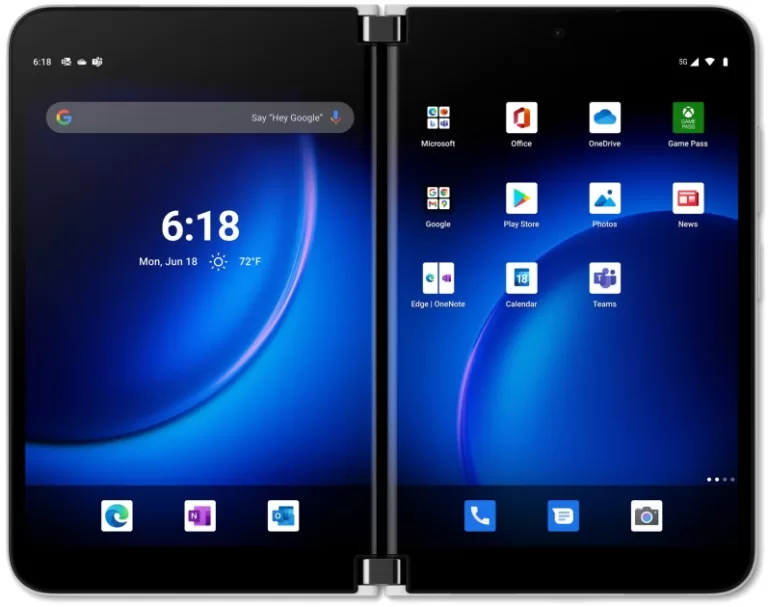
When it comes to foldable phones, two screens isn’t always better than one. Microsoft is planning to pivot away from the dual-screen phone design it established with the first two versions of its Surface Duo, according to Windows Central. It will instead launch a phone with one screen that folds, similar to foldable phones made by Samsung, Vivo and Oppo.
The new phone will reportedly have a 180-degree hinge and an external cover display, signaling a notable design shift for Microsoft. The current Surface Duo 2 consists of two separate displays joined together by a hinge, unlike other foldables such as the Samsung Galaxy Z Fold 4 or Vivo X Fold.
Microsoft reportedly made this decision after the company finalized the Surface Duo 3’s design. It was supposed to launch at the end of 2023 with the same double display format as the first two Surface Duo generations, according to Windows Central.
A Microsoft spokesperson said the company doesn’t comment on rumors or speculation.
The Surface Duo 2 felt like it had the potential to be a great e-reader and handheld gaming device thanks to its dual-screen design. But it had too many shortcomings to make it worth recommending, as I wrote in my review from 2021. Not all apps were optimized for both screens, the camera was subpar compared with those on most competing phones. Taking photos with the Surface Duo 2 also felt awkward, since you have to keep the device open to see what you’re shooting.
Moving to a new design with an external display could solve some of those problems. However, it’ll also likely make it more difficult for Microsoft to distinguish the Surface Duo from other foldables.
The report comes as phone makers are continuing to experiment with new designs for foldable phones. Samsung, for example, exhibited several foldable and slidable display concepts at CES 2023, while Motorola showcased a concept device with a rollable screen in October.
Though sales of foldable phones are growing, they still account for a sliver of the overall phone market. In early 2022, The International Data Corporation forecast that foldable phones would account for only 1.8% of global smartphone shipments in 2025.
Now playing: Watch this:
Microsoft’s second foldable phone, the Surface Duo 2
8:16
Surface Duo 2 photos: See Microsoft’s new foldable phone in action
Well, hello there! Astronomers have discovered a previously undetected Earth-size planet hanging out in the habitable zone of star TOI 700. The star was already known to host three planets (designated b, c and d). TOI 700 e — expected to be rocky and about 95% of Earth’s size — has now been found in the area where liquid water could exist.
TOI 700 e is in good company with TOI 700 d, which is also Earth-size and orbits in the star’s habitable zone. TOI 700 is a special place in space. “This is one of only a few systems with multiple, small, habitable-zone planets that we know of,” said NASA JPL postdoctoral fellow Emily Gilbert, who led the research. “That makes the TOI 700 system an exciting prospect for additional follow up.” A study on the planet has been accepted for publication in The Astrophysical Journal Letters.
TOI 700 is classified as an M dwarf, a type of small, cool star. It’s lurking in the constellation Dorado about 100 light-years away from us. NASA’s Transiting Exoplanet Survey Satellite (TESS) made the discovery possible. TESS works by looking for telltale dips in brightness as planets move in front of stars.
The already-known planets are likely tidally locked, meaning they have one side that always faces the star (like how the moon faces Earth). TOI 700 e is probably tidally locked like its companions. It takes 28 days to orbit the star and it’s located in a region known as the “optimistic habitable zone.” “Scientists define the optimistic habitable zone as the range of distances from a star where liquid surface water could be present at some point in a planet’s history,” NASA said.
TOI 700 e may be rocky and Earth-size, but it may not be very Earth-like in other respects. Still, the size, location and composition of the planet make it a candidate for a place that could potentially host life. It will take further study to learn more about the TOI 700 planets and their atmospheres.
TESS’s work continues. So far, astronomers have confirmed 285 exoplanets from TESS data. It’s currently operating on an extended mission, which is paying off with the discovery of intriguing new worlds that remind us of home.
This story is part of Welcome to Mars, our series exploring the red planet.
NASA’s Perseverance rover isn’t alone in the Jezero Crater on Mars. Its overachieving companion, the Ingenuity helicopter, is still taking to the air. Percy’s an avid photographer, but it hasn’t taken a lot of photos of elusive Ingenuity. There’s a new snapshot of the chopper out, but it will take all your image-searching skills to find it in the Martian landscape.
The image comes from one of the rover’s mast-mounted cameras on Jan. 8, just days after the rotorcraft completed its 38th flight. The view shows a wide, rocky expanse of Jezero along with some noticeable wheel tracks left behind by the rover. Undulating sand dunes appear in the distance.
Ingenuity’s latest aerial escapade carried it 363 feet (110 meters) across Mars for a repositioning flight. The helicopter team works to keep it reasonably close to Percy so the two can stay in communication.
At first, you might doubt Ingenuity is really in the rover image. Keep in mind the rotorcraft’s main body is about the size of a box of tissues. Expand the view for a better chance at finding Ingenuity:
Expand this Perseverance rover view and see if you can find NASA’s Ingenuity helicopter.
NASA/JPL-Caltech/ASU/Processing by Amanda Kooser/CNET
Still looking? Here’s another hint. NASA’s map of the rover and helicopter’s current locations gives a good top-down look at the Martian terrain. Judging by the satellite view, you can narrow down where Ingenuity appears in the photo.
This cropped view shows part of the Jezero Crater with some of the Perseverance rover’s travel marked in white lines. The rover’s location as of Sol 670 is marked in blue. Ingenuity’s location is also mark by a blue icon towards the top.
NASA
Ingenuity’s a history maker that represents the first powered, controlled flight on another planet. It first took to the Martian air in April 2021 and has long outlived its expected lifespan. NASA wasn’t sure if it would even fly once, but now it’s racked up dozens of flights.
Still looking? Here you go:
Ingenuity chills out on a sand dune on Mars.
NASA/JPL-Caltech/ASU/Image processing by Amanda Kooser/CNET
If you blow up the image and crank the contrast, you can make out Ingenuity’s angled legs and boxy body.
I browse Percy’s Mars images almost every day, but I didn’t notice the helicopter until Twitter user DejaSu pointed it out. “Ingenuity in the closest/best view we’ve seen in quite a long time, safely at the Flight 38 landing zone on the side of a shallow sand ripple, ~280m NNE,” DejaSu tweeted.
For extra fun, you can try out DejaSu’s cross-eyed 3D image by looking at the two images and then crossing your eyes to make a 3D version seem to pop out. I can get it to work with some eyeball-straining effort.
NASA acknowledged Percy and Ingenuity’s long-distance robo-mance. “The Mars helicopter and I are closer together than we’ve been in a while, and guess who I spotted resting on a dune between flights,” the Perseverance team tweeted on Wednesday.
Here’s one for the “what goes up must come down” file. NASA’s retired Earth Radiation Budget Satellite got a blazing welcome back to Earth on Sunday after nearly four decades in space. The Department of Defense confirmed the 5,400-pound (2,450-kilogram) satellite had reentered Earth’s atmosphere over the Bering Sea, NASA said on Monday.
ERBS made contributions to climate and weather science. Atmospheric reentry as a retirement present was a long time coming for the old satellite, which originally launched from the Space Shuttle Challenger in late 1984.
Dying Space Missions Remembered in Inspirational Final Images
The satellite had an expected two-year-service life, but it blew past that mark. “For 21 of its years in orbit, the ERBS actively investigated how the Earth absorbed and radiated energy from the sun, and made measurements of stratospheric ozone, water vapor, nitrogen dioxide, and aerosols,” NASA said.
Spacefaring machines that come back to Earth are subject to an intense reentry process. NASA expected most of ERBS to burn up, “but for some components to survive the reentry.” The return trajectory over a body of water means anything that wasn’t toast likely fell harmlessly into the sea.
The satellite’s uneventful fall back to its home planet is a bit of good news at a time when orbital space is increasingly crowded with junk, debris and defunct satellites. ERBS went out in a blaze of glory after its distinguished service to science.
In a nutshell: The pandemic boom for the PC market has come to an end as evident by the latest market report from International Data Corporation. Global shipments of traditional PCs slid to 67.2 million units in the fourth quarter of 2022. That’s down 28.1 percent versus the same period in 2021 and is comparable to the fourth quarter of 2018 when Intel was strolling with its supply of processors.
Lenovo led the way in Q4, shipping 15.5 million PCs followed by HP with 13.2 million units. Dell placed third with 10.8 million systems shipped during the holiday quarter while Apple moved 7.5 million Macs over the same period. All experienced negative growth compared to Q4 2021.
With 292.3 million units shipped for the full year, the market is well above pre-pandemic levels. Still, there’s reason for concern as IDC points out that many users have relatively new PCs and the global economy isn’t in great shape.
As Adobe noted in its recent holiday shopping analysis, retailers turned to discounts in the fourth quarter to spur demand. The PC industry wasn’t immune as average selling prices (ASPs) across several channels fell in hopes of moving excess inventory.
IDC Research Manager Jitesh Ubrani noted that despite the efforts, inventory management will remain a key issue in the coming quarters and could continue to impact ASPs.
According to the market research firm, the general consensus is that segments of the PC market could return to growth by the end of 2023 with a broader market recovery to follow sometime in 2024.
Microsoft ended support for Windows 7 and Windows 8 earlier this week, which could drive sales in the near term. Windows 7’s global market share sat at 11.2 percent as of December 2022 according to StatCounter while Windows 8 was installed on just 0.66 percent of machines worldwide.
Windows 10, with a market share of nearly 68 percent, isn’t too far away from reaching end of life status either. Microsoft has set a date of October 14, 2025, for its retirement.
Cutting corners: People are reacting to ChatGPT’s potential for abuse, developing new tools to catch cheaters and plagiarized material. A student has developed a tool that can potentially (and quickly) discover when a text has been created by the AI rather than by a human writer.
ChatGPT can write code or school essays and any sort of content in response to a human (textual) prompt. OpenAI’s chatbot is also easy to abuse, creating new content to cheat during exams or filling entire websites with worthless – yet superficially convincing – textual garbage. As a response to this, 22-year-old computer science senior at Princeton University, Edward Tian has created a tool named GPTZero.
Tian spent his winter break developing a platform that could detect whether a human or the ChatGPT algorithm created a given essay. GPTZero, which is still in beta, uses two different indicators, “perplexity” and “burstiness,” to identify human-made or AI-based text excerpts. Tian says we “deserve to know” when a text has been created by a self-conscious brain or by a computer algorithm.
Perplexity measures the complexity of text, or rather how much GPTZero is “perplexed” by the text: a higher perplexity level suggests a high level of text complexity, meaning the excerpt was likely written by a human being. When perplexity is low, GPTZero has likely found text patterns it is more familiar with — meaning the text is more likely AI-generated.
Burstiness, on the other hand, measures the variations of sentences. Humans tend to write with greater burstiness, using some longer or complex sentences alongside shorter ones. AI sentences tend to be more uniform, which is a red alert for a likely generated text. GPTZero isn’t perfect or foolproof, Tian admits, but the system can indeed provide a quick result to a plagiarism test.
The tool seems to be at least somewhat effective, and pretty interesting for many professionals working with text: after getting released online on January 2, GPTZero has attracted over 7 million visits and used by over 30,000 people. It was so popular that the service crashed, pushing the free platform currently hosting the code to support Tian with more server resources to better manage the increased internet traffic.
Tian explained on Twitter that he wanted to do something to curb growing AI-based plagiarism, bringing some light and transparency to the black box technology the AI is based on. “We really don’t know what’s going on inside” ChatGPT algorithms, Tian said, and GPTZero is design to fight against this approach.
Recap: The Legend of Zelda launched on the Famicom Disk System in Japan in early 1986 before finding its way to the Nintendo Entertainment System in North America in the summer of 1987. It ranks as the sixth best-selling NES game of all time with sales of 6.51 million units and is often considered among the best and most influential titles in video game history.
The Legend of Zelda: Tears of the Kingdom launches in May, leaving plenty of time to try out this VR experience based on the game that started it all.
YouTuber Sugary Noe has shared a 12-minute video showcasing gameplay from the curious creation, which is listed as The Legend of Doom on the title screen. It was made using the QuestZDoom engine for the Oculus Quest VR headset. As you can see, the overworld has been faithfully recreated with the exact same layout as the original complete with accurate enemy placement, sound effects and music.
It only gets better when entering the first dungeon as the addition of the ceiling helps to heighten immersion. Even the little details, like the small hallway between each room, feel special considering they weren’t “visible” in the top-down game.
It’s not perfect though. For example, enemy targeting could use some polish and the music keeps recycling for some reason. The demo is also missing helpful elements like an always-visible HUD and the map. Motion sickness could also be a real concern for some players, but that’s going to be true of most VR games.
In a follow-up post on Twitter, Sugary Noe is quick to point out that he didn’t create the game and is only sharing gameplay footage of the mod.
Zelda also among Nintendo’s most popular franchises, second only to Mario. Nintendo celebrated Zelda’s 35th anniversary in 2021 with the launch of a new Game & Watch system featuring the original game.
Found is a TechSpot feature where we share clever, funny or otherwise interesting stuff from around the web.
In brief: Microsoft’s next Surface Duo will not be a true dual-screen device like previous efforts, at least if the latest rumblings from the rumor mill prove accurate. Sources familiar with the company’s plans told Windows Central that after a year of experimenting and prototyping, Microsoft has decided to switch to a more traditional foldable display design with a 180-degree hinge and an external cover display.
Microsoft apparently had a dual-screen design lined up for what would have become the Surface Duo 3 due out at the end of 2023, complete with an edge-to-edge display, wireless charging and more. After the Surface Duo 2 launched in late 2021 to a lukewarm reception, however, Microsoft reportedly went back to the drawing board.
Windows Central sources did not share specifications for the new foldable device. What’s more, we don’t know if Microsoft is planning to simulate a dual-screen experience with software or take a more traditional route with its UI. This decision could influence other aspects of the handset and perhaps even facilitate a name change.
Foldable display durability leaves a lot to be desired but there’s no arguing that the tech is flashier than two separate slabs.
Sources say Microsoft is also working to tweak its mobile UI to better stand out from the sea of other Android smartphones already on the market. Dubbed “Perfect Together,” the initiative reportedly aims to deliver an experience between Windows PCs and future Microsoft Android hardware that resembles what Apple has with the Mac and the iPhone.
Redmond also reportedly has not committed to a firm shipping window, meaning the handset could slip past its original end of year 2023 slot.
In related news, sources claim Microsoft is also keen on expanding its Android-based smartphone family and has been exploring additional form factors beyond foldables. Noting is concrete yet, but Microsoft has reportedly prototyped multiple slab-style smartphone designs that could ship as a mainstream Surface phone, positioning the foldable as a premium or enthusiast-grade product.
Either way, Microsoft is said to be “all in” on its Android smartphones for the foreseeable future.
At the opening of Meta’s last company-wide Q&A of 2022, Mark Zuckerberg sounded disappointed but determined.
“We made our plan for ’22 in terms of how we thought the business was going to go, and obviously it hasn’t gone the way that we wanted to,” Zuckerberg told employees in an audio recording of the meeting that Recode obtained.
The tech CEO was putting it mildly.
Meta has arguably had one of its toughest years ever — not because of scandals like in times past, but because, after 18 years of seemingly unstoppable growth, its stock price plunged by 65 percent year over year. In 2022, the entire tech industry faced a stock market slump due to rising interest rates, sharp inflation, and other rocky macroeconomic conditions. But Meta was hit with the largest drop in valuation among the top five Big Tech firms. Wall Street analysts blamed a number of setbacks specific to the company: rising competition from TikTok, slowing ad sales because of Apple’s new privacy restrictions, and skepticism about Zuckerberg’s $10-billion-a-year investment in building a virtual- and augmented-reality metaverse.
Zuckerberg says he has a plan to reverse the slump. He’ll keep building the metaverse, but he’ll focus most of his time on improving Meta’s core social media business (Facebook and Instagram) and finding new ways to expand the company’s popular but less profitable messaging apps. And he’s going to need Meta employees to work harder than ever.
“I’m quite optimistic about all of this,” he said at the recent company-wide Q&A meeting. “But 2022 is a good reminder that things are not always as good as what you want, and you can’t take that for granted, so we’re gonna have to really push hard.”
Recode interviewed nearly a dozen Meta employees — some current and some who left the company in the past year — who described a state of anxiety and optimism inside the company about the challenges it faces. These sources, who include high-level directors and rank-and-file engineers, told Recode the company’s culture is becoming more focused on efficiency and increasingly restrictive about employee communications. At the same time, they said colleagues are more competitive than ever. Some welcomed these changes, but overall, they said morale is lower than in previous years, especially because of the recent layoffs, the stock price decline, and persisting doubts about the company’s metaverse pivot. (These sources were granted anonymity for fear of professional repercussions for speaking publicly.)
“The worry is: What is going to sustain us, especially if the stock keeps going down?” said one employee who has worked at the company for several years. This person is genuinely excited about Meta’s long-term plans, like developing lightweight augmented reality glasses, but is concerned about how long it will take until Meta begins making money from these kinds of products. “I don’t know when they will become a reality,” they said.
An internal Meta survey from October that Recode obtained reflects these employees’ perspectives: Only 28 percent of employees responding to the survey gave a favorable response about their optimism for the company, and 58 percent were favorable toward the company overall. The survey results came around the time that rumors of layoffs started to swirl and the company had instituted a hiring freeze. In this October survey, only 31 percent of employees reported favorable scores in their confidence in leadership itself, an 11 percent drop from the last survey that ran in May. Still, employees were optimistic on some fronts: 74 percent of employees felt favorably about leadership’s “set vision,” 82 percent felt favorably about Meta’s mission, and 84 percent felt favorably about their managers.
In response to the Pulse survey results, a company spokesperson sent Recode the following statement: “Feedback is a core part of our culture and the purpose of the survey is to learn where we’re doing well or where we need to improve. We’re optimistic about the path ahead and appreciate all of our employees who work every day toward our mission.”
Several employees told Recode they’re waiting to see if the next year gets any better for Meta. There are some reasons to be more hopeful: Facebook is growing its user base again after a first-time reported drop earlier last year; people are spending more time watching Reels (Meta’s TikTok competitor) than before; and the company’s stock has increased by 40 percent from its lowest point in November 2022. But the tech giant still has a long way to go before it gets back to its market peak.
Meta’s products are collectively used by over 3.71 billion people — nearly half the world — making it by far the biggest social media company on the planet. Apps like Facebook and Instagram shape our cultural, economic, and political norms. The fate of the company — and whether or not it can regain investor and employee confidence — will determine whether it continues to be a dominant force in people’s everyday lives, or starts to cede its power to other growing competitors like TikTok.
Trying to return to a “scrappier” culture
As Meta’s core business growth has slowed this year, the company has made some unpopular decisions to cut certain jobs and staff perks, and it has begun restricting what employees can talk about internally. While that’s angered some of Meta’s staff, the company’s leaders see it as a tough but ultimately necessary course correction.
“One of the big things for 2023 that I would like us to focus on is can we return to a scrappier culture overall where we’re a lot leaner and doing things more efficiently,” Zuckerberg said in Meta’s end-of-year all-staff meeting. “Because you’ve got the layoffs, this was the first step around resetting some of the headcount. But there are a lot of other things that we need to do,” he added.
In November, Meta laid off an unprecedented 11,000 people — or about 13 percent of its workforce — across virtually every department (some, like recruiting, were harder hit). After the tech giant aggressively hired more than 27,000 employees in 2020 and 2021 combined, it had over 80,000 employees before its November layoffs. Out of all the major tech companies that have done layoffs so far in the past six months, Meta’s have been the largest.
“It wasn’t just the low point of my 2022, it was probably the low point of my professional career,” Meta CTO Andrew “Boz” Bosworth told Recode in a December interview about his end-of-year memo that reflected on the company’s challenges and achievements in the past year.
In the recent company Q&A meeting, Zuckerberg told employees that Meta would cut more costs in the months ahead by further limiting employee travel, reducing the number of free catering options at the office, and consolidating real estate. While he thanked employees for their resilience and executing well “during what has been a thrashy and difficult time,” he also renewed his call for employees to work with greater speed and efficiency. That’s a repeated message from last year that didn’t sit well with some employees who had been working hard during the pandemic.
“He was telling us we were spoiled,” said one former employee who left the company this year.
At the end-of-year company Q&A, Zuckerberg implied that his company had been too lenient with employees for too long, especially during the initial phases of the pandemic, when the company focused on “flexibility” to support staff through what the executive in the end-of-year Q&A called a “weird time.”
Some employees poked fun at Meta’s calls for working with greater intensity on Meta’s internal employee discussion groups. In one group where employees often post memes and jokes, called “shitposting,” an employee wrote a post in July calling on people to “shitpost with increased intensity.”
“Intensity is not a new concept for us, but [at] Shitposting for the last week, we have seen what each of us can do to help move the memes forward during this period of economic and business uncertainty,” said the post, mimicking the efficiency-focused language used by Zuckerberg and other executives.
But now that leadership’s focus is on efficiency over flexibility, they have started implementing new guidelines to tighten employees’ focus, including around what they’re allowed to talk about at work. Meta has long been a company that has permitted employees some freedom to share their politics and criticize management on internal Workplace groups. While the company’s culture isn’t known to be as open as its tech rival Google, it’s still far more so than most other non-tech companies of its size.
In early December, the company instituted a new “Community Engagement Expectations” policy (CEE) limiting what employees can say on Meta’s internal messaging platforms like Workplace. The policies banned employees from talking about sensitive political, health, or legal matters, such as abortion and gun control, unless it was specifically related to their job function.
“Over the past few years, we’ve seen discussions that cause a lot of churn and distraction, which drain us as a community and take us away from our work,” read an internal memo posted by Lori Goler, Meta’s head of HR, announcing the change in December.
The note told employees to “give feedback appropriately,” to specific teams or people, instead of making general negative statements. In response, some employees have begun sharing critical comments verbally or posting to platforms managers don’t oversee, like Signal or Blind, one employee said.
“The company as a whole can’t seem to go a week without doing something that disappoints employees,” one employee told Recode. But given its financial reality as it starts 2023, Meta may have to continue making some unpopular decisions with its staff.
During Meta’s company-wide Q&A meeting in December, one employee asked Zuckerberg, “What initiatives will improve employee morale and culture in 2023?”
The tech CEO paused. “Winning,” he said, then laughed. Joking aside, while Zuckerberg acknowledged that Meta’s declining stock price is affecting his employees’ personal finances (it’s common for a large portion of Meta employees’ salaries to be paid in stock), he made it clear his primary goal is to improve the business.
“It’s not like there’s an initiative to improve morale and results. It’s succeeding at more of the things that we’re doing,” said Zuckerberg, “I think we’re here to win and achieve the mission of the company and put up good business results.”
A rude awakening for Metamates
The past several months have forced Meta employees to adjust to the harsh new realities of working at a company that, at least for now, is no longer winning.
Meta’s tanking stock prices have been a particularly sore point for employees, and a common focus of grumbling.
In screenshots of posts on Workplace, Meta’s internal employee message board, that Recode viewed, staff shared memes making fun of Meta’s falling stock price when it started dipping after Meta’s rough October earnings report. One employee made a bot that calculated what employees’ stock price was when they were hired compared to the stock’s current value. “You are down 71.1% from your initial grant price,” read one image posted on Workplace in August. Another employee posted a meme of three Winnie the Poohs, one of them representing Amazon, the other Google, and the other Meta, with the lowest comparative stock price after adjusting for a stock split. “One of these is not like the other,” the meme was captioned.
For many employees, Meta’s falling financial performance has given them pause about staying at the company.
“Some people had moral qualms about working at Meta, but the money is pretty good,” one former employee who left the company this year told Recode in September. “Then all of a sudden, the money is not good.”
One said that morale was the worst they’ve seen since the 2018 Cambridge Analytica scandal, during which the company faced a deluge of criticism after reports that it allowed third parties to collect millions of users’ data without their consent and use it for political advertising.
“It makes it hard to justify working on things you don’t believe in if you don’t make that much money at the same time,” said one current employee. “I think people at the boundary of the ethics of what Facebook does are looking around more critically.”
Complicating matters is that there’s been a shift throughout Silicon Valley. In earlier times, it would be fairly easy for Meta employees to jump to another tech giant like Google, Apple, or Amazon, but all of these companies have slowed or frozen hiring in the past year.
Meta staffers continue to worry that more cuts are coming — a possibility that Zuckerberg didn’t rule out at the company’s recent Q&A meeting.
“I tried to be pretty clear that the hope was that the cuts that we made were deep enough that we weren’t going to have to do another significant company-wide round of layoffs,” he said. “But I also can’t predict the future. And obviously, if there’s a very big downturn, then we may have to revisit.”
Competition, internal politics, and reorgs
Meta has long been a company known to be metrics-oriented and competitive, with rank-based performance reviews tied to the company’s product metrics determining employees’ career trajectories. Now that resources are limited, several current and former employees described an even more cutthroat culture, reinforced by increased company reorganizations and fear of more layoffs to come.
Some workers see Meta’s reorgs and focus on performance metrics as simply a reality of working at a tech giant: “They’re a necessary function of a lot of corporate entities” as large as Meta, they told Recode.
Another former employee thinks it’s going further than that. “Facebook is the most political place I’ve worked, and it’s become 10 times more political,” said the employee, who left in 2022 after several years at Meta. “People are backstabbing each other, wanting to show results to their managers as quickly as possible.”
As the company changed its structure, many employees tried to shift their work toward the highest-priority projects at the company, such as Meta’s TikTok competitor Reels and metaverse-related projects.
“There’s been a mad dash toward jobs in Reality Labs,” one former employee told Recode earlier this year. “Particularly within the metaverse product group. Even if you’re in privacy or policy or any of those teams, it’s, ‘Get on the metaverse privacy team, get on the metaverse policy team.’”
One employee said that people not working on high-priority projects feel at risk of losing their jobs or being given fewer resources. “For teams that are not on the critical path, it’s a pretty tough time to work. All the focus is on doing more with less and trying to avoid being a part of more restructuring over the next year.” The employee added that they worried that social impact-related teams — such as those related to youth and well-being and charitable giving — are “basically going to keep the bare minimum going.”
Even some Meta employees working on its critical AR/VR teams have struggled with Meta’s work culture this year.
Virtual reality industry titan John Carmack, who used to be an executive consultant on VR for Meta, quit the company in late December. He wrote in a now-public goodbye note that while he believed in Meta’s vision for AR/VR, he feels the organization has a problem with efficiency.
“We have a ridiculous amount of people and resources, but we constantly self-sabotage and squander effort,” wrote Carmack. “There is no way to sugar coat this; I think our organization is operating at half the effectiveness that would make me happy.”
Several employees Recode spoke with said Carmack’s frank assessment of Meta’s organizational problems made waves within the company. One said that it worried them how “even someone of his stature couldn’t fix the issues.” Carmack did not respond to a Recode request for comment.
Carmack’s note shows just how hard it is for company leaders to steer a ship as large as Meta in a single direction, even when the top-level vision is clear.
“It’s irrelevant whether Zuck knows what he’s doing, because he has to fight bureaucracy,” said one former employee. “There are 20 layers up and under him who are not worried about the metaverse. They are worried about headcount and getting through the next re-org.”
Though Meta’s cuts and push for efficiency are challenging, some employees support the effort and hope it will help the company refocus.
In the past few months, Zuckerberg’s leadership has been “pretty good” in terms of clearly defining priorities with “a lot more transparency” and “depth that was not there beforehand,” according to one employee, who said that the layoffs are “motivating a lot of people to get aligned with the company mission and move into the areas that need support.”
“The layoffs sucked,” said the employee. “But I think the level of cohesion that has resulted since then might, in the long term, be good for the company.”
Unexpected wins and the long-game metaverse bet
There are some silver linings to Meta’s tough year.
In 2022, Meta grappled with fewer public scandals than in prior years. That could be in part because Elon Musk’s dramatic Twitter takeover and the fall of Sam Bankman-Fried and FTX dominated headlines, particularly in the latter half of the year. It’s also because Meta didn’t mess up publicly on the scale of past years.
Even among employees who are doubtful about Zuckerberg’s metaverse concept, many see promise in the tangible technologies supporting that work. In particular, they’re excited about the potential of augmented reality (AR) technology to allow for more practical products in the future than a heavy virtual reality (VR) headset, like lightweight glasses with the power of a computer in them.
“From my point of view, this metaverse pivot has been well-received,” said one former employee. “I did not expect people to actually call the company ‘Meta’ and see it as something really happening, as opposed to some PR talking point from Zuck.”
For now, Meta’s closest thing to an AR product — the Quest Pro (which it calls “mixed reality”) — is expensive for many people, priced at $1,500 per headset. It could take years for Meta to develop a breakthrough AR device that’s significantly more affordable. But in some ways, Zuckerberg is one of the best-positioned tech leaders to make the long-term investments required to reach that breakthrough.
“Mark is somebody who has tremendous vision for what will be popular and resonate with billions of people in the future,” said Meta CTO Bosworth, speaking to Recode in a December interview about his end-of-year memo. “He has the willpower and the fortitude to survive all the critiques and criticism around it. And he’s got a track record that I think speaks for itself.”
One of Zuckerberg’s greatest strengths as a leader — which many employees recognize — is that he is the only remaining major tech CEO who is also a company founder, with control of the board and essential immunity from being fired. That means he can make decisions that may seem risky to shareholders at the time but end up being smart long-term bets. Ten years ago, many industry experts thought Zuckerberg was wildly overspending when he bought Instagram, but it ended up being one of the most successful acquisitions in tech history.
“He’s always had a one-year, three-year, five-year, and 10-year plan,” said top social media business analyst Mark Mahaney, senior managing director of Evercore. “It’s a great thing for managers to show they’re running the business long term, [and] they’re not gonna be juked out of a business plan just because of Wall Street.”
Still, though Mahaney is long-term bullish on Meta, he’s asking himself, “Is this the next Yahoo or not? Is this a melting ice cube? Are there going to be fewer people using Facebook” in the future?
Many Meta employees are asking themselves the same questions. For those who believe in Zuckerberg’s vision and stick around, this could be a chance to beat the skeptics.
Toward the end of Zuckerberg’s Q&A with employees, in response to an employee question about some of the more “alarming” results in the employee morale survey reflecting people’s poor confidence in leadership, Zuckerberg told his employees to see the upside. He said that now, with lower stock prices, employees would benefit more if the markets swing the other way.
“I don’t know when investors will recognize the success of what we’re doing,” Zuckerberg said. “And maybe that’ll be in [2023], or maybe a week, [or] maybe we’ll take a few more years.”
rn rnvox-markrn rn rn rn rn rn“,”cross_community”:false,”groups”:[{“base_type”:”EntryGroup”,”id”:80301,”timestamp”:1673461132,”title”:”Recode”,”type”:”SiteGroup”,”url”:”https://www.vox.com/recode”,”slug”:”recode”,”community_logo”:”rn“,”community_name”:”Vox”,”community_url”:”https://www.vox.com/”,”cross_community”:false,”entry_count”:22862,”always_show”:false,”description”:”Uncovering and explaining how our digital world is changing — and changing us.”,”disclosure”:””,”cover_image_url”:””,”cover_image”:null,”title_image_url”:”https://cdn.vox-cdn.com/uploads/chorus_asset/file/16201674/REC_Wordmark_Red_RGB.0.png”,”intro_image”:null,”four_up_see_more_text”:”View All”,”primary”:true},{“base_type”:”EntryGroup”,”id”:24823,”timestamp”:1673446715,”title”:”Features”,”type”:”SiteGroup”,”url”:”https://www.vox.com/features”,”slug”:”features”,”community_logo”:”rn“,”community_name”:”Vox”,”community_url”:”https://www.vox.com/”,”cross_community”:false,”entry_count”:764,”always_show”:false,”description”:”A collection of Vox’s longreads and feature reporting projects. “,”disclosure”:””,”cover_image_url”:””,”cover_image”:null,”title_image_url”:””,”intro_image”:null,”four_up_see_more_text”:”View All”,”primary”:false},{“base_type”:”EntryGroup”,”id”:27524,”timestamp”:1673446715,”title”:”Technology”,”type”:”SiteGroup”,”url”:”https://www.vox.com/technology”,”slug”:”technology”,”community_logo”:”rn“,”community_name”:”Vox”,”community_url”:”https://www.vox.com/”,”cross_community”:false,”entry_count”:2203,”always_show”:false,”description”:”How new technology is transforming cities and societies, from the latest apps to advances in renewable energy, computing, transportation, and more.”,”disclosure”:””,”cover_image_url”:””,”cover_image”:null,”title_image_url”:”https://cdn.vox-cdn.com/uploads/chorus_asset/file/22360844/VoxTech_Highlight_2.gif”,”intro_image”:null,”four_up_see_more_text”:”View All”,”primary”:false},{“base_type”:”EntryGroup”,”id”:80373,”timestamp”:1673446715,”title”:”Facebook”,”type”:”SiteGroup”,”url”:”https://www.vox.com/facebook”,”slug”:”facebook”,”community_logo”:”rn“,”community_name”:”Vox”,”community_url”:”https://www.vox.com/”,”cross_community”:false,”entry_count”:2449,”always_show”:false,”description”:”News and analysis for all things Facebook and Meta, its parent company. “,”disclosure”:””,”cover_image_url”:””,”cover_image”:null,”title_image_url”:””,”intro_image”:null,”four_up_see_more_text”:”View All”,”primary”:false},{“base_type”:”EntryGroup”,”id”:80387,”timestamp”:1673446715,”title”:”Mark Zuckerberg”,”type”:”SiteGroup”,”url”:”https://www.vox.com/mark-zuckerberg”,”slug”:”mark-zuckerberg”,”community_logo”:”rn“,”community_name”:”Vox”,”community_url”:”https://www.vox.com/”,”cross_community”:false,”entry_count”:267,”always_show”:false,”description”:””,”disclosure”:””,”cover_image_url”:””,”cover_image”:null,”title_image_url”:””,”intro_image”:null,”four_up_see_more_text”:”View All”,”primary”:false},{“base_type”:”EntryGroup”,”id”:80422,”timestamp”:1673446715,”title”:”Virtual reality”,”type”:”SiteGroup”,”url”:”https://www.vox.com/vr”,”slug”:”vr”,”community_logo”:”rn“,”community_name”:”Vox”,”community_url”:”https://www.vox.com/”,”cross_community”:false,”entry_count”:404,”always_show”:false,”description”:””,”disclosure”:””,”cover_image_url”:””,”cover_image”:null,”title_image_url”:””,”intro_image”:null,”four_up_see_more_text”:”View All”,”primary”:false},{“base_type”:”EntryGroup”,”id”:102793,”timestamp”:1673446715,”title”:”Technology & Media”,”type”:”SiteGroup”,”url”:”https://www.vox.com/business-of-media”,”slug”:”business-of-media”,”community_logo”:”rn“,”community_name”:”Vox”,”community_url”:”https://www.vox.com/”,”cross_community”:false,”entry_count”:248,”always_show”:false,”description”:””,”disclosure”:””,”cover_image_url”:””,”cover_image”:null,”title_image_url”:””,”intro_image”:null,”four_up_see_more_text”:”View All”,”primary”:false},{“base_type”:”EntryGroup”,”id”:102794,”timestamp”:1673446715,”title”:”Innovation”,”type”:”SiteGroup”,”url”:”https://www.vox.com/innovation”,”slug”:”innovation”,”community_logo”:”rn“,”community_name”:”Vox”,”community_url”:”https://www.vox.com/”,”cross_community”:false,”entry_count”:114,”always_show”:false,”description”:””,”disclosure”:””,”cover_image_url”:””,”cover_image”:null,”title_image_url”:””,”intro_image”:null,”four_up_see_more_text”:”View All”,”primary”:false},{“base_type”:”EntryGroup”,”id”:102796,”timestamp”:1673446715,”title”:”Influence”,”type”:”SiteGroup”,”url”:”https://www.vox.com/influence”,”slug”:”influence”,”community_logo”:”rn“,”community_name”:”Vox”,”community_url”:”https://www.vox.com/”,”cross_community”:false,”entry_count”:179,”always_show”:false,”description”:””,”disclosure”:””,”cover_image_url”:””,”cover_image”:null,”title_image_url”:””,”intro_image”:null,”four_up_see_more_text”:”View All”,”primary”:false}],”internal_groups”:[{“base_type”:”EntryGroup”,”id”:72743,”timestamp”:1673446715,”title”:”Category—Vox Features”,”type”:”SiteGroup”,”url”:””,”slug”:”category-features”,”community_logo”:”rn“,”community_name”:”Vox”,”community_url”:”https://www.vox.com/”,”cross_community”:false,”entry_count”:418,”always_show”:false,”description”:””,”disclosure”:””,”cover_image_url”:””,”cover_image”:null,”title_image_url”:””,”intro_image”:null,”four_up_see_more_text”:”View All”}],”image”:{“ratio”:”*”,”original_url”:”https://cdn.vox-cdn.com/uploads/chorus_image/image/71852303/02b.0.jpg”,”network”:”unison”,”bgcolor”:”white”,”pinterest_enabled”:false,”caption”:null,”credit”:”Amanda Northrop/Vox”,”focal_area”:{“top_left_x”:2047,”top_left_y”:920,”bottom_right_x”:2527,”bottom_right_y”:1400},”bounds”:[0,0,3000,2000],”uploaded_size”:{“width”:3000,”height”:2000},”focal_point”:null,”image_id”:71852303,”alt_text”:”Illustration of a jagged downward-trending graph line with a Facebook thumbs-up logo at the bottom end of it.”},”hub_image”:{“ratio”:”*”,”original_url”:”https://cdn.vox-cdn.com/uploads/chorus_image/image/71852303/02b.0.jpg”,”network”:”unison”,”bgcolor”:”white”,”pinterest_enabled”:false,”caption”:null,”credit”:”Amanda Northrop/Vox”,”focal_area”:{“top_left_x”:2047,”top_left_y”:920,”bottom_right_x”:2527,”bottom_right_y”:1400},”bounds”:[0,0,3000,2000],”uploaded_size”:{“width”:3000,”height”:2000},”focal_point”:null,”image_id”:71852303,”alt_text”:”Illustration of a jagged downward-trending graph line with a Facebook thumbs-up logo at the bottom end of it.”},”lede_image”:{“ratio”:”*”,”original_url”:”https://cdn.vox-cdn.com/uploads/chorus_image/image/71852304/02b.0.jpg”,”network”:”unison”,”bgcolor”:”white”,”pinterest_enabled”:false,”caption”:null,”credit”:”Amanda Northrop/Vox”,”focal_area”:{“top_left_x”:2047,”top_left_y”:920,”bottom_right_x”:2527,”bottom_right_y”:1400},”bounds”:[0,0,3000,2000],”uploaded_size”:{“width”:3000,”height”:2000},”focal_point”:null,”image_id”:71852304,”alt_text”:”Illustration of a jagged downward-trending graph line with a Facebook thumbs-up logo at the bottom end of it.”},”group_cover_image”:null,”picture_standard_lead_image”:{“ratio”:”*”,”original_url”:”https://cdn.vox-cdn.com/uploads/chorus_image/image/71852304/02b.0.jpg”,”network”:”unison”,”bgcolor”:”white”,”pinterest_enabled”:false,”caption”:null,”credit”:”Amanda Northrop/Vox”,”focal_area”:{“top_left_x”:2047,”top_left_y”:920,”bottom_right_x”:2527,”bottom_right_y”:1400},”bounds”:[0,0,3000,2000],”uploaded_size”:{“width”:3000,”height”:2000},”focal_point”:null,”image_id”:71852304,”alt_text”:”Illustration of a jagged downward-trending graph line with a Facebook thumbs-up logo at the bottom end of it.”,”picture_element”:{“html”:{},”alt”:”Illustration of a jagged downward-trending graph line with a Facebook thumbs-up logo at the bottom end of it.”,”default”:{“srcset”:”https://cdn.vox-cdn.com/thumbor/RYO8hRLbUvkkcTNyBVBCY8FMa-k=/0x0:3000×2000/320×240/filters:focal(2047×920:2527×1400)/cdn.vox-cdn.com/uploads/chorus_image/image/71852304/02b.0.jpg 320w, https://cdn.vox-cdn.com/thumbor/5iEvYrBzNFZaus1cy25BviSi3Fw=/0x0:3000×2000/620×465/filters:focal(2047×920:2527×1400)/cdn.vox-cdn.com/uploads/chorus_image/image/71852304/02b.0.jpg 620w, https://cdn.vox-cdn.com/thumbor/L2BzzcTcfxBqo2hAj4vTNAWRi4E=/0x0:3000×2000/920×690/filters:focal(2047×920:2527×1400)/cdn.vox-cdn.com/uploads/chorus_image/image/71852304/02b.0.jpg 920w, https://cdn.vox-cdn.com/thumbor/3AB4OHKirTfnGSBv5quD1q6BEqk=/0x0:3000×2000/1220×915/filters:focal(2047×920:2527×1400)/cdn.vox-cdn.com/uploads/chorus_image/image/71852304/02b.0.jpg 1220w, https://cdn.vox-cdn.com/thumbor/LgWTYYAqMSZoakwyTOeRgsmGXjQ=/0x0:3000×2000/1520×1140/filters:focal(2047×920:2527×1400)/cdn.vox-cdn.com/uploads/chorus_image/image/71852304/02b.0.jpg 1520w”,”webp_srcset”:”https://cdn.vox-cdn.com/thumbor/1n97kLdOa6sAPRA87aCUWh2dY9c=/0x0:3000×2000/320×240/filters:focal(2047×920:2527×1400):format(webp)/cdn.vox-cdn.com/uploads/chorus_image/image/71852304/02b.0.jpg 320w, https://cdn.vox-cdn.com/thumbor/nze31Ioec9u6LS94DWhf0q9WRyo=/0x0:3000×2000/620×465/filters:focal(2047×920:2527×1400):format(webp)/cdn.vox-cdn.com/uploads/chorus_image/image/71852304/02b.0.jpg 620w, https://cdn.vox-cdn.com/thumbor/3WqiuaoXSblS7dhc_LLp8w4ja8s=/0x0:3000×2000/920×690/filters:focal(2047×920:2527×1400):format(webp)/cdn.vox-cdn.com/uploads/chorus_image/image/71852304/02b.0.jpg 920w, https://cdn.vox-cdn.com/thumbor/xTV6LvLTo86NhKpMrg6Z3LuGJb0=/0x0:3000×2000/1220×915/filters:focal(2047×920:2527×1400):format(webp)/cdn.vox-cdn.com/uploads/chorus_image/image/71852304/02b.0.jpg 1220w, https://cdn.vox-cdn.com/thumbor/5r7ixni4kldCZakVwIOc2sOa9Tg=/0x0:3000×2000/1520×1140/filters:focal(2047×920:2527×1400):format(webp)/cdn.vox-cdn.com/uploads/chorus_image/image/71852304/02b.0.jpg 1520w”,”media”:null,”sizes”:”(min-width: 809px) 485px, (min-width: 600px) 60vw, 100vw”,”fallback”:”https://cdn.vox-cdn.com/thumbor/GzjhhdxOgK97fshwLQ8_YqFk_z4=/0x0:3000×2000/1200×900/filters:focal(2047×920:2527×1400)/cdn.vox-cdn.com/uploads/chorus_image/image/71852304/02b.0.jpg”},”art_directed”:[]}},”image_is_placeholder”:false,”image_is_hidden”:false,”network”:”vox”,”omits_labels”:true,”optimizable”:false,”promo_headline”:”What Meta employees really think about their company’s brutal year “,”recommended_count”:0,”recs_enabled”:false,”slug”:”recode/2023/1/11/23547490/meta-facebook-mark-zuckerberg-stock-employees-morale-survey-2022-year”,”dek”:”Recode obtained a recording of a Mark Zuckerberg Q&A and internal survey results that show how Meta’s struggles are impacting staff.”,”homepage_title”:”What Meta employees really think about their company’s brutal year “,”homepage_description”:”Recode obtained a recording of a Mark Zuckerberg Q&A and internal survey results that show how Meta’s struggles are impacting staff.”,”show_homepage_description”:false,”title_display”:”What Meta employees really think about their company’s brutal year “,”pull_quote”:null,”voxcreative”:false,”show_entry_time”:true,”show_dates”:true,”paywalled_content”:false,”paywalled_content_box_logo_url”:””,”paywalled_content_page_logo_url”:””,”paywalled_content_main_url”:””,”article_footer_body”:”Millions turn to Vox to educate themselves, their family, and their friends about what’s happening in the world around them, and to learn about things that spark their curiosity. Financial contributions from our readers are a critical part of supporting our resource-intensive work and help us keep our journalism free for all. rn Please consider making a one-time contribution to Vox today.rn“,”article_footer_header”:”Will you support Vox’s explanatory journalism?“,”use_article_footer”:true,”article_footer_cta_annual_plans”:”{rn “default_plan”: 1,rn “plans”: [rn {rn “amount”: 95,rn “plan_id”: 74295rn },rn {rn “amount”: 120,rn “plan_id”: 81108rn },rn {rn “amount”: 250,rn “plan_id”: 77096rn }rn ]rn}”,”article_footer_cta_button_annual_copy”:”year”,”article_footer_cta_button_copy”:”Yes, I’ll give”,”article_footer_cta_button_monthly_copy”:”month”,”article_footer_cta_default_frequency”:”annual”,”article_footer_cta_monthly_plans”:”{rn “default_plan”: 1,rn “plans”: [rn {rn “amount”: 9,rn “plan_id”: 77780rn },rn {rn “amount”: 20,rn “plan_id”: 69279rn },rn {rn “amount”: 50,rn “plan_id”: 46947rn }rn ]rn}”,”article_footer_cta_once_plans”:”{rn “default_plan”: 0,rn “plans”: [rn {rn “amount”: 20,rn “plan_id”: 69278rn },rn {rn “amount”: 50,rn “plan_id”: 48880rn },rn {rn “amount”: 100,rn “plan_id”: 46607rn }rn ]rn}”,”use_article_footer_cta_read_counter”:true,”use_article_footer_cta”:true,”featured_placeable”:true,”video_placeable”:false,”disclaimer”:null,”volume_placement”:”lede”,”video_autoplay”:false,”youtube_url”:”http://bit.ly/voxyoutube”,”facebook_video_url”:””,”play_in_modal”:true,”user_preferences_for_privacy_enabled”:false,”show_branded_logos”:true}”>
Free-to-play card game Marvel Snap has taken the video game industry by storm, bringing even non-comic book fans on board to enjoy its wild antics. It’s a game with a satisfying loop, a rewarding sense of progression, and plenty to unlock, without ever feeling overwhelming. Despite this, developer Second Dinner still has lots in store for Marvel Snap players, including a new way to play with friends.
As it stands, you can’t actually pair up with your friends … yet. But with the upcoming Battle Mode, Marvel Snap aims to allow a more casual way to play with anyone you’d like. But when does Battle Mode launch and what do we know about it?
What is Marvel Snap Battle Mode?
With Battle Mode, being able to pair with friends is the main draw. You’ll use a match code to find the game you want, and players will have a much more casual experience, without worrying about rank. This way, you’ll get to test out various decks and strategies without any penalties.
In addition, the mode will be based on a health system, wherein players will deal damage by winning matches. Each player starts with 10 health, and — just like the main mode — snapping allows you to double down and raise the stakes (or in this case, the amount of damage you’ll do). You’ll play multiple matches until the final player is left standing, which is a nice change of pace from the standard mode.
Marvel Snap Battle Mode release date
New patch coming tomorrow with some balance changes and other cool stuff! This is not the patch that includes Battle Mode, that patch will drop towards the end of the season. ????
Battle Mode doesn’t have a solid release date, but it’ll be out soon. According to Second Dinner Chief Development Officer Ben Brode, Battle Mode will come to Marvel Snap “towards the end of the season.”
The current Savage Land season is set to conclude on January 30, 2023, so we should expect Battle Mode to launch on or around that time. Since Second Dinner is comprised of a smaller team, it’s harder for them to commit to an exact date, but rest assured, you’ll be playing with your friends in no time.
Today’s tech news, curated and condensed for your inbox
Check your inbox!
Please provide a valid email address to continue.
This email address is currently on file. If you are not receiving newsletters, please check your spam folder.
Sorry, an error occurred during subscription. Please try again later.