Home Blog Page 30

Heatbit Maxi Pro Review: a Space Heater That Also Mines Bitcoin

Bitcoins

But once you’ve set up your device, Heatbit will track and file your mining revenue to your phone, even if you don’t yet have a bitcoin wallet set up. After you reach the transfer minimum of 100,000 satoshis, or one thousandth of one bitcoin ($66 at April 2026 prices), you can transfer this to your wallet and, presumably, spend it. Heatbit’s app is compatible with the Lightning networks and most major exchanges (Coinbase, Binance, OKX, BitFinex).

Unlike many air purifiers that activate only when there are air quality issues, the Heatbit continually pushes air through its HEPA filter while the miner and heater are active. While Heatbit recommends filter replacement once every six months, in practice, the app showed that the filter was being used up by about 1 percent a day. For whatever reason, my Heatbit app refused to believe that I was not in Seattle, and so my exterior air quality readings were all tied to King County, Washington.

Early quirks aside, the ease of onramp is admirable for a device not aimed at crypto-loving engineers. At current prices, if I run my heater/miner nonstop, this would net me about a $70 to $100 rebate on my heating bills once every two months. Pretty cool, right?

Bitcoins Why the Math on Heatbit Doesn’t Pencil

bitcoins Image may contain Text

Heatbit via Matthew Korfhage

But here’s the problem with that math. I’d also need to pay at least $1,500 upfront (the current discounted price of the Maxi Pro) before I get access to these savings. This is about $1,350 more than the best space heaters I’ve tested. It’s also around $900 or $1,000 more than a combination purifier–heater from Dyson. So your money-saving math needs to take this upfront cost into account.

At this rate, assuming my energy costs and bitcoin prices stayed constant, it would take me between five and eight years to “make my money back” in bitcoin if I ran this thing 24/7 for four months a year. That’s on a device with a one-year warranty. (Heatbit’s founders say there has been a failure rate only in the “low single digits” after three years for the first-generation Heatbit Trio.)

These numbers assume I would otherwise run a space heater nonstop at full blast for months on end as a primary heat source—which is not how most people use space heaters. I tend to turn on a space heater only when I’m in a room, and direct it toward myself. For heating a whole house, natural gas or a heat pump are both far more cost-effective options, if available.

But let’s say you have only electricity for heat. And you would always be running a space heater. And let’s assume the Heatbit keeps running at the same efficiency for at least five years. Is the Heatbit now the best choice, economically? Well, still maybe not.

Bitcoins Every Crypto Miner Is a Heater

Every crypto mining device will heat your house, whether or not its makers advertise it as a space heater. Each miner will release heat with 100 percent efficiency, according to how much power it uses. That’s because one way or another, all power waste will eventually get converted to heat.

The most efficient combination space heater and bitcoin miner will always be the one that mines bitcoin most efficiently. At that point, you could just pick up a Canaan Avalon Q ($1,900) and get a 50 percent better hash rate and produce about the same amount of heat. Newfangled ASIC Application-Specific Integrated Circuit) miners might net you even better efficiency. Pretty much anything you use, with the same amount of power, will release this much heat.

Matthew Korfhage Read More

Bitcoin On-Chain Data Hints At Macro Bottom Near $47,960 – Details

Bitcoins

bitcoins Bitcoin

Reason to trust

Strict editorial policy that focuses on accuracy, relevance, and impartiality

Created by industry experts and meticulously reviewed

The highest standards in reporting and publishing

How Our News is Made

Strict editorial policy that focuses on accuracy, relevance, and impartiality

Ad discliamer

Morbi pretium leo et nisl aliquam mollis. Quisque arcu lorem, ultricies quis pellentesque nec, ullamcorper eu odio.

The Bitcoin bear market is now six months in and showing no signs of letting up. During this time, a cycle low of $60,000 was established, preceding the present consolidation action being seen. However, bearish sentiments remain at heightened levels, especially considering the disturbed geopolitical landscape of the past month. While there have been encouraging signs of ongoing institutional accumulation, there are still expectations of a market bottom, which would confirm a bullish trend reversal.

Bitcoin ‘Ultimate Support’ Lies At $47,960 – Analyst

In an X post on April 4, renowned analyst Ali Martinez shares a critical insight on the Bitcoin market structure, predicting the macro bottom amid an enduring corrective phase. This analysis is based on the Cumulative Value Days Destroyed (CVDD), an on-chain metric used to estimate Bitcoin’s long-term price floor by measuring the cumulative value of “Coin Days Destroyed” over time.

For context, Coin Days Destroyed measures how long coins were held before being spent, with older coins having more coin days destroyed upon any on-chain movement. The cumulative value of the CDD, when adjusted, creates the CVDD that tracks the price level at which long-term holders are likely to distribute their coins, thus forming a macro market bottom.

bitcoins Bitcoin
Source: @alicharts on X

The importance of token distribution by long-term holders comes from the ownership change with new participants, injecting fresh capital. A macro bottom is presumed to be formed at this level because it represents a new cost basis, which the new holders are likely to defend, transforming it into a key support level.  

According to Martinez, the present CVDD price floor is at $47,960, which the analyst recognizes as the ultimate support zone. Notably. Bitcoin trades at $66,683, indicating there is still significant room for a downside despite the price dip since the bear market commenced in October 2025. If Bitcoin dips to the CVDD floor, historical data shows consistent proof of a major rebound. Considering this pattern, Martinez refers to this price level ($47,960) as the structural foundation of the Bitcoin market.

Bitcoin Price Overview

At the time of writing, Bitcoin trades at $67,279 after a slight increase of 0.69% in the past day and 0.72% in the past week. The maiden cryptocurrency has experienced a cumulative devaluation of 46.7% in this bear market, bringing its total cap to around $1.34 trillion. However, Bitcoin’s influence in the crypto ecosystem remains strong with a market dominance of 58.1%.

bitcoins Bitcoin
BTC trading at 66,865 on the daily chart | Source: BTCUSDT chart on Tradingview.com

Featured image from iStock, chart from Tradingview

bitcoins Semilore Faleti

Semilore Faleti is a cryptocurrency writer specialized in the field of journalism and content creation. While he started out writing on several subjects, Semilore soon found a knack for cracking down on the complexities and intricacies in the intriguing world of blockchains and cryptocurrency.

Semilore is drawn to the efficiency of digital assets in terms of storing, and transferring value. He is a staunch advocate for the adoption of cryptocurrency as he believes it can improve the digitalization and transparency of the existing financial systems.

In two years of active crypto writing, Semilore has covered multiple aspects of the digital asset space including blockchains, decentralized finance (DeFi), staking, non-fungible tokens (NFT), regulations and network upgrades among others.

In his early years, Semilore honed his skills as a content writer, curating educational articles that catered to a wide audience. His pieces were particularly valuable for individuals new to the crypto space, offering insightful explanations that demystified the world of digital currencies.

Semilore also curated pieces for veteran crypto users ensuring they were up to date with the latest blockchains, decentralized applications and network updates. This foundation in educational writing has continued to inform his work, ensuring that his current work remains accessible, accurate and informative.

Currently at NewsBTC, Semilore is dedicated to reporting the latest news on cryptocurrency price action, on-chain developments and whale activity. He also covers the latest token analysis and price predictions by top market experts thus providing readers with potentially insightful and actionable information.

Through his meticulous research and engaging writing style, Semilore strives to establish himself as a trusted source in the crypto journalism field to inform and educate his audience on the latest trends and developments in the rapidly evolving world of digital assets.

Outside his work, Semilore possesses other passions like all individuals. He is a big music fan with an interest in almost every genre. He can be described as a “music nomad” always ready to listen to new artists and explore new trends.

Semilore Faleti is also a strong advocate for social justice, preaching fairness, inclusivity, and equity. He actively promotes the engagement of issues centred around systemic inequalities and all forms of discrimination.

He also promotes political participation by all persons at all levels. He believes active contribution to governmental systems and policies is the fastest and most effective way to bring about permanent positive change in any society.

In conclusion, Semilore Faleti exemplifies the convergence of expertise, passion, and advocacy in the world of crypto journalism. He is a rare individual whose work in documenting the evolution of cryptocurrency will remain relevant for years to come.

His dedication to demystifying digital assets and advocating for their adoption, combined with his commitment to social justice and political engagement, positions him as a dynamic and influential voice in the industry.

Whether through his meticulous reporting at NewsBTC or his fervent promotion of fairness and equity, Semilore continues to inform, educate, and inspire his audience, striving for a more transparent and inclusive financial future.

Disclaimer: The information found on NewsBTC is for educational purposes
only. It does not represent the opinions of NewsBTC on whether to buy, sell or hold any
investments and naturally investing carries risks. You are advised to conduct your own
research before making any investment decisions. Use information provided on this website
entirely at your own risk.

Semilore Faleti Read More

Bitcoin Sentiment Hits 5-Week Fear Level – Is A Reversal Coming?

Bitcoins

Bitcoin is entering the new week under a cloud of doubt, with social sentiment tilting to fear just as price action continues to stall below $66,800.

Data from Santiment shows a noticeable change in crowd behavior, hinting that the market’s mood may be reaching an inflection point. Sentiment extremes have often corresponded with turning points in previous cycles, but the current backdrop of price action is somewhat confusing.

FUD Returns With Bitcoin Stalling At $66,800

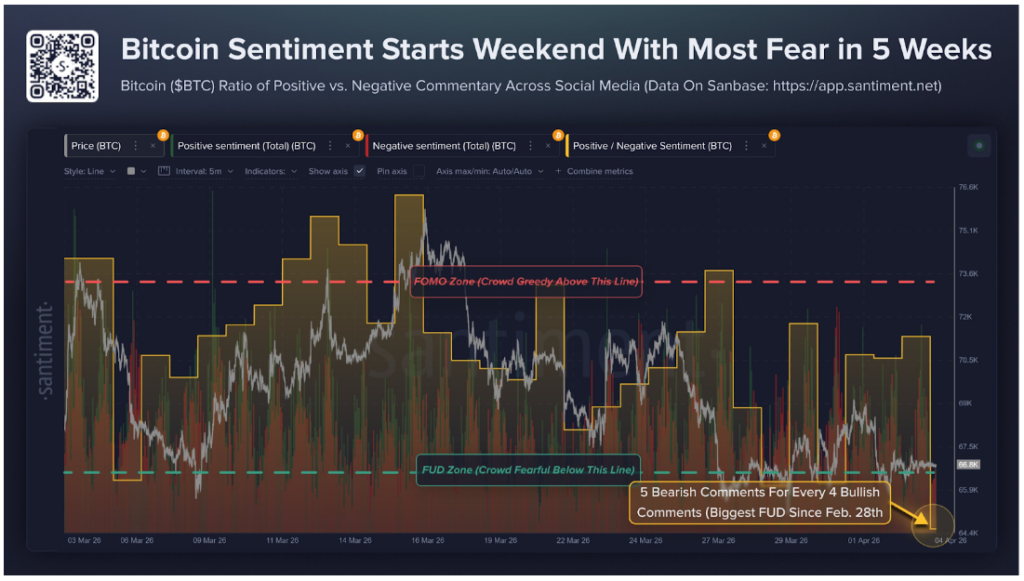
On-chain analytics platform Santiment pointed out a notable change in crowd psychology on Saturday, reporting that bearish discussions across X, Reddit, Telegram, and other major platforms have increased to their highest ratio relative to bullish commentary since February 28th. 

Bitcoin was trading at $66,800 at the time of the data snapshot, within what Santiment’s sentiment model designates as the FUD Zone. This is a threshold where negative commentary structurally overwhelms positive discourse.

The ratio stood at just 0.81 bullish comments for every 1.00 bearish comment, marking the most pessimistic social reading in five weeks. A review of Santiment’s chart shows the spread between bullish and bearish commentary widening materially through the final days of March and into the first weekend of April.

Bitcoin Sentiment Chart. Source: @santimentfeed On X

Santiment attributed the deteriorating sentiment in part to an extended period of stagnancy across the broader cryptocurrency market throughout 2026, a year that has so far frustrated bulls who anticipated a reversal of 2025’s year-end bearish momentum. 

Bitcoin spent much of the first quarter trading bearish, and the lack of a meaningful breakout appears to be wearing on retail participants. Furthermore, Bitcoin ended Q1 2026 with a negative 22.1% close.

BTCUSD currently trading at $67,070. Chart: TradingView

Peak FUD Could Be The Setup Bulls Are Waiting For

This sentiment deterioration has been characterized by the Bitcoin price action relatively compressed below $70,000, with repeated attempts to reclaim higher levels in late March and early April being met with rejection. 

However, the very depth of current pessimism is being read by Santiment as a constructive signal. The firm’s commentary leaned contrarian, noting that markets have historically tended to move in the opposite direction of prevailing crowd expectations. According to the on-chain analytics platform, a high level of FUD like this is a good sign that things can turn positive sooner rather than later.

There are also external uncertainties playing a role in how the sentiment surrounding Bitcoin has turned out. Geopolitical tensions and regulatory discussions, including those surrounding the proposed CLARITY Act, are causing hesitation among participants. 

These factors are feeding into the broader what-if environment, and they are limiting the ability of Bitcoin’s investors to keep their optimism. At the time of writing, Bitcoin is trading at $66,650, down by 0.5% in the past 24 hours.

Featured image from Unsplash, chart from TradingView

Scott Matherson Read More

Bitcoin LTH SOPR Indicates Concerning Capitulation Levels — What Does This Mean For Price?

Bitcoins

bitcoins Bitcoin

Reason to trust

Strict editorial policy that focuses on accuracy, relevance, and impartiality

Created by industry experts and meticulously reviewed

The highest standards in reporting and publishing

How Our News is Made

Strict editorial policy that focuses on accuracy, relevance, and impartiality

Ad discliamer

Morbi pretium leo et nisl aliquam mollis. Quisque arcu lorem, ultricies quis pellentesque nec, ullamcorper eu odio.

Prominent market analyst with the pseudonym RugaResearch has drawn attention to recent developments with Bitcoin long-term holders (LTH) Spent Output Ratio (SOPR), indicating that these key participants are exiting their positions at a significant loss.

Bitcoin LTH SOPR: Quiet Market Divergence

The SOPR compares the price at which coins were last moved (cost basis) to the price at which they are currently being spent. It is used to measure whether coins being spent are in profit or loss. When the SOPR drops below 1, it indicates investors are selling their holdings at a loss and vice versa.

Since March 11, RugaResearch reports that Bitcoin LTH SOPR has dipped below the 0.80 mark on seven different occasions to date, suggesting the long-term holders have steadily produced capitulations over the last month. Some of these occasions include 0.639 on March 11, 0.723 on March 28, 0.681 on March 30, and recently 0.753 on April 3. This suggests that Bitcoin long-term holders are presently realizing losses equal to 25% of their cost basis.

bitcoins Bitcoin
Source: CryptoQuant

When compared with the short-term holders (STH) SOPR of 0.996, RugaResearch also highlights a developing market divergence drawing little to no attention from investors. These figures, combined with the SOPR Ratio of 0.757, suggest that short-term holders are barely making losses, while the diamond hands are deep underwater, a situation in total contrast to a typical market structure where LTH are expected to realize their assets at a profit. However, it’s worth noting that a substantial portion of this distribution is going to exchanges, which have now recorded a net positive period over the last month.

According to the renowned market analyst, while an LTH SOPR significantly below 1 could indicate a severe lack of conviction, this on-chain development also served as a forerunner of major structural market shifts. RugaResearch explains that the implication of the frequency of negative SOPR is less about the current losses and their eventual results, which could be either deeper losses or the formation of a price floor.

Bitcoin Price Overview

At press time, Bitcoin exchanges hands at $67,390 following a 0.79% gain in the last 24 hours. However, daily trading volume is down by 30.57% and valued at $15.95 billion. This sharp decline in transaction activity suggests the recent minor gains are speculation-driven.

According to additional data from CoinCodex, the market sentiment remains strongly bearish, with the Fear & Greed Index at 11, suggesting extreme fear among investors. Nevertheless, CoinoCodex analysts foresee a rebound to $72,284 in the next month in line with the range-bound movement observed since early February.

bitcoins Bitcoin
BTC trading at $66,837 on the daily chart | Source: BTCUSDT chart on Tradingview.com

Featured image from iStock, chart from Tradingview

bitcoins Semilore Faleti

Semilore Faleti is a cryptocurrency writer specialized in the field of journalism and content creation. While he started out writing on several subjects, Semilore soon found a knack for cracking down on the complexities and intricacies in the intriguing world of blockchains and cryptocurrency.

Semilore is drawn to the efficiency of digital assets in terms of storing, and transferring value. He is a staunch advocate for the adoption of cryptocurrency as he believes it can improve the digitalization and transparency of the existing financial systems.

In two years of active crypto writing, Semilore has covered multiple aspects of the digital asset space including blockchains, decentralized finance (DeFi), staking, non-fungible tokens (NFT), regulations and network upgrades among others.

In his early years, Semilore honed his skills as a content writer, curating educational articles that catered to a wide audience. His pieces were particularly valuable for individuals new to the crypto space, offering insightful explanations that demystified the world of digital currencies.

Semilore also curated pieces for veteran crypto users ensuring they were up to date with the latest blockchains, decentralized applications and network updates. This foundation in educational writing has continued to inform his work, ensuring that his current work remains accessible, accurate and informative.

Currently at NewsBTC, Semilore is dedicated to reporting the latest news on cryptocurrency price action, on-chain developments and whale activity. He also covers the latest token analysis and price predictions by top market experts thus providing readers with potentially insightful and actionable information.

Through his meticulous research and engaging writing style, Semilore strives to establish himself as a trusted source in the crypto journalism field to inform and educate his audience on the latest trends and developments in the rapidly evolving world of digital assets.

Outside his work, Semilore possesses other passions like all individuals. He is a big music fan with an interest in almost every genre. He can be described as a “music nomad” always ready to listen to new artists and explore new trends.

Semilore Faleti is also a strong advocate for social justice, preaching fairness, inclusivity, and equity. He actively promotes the engagement of issues centred around systemic inequalities and all forms of discrimination.

He also promotes political participation by all persons at all levels. He believes active contribution to governmental systems and policies is the fastest and most effective way to bring about permanent positive change in any society.

In conclusion, Semilore Faleti exemplifies the convergence of expertise, passion, and advocacy in the world of crypto journalism. He is a rare individual whose work in documenting the evolution of cryptocurrency will remain relevant for years to come.

His dedication to demystifying digital assets and advocating for their adoption, combined with his commitment to social justice and political engagement, positions him as a dynamic and influential voice in the industry.

Whether through his meticulous reporting at NewsBTC or his fervent promotion of fairness and equity, Semilore continues to inform, educate, and inspire his audience, striving for a more transparent and inclusive financial future.

Disclaimer: The information found on NewsBTC is for educational purposes
only. It does not represent the opinions of NewsBTC on whether to buy, sell or hold any
investments and naturally investing carries risks. You are advised to conduct your own
research before making any investment decisions. Use information provided on this website
entirely at your own risk.

Semilore Faleti Read More

Bitcoin Difficulty Climbs 3.87% as Hashrate Slips and Next Cut Looms

Bitcoins

After the previous difficulty epoch delivered a 7.76% reduction, Bitcoin’s difficulty moved higher by 3.87% at block height 943488. This latest adjustment represents the third increase recorded so far this year.

Key Takeaways:

  • Bitcoin difficulty rose 3.87% at block 943488 as hashrate fell 60.45 EH/s; a 15.73% cut is projected.
  • Miners face $30.67 PH/s hashprice and 0.56% fees, pushing firms toward AI over BTC mining.
  • Bitcoin network nears April 19, 2026, adjustment as slower 11:51 blocks signal easing difficulty ahead.

Bitcoins Bitcoin Mining Tightens

The Bitcoin network has logged a total of seven adjustments this year, comprising three increases and four decreases. The most recent reduction, two weeks ago, was sizable, arriving after consecutive gains of 14.73% and 0.45% across the prior two epochs.

Following the latest adjustment, the difficulty rating is now 3.87% higher, making blocks that much harder to discover, and it further stands at 138.97 trillion times more difficult than Bitcoin’s launch.

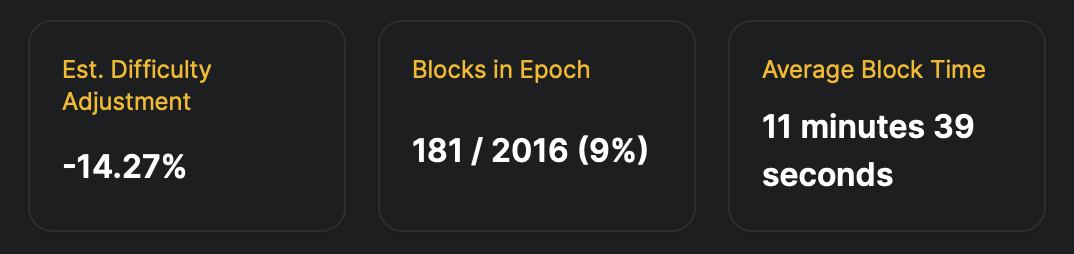
As of 4 p.m. Eastern time, 181 of the 2,016 blocks in the current epoch have been mined, placing the network roughly 9% of the way toward the next adjustment expected on April 19, 2026. While it remains early and conditions can shift considerably between now and then, current estimates point to a projected 14.27% reduction.

bitcoins Bitcoin Difficulty Climbs 3.87% as Hashrate Slips and Next Cut Looms
Image source: hashrateindex.com on April 4, 2026.

This outlook stems from a noticeable slowdown in block intervals over the past day, with data from hashrateindex.com indicating an average block time of 11 minutes 39 seconds, well above the expected 10-minute cadence.

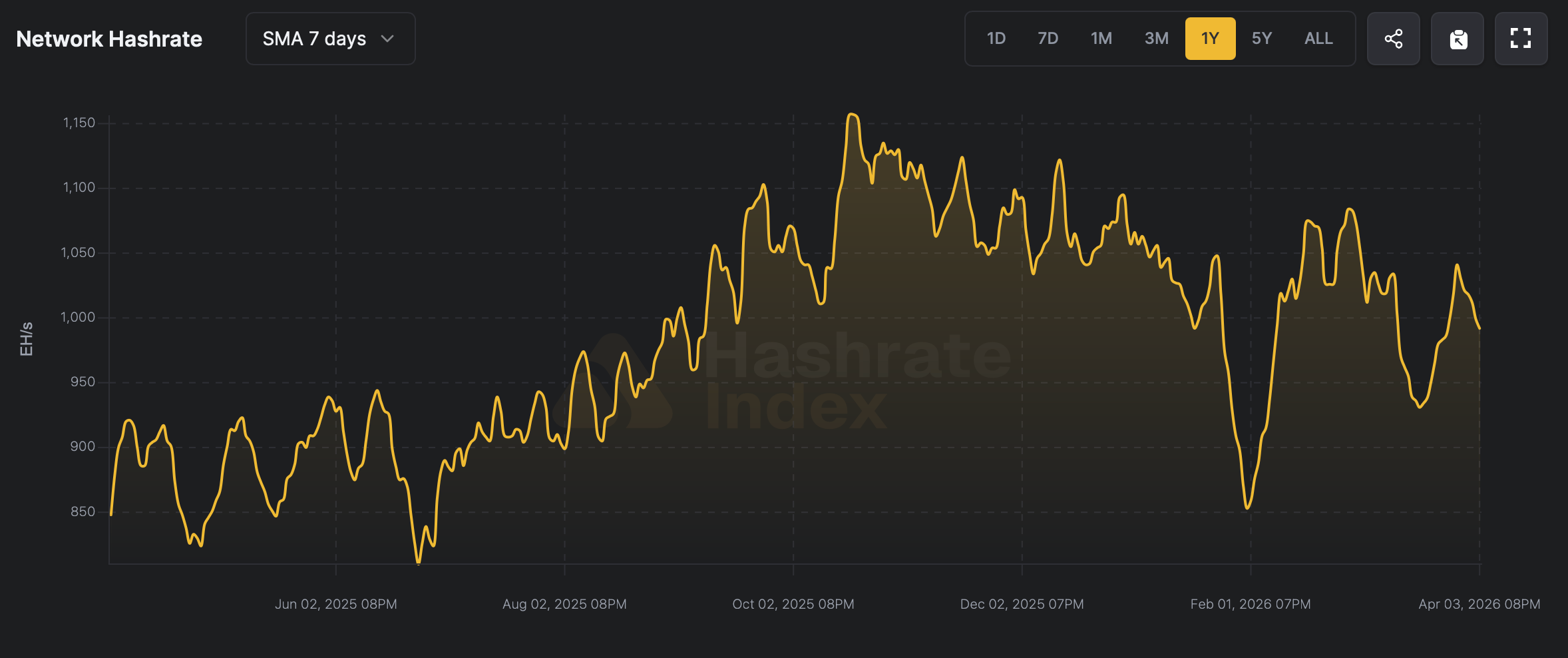
Bitcoin’s total hashrate on Saturday, April 4, 2026, via hashrateindex.com.

What’s behind the shift? A decline in hashrate. Bitcoin.com News reported on March 28 that the Bitcoin network’s total computational power had exceeded 1,000 exahash per second (EH/s), or 1 zettahash per second (ZH/s). On that day, hashpower reached 1,022 EH/s, whereas it now sits 60.45 EH/s lower at 961.55 EH/s.

Bitcoins Revenue Compression Tightens the Squeeze

Compressed revenues are likely a key factor behind the downturn, alongside mining operations opting to allocate resources toward artificial intelligence (AI) infrastructure rather than mining BTC in pursuit of stronger returns. An infrastructure provider deploying its megawatts toward AI rather than mining bitcoin can realize significantly higher returns, a dynamic that has persuaded many of today’s operators to redirect their focus.

A daily hashprice of $30.67 per petahash per second (PH/s) ranks among the lowest revenue levels bitcoin miners have faced since the network’s early years, when bitcoin carried a far smaller valuation. With 106,335 blocks remaining until the next halving, conditions are poised to tighten further.

Adding pressure, miners cannot rely on fees, which account for just 0.56% of the block reward. In effect, the system appears to be approaching a breaking point. Yet Bitcoin’s difficulty adjustment is engineered for precisely this scenario. If miners exit and hashrate declines, difficulty adjusts downward, drawing participants back with more accessible conditions.

Jamie Redman Read More

Rajasthan to host nationwide roadshows ahead of agritech meet

Bitcoins

bitcoins Image used for representational purpose only.

Image used for representational purpose only.
| Photo Credit: Getty Images/iStockphoto

In a push to position Rajasthan as a leading destination for investments in the agriculture sector, the State government on Saturday decided to roll out a series of roadshows in several cities ahead of the Global Rajasthan Agritech Meet (GRAM)-2026, scheduled to be held here from May 23 to 25.

The initiative aims at engaging with investors, agritech firms, research institutions, startups and key stakeholders to ensure participation and attract investments to the agriculture sector. The investors outreach through roadshows has been planned in Jaipur on April 10, and later in New Delhi, Ahmedabad, Hyderabad and Pune.

bitcoins

Principal Agriculture Secretary Manju Rajpal said here that the roadshows would serve as a platform to present Rajasthan’s evolving agricultural landscape, highlight policy support and showcase emerging opportunities in agri-business, food processing and value-added sectors.

“The initiative is also aligned with our broader vision to integrate innovation, advanced technologies and digital solutions into agriculture,” Ms. Rajpal said. The roadshows will facilitate high-level interactions among prospective investors, agritech developers, industry representatives and policymakers, with a focus on finding investment potential in the sector.

GRAM-2026 is expected to connect Rajasthan’s agriculture sector with global investment and innovation. The participants will be provided an overview of the three-day event’s key highlights, including technical sessions, workshops, exhibitions, smart farm and livestock showcases, and dedicated investment dialogues.

The previous edition of GRAM was held in Jaipur in 2016-17. The upcoming edition is expected to witness the participation of about 75,000 farmers from Rajasthan, more than 250 exhibitors, and over 100 companies from India and overseas.

Delegations from regions such as South Asia, Europe, Australia, and North and South America are also likely to participate. Ms. Rajpal said the GRAM-2026 would accelerate the adoption of modern agricultural technologies, foster innovation-led growth and contribute to sustainable agricultural development to enhance farmers’ incomes. (EOM)

Published – April 05, 2026 03:15 am IST

Luz Klemp Read More

Bitcoin Whales and Sharks Record $30.9B Losses Amid Q1 2026 Market Sell-Off

Bitcoins TLDR: Bitcoin whales and sharks recorded over $30.9B in losses, averaging $337M daily in Q1 2026. Early February saw peak capitulation, with realized losses hitting $1.6B in a single day. Large holders led the sell-off, showing institutional-level distribution during market stress. Market stabilized post-February, with reduced losses and BTC trading within a tight range…
Brenda Mary Read More

Record-low retail demand, $18B ETF flows: Is Bitcoin near a supercycle?

Bitcoins

Retail activity is often the clearest gauge of the market’s current mood. 

When we see high retail participation, it points to a risk-on environment, where traders are taking positions, dip buying picks up, and overall conviction remains strong, often signaling a local bottom in a crypto asset. 

Conversely, when retail activity drops, it tends to reflect a risk-off market, where participants are cautious and less willing to chase opportunities. Looking at on-chain data reinforces this point: Bitcoin’s [BTC] “shrimp” inflows (addresses holding less than 1 BTC) have fallen to record lows, highlighting just how subdued retail engagement has become.

bitcoins Bitcoin shrimp flow
Source: CryptoQuant

From a technical perspective, this underscores the lack of dip-buying momentum from smaller investors. Psychologically, these record-low inflows highlight the low risk appetite and reinforce the fear in the market. Put together, it’s clear why BTC’s $65k as a local bottom still feels a bit too ambitious for now.

However, this isn’t the only divergence in play this cycle. The memecoin space is staying mostly quiet too. The gap between new token launches and active traders is at an all-time high. Take Solana [SOL] as an example: At its mid-2025 peak, it had over 30 million active wallets, and now that number has fallen below 5 million, showing just how much engagement has dried up.

Historically, rotations into memecoins during risk-off periods have helped keep capital moving within the crypto market. Right now, with both low Bitcoin retail inflows and minimal memecoin activity, the market clearly remains cautious and far from a full risk-on environment. That said, this quiet setup could be exactly what Bitcoin needs to kick off its next institutional supercycle.

Bitcoins Can Bitcoin’s “buy the fear” approach spark a supercycle?

On the psychological side, both low retail activity and muted memecoin flows point to a low-risk appetite.

As mentioned earlier, low retail inflows show that investors who normally chase hype or macro-driven trends are staying on the sidelines. Similarly, strong memecoin rotation usually signals strategic players taking on higher-risk, quick-gain opportunities.

Right now, with both sides quiet, one thing is clear: ‘Fear’ of a Bitcoin correction is dominating sentiment. That said, the chart below highlights a key development. BlackRock’s IBIT Bitcoin ETF is now trading $16-18 billion daily, nearly matching Binance spot volumes and more than double Coinbase ($6-8 billion).

bitcoins BTC ETF
Source: Kaiko

From a technical perspective, this represents a classic “buy the fear” setup. 

In other words, when high-risk participants such as retail and memecoin traders step back, sentiment remains firmly in the fear zone. Consequently, this creates an opening for institutional investors to step in, accumulate, and reinforce BTC’s floor, setting the stage for a sharp rebound once risk-on sentiment returns.

With this setup unfolding in real time, the possibility of Bitcoin bottoming around $65k can’t be dismissed. If it holds, BTC could be gearing up for a full-blown institutional supercycle.


Bitcoins Final Summary

  • Low retail and memecoin activity signal fear in the market, keeping risk appetite muted and BTC’s $65k bottom still uncertain.
  • Institutional buying, highlighted by BlackRock’s IBIT ETF, creates a “buy the fear” setup that could kickstart Bitcoin’s institutional supercycle.

Ritika Gupta Read More

Grayscale Says 5 Altcoins Are at ‘Buy Zone’ Levels

Bitcoins Grayscale Investments posted consecutive endorsements of Sui (SUI) this week, praising its programming model for institutional use while calling current altcoin prices a potential buying opportunity. The asset manager highlighted SUI alongside Ethereum (ETH), Solana (SOL), Chainlink (LINK), and Avalanche (AVAX) as tokens trading at historically low levels…
Lockridge Okoth Read More

‘Moving boldly’: Mayor discusses homelessness, DEED and funding at State of the City

Mayor Cynthia Block speaking at the State of the City event.
Mayor Cynthia Block discussed homelessness, DEED and funding during the State of the City luncheon at TCU Place on May 14. Photo by Brody Langager /Saskatoon StarPhoenix

Article content

“Moving boldly” is the theme that Saskatoon’s mayor brought to her State of the City event, as she fielded questions from businesses and media on a range of hot topics.

The Star Phoenix

THIS CONTENT IS RESERVED FOR SUBSCRIBERS ONLY

Subscribe now to read the latest news in your city and across Canada.

  • Unlimited online access to articles from across Canada with one account.
  • Get exclusive access to the Saskatoon StarPhoenix ePaper, an electronic replica of the print edition that you can share, download and comment on.
  • Enjoy insights and behind-the-scenes analysis from our award-winning journalists.
  • Support local journalists and the next generation of journalists.
  • Daily puzzles including the New York Times Crossword.

SUBSCRIBE TO UNLOCK MORE ARTICLES

Subscribe now to read the latest news in your city and across Canada.

  • Unlimited online access to articles from across Canada with one account.
  • Get exclusive access to the Saskatoon StarPhoenix ePaper, an electronic replica of the print edition that you can share, download and comment on.
  • Enjoy insights and behind-the-scenes analysis from our award-winning journalists.
  • Support local journalists and the next generation of journalists.
  • Daily puzzles including the New York Times Crossword.

REGISTER / SIGN IN TO UNLOCK MORE ARTICLES

Create an account or sign in to continue with your reading experience.

  • Access articles from across Canada with one account.
  • Share your thoughts and join the conversation in the comments.
  • Enjoy additional articles per month.
  • Get email updates from your favourite authors.

THIS ARTICLE IS FREE TO READ REGISTER TO UNLOCK.

Create an account or sign in to continue with your reading experience.

  • Access articles from across Canada with one account
  • Share your thoughts and join the conversation in the comments
  • Enjoy additional articles per month
  • Get email updates from your favourite authors

Sign In or Create an Account

or

Article content

Here’s a rundown of some of the discussions.

Article content

Article content

Downtown Event and Entertainment District

Article content

“In the 1960s, this building (TCU Place), once the Centennial Auditorium, was the front page of the newspaper and everyone was screaming ‘we don’t want this’,” Cynthia Block told the crowd on Thursday.

Article content

Article content

Now, she said she couldn’t imagine not having TCU Place in downtown Saskatoon.

Article content

By signing up you consent to receive the above newsletter from Postmedia Network Inc.

Article content

The same thing happened in the 1970s, when railroad tracks needed to be moved to make way for Midtown Plaza, Block noted.

Article content

“People were super mad. Could you imagine not having that anchor in our downtown?”

Article content

She said these kinds of public investments bring in tourism — and private investment follows.

Article content

Today’s examples, Block said, include the Link Bus Rapid Transit system and the Downtown Event and Entertainment District.

Article content

She alluded to the possibility of a partnership still being an option for the DEED, despite the previous potential partnership being voted down by city council.

Article content

She stressed that while there isn’t an announcement coming, she hopes there will be one in the future.

Article content

Block acknowledged that public pushback comes from caring, and fear loss, adding that she saw the DEED as a natural evolution of Saskatoon.

Article content

She said it’s not just a “nice to have” project: they are losing business due to less opportunities at the SaskTel Centre.

Article content

Mayor Cynthia Block speaking at the State of the City event.
Mayor Cynthia Block at the State of the City event on May 14. Photo by Brody Langager /Saskatoon StarPhoenix

Article content

Homelessness

Article content

Block said Saskatoon had 1,931 people facing homelessness that were counted in the last point-in-time homelessness count.

Article content

Article content

“That’s up 30 per cent from last year. That is not sustainable, it is unmanageable, and I don’t think there’s a single person in this room that hasn’t been impacted by it and is frustrated.”

Article content

Article content

Block said the only way Saskatoon is improving the state of homelessness is through interim housing.

Article content

“There is no other way out … housing is the foundation to begin recovery in 99.99 per cent of cases.”

Article content

She said housing with wraparound services to support people facing homelessness can be really expensive, but the city is spending much more money doing what it is now to deal with homelessness.

Article content

Funding cities

Article content

Article content

She said cities maintain about 60 per cent of the infrastructure in the country, but only get about eight per cent of the tax revenue.

Article content

Many people are mad about their property assessment increasing, which causes their property taxes to increase, Block noted.

Article content

She said property taxes aren’t the right tool, and the four-year assessment cycle can create “enormous swings in assessment,” creating risk for homes and businesses.

Brody Langager
Read More