Home Blog Page 3

Algorand just jumped 50% after a Google flags quantum risk for Bitcoin and Ethereum

Bitcoins

Algorand has emerged as an early standout in the crypto market’s latest quantum security debate after a recent Google Quantum AI paper highlighted the blockchain as a live example of post-quantum cryptography being deployed on a network.

The attention came as the paper sharpened concerns around Bitcoin and Ethereum, two networks whose size, age, and design choices could make any future migration to quantum-resistant infrastructure slower and more complicated.

Against that backdrop, Algorand’s quieter work on Falcon digital signatures, state proofs, and key rotation suddenly looked less like a niche technical experiment and more like a practical head start.

The shift in attention helped lift Algorand’s token sharply over the past week, with traders treating the Google paper as validation of work already underway on the network.

According to CryptoSlate’s data, ALGO, the blockchain network’s native token, is one of the top performers over the past week, gaining around 50% to rise to $0.12 as of press time. Notably, the price performance came less than a week after the token fell to an all-time low of $0.08.

Bitcoins Algorand’s quiet quantum computing lead over Bitcoin and Ethereum

Algorand’s advantage over Bitcoin and Ethereum is narrower than the recent enthusiasm suggests, but it is also more concrete than what many larger chains can currently show.

In its paper, Google described Algorand as an example of real-world deployment of post-quantum cryptography on an otherwise quantum-vulnerable blockchain.

The distinction was important. It did not say Algorand had solved the problem end-to-end, but it did point to a network that had moved from theory into live implementation.

Algorand’s core consensus and built-in transactions still rely on Ed25519, which remains vulnerable in a sufficiently advanced quantum scenario.

However, the network has already deployed Falcon digital signatures for smart transactions and state proofs, the cryptographic attestations used to verify blockchain state across chains. It has also made Falcon verification available as a primitive for developers building on the Algorand Virtual Machine, giving the ecosystem a working set of tools rather than just a roadmap.

The network executed its first post-quantum-secured transaction in 2025, a milestone that set it apart from many larger rivals that are still debating design paths, governance trade-offs, and implementation timelines.

Algorand also allows users to rotate the private keys associated with their accounts, a feature that does not eliminate the underlying threat but could make future migrations more manageable.

That combination, live transaction capability, developer tooling, state-proof support, and native key rotation, is what turned Algorand into a focal point as the paper circulated through the market.

In a sector where many conversations around quantum risk remain theoretical, Algorand could point to infrastructure already in production.

Bitcoins Bitcoin and Ethereum face quantum computing risk

For Bitcoin, the concern is not only whether quantum computers will eventually be able to derive private keys from public information, but also how much of the network’s legacy footprint would be difficult to migrate in time.

The paper said a quantum computer with fewer than 500,000 physical qubits could crack the elliptic-curve cryptography protecting Bitcoin wallets, a far lower threshold than earlier estimates that ran into the millions.

Google’s own most advanced chip, Willow, remains far below that level, but the revised estimate has intensified scrutiny of how much Bitcoin could be exposed if the technology advances faster than expected.

CryptoSlate Daily Brief

Daily signals, zero noise.

Market-moving headlines and context delivered every morning in one tight read.

5-minute digest 100k+ readers

Free. No spam. Unsubscribe any time.

You’re subscribed. Welcome aboard.

The burden is particularly acute because some of Bitcoin’s oldest addresses keep public keys visible on-chain.

The paper cited an estimated 6.7 million BTC in older Pay-to-Public-Key addresses, including coins long associated with Bitcoin creator Satoshi Nakamoto.

Even outside those legacy wallets, the migration challenge is politically and technically heavy for a network that prioritizes backward compatibility and moves cautiously on base-layer changes.

Quantum risk, in Bitcoin’s case, is as much a governance and coordination problem as it is a cryptographic one.

Meanwhile, Ethereum’s exposure to the same quantum computing risk is somewhat broader.

Once an Ethereum user sends a transaction, the public key tied to that account becomes permanently visible on-chain. The paper said that this leaves the top 1,000 Ethereum wallets, holding roughly 20.5 million ETH, exposed under a sufficiently advanced quantum attack.
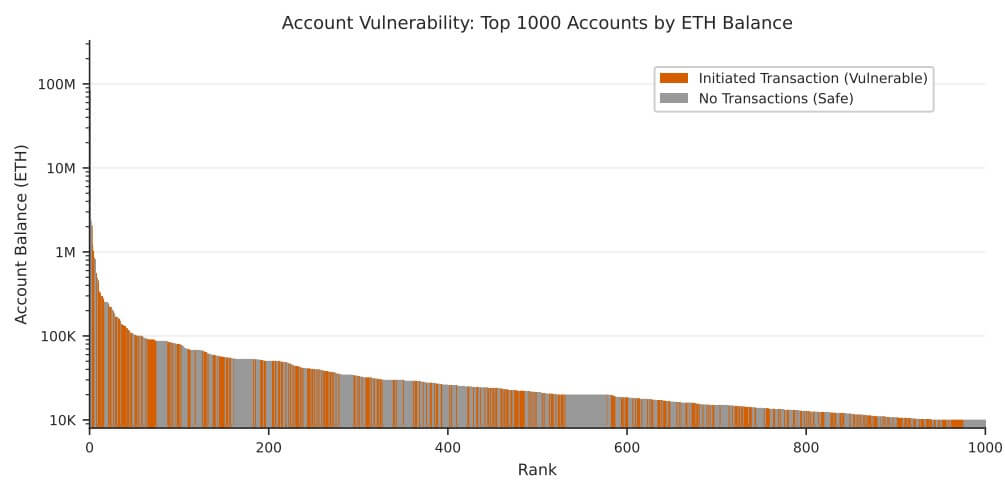
bitcoins Vulnerable Ethereum Wallets to Quantum Computing Risks
Vulnerable Ethereum Wallets to Quantum Computing Risks (Source: Google)

It also identified at least 70 major contracts with administrator keys visible on-chain, which ultimately control far more than the ETH they directly hold, including stablecoin minting authority and other system-critical permissions.

Moreover, the attack surface extends beyond wallets and contract administrators.

Ethereum’s proof-of-stake validator set, major Layer 2 networks, and parts of its data-availability architecture all rely on cryptographic components the paper described as vulnerable.

According to the paper, roughly 37 million ETH is staked, and much of Ethereum’s transaction load now flows through rollups and bridges that inherit assumptions from the base layer.

That means any serious post-quantum migration would have to reach not only users and validators, but also the network of applications and scaling systems built around them.

Oluwapelumi Adejumo Read More

‘Back to Work’: Michael Saylor Fuels Optimism for Another Massive Strategy Bitcoin Buy

0

Bitcoins

Renewed signals from Strategy’s bitcoin activity hint at another major purchase as Michael Saylor resumes a closely watched “orange dot” posting pattern tied to accumulation cycles.

Key Takeaways:

  • Michael Saylor’s “orange dot” post revived, fueling anticipation of a massive bitcoin buy announcement.
  • Strategy holds 762,099 BTC, underscoring its dominant reserve and long-term accumulation model.
  • SEC filing confirmed Strategy paused bitcoin purchases last week, pausing its steady accumulation streak.

Bitcoins Strategy Bitcoin Signals Intensify as Saylor Revives Orange Dot Pattern

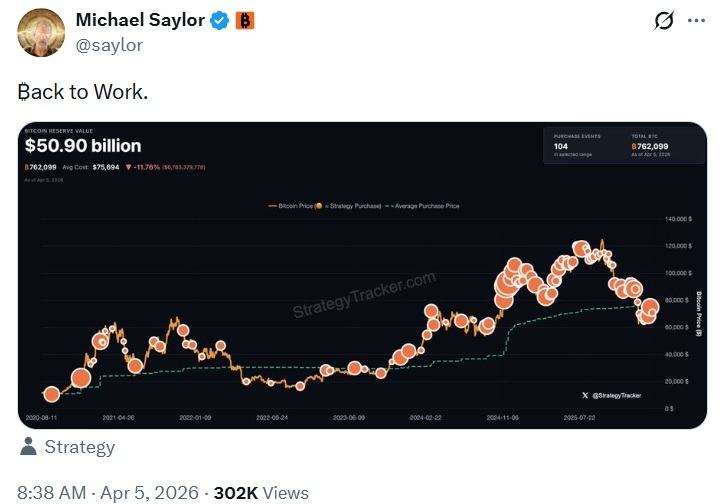
Expectations have intensified that Strategy (Nasdaq: MSTR) could have added a substantial amount of bitcoin after a new post by Michael Saylor. The executive chairman of Strategy shared on social media platform X on April 5 a brief message marking a return to his widely followed “orange dot” updates after skipping the prior week. Market participants closely monitor these posts for signals tied to Strategy’s buying activity.

“Back to Work,” Saylor wrote. The message accompanied a chart summarizing Strategy’s bitcoin reserve trajectory, showing a total of 762,099 BTC. The graphic displayed cumulative buying activity across multiple market cycles, with dots marking each acquisition over time.

bitcoins 'Back to Work': Michael Saylor Fuels Optimism for Another Massive Strategy Bitcoin Buy

The trend line suggests consistent accumulation during both rising and declining price periods. The visualization points to a long-term approach rather than short-term trading behavior. The clustering of purchases during price dips suggests systematic buying rather than reactive decision-making. The return of the orange dot format has historically aligned with purchase disclosures, driving expectations of another update.

Bitcoins SEC Filing Pause and Market Data Frame Strategy Next Move

The post followed a quieter period disclosed in a recent regulatory filing, where Strategy reported no bitcoin purchases or share sales for the week ending March 29. According to the Form 8-K filed with the U.S. Securities and Exchange Commission (SEC), the company maintained its existing position without deploying additional capital. Strategy stated: “On March 30, 2026, Strategy Inc. announced that, during the period between March 23, 2026 and March 29, 2026, Strategy did not sell any shares under its at-the-market offering program and did not purchase any bitcoin.”

Strategy’s dashboard data presented the company’s broader financial position alongside its bitcoin exposure. The firm’s market capitalization was near $41.4 billion, while its enterprise value reached approximately $57.3 billion. The bitcoin reserve totals 762,099 BTC, with an estimated value of around $50.90 billion based on a market price near $67,335. The average acquisition cost stands close to $75,894 per bitcoin, reflecting a large cumulative investment. Other indicators included implied volatility near 66% and annualized historical volatility exceeding 70%. The data also showed significant leverage metrics, dividend coverage, and capital structure alignment tied to bitcoin holdings. These figures reflects how Strategy integrates bitcoin into its corporate treasury model. With Saylor resuming his signature posting style, anticipation has grown that Strategy could announce a new bitcoin purchase on Monday, consistent with its typical disclosure cadence.

Kevin Helms Read More

Bitcoin is now front-running the Fed rather than reacting to it. ETFs are the cause

Bitcoins

Bitcoins Bitcoin’s correlation with global central bank easing has turned strongly negative since 2024, suggesting BTC now leads rather than lags monetary policy signals.

Apr 5, 2026, 4:00 p.m. 2 min read

Make preferred on

Bitcoin may no longer move in step with Federal Reserve policy, according to a new report from Binance Research, which points to a structural shift driven by spot exchange-traded funds.

For years, crypto markets reacted sharply to interest rate signals, with bitcoin falling when central banks tightened monetary policy.

That pattern now appears to be breaking as Binance data shows bitcoin’s correlation with its Global Easing Breadth Index, which tracks 41 central banks, has turned strongly negative since 2024. Spot bitcoin ETFs were approved by the U.S. Securities and Exchange Commission (SEC) in January 2024.

bitcoins (Binance Research)

Before ETFs, the relationship was mildly positive, with BTC tending to follow global easing cycles by several months. Now, the report finds the opposite effect is nearly three times stronger, suggesting the old link has reversed.

The change reflects a shift in who drives prices. Retail investors once dominated crypto trading and reacted to macro news. ETFs allowed institutions to play a bigger role, and these firms often positioned months ahead of policy changes, treating BTC as a forward-looking asset.

“As a result, BTC may have evolved from a macro ‘lagging receiver’ to a ‘leading pricer,” Binance Research wrote. “A peak in easing may already be old news for BTC, and crypto-native drivers—such as policy progress and institutional flows—could matter more than the direction of monetary easing itself.”

The findings come as markets grapple with renewed stagflation fears tied to rising oil prices and growing geopolitical tensions over the war in the Middle East.

Rate expectations have swung from projected cuts to possible hikes, a backdrop that historically pressured risk assets.

Binance argues that the reaction may be overstated. In past cycles, central banks often pivoted to support growth despite inflation spikes. If history repeats itself, central banks are to eventually prioritize growth over inflation, and bitcoin will likely price that pivot earlier than expected.

AI Disclaimer: Parts of this article were generated with the assistance from AI tools and reviewed by our editorial team to ensure accuracy and adherence to our standards. For more information, see CoinDesk’s full AI Policy.

More For You

bitcoins Bitcoin down

A hopeful posting on Iran from President Trump helped erase morning losses.

Read full story

Francisco Rodrigues Read More

Bitcoin ETFs and Institutions Are Buying, So Why Is Spot Demand Still Weak? (CryptoQuant)

Bitcoins

Selling pressure from other market participants is offsetting incremental institutional buying and sustaining the current wave of distribution.

Under the current crypto market conditions, Bitcoin exchange-traded funds (ETFs) and some institutions are still in accumulation mode. However, spot demand remains weak. Market research platform CryptoQuant explained why this contraction has persisted in its latest weekly report.

According to the firm’s findings, spot demand has remained in deep contraction because broader market selling pressure outweighs institutional buying. Selling from retail and other market participants is more than offsetting incremental institutional buying; this trend is sustaining the current wave of distribution.

Bitcoins Spot Demand Remains Contracted

In March, ETF 30-day purchases increased sharply to roughly 50,000 bitcoin (BTC). This was the highest the investment products had recorded since October 2025. On the other hand, the business intelligence entity, Strategy, recorded a 30-day accumulation of approximately 44,000 BTC.

Contrarily, the 30-day apparent demand growth hovered at -63,000 BTC by the end of March. This figure reflected persistent selling pressure in the broader market. Spot demand has witnessed sustained contraction since late November 2025, confirming a distribution phase.

Among other market participants, Bitcoin whales have become net distributors, with the one-year change in their holdings reading -188,000 BTC. This cohort of investors accumulated over 200,000 BTC in 2024, but began distributing aggressively from mid-2025, with an increased pace in the last quarter of the year and early 2026.

“The 365-day SMA remains in a declining trend, confirming that this distribution is structural rather than temporary. Historically, sustained negative whale accumulation has coincided with periods of prolonged price weakness, and the current reading suggests selling remains a significant structural headwind,” CryptoQuant explained.

Bitcoins BTC Faces Possible Relief Rally

Unlike whales, mid-tier holders, also known as dolphins, have remained net accumulators, but at a reduced pace. The one-year change in the holdings of these investors has declined by more than 60% from almost 1 million BTC in October 2025 to 429,000 BTC today.

Furthermore, demand from U.S. investors has also weakened in recent weeks, as seen in the Coinbase Premium turning negative again. The metric turned negative after BTC hit its all-time high of $126,000 in early October and has since been unable to sustain a meaningful positive trajectory.

You may also like:

Given the market’s state, CryptoQuant analysts believe BTC may rebound toward $71,500-$81,200 in the short term if macro conditions, especially the US-Iran conflict, improve. In essence, de-escalating geopolitical tensions may serve as a positive catalyst, triggering a relief rally.

SPECIAL OFFER (Exclusive)

Binance Free $600 (CryptoPotato Exclusive): Use this link to register a new account and receive $600 exclusive welcome offer on Binance (full details).

LIMITED OFFER for CryptoPotato readers at Bybit: Use this link to register and open a $500 FREE position on any coin!

Mandy Williams Read More

Police Credit Gov Umo Eno For Improved Security In Akwa Ibom

Bitcoins

 
bitcoins FBN750x90

April 05, (THEWILL) — The Akwa Ibom State Police Command has attributed the relative peace and recent gains in crime reduction across the state to the sustained support of Governor Umo Eno, highlighting key investments in security infrastructure and logistics.

In a statement issued on Sunday to mark the ongoing Police Week celebration, the Command said the administration’s interventions have significantly strengthened the operational capacity of the Nigeria Police Force and other security agencies.

The Commissioner of Police in the state, Baba Mohammed Azare, noted that government-backed projects, including the construction of internal road networks at the Police Headquarters, the establishment of a Command and Control Centre, and the ongoing development of a Counter Terrorism Unit (CTU) barracks have improved coordination, mobility, and rapid response.

bitcoins Ask ZiVA 728x90 Ads

According to the statement endorsed by the Police Public Relations Officer, DSP Timfon John, additional support such as the regular fuelling of patrol vehicles and provision of operational logistics has boosted officers’ morale and enhanced service delivery.

The Command said these measures have contributed to improved public confidence in security institutions and more effective crime-fighting strategies across Akwa Ibom.

It also reaffirmed its commitment to intensifying intelligence-led policing, community engagement, and visibility patrols throughout the state.

Residents were urged to support security agencies with timely and credible information to aid ongoing efforts to prevent and combat crime.

bitcoins THEWILL APP ADS 2

Udeme Utip, THEWILL Read More

US jobs crush forecasts, yet hidden labor weakness could keep Bitcoin under pressure

Bitcoins

A blowout US jobs report should have settled the current macro story. Instead, it exposed a split picture that keeps Bitcoin vulnerable in the short term.

Headline payroll growth came in far above expectations, but weaker labor-force and household data suggest the labor market may be firmer on the surface than underneath.

The US economy added 178,000 jobs in March, nearly three times the consensus estimate of 60,000, and unemployment dipped to 4.3%. That is the kind of print that resets macro narratives and hits risk assets before traders finish their first read.

Bitcoin traded around $67,000, unfazed by the data. The 10-year Treasury yield climbed four basis points to 4.35%, and the dollar index ticked up to 100.08.

The market’s first-order read was straightforward: a labor market that looks this strong gives the Federal Reserve less reason to cut, which in turn yields tighter financial conditions and weighs on a macro-sensitive asset like Bitcoin.

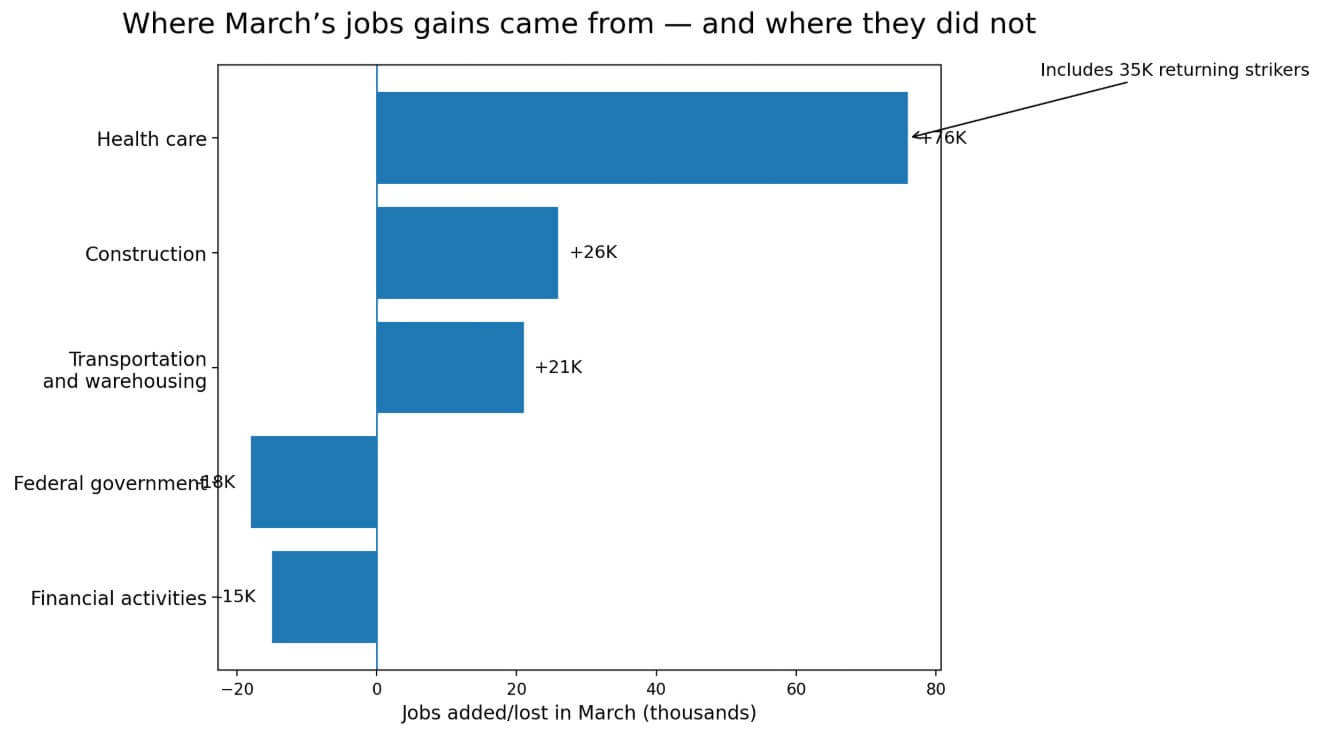
Zoom in on where those 178,000 jobs came from, and the picture gets less clean. Health care alone added 76,000 positions, and 35,000 of those were workers returning from a strike in physicians’ offices. The numbers represented a catch-up hiring.

Construction added 26,000, partly weather-aided, and transportation and warehousing contributed another 21,000. Federal government employment fell by 18,000, and financial activities shed 15,000.

BLS noted that total payroll employment had moved little on net over the prior 12 months.

That backdrop makes March read as a rebound from a noisy February, with sector-specific catch-up doing most of the lifting.

bitcoins Where March's jobs gains come from
A bar chart shows health care leading March job gains at 76,000, including 35,000 returning strikers, while federal government and financial activities shed jobs.

Bitcoins The household survey runs the other way

The household survey, which tracks employed and unemployed individuals across the population, moved in the opposite direction from the payroll numbers.

The civilian labor force contracted by 396,000 in March, with participation falling to 61.9%. Household employment declined by 64,000, and the number of people not in the labor force rose by 488,000.

Marginally attached workers jumped 325,000 to 1.9 million, and discouraged workers climbed 144,000 to 510,000. The average workweek is shortened to 34.2 hours.

Average hourly earnings rose just 0.2% month over month and 3.5% year over year, with no wage acceleration to complement the payroll beat.

IndicatorMarch readingWhy it matters
Nonfarm payrolls+178KStrong headline beat versus expectations
Unemployment rate4.3%Makes the labor market look firm at first glance
Civilian labor force-396KSuggests weaker labor-market participation beneath the headline
Labor-force participation rate61.9%Fewer people working or looking for work
Household employment-64KThe people-based survey moved opposite the payroll survey
Not in labor force+488KReinforces the softer under-the-hood read
Marginally attached workers+325K to 1.9MShows weaker labor attachment at the margin
Discouraged workers+144K to 510KSignals more workers are giving up on job searches
Average workweek34.2 hoursA shorter workweek can point to softer labor demand
Average hourly earnings+0.2% m/m, +3.5% y/yNo wage reacceleration to confirm the payroll beat

February’s revision adds another layer. BLS marked February down to -133,000 from -92,000 and revised January up to 160,000 from 126,000. The net two-month revision was only -7,000, making the pattern noisy and lacking a consistent directional pull.

Payroll growth in the first quarter averaged roughly 68,000 per month, a soft pace by any expansion standard.

BLS revises monthly estimates twice as additional employer reports arrive and seasonal factors reset.

Since 2003, the average absolute revision from the first to the third estimate has been 51,000 jobs. A revision of that size would take March from 178,000 to around 127,000, which is noticeably less dramatic.

To erase the entire beat, March would need a job-creation figure exceeding 118,000, roughly 2.3 times the historical average, and ordinary revision noise does not get there.

BLS’s annual benchmark revision stripped 898,000 jobs from the March 2025 payroll level, four times the average absolute benchmark revision of the prior decade.

The revision established that first-print payrolls have recently carried more uncertainty than markets typically price in during the first trading hour following a strong print.

That leaves the market with a narrow question: Was March a genuine reacceleration in labor demand, or a strong headline print masking a softer underlying trend? Bitcoin’s next move depends less on the headline beat itself and more on which of those readings the next data confirms.

Bitcoins The rates channel behind Bitcoin’s drop

The Federal Reserve held its target range at 3.50% to 3.75% in March.

CryptoSlate Daily Brief

Daily signals, zero noise.

Market-moving headlines and context delivered every morning in one tight read.

5-minute digest 100k+ readers

Free. No spam. Unsubscribe any time.

You’re subscribed. Welcome aboard.

The median participant’s projection put 2026 unemployment at 4.4%, PCE inflation at 2.7%, and the year-end fed funds rate at 3.4%. March unemployment at 4.3% and a payroll print of 178,000 gave policymakers no urgency to move.

NYDIG’s research frames the Bitcoin-to-macro link in the same terms: BTC trades in line with real rates, liquidity, and risk appetite. A Fed that holds its position on a firm labor market removes the near-term catalyst that Bitcoin most needs.

The February JOLTS report reinforces this without turning alarming. Openings held near 6.9 million, but hires fell to 4.8 million, and the hiring rate dropped to 3.1%, the lowest reading since April 2020.

Initial jobless claims for the week ended March 28 came in at 202,000, near cycle lows.

Together, these data points describe a labor market in stasis, with layoffs contained, new hiring tepid, and firms holding headcount steady.

That environment does not trigger a Fed pivot, and a Fed that does not pivot keeps financial conditions tighter for longer.

Bitcoins Potential outcomes for Bitcoin

Bitcoin’s price action on April 3 ran through the rates channel. Labor strength reduced cut expectations, firmer yields, and a stronger dollar tightened conditions for liquidity-sensitive assets. This channel can reverse.

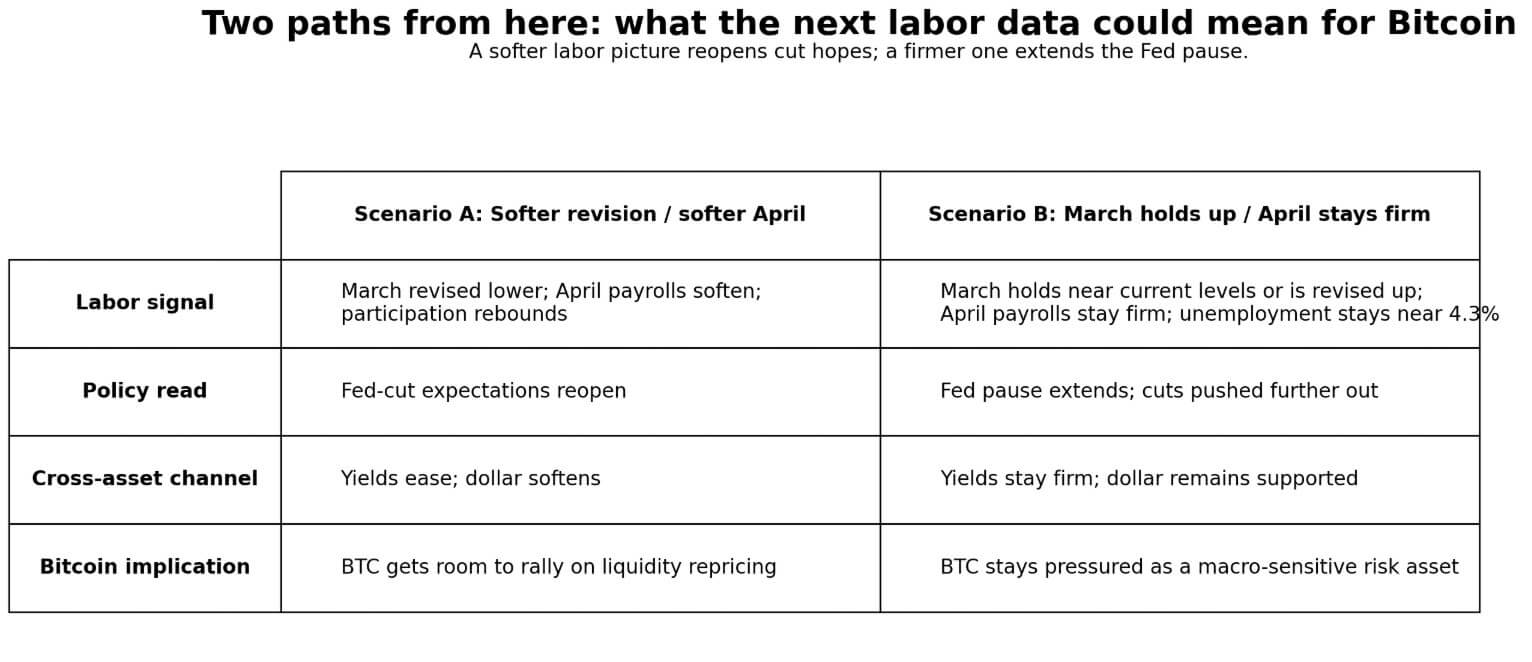
If BLS revises March payrolls materially lower toward sub-100,000, and April payrolls also land soft while participation rebounds, the “headline-only strength” thesis gains traction.

Cut expectations would reopen, yields would ease, and Bitcoin would have room to rally on liquidity repricing. The weakness in the household survey, the strike-return distortion in health care, and the low-hiring JOLTS backdrop each make that path plausible, but April data on May 8 would need to confirm it.

If March holds near current levels or BLS revises it higher, and April payrolls land above roughly 125,000 while unemployment stays near 4.3% or below, February becomes the clear outlier.

The Fed extends its pause with more confidence, cuts get pushed further out, and Bitcoin keeps trading as a macro risk asset with no near-term liquidity catalyst.

The cross-asset move on April 3, with yields up, the dollar up, and BTC down, showed the market had already begun pricing that path.

bitcoins Two paths for Bitcoin
A two-scenario table maps how softer or firmer April labor data would flow through Fed policy, yields, and the dollar to Bitcoin’s price.

The next Employment Situation release is scheduled for May 8 at 8:30 a.m. ET, bringing both April payrolls and the first revision to March.

That puts three checkpoints in front of Bitcoin: March CPI on April 10, the April 28-29 FOMC meeting, and the May 8 employment report with the first revision to March. If inflation stays sticky and payrolls hold up, Bitcoin remains tied to tighter-for-longer conditions. If labor softens beneath the headline, the liquidity case can reopen fast.

Gino Matos Read More

Is Bitcoin’s ‘9x’ liquidity spike bull trap? Assessing BTC’s $67K floor

Bitcoins

As uncertainty builds across the market, capital does not leave; instead, it shifts, and Binance sits at the center of that movement.

Bitcoin [BTC] held near $67,250 as of press time, while Tether [USDT] inflows surged to nearly 9 times the levels seen at the $123,000 peak. This shows capital is positioning, not exiting, as large players prepare for deployment.

At the same time, the Binance Whale Concentration Indicator (BWCI) rose toward 75%, far above the earlier 8.25%, confirming whales now dominate flows.

Source: CryptoQuant

Institutions stepped in during volatility, using deep liquidity to absorb selling and build positions. As USDT Reserves approached $3.49 billion, that capital supported Spot demand and derivatives expansion, where Open Interest [OI] increased.

This created a controlled structure where the downside was absorbed. However, sustained upside still depended on broader demand confirmation.

USDT inflows signal active buying power

This liquidity buildup explained why the price held despite pressure. Capital is positioned instead of exiting.

USDT inflows increased, showing buying power moved onto exchanges, ready for deployment.

Tether supply reached $184.1 billion, holding about 58% dominance. The broader stablecoin market grew by 0.43%.

That increase reflected controlled capital entry instead of speculative excess.

Institutions preferred entering during weakness, using stablecoins as flexible capital. The market held latent demand, where liquidity could absorb supply or delay entry.

Bitcoin holds above realized price as buyers defend market structure

This liquidity presence began to show in price behavior, where Bitcoin holds firm instead of breaking under pressure.

At press time, BTC traded above its Realized Price near $54,000. That meant most holders remained in profit and felt less urgency to sell.

Source: CryptoQuant

That stability reflected a market absorbing supply rather than reacting to stress. More importantly, the Volatility-Adjusted Premium cooled from its peak and trended toward 0.

That shift indicated previous market excess had largely cleared.

Buyers continued defending structure, pointing to steady accumulation rather than capitulation. However, the Market Heat Score had not reached prior bottom zones.

That suggested the reset remained incomplete.


Final Summary

  • Bitcoin [BTC] holds structure as Tether [USDT] inflows and rising BWCI show institutional positioning absorbing supply, keeping downside limited despite market uncertainty.
  • Bitcoin now depends on demand confirmation, where strong liquidity can drive upside, yet incomplete cooling signals delay a full cycle reset.

Muriuki Lazaro Read More

The Next Phase of Bitcoin: Why Passive BTC Models Like Bitcoin Everlight Are Gaining Momentum in 2026

Bitcoins

bitcoins sp

It appears that the era of loud, energy-draining mining rigs is coming to an end, or at least to a change in 2026. The cryptocurrency market has matured considerably and is moving away from speculative noise toward functional utility that actually pays.

Investors are no longer happy with holding coins – they want their assets to work for them. In fact, a lot of the regulatory lobbying is focused that way as well. This shift has sparked a considerable surge in passive BTC models, which allow users to earn the world’s most valuable digital asset without having a degree in computer science or a massive electricity budget.

Bitcoin Everlight is at the forefront of this movement. It offers a streamlined way to tap into network transaction fees. The protocol prioritizes accessibility and real-world efficiency, proving that the next phase of Bitcoin won’t just be about hardware but also about decentralized infrastructure that rewards its community effortlessly.

Exclusive bonuses up now. Use Code SHARD15 at Checkout to Receive an Extra 15%

Bitcoins Redefining the Digital Asset Landscape

Bitcoin Everlight (BTCL) is a considerable shift in the way we perceive blockchain-based rewards. It’s not a speculative fork or a copycat coin. On the other hand, the team introduces a sophisticated routing layer, which is built to scale the Bitcoin network. At the time of this writing, the project is in Phase 4 of its presale, and the tokens are priced at $0.0014. The team has already secured $2.5 million from participants who are apparently eager to join the very next generation of finance.

With a fixed supply of 21 billion tokens, BTCL mirrors the scarcity of Bitcoin while offering a launch price target of $0.03110. This ecosystem turns participants into vital components of a decentralized network, ensuring that the rewards generated are rooted in actual network utility and speed improvements.

Bitcoins Unlocking Yield Through the Shard Architecture

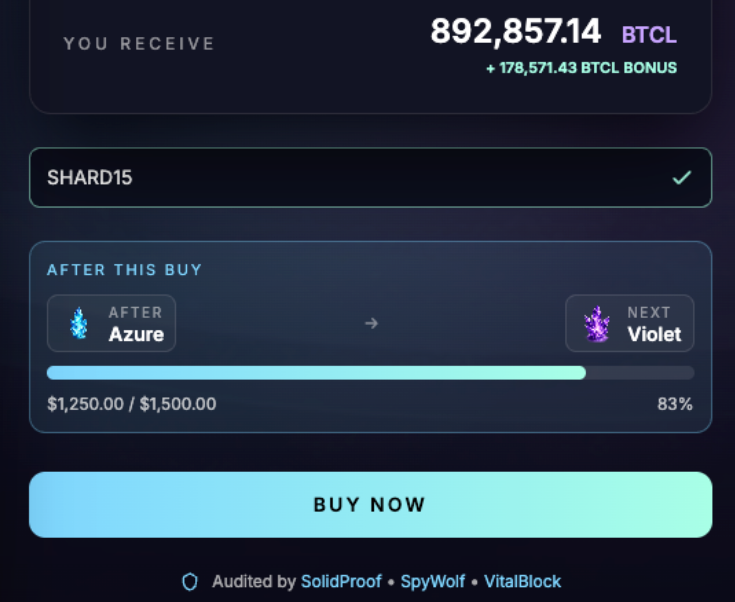
The center of the model is the so-called Shard system. It provides a direct path to native Bitcoin earnings. That said, the recently launched Jade Shard allows users to enter for as little as $100 in BTCL tokens. It offers a 6% yield during the current phase, which will convert into native BTC rewards upon activating the mainnet.

It’s important to note that participants will retain 100% of the ownership of their BTCL tokens and can choose to sell once the official launch happens. However, to keep a Shard active, they will have to keep their balance above the required threshold. Otherwise, the Shard will enter a dormant state.

The tiered rewards are designed to grow as the user contributes: Azure ($500 / 12%), Violet ($1,500 / 20%), and Radiant ($3,000 / 28%+ APY).

Going forward, the rewards are generated from actual transaction routing fees. This eliminates the need for high energy bills or ASIC-based equipment. The shards upgrade automatically once the user’s cumulative contributions across assets like BTC, SOL, or ETH hit the following tier.

Ready to get started? Use Code SHARD15 at Checkout to Unlock Your 15% Bonus

Bitcoins The Power of a Transparent Community

It goes without saying that social proof is a very important indicator for a project’s health. Bitcoin Everlight has already managed to establish a notable presence. The official X account is a primary source for real-time news and technical insights, while the Telegram community is a hub for shard holders to share their dashboard successes. This transparency is reinforced by live leaderboards and activity feeds, which foster a sense of healthy competition.

Bitcoins Strategic Market Expansion and Listing Goals

When it comes to the BTCL token’s growth potential, it’s worth noting that it’s closely tied to its upcoming listing on major centralized exchanges. The team is now working on securing debuts on global platforms. To ensure the price stays stable and the market remains healthy, 15% of the total token supply is reserved for liquidity on both decentralized and centralized exchanges.

As some industry observers have pointed out, early participants who secure their shards now are positioning themselves for significant upside as the project gains mainstream visibility. This strategic reserve ensures that as adoption grows, the ecosystem remains liquid and accessible for all holders.

Bitcoins Technical Innovation in Bitcoin Scaling

Bitcoin serves as a lightweight routing and validation layer that operates alongside the original chain, unlike traditional Layer-2 solutions. It’s designed to address real-world usability issues, including transaction speed and high fees, without changing Bitcoin’s core consensus.

Everlight Nodes handle the optimized routing paths, ensuring that security remains anchored to the base layer.

  • The project has undergone rigorous security checks by Spywolf and Solidproof to ensure contract safety.
  • Team identity is fully verified through Spywolf and Vital Block protocols.
  • The shard model makes node-level participation accessible to retail investors for only a $10 minimum.
  • This architecture is designed to remain profitable even as traditional mining difficulty rises.

Crypto Nitro has noted that this security-first approach is what gives the platform its competitive edge in a crowded market.

Bitcoins Effortless User Experience and Global Reach

The platform is built for everyone, not just technical experts.

The dashboard is fully responsive on both mobile and desktop, featuring WalletConnect integration for a secure and immediate link to your assets. With a simple three-step process: buy, activate, and earn, the friction of participating in Bitcoin rewards is gone. Support for multiple payment options ensures that anyone can participate without being slowed down by technical hurdles.

The live reward tracking and visual tier progress help users stay informed about their earnings in real time, making the journey toward passive income as simple as possible.

Bitcoins Conclusion

The transition toward passive BTC models is the defining trend of 2026, and Bitcoin Everlight is leading the way. By combining a secure shard system with a transparent technical foundation, the project offers a sustainable alternative to traditional mining. The opportunity to secure tokens at Phase 4 prices is a limited window that allows you to participate in the growth of the Bitcoin payment layer. As the project moves toward its mainnet launch and major exchange listings, the momentum continues to build for those ready to embrace the next phase of digital wealth.

To get started, visit our official site and use code SHARD15 at checkout to receive your exclusive 15% bonus.

Interested investors can find more information here or check Bitcoin Everlight’s X and Telegram.

Disclaimer: The above article is sponsored content; it’s written by a third party. CryptoPotato doesn’t endorse or assume responsibility for the content, advertising, products, quality, accuracy, or other materials on this page. Nothing in it should be construed as financial advice. Readers are strongly advised to verify the information independently and carefully before engaging with any company or project mentioned and to do their own research. Investing in cryptocurrencies carries a risk of capital loss, and readers are also advised to consult a professional before making any decisions that may or may not be based on the above-sponsored content.

Readers are also advised to read CryptoPotato’s full disclaimer.

SPECIAL OFFER (Exclusive)

Binance Free $600 (CryptoPotato Exclusive): Use this link to register a new account and receive $600 exclusive welcome offer on Binance (full details).

LIMITED OFFER for CryptoPotato readers at Bybit: Use this link to register and open a $500 FREE position on any coin!

Bridgit Murphy Read More

The 34 participants in the Accelerator program include Mike McDaniel, Eric Bieniemy

Since the inauguration of the 47th president, the NFL has been engaged in a delicate dance regarding its diversity, equity, and inclusion efforts. This week, one of the key aspects of the NFL’s efforts returns, with a twist.

As the league explained in March, the Accelerator program is back — and it’s open to everyone.

At the time, NFL senior V.P. and chief diversity and inclusion officer Jonathan Beane said that it’s “not us taking the direction of anyone on the outside” or a “reaction to D.C.”

The NFL canceled last year’s Accelerator program, prompting speculation that it was hoping to avoid scrutiny by the anti-DEI forces within the federal government.

According to Jeremy Fowler of ESPN, 34 coaches and executives are scheduled to participate. They include Chargers offensive coordinator (and former Dolphins head coach) Mike McDaniel and current (and former) Chiefs offensive coordinator Eric Bieniemy.

Many of the other coaches on the list have had head-coaching interviews. Per Fowler, Rams offensive coordinator Nate Scheelhaase, Lions passing game coordinator (and former Giants interim head coach) Mike Kafka, Jaguars offensive coordinator Grant Udinski, Seahawks defensive coordinator Aden Durde, Falcons defensive coordinator Jeff Ulbrich, Vikings quarterbacks coach Josh McCown, and Broncos special teams coordinator Darren Rizzi appear on the roster.

The list of executives set for the 2026 Accelerator program includes Terrance Gray (Bills), Nolan Teasley (Seahawks), John McKay (Rams), R.J. Gillen (49ers), Chad Alexander (Chargers), Glenn Cook and Catherine Hickman (Browns), Brandon Brown (Giants), Josh Williams (49ers), James Liipfert (Texans), Mike Bradway (Chiefs), Lance Newmark (Commanders), and Mike Greenberg (Buccaneers).

Although the federal government has yet to scrutinize the Accelerator program, it has become one of the issues in Florida’s ongoing attack against the NFL’s diversity initiatives. In a May 1, 2026, letter to Florida attorney general James Uthmeier, NFL general counsel Ted Ullyot wrote this: “[T]he Accelerator program is open to all individuals, regardless of race or sex. It provides an opportunity for prospective candidates for front office positions to participate in networking events, interview training, and facilitated development sessions.”

The dramatic change in the demographics of the Accelerator program will only reinforce the perception that the NFL is trying to avoid a late-night social-media storm of criticism regarding its commitment to diversity (along with the new kickoff formation). Regardless, after last year’s conspicuous cancellation, the Accelerator program is back. And it’s giving plenty of names already in the pipeline for one of the biggest jobs (coach and General Manager) access to the key decision makers and extra help to eventually secure one of those positions.

Samatha Noren
Read More

How American businessman built a home for Cebu’s forgotten children

John Drake once spent his days managing corporate operations and flying across countries as an American executive whose life revolved around business.

Today, at 78, he has spent two decades raising abandoned and neglected children in Toledo City — children who now call him “Tito John.”

What was meant to be one final trip to the Philippines became a mission that helped turn forgotten children into graduates, engineers, teachers and nurses.

When he first came to Cebu in the early 1990s, it was for overseeing power plant operations in places such as Toledo City, Cebu. “I was always focused on the work,” Drake said. For years, the Philippines was simply another stop in a career that had already taken him across the world.

Then, in 2002, something changed. Before returning to the United States, he joined then-Toledo City Mayor in visiting schools where computer donations had been distributed.

“She said, ‘You’re the orphan guy, aren’t you?’” Drake recalled. She then asked if he would consider renovating and running a struggling children’s facility in Toledo City.

He initially dismissed the idea. “Different culture, language, laws, customs — everything. Plus I had a family and projects around the world. Why would I do this?” he said.

Still, he agreed to visit the old Lingap Center. The facility was in poor condition, but it was the children inside that stayed with him.

“There were 26 kids there that day,” Drake said. The children barely had enough food. Many had no birth certificates, no schooling and no certainty about what tomorrow would look like.

Yet despite their circumstances, Drake remembered how ordinary they seemed.

“These kids were just like my own kids,” he said. “The big difference was my kids would be successful because I would make sure. These kids had no chance at all.”

What struck him most was not their poverty. It was their humanity. “But they also had names. Usually when people talk about street kids, it’s just a sad face in a brochure. But these were real kids. There was Roger, Marmy, John Ryan, Marites.”

Drake returned but the children’s faces followed him home. “It was Mother Teresa who said, ‘God speaks in the silence of the heart,’” he said.

Eventually, Drake decided he had to try. Not because he believed he was qualified. In fact, he believed the opposite.

“I’m not good with kids. But I thought, if one day God calls me and asks why I didn’t answer, at least I could say I tried.”

Building more than shelter

In 2004, Drake began raising funds in the US. A year later, construction for a new facility began and he officially established the Lingap Children’s Foundation. In March 2006, 39 children moved into the new Lingap Center.

Drake retained the name “Lingap Center,” noting later that “lingap— a Filipino word meaning “to care for” — is commonly used by the Department of Social Welfare and Development (DSWD) for many of its child and welfare facilities across the Philippines.

Despite the shared title, the home he built in Brgy. Ilihan, Toledo City operates independently while remaining accredited by the DSWD. Today, the center holds a Level 3 accreditation — the highest possible rating given by the agency — recognizing its standards in child care, administration and social welfare services.

“This is our 20th anniversary,” Drake said. The center, which he referred to as a residential care facility, has served more than 800 children. 

But he soon realized that shelter alone was not enough. “When you take neglected or abandoned kids and let them grow up until they’re 17, then throw them back out into the street, they’re going to end up in the same situation,” he said.

So Drake pushed for education. He coordinated with local school officials so children without legal documents could still attend classes.

And so, the center began sending children to college. Nearly 50 have since graduated from college or vocational programs. And even after moving on to live independently, the facility still holds a wall of framed smiles from children who graduated.

Over the years, the Lingap Center also created one of its most cherished traditions — the Honor Society Awards Night. Now in its 13th year, the event celebrates academic achievers within the center through festivities.

This year’s celebration is especially meaningful as it coincides with Lingap Center’s 20th founding anniversary.

Through storms, succession

Despite the milestones, the journey has never been easy. The center survived the Covid-19 pandemic by locking down the facility for months to protect the children. During Typhoon Odette, the home endured weeks without electricity.

“That was a nightmare,” Drake’s son, Jeff, recalled. Jeff, who works full time in the US and has a family of his own, now slowly prepares to take over the mission his father built. “As soon as I drop dead, he’ll take over,” Drake joked. But for Jeff, the responsibility was never unexpected.

“I always knew,” he said. “I was there when he decided to do this in the first place. Our whole family knew what we were getting into.” Jeff currently helps oversee fundraising efforts in the US while learning the operational side of the center.

For Drake, succession matters because he wants the center to continue long after he is gone. The organization remains funded through donations, with a board of directors in the US and in the Philippines.

“Every single centavo goes directly to the benefit of the kids,” Drake said.

Looking around the center today, complete with tutoring, life skills training, counseling, music programs, spiritual development, vocational training and more, Drake admits he no longer dreams of expanding. Instead, his goal for the place to be the best it can possibly be.

Jewil Anne M. Tabiolo
Read More