The U.S. Supreme Court recently ruled that former President Donald Trump imposed certain tariffs without proper constitutional authority. In response, a new refund system is set to roll out on Monday to reimburse businesses that paid these tariffs.
Beginning at 8 a.m., importers and their brokers can start filing for refunds through an online portal managed by U.S. Customs and Border Protection, the agency in charge of this initiative.
This marks the initial phase of a complex process that could eventually result in refunds for consumers who were indirectly charged these tariffs on products imported into the United States.
Businesses are required to submit declarations detailing the goods on which they paid billions in taxes that the court has now invalidated. Once a claim is approved, U.S. Customs and Border Protection estimates a refund timeline of 60 to 90 days.
The government plans to handle refunds in stages, prioritizing more recent payments. However, various technical and procedural hurdles could delay the processing of these claims, meaning any refunds businesses intend to pass on to consumers might be distributed gradually.
In a 6-3 decision, the Supreme Court on Feb. 20 found that Trump usurped Congress’ tax-setting role last April when he set new import tax rates on products from almost every other country, citing the U.S. trade deficit as a national emergency that warranted his invoking of a 1977 emergency powers law.
Although the court majority did not address refunds in its ruling, a judge at the U.S. Court of International Trade determined last month that companies subjected to IEEPA tariffs were entitled to money back.
Not all taxed imports immediately eligible
Customs and Border Protection said in court filings that over 330,000 importers paid a total of about $166 billion on over 53 million shipments.
Not all of those orders qualify for the first phase of the refund system’s rollout, which is limited to cases in which tariffs were estimated but not finalized or within 80 days of a final accounting.
To receive refunds, importers have to register for the CPB’s electronic payment system. As of April 14, 56,497 importers had completed registration and were eligible for refunds totaling $127 billion, including interest, the agency said.
System requires accuracy
Meghann Supino, a partner at Ice Miller, said the law firm has advised clients to carefully list in their declarations all of the document numbers for forms that went to CBP to describe imported goods and their value.
“If there is an entry on that file that does not qualify, it may cause the entire entry to be rejected or that line item might be rejected by Customs,” she said.
Supino thinks the portal going live will require composure as well as diligence.
“Like any electronic online program that goes live with a lot of interest, I would expect that there might be some hiccups with the program on Monday,” she said. “So we continue to ask everyone to be patient, because we think that patience will pay off.”
Nghi Huynh, the partner-in-charge of transfer pricing at accounting and consulting firm Armanino, said most companies claiming refunds will have imported a mix of items, and not all will qualify right away.
“It’s about having a clear process in place and keeping track of what’s been submitted and what’s been paid, so nothing falls through the cracks,” she said. “Each file can include thousands of entries, but accuracy is critical, as submissions can be rejected if formatting or data is incorrect.”
Patience with the process
Small businesses have eagerly awaited the chance to apply for refunds. Brad Jackson, co-founder of After Action Cigars in Rochester, Minnesota, said he starting compiling records and preparing to enter information into the system the minute CPB announced the launch date.
The company imports cigars and accessories from Nicaragua and the Dominican Republic. Last year, it paid $34,000 in tariffs and absorbed much of the cost instead of raising customer prices, Jackson said.
Last spring, he had a two-week delay in a shipment due to a missing document, so he is being more careful with refund documents, he said.
“My main concern is the turnaround time,” Jackson said. “A refund process that takes several months to complete doesn’t solve the cash flow problem that it is supposed to fix.”
Will consumers see refunds?
Tariffs are paid by importers, and some companies pass on the tax costs to consumers via higher prices.
The system starting up Monday will refund tariffs directly to the businesses that paid them, which are not obligated to share the proceeds with customers. However, class-action lawsuits that aim to force companies, ranging from Costco to Ray-Ban maker Essilor Luxottica, to reimburse shoppers are winding their way through the U.S. legal system.
Individuals may be more likely to receive refunds from delivery companies like FedEx and UPS, which collected tariffs on imports directly from consumers. FedEx has said it would return tariff refunds to customers when it receives them from the CPB.
“Supporting our customers as they navigate regulatory changes remains our top priority,” FedEx said in a statement. “We are working with our customers as CBP begins processing refunds and plan to begin filing claims on April 20.”
In a significant court ruling, former football star Barry Cable has been acquitted of multiple historical child sexual abuse charges. The 82-year-old faced these serious allegations in a judge-only trial, which scrutinized claims dating back to the late 1960s.
The accusations centered around an alleged incident involving a young girl, approximately eight or nine years old at the time, who was reportedly abused while staying at Cable’s family residence. During this period, she was living with Cable and his wife, Helen, for about a month.
The former Australian Rules player returned to the Western Australian District Court in Perth today for Judge Michael Bowden’s verdict more than a month after the trial ended.
Barry Cable. (AAP / Aaron Bunch)
Prosecutors argued that Cable had taken advantage of the girl’s vulnerable situation while she was under his care. In her testimony, the alleged victim recounted that Cable initially showed her kindness.
“He was loving towards me like an uncle,” she testified in March. “Then things changed,” she added, describing a shift that led to the accusations.
“He was loving towards me like an uncle … then things changed,” she said while giving evidence in March.
“He started touching my body.”
The abuse allegedly involved penetrative sex on multiple occasions when the former North Melbourne player’s wife was asleep.
The woman reported the alleged abuse to police in 2023 when she spotted Cable on television, telling the court during the trial that it had “brought back memories of what he had done to me”.
All told, Cable denied five counts of indecent dealing with a girl aged under 13 and two counts of unlawful carnal knowledge of a girl under 13 between December 31, 1966 and December 31, 1969.
A civil trial in the same court in 2023 found Cable abused a girl over five years from 1968 when she was aged 12.
The victim was awarded $818,700 in damages.
The civil trial judge said there was compelling evidence the former footballer had violated other children.
Cable, who repeatedly attempted to have the civil case proceedings permanently thrown out and did not attend the trial, denied the abuse.
He was later stripped of his Australian Football Hall of Fame honours following an illustrious playing career in the 1960s and ’70s for Perth and East Perth in the WAFL and North Melbourne in the VFL, going on to coach in both leagues.
He has been dumped from the Sport Australia Hall of Fame, and the West Australian Football Commission revoked the former champion’s Hall of Fame membership, including his Legend status.
NEVER MISS A STORY:Get your breaking news and exclusive stories first by following us across all platforms.
The deal is an internal Blackstone consolidation, both AirTrunk (acquired for A$24 billion in 2024) and Lumina CloudInfra (launched by Blackstone in 2022) sit within the same portfolio.
By folding Lumina into AirTrunk, Blackstone gives its Asia-Pacific data centre platform a foothold in India’s hyperscale market without a third-party acquisition. Terms were not disclosed.
AirTrunk, the Asia-Pacific data centre operator owned by Blackstone, is acquiring Lumina CloudInfra, an India-focused data centre developer, marking AirTrunk’s entry into one of the world’s fastest-growing digital infrastructure markets.
The acquisition gives AirTrunk access to Lumina’s development pipeline, customer contracts and relationships, and operational capabilities, including approximately 600 megawatts of planned capacity across India’s major cities, representing up to $5 billion of development potential. Financial terms were not disclosed.
The 💜 of EU tech
The latest rumblings from the EU tech scene, a story from our wise ol’ founder Boris, and some questionable AI art. It’s free, every week, in your inbox. Sign up now!
The deal has an unusual structure: both companies are Blackstone entities. Lumina CloudInfra was launched by Blackstone in 2022 as a standalone India-focused hyperscale data centre platform, seeded with significant capital and led by local industry veterans.
AirTrunk, Asia-Pacific’s largest independent data centre operator, was acquired by Blackstone in December 2024 for A$24 billion, Blackstone’s largest ever transaction in the region.
Rather than bring in a third-party acquirer, Blackstone is consolidating its two data centre platforms under a single operating entity, giving AirTrunk a ready-built India entry point with existing land positions, customer relationships, and a management team with deep local market experience.
Post-acquisition, AirTrunk will operate across six markets: Australia, Singapore, Japan, Malaysia, Hong Kong, and India, with a combined portfolio of more than 3 gigawatts of operating and planned capacity across 20 campuses.
Lumina’s planned 600MW pipeline is spread across India’s Tier-1 cities, beginning with Mumbai and Chennai and extending to Pune, Delhi/NCR, and Hyderabad.
Lumina’s co-founder and CEO Sujeet Deshpande, a former head of Colt Data Center Services’ India operations who previously led Reliance Jio Infocomm’s integrated data centres, framed the deal as combining “local strength with global platforms.”
AirTrunk’s founder and CEO Robin Khuda described India as “one of the largest and fastest growing markets for hyperscale and AI infrastructure worldwide” and said the acquisition positions the company to “deliver the scale, speed, and performance our customers need as they expand across the APAC region.”
Peng Wei Tan, Senior Managing Director of Real Estate at Blackstone, framed it as reinforcing “one of Blackstone’s highest conviction themes, digital infrastructure,” and noted that as the world’s largest data centre investor, Blackstone is positioned to meet rising demand across Asia-Pacific’s fastest-growing economies.
India’s data centre market has attracted significant international capital in recent years as hyperscale cloud providers, AWS, Microsoft Azure, Google Cloud, and others, accelerate their buildout in the country.
Blackstone had previously committed to investing approximately $11 billion in Indian data centres, with Lumina as the primary vehicle.
Integrating Lumina into AirTrunk’s global operating platform gives those India investments access to AirTrunk’s hyperscale customer network, global design and construction standards, and Blackstone’s full capital resources, a consolidation of capabilities rather than a simple financial transaction.
Tiger Woods remains hopeful about making a comeback to professional golf despite the recent turmoil surrounding his DUI arrest, which sent shockwaves through the sports community.
The 50-year-old golfing icon found himself in legal trouble on March 27 after he lost control of his SUV while attempting a high-speed maneuver to overtake a truck and trailer on the exclusive roads of Jupiter Island. Upon arriving at the scene, police discovered two pills in his possession.
Woods faces charges of driving under the influence, causing property damage, and refusing to comply with a lawful test. He has pleaded not guilty and is scheduled to appear in court on May 5 to address these charges.
Currently, Woods is reportedly in Zurich, Switzerland, where he is seeking professional treatment following the incident. Sources close to the situation informed the Daily Mail that Woods is making promising strides after undergoing intensive rehabilitation.
Amidst his recovery journey, there is buzz from a ‘golf insider’ who indicates that Woods is eager to return to the sport he loves once he completes his rehab. This determination signals his unwavering commitment to rekindling his illustrious golf career.
Speaking to People, the source said: ‘He knows he needs to beat his issues and also deal with the pain from not only playing golf but also from his regular fitness schedule.
Tiger Woods has not given up on his hopes of returning to golf despite his shock DUI arrest
The latest saga is the fourth time Woods has got himself in trouble behind the wheel of a car
‘People around him are supporting him, both personally and professionally. All of this is helping him deal with it enough to get through it.’
Meanwhile, another source told the same outlet that Woods ‘still has golf in him’, despite the concerning incident that unfolded in Jupiter Island, Florida.
‘He just wants to get better in all areas of his life,’ the source revealed to the outlet.
As Woods continues his road to recovery, girlfriend Vanessa Trump is said to be in full ‘support’ of the golf legend.
Another source, again speaking to People, revealed: ‘Tiger needed to do intensive therapy, and his girlfriend Vanessa has been in favor of it.
‘She still supports this and supports him. She loves him and knows that private treatment was necessary.’
They further claimed that the couple have a ‘strong bond’ and it was never in doubt that she would be there to support him on his road to recovery.
‘Vanessa suffered through some rough spots but has always been on his side even when she worried about him and softly mentioned that,’ they added.
Vanessa Trump is in full ‘support’ of Woods, 50, as he continues his treatment and rehab
Woods rolled his car near his Jupiter Island home in March, his fourth incident involving a car
Meanwhile, a source close to the 50-year-old recently revealed to the Daily Mail that Woods is showing encouraging signs after undergoing ‘intense treatment’ in rehab.
‘He’s got a pain management doctor who is helping him deal with his body pain without addictive opioids,’ the source told the Daily Mail. ‘He calls or Zooms a small number of people: Vanessa, his kids, Mark Steinberg.
‘He’s responding well to treatment, and Vanessa is very happy with what she’s hearing.’
Woods has been in a relationship for around 18 months with Vanessa, the ex-wife of Donald Trump Jr.
There had been speculation that their relationship could be on the rocks after his arrest, but Vanessa rubbished that talk by throwing her support behind Woods on Instagram.
A week after his arrest, she shared a loved-up photo of them together on Instagram and wrote: ‘Love you’.
Woods had flirted with a stunning Masters comeback prior to his arrest, although the possibility of it coming to fruition was always extremely unlikely.
‘Tiger paid casual attention to the Masters, but is more focused on recovery,’ the source added. ‘He’s getting both physical and psychological attention.
Woods stands alongside his Range Rover SUV after clambering out of the passenger side
Woods previously revealed that he was battling to make it to the Masters, prior to his crash
‘It’s a 90-day program but he’s able to leave whenever he wants.’
Meanwhile, shortly before his DUI arrest, Woods had reiterated that he was battling to play at Augusta as he made his long-awaited return to golf at the finals of TGL.
‘I’ve been trying. It’s just this body doesn’t recover like when I was 24, 25. It doesn’t mean I’m not trying – I’ve been trying for a while,’ Woods admitted at the time.
‘I’ve had a couple of back injuries the past year that I’ve had to fight through and it’s taken some time. But I keep trying.
‘I want to play, I’ve loved the tournament, I’ve loved being there since I was 19 years old. So it’s meant a lot to me and my family over the years and I’m going to be there either way.’
The latest saga is the fourth time that Woods has been in trouble after being behind the wheel of a car.
He was arrested for another DUI in 2017 after police found him slumped in his car in Florida with five drugs in his system, including two painkillers.
Woods was later involved in a similar crash in 2021 in California, which shattered his right leg after he was trapped under the vehicle. He needed multiple surgeries in order to recover from his injuries.
Woods, 50, was detained on March 27 after flipping his SUV in Jupiter Island, Florida
He also crashed into a fire hydrant in November 2009 as he tried to flee his Florida home after wife Elin Nordegren discovered he had been having an affair. It sparked an unraveling of his reputation that he has never truly recovered from.
Although he passed a breathalyzer test at the scene of the crash, officers said he was traveling at ‘high speeds’ and ‘showed signs of impairment’ when he rolled his SUV last month, including ‘bloodshot and glassy’ eyes with ‘extremely dilated pupils.’
A deputy found two white pills on Woods, which have since been identified as the opioid hydrocodone. He later refused to take a urine test resulting in his arrest and has since pleaded not guilty to a DUI charge.
In bodycam footage, the five-time Masters winner told police that he was ‘hoping to’ play in the Masters – but that it ‘depends on y’all.’
Mexico will make history this summer as the first country to host three World Cups, but the excitement over that record is not reflected among Mexican fans.
Francisco Javier Ferreira remembers the two World Cups he attended in his home country in 1970 and 1986, but he will not be able to attend the third. The 70-year-old says the high cost of tickets for the 13 matches on Mexican soil, combined with the difficulty of getting a ticket and the limited number of games assigned to Mexico as the third host country, has dampened his excitement as a fan.
“For Mexico’s economic reality, the only people who have the most means will be able to get in,” he said.
Of the 104 matches in this year’s World Cup, four will be played in Monterrey, four in Guadalajara, and five at the newly renovated Banorte Stadium in Mexico City, including the opening match between Mexico and South Africa.
When FIFA released a second round of tickets in April, prices for the first game in Mexico, on June 11, ranged from $3,000 to $10,000. The sky-high ticket costs are unaffordable for most Mexicans, like Ferreira, who is retired and receives an average monthly income of $1,000.
“It doesn’t feel the same as the previous two World Cups. This World Cup basically belongs to the United States. It doesn’t feel Mexican. That’s how it feels to me because even ticket prices are out of reach for everyone,” he laments.
Criticism from fans has been increasing over ticket prices at this year’s tournament. When FIFA released a new set of official tickets for the World Cup final at MetLife Stadium in New Jersey last week, they went on sale at $10,990 each, per the Associated Press.
On FIFA’s own resale marketplace, the cheapest standard ticket for the final is now listed at just under $11,000, with some lower deck tickets for the final going for nearly $3 million each. FIFA does not control the asking prices on this portal, with existing ticket holders essentially allowed to charge whatever they want. FIFA does, though, take a 15% cut from both the buying and selling sides.
When asked about the ticket prices in Mexico, FIFA said it had “established a ticket sales and secondary market model that reflects standard ticket market practices for major sporting and entertainment events across the host countries.”
FIFA added that it has also offered tickets starting at USD $60, and at least 1,000 tickets at that price point were made available for every match, including the final, allocated specifically to supporters of qualified teams through their respective national associations.
It is not clear how many of those $60 tickets were purchased by Mexican fans for in-country games. FIFA did not provide figures on how many tickets at the lowest price tier were sold or claimed.
Mexico City’s Estadio Banorte, formerly known as the Estadio Azteca, reopened after 22 months of renovations, which included installing a new hybrid pitch, an LED screen system, surveillance cameras, new seats and an expansion of capacity from 82,000 to 86,000 spectators. However, attending matches at this stadium during the World Cup has become unaffordable for many.
Alan Rea attended the reopening match at Estadio Banorte with his one-year-old son in his arms. He admits his dream of taking him to a World Cup vanished when he couldn’t get tickets. Still, he remains upbeat and decided to share with him the experience of seeing the renovated stadium during the Mexico vs. Portugal international friendly match on March 28.
“I think we should have gotten the whole World Cup and not just the 13 games in Mexico — but anyway, we’re going to make the most of every match that comes,” he said after taking a selfie outside the stadium before going in.
The stadium’s reopening in Mexico City — one of the largest in the world — also sparked disappointment. While city authorities described the “test run” as positive, fans said otherwise. The stadium was still not fully finished, there was no parking access for the general public, and drivers’ entry was restricted to “special guests.”
That forced the nearly 82,000 spectators who attended that Saturday to walk about two kilometers, clogging access points even for those who arrived an hour early for the friendly. The game ended in a scoreless draw but not without incident: a 26-year-old fan died after falling from the box-seat area while intoxicated.
Although authorities have reiterated that this will be a great World Cup, security remains one of the main concerns for tourists. Mexico recently saw scenes of violence with cartel roadblocks after the arrest of Nemesio “El Mencho” Oseguera Cervantes, the founder of the Jalisco New Generation Cartel on February 22. On April 27, there were tense moments, with cars set on fire in Nayarit after the capture of Oseguera’s alleged successor, known as “El Jardinero.”
The security concerns were reinforced by FIFA President Gianni Infantino during his visit to the National Palace on March 30, after meeting with Mexican President Claudia Sheinbaum.
“Are there security conditions for the millions of international visitors who plan to come to Mexico for the World Cup?” President Claudia Sheinbaum was asked at her morning news conference after these events.
Mexico faces big challenges, and the reality contrasts with the image authorities are trying to project of this World Cup as a celebration.
Proof of that were the demonstrations that took place outside the stadium during its reopening, which included protesters denounced the country’s disappearance crisis.
Young people also organized a pickup soccer game on one of the main access avenues, blocking traffic for vehicles trying to reach the stadium. Their complaint: a lack of water and affordable housing in Mexico’s capital. The World Cup has driven up rents in Mexico City, with many apartments converted into short-term rentals. The young people said this World Cup “has become elitist.”
With problems at home far more pressing than hosting a World Cup, the celebratory mood appears to have deflated.
A group of youths under the aegis of the Coalition for Goodluck Jonathan gathered on Thursday at the Abuja home of former President Goodluck Jonathan, holding a rally in his support and urging him to return to politics ahead of the 2027 elections.
The supporters sang and chanted as they called on Jonathan to contest again, filling the streets around Taraba Close in Maitama, Abuja.
The large crowd caused traffic delays in the area as participants danced, held placards, and expressed their demands through slogans.
Some of the messages on their placards included ‘GEJ: Nigeria is dying, save it!’, ‘GEJ, Nigerian youths break the medicine wey dem do you’, and ‘GEJ, if you no run, we quench’.
The youths described the former president as a leader who could bring unity and help address Nigeria’s current problems.
They joined a growing number of groups encouraging him to consider another presidential run in 2027.
Speaking to the crowd, Goodluck Jonathan acknowledged their calls and said he would carefully think about their request.
“I’ve heard you loud and clear. I will consult widely before taking any decision,”Jonathan said.
He also used the opportunity to encourage Nigerian youths to take part in elections and not remain passive observers, stressing that active participation is important for strengthening democracy.
“Nigeria has one of the highest levels of voter apathy in all the elections I have observed globally,” he said.
Jonathan urged young people to become more involved in civic and political activities, especially during elections.
Goodluck Jonathan served as Nigeria’s president from 2010 to 2015. He lost his re-election bid in 2015 to Muhammadu Buhari of the All Progressives Congress (APC).
Some ‘high roller’ guests for the UFC’s one of a kind event at the White House on 14 June will need to fork out $1.5m (£1.1m) for special access.
That is according to respected MMA journalist Ariel Helwani, who said the packages are being dubbed “partner investment”.
“This is the offer: UFC Freedom 250, a partner welcome reception, press conference reserved seating, ceremonial weigh-ins, general admission access, Zak Brown concert access, UFC 329 floor tickets, and WWE event integration ring signage,” said Helwani.
“It’s a deck being sent out to a lot of influential people, high rollers.”
UFC sources confirmed the existence of such packages for special guests, but did not confirm how much they cost.
The promotion is set to host a show at the home of the United States president, called UFC Freedom 250, to mark 250 years of American independence.
UFC president Dana White said this week that 4,300 people will watch the event on the South Lawn, most of whom will be members of the military, while 85,000 tickets will be made available for free to members of the public to watch the event at the nearby Ellipse Park.
The UFC say no tickets will be on general sale to the public.
The show is headlined by a unification bout between Georgian-Spanish lightweight champion Ilia Topuria and American interim title holder Justin Gaethje.
In the co-main event Brazil’s Alex Pereira face Frenchman Ciryl Gane for the interim heavyweight title.
On Wednesday, the fighters met US President Donald Trump inside the Oval Office at the White House, where Topuria confidently predicted he would defeat Gaethje.
Topuria asked Trump why he wanted to give the “toughest test” to his “friend” Gaethje, with the President responding that each fighter in the room will be fighting their “toughest test” at the event.
“I have complete faith and I hope he has the same faith. That’s going to make an amazing fight,” added Topuria.
Gaethje could be seen smiling wryly during the encounter, before Trump shook hands with the fighters.
Trump also revealed commemorative red, white and blue belts which will be given to champions at the event.
The White House has hosted recreational sports and events before but the UFC’s show will mark the first professional live sporting event to take place on the grounds.
The UFC is set to spend about $60m (£44.3m) on the event.
Rescue workers search through the rubble of a building destroyed in an Israeli airstrike the previous day in Beirut’s southern suburbs, on Thursday.
Bilal Hussein/AP
The Israel Defense Forces (IDF) said a senior Hezbollah commander was killed in a strike in Beirut on Wednesday.
The military said it struck and killed Hezbollah’s Redwan Force commander Ahmed Ali Balout “in a precise strike” in the southern suburbs of Beirut.
A residential apartment in the southern suburbs of Beirut was targeted with three missiles, Lebanon’s National New Agency (NNA) reported on Wednesday. The strike on Beirut marked the first in the Lebanese capital since a ceasefire in the country took effect.
Expansion Drill Program: The 2026 drilling program at Iska Iska, as part of the Preliminary Economic Assessment (PEA) process, follows the successful completion of the Updated Mineral Resource Estimate (MRE) in late April 2026. Its main objectives are to strategically expand and upgrade the 85.17 million tonnes of Indicated Resources grading 78.38 Ag g/t Eq. and 945.43 million tonnes of Inferred Resources grading 22.04 Ag g/t Eq. in the Updated MRE.
Indicated Resource Definition:Targeted step-out drilling with 50m spacing within the higher-grade core area of the Potential Starter Pit, aiming to further expand the Initial Indicated Resource.
Strike and Depth Extensions:Testing the potential down-dip and strike length of known higher-grade Silver-Tin (Ag-Sn)-polymetallic shoots which remain open laterally and vertically.
Trend Expansion:Follow up on successful 2024-2025 step-out drilling that extended the mineralized envelope down-dip and along a strike length of approximately 1.4 kilometres to the east and west.
Contractor – Major Drilling Group: Major Drilling Group International Inc. is the process of mobilizing two diamond drill rigs to the Iska Iska project, with a third drill expected to be added in the next three months.
Eloro Resources Ltd. (TSX: ELO; OTCQX: ELRRF; FSE: P2QM) (“Eloro: or the “Company”) is pleased to announce the commencement of its expansion drilling program, which is focused on upgrading and expanding higher grade Silver-Tin (Ag-Sn)-Polymetallic mineralization at its 100% owned Iska Iska Project in Southern Bolivia. Major Drilling Group International Inc. is in the process of mobilizing two diamond drill rigs to the Iska Iska Project, with a third drill expected to be added in the next three months.
The drilling campaign comprises 40,000m of diamond drilling in approximately 75 holes, following the Company’s recent definition drilling program that intersected mineralization over a strike length of approximately 1.4 kilometres. Initially, 40 holes totalling 18,250m will be drilled and then it will be followed up by approximately 45 holes totalling 21,750m.
Tom Larsen, CEO of Eloro, commented: “We are excited to be commencing our expansion drilling program, a major milestone in advancing the Iska Iska Project, after the release of the successful Updated MRE in late April. The next phase of drilling is an opportunity to add additional Indicated Resources to, and further support, our planned PEA.”
Mr. Larsen continued: “This program is the continuation of exploration efforts leading to the highly prospective target areas developed by the exploration work between 2020-2025. In addition, our exploration team has identified compelling targets at other prospective areas such as Central, Porco, Huayra Kasa East, San Juan and Mina 2.”
Dr. Osvaldo Arce, P.Geo., Eloro’s Executive Vice President, Exploration and Latin America Operations added: “It’s been nearly six years since we started exploring and drilling the Iska Iska mineralized system, which is a true grass-root discovery that has now developed into one of the largest silver-tin polymetallic deposits discovered in the prolific Bolivian Tin Belt. We are optimistic about the planned drilling program since we believe that we can continue to expand and upgrade this very large mineralized system which has become a significant discovery for Bolivia.”
EXPANSION DRILLING PROGRAM
The latest Iska Iska Mineral Resource Estimate (“MRE”), the findings of which were reported by Eloro on April 22, 2026, confirms a large-scale polymetallic system with an Indicated Mineral Resource of 85.17 million tonnes grading 40 g/t Ag, containing 109.53 million ounces of silver, 1.03 million tonnes of zinc grading 1.21% Zn, 0.60 million tonnes of lead grading 0.71% Pb (78.38 Ag g/t Eq.) and an Inferred Mineral Resource of 945.43 million tonnes grading 8.5 g/t Ag, containing 248.60 million ounces of silver, 4.72 million tonnes of zinc grading 0.47% Zn, 1.50 million tonnes of lead grading 0.16% Pb, 290,000 tonnes of tin grading 0.03% Sn and 1.21 million ounces of gold grading 0.04 g/t Au (22.04 Ag g/t Eq.).
The expansion drilling program is particularly important to define the full extent of the higher-grade Silver-Tin (Ag-Sn)-Polymetallic Indicated Resource, which has a major influence on overall grade and resources for the Preliminary Economic Assessment (“PEA”).
Detailed geological and engineering work will be carried out to further assess the ground-water quality, contamination risks, predicting geologic hazards, characterizing mineral resources and their extraction costs, producing geotechnical information and waste repository siting for the planned PEA.
While the system contains multiple minerals of silver-tin-zinc-lead (Ag-Sn-Zn-Pb), silver (Ag) represents a key metal in terms of its distribution and economic value. As a result, one of the key objectives of the expansion drilling program is to potentially expand the Indicated Resource in the central part of the Santa Bárbara feeder zone. The actual Indicated Mineral Resource occurs in the central part of the Santa Bárbara feeder zone, and it will continue as the primary target for the 2026 expansion drilling.
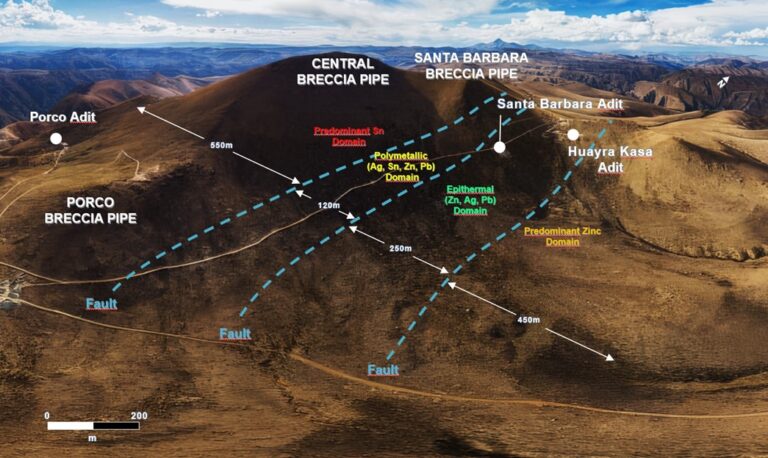
The mineralized system at Iska Iska is zoned from west to east into four principal domains (Figure 1):
Predominant Tin (Sn) domain is mainly developed in the western portion of the system and comprises both shallow and deeper mineralization.
The Polymetallic (Ag, Sn, Zn, Pb) domain is located mostly upwards within the central and western sectors of the deposit, with localized extensions of the mineralization toward the east, southeast, and northwest.
The Epithermal (Zn, Ag, Pb) domain is located between the Polymetallic and Predominant zinc (Zn) domains, and
The Predominant Zinc (Zn) domain is primarily distributed within the eastern to southeastern sectors of the deposit.
Figure 1: Panoramic view of the Iska Iska project caldera, showing the four main metal domains over a strike length of about 1.4 km
The 50m-spacing step-out drilling is focused on enlarging the Indicated Resource and to confirm the continuity of mineralization beyond its current boundaries. The targets are Ag-Sn-Polymetallic mineralization but especially mainly Ag-bearing intervals that were intercepted in previous wider spaced drilling.
Another objective of the 2026 step-out drilling program is to advance towards a planned PEA, which will allow future pit designs to include most of the current Mineral Resources outside the current pit shells.
The 2026 drilling program comprises 40,000m, from which about 85% will be assigned to the Santa Barbara mineralized area with the remaining meterage to other outside potential areas. Drilling will be conducted using a combination of 100m and 50m spacings for Inferred and Indicated Resource categories, respectively, in selected locations of the deposit.
The initial drilling phase comprising a total of 40 planned drill holes, including step-out, infill, and exploratory holes, reaching 18,250m is listed in Table 1 with collar locations shown in Figure 2. Of the planned drill holes, 22 totalling 10,500m are step-outs, primarily targeting silver-dominant mineralization strategically distributed to expand the Indicated Resource. In addition, 4 exploratory drill holes (2,250m) are planned to test for extensions in the underexplored areas surrounding the Santa Barbara mineralized zone.
Table 1 and Figure 2 detail the First phase Expansion Drill Program that includes 40 drill holes totalling 18,250m. The following Phase II drilling will comprise approximately 21,750m, which will be drilled following evaluation of the results from the Expansion Drilling – Phase I.
Table 1: Expansion Drill Program – Phase I
Hole ID
Easting
Northing
Elevation
m.a.s.l.
Planned
metres
Target
DSB-94
205157
7656097
4322
350
Polymetallic
DSB-95
205393
7656476
4186
350
Epithermal
DSB-96
205269
7656070
4285
350
Polymetallic
DSB-97
205605
7656123
4109
500
Polymetallic
DSB-98
205303
7656039
4261
350
Polymetallic
DSB-99
205747
7656193
4088
550
Polymetallic
DSB-100
205677
7656157
4091
550
Polymetallic
DSB-101
205359
7655980
4214
550
Polymetallic
DSB-102
205676
7656051
4071
600
Polymetallic
DSB-103
205149
7656161
4344
500
Predominant Sn
DSB-104
205782
7656017
4045
550
Epithermal
DSB-105
205216
7656193
4319
500
Polymetallic
DSB-106
205748
7655945
4048
550
Polymetallic
DSB-107
205251
7656268
4293
400
Polymetallic
DSB-108
205676
7655981
4057
500
Polymetallic
DSB-109
205291
7656233
4274
450
Polymetallic
DSB-110
205623
7656033
4084
200
Polymetallic
DSB-111
205305
7656351
4254
450
Polymetallic
DHK-32
205987
7656434
4120
500
Epithermal
DSB-112
205305
7656422
4229
350
Epithermal
DSB-113
205569
7656229
4138
600
Epithermal
DSB-114
205416
7656210
4205
550
Polymetallic
DSB-115
205428
7656016
4185
350
Polymetallic
DSB-116
205517
7656316
4171
450
Epithermal
DSB-117
205553
7656136
4133
550
Polymetallic
DSB-118
205535
7656087
4136
500
Polymetallic
DSB-119
205341
7656458
4206
350
Epithermal
DSB-120
205217
7655909
4250
450
Epithermal
DSB-121
205393
7656406
4207
500
Polymetallic
DSB-122
205218
7656264
4310
650
Predominant Sn
DSB-123
205146
7656263
4336
600
Predominant Sn
DSB-124
205262
7656133
4292
500
Polymetallic
DSB-125
205042
7655945
4333
400
Polymetallic
DSB-126
204933
7656228
4329
650
Predominant Sn
DSB-127
205296
7656100
4266
450
Polymetallic
DSB-128
205340
7656069
4242
150
Polymetallic
DSB-129
205570
7656016
4112
500
Polymetallic
DSB-130
205606
7656086
4102
500
Polymetallic
DSB-131
205288
7656122
4272
100
Polymetallic
DSB-132
205323
7656016
4243
350
Polymetallic
TOTAL
18,250
Note. All holes azimuths are 225 degrees and their inclinations vary from 50 to 85 degrees.
Figure 2: Location of the main planned drill holes at Iska Iska compared to the Ag-dominant domain.
Table 2: Summary of Indicated and Inferred Mineral Resources in Optimized Pit (April 2026)
Classification
Tonnes
Ag
Ag
Ag
Zn
Zn
Pb
Pb
Sn
Sn
Au
Au
Millions
g/t
Eq.
g/t
Moz
%
Mt
%
Mt
%
Mt
g/t
Moz
Indicated
85.17
78.38
40
109.53
1.21
1.03
0.71
0.60
N/A
N/A
N/A
N/A
Inferred
945.43
22.04
8.5
248.60
0.47
4.72
0.16
1.50
0.03
0.29
0.04
1.21
Source: Eloro Press Release dated April 22, 2026.
INDICATED RESOURCES – A CLEAR PATH TO A PLANNED PEA
A compelling feature of the Iska Iska Updated MRE is the distribution of the resources relative to the optimized pit shell. 284 million tonnes are spatially contained within the current pit limits, including 85.2 million tonnes of Indicated Resources, grading 78.4 g/t silver equivalent. 181 million tonnes of Inferred Resources are sitting alongside and beneath the existing Indicated resource in the same geological envelope. This is not peripheral or marginal mineralization, but it sits in the economic boundary already defined by independent pit optimization, located with the higher-grade Indicated blocks within the Santa Barbara zone (Figure 3).
Figure 3: Isometric 3D view of the Iska Iska Ultimate Pit and 83.2 Mt of Indicated Resources.
The proximity of this Inferred tonnage to the existing Indicated Resource blocks, within the same optimized pit shell and sharing the same structural controls, signifies it is uniquely amenable to conversion with targeted drilling. The 2026 expansion drilling program is precisely designed to close the drill spacing required to reclassify these tonnes. Successful drilling could potentially lift the total Indicated Resource, a step-change that would materially transform the project´s PEA economics.
Figure 4: Iska Iska Section view looking North showing Oxides, Transitional and Sulphides zones.
Table 3 sets out the resource tonnage and grade contained within the optimized pit limits, separated by resource classification and by Weathering Zones: Oxides, Transitional and Sulphides, reflecting the vertical zonation of the Santa Barbara mineralized system.
Table 3: Mineral Resources Within the Optimized Pit Limits, and by Classification and Weathering Zones (Lithology), at the Iska Iska Project (April 2026 MRE)
Qualified Person
Dr. Osvaldo Arce, P.Geo. Executive Vice President, Latin America for Eloro and General Manager of Eloro’s Bolivian subsidiary, Minera Tupiza S.R.L, and a Qualified Person (“QP”) as defined by National Instrument (“NI”) 43-101 has reviewed and approved the technical content of this news release. Dr. Arce who has more than 35 years of mineral exploration and extensive mining expertise across several countries in North and South America manages the overall technical program and supervises all field work conducted at Iska Iska.
Eloro utilized both ALS and AHK for drill core analyses, both of whom are major international accredited laboratories. Drill samples sent to ALS were prepared in both ALS Bolivia Ltda’s preparation facility in Oruro, Bolivia and the preparation facility operated by AHK in Tupiza with pulps sent to the main ALS Global laboratory in Lima for analysis. Drill core samples sent to AHK Laboratories are also prepared by AHK in Tupiza with pulps sent to the AHK laboratory in Lima, Peru.
Silver (Ag), zinc (Zn) and lead (Pb) are analyzed by Inductively Coupled Plasma Atomic Emission Spectroscopy (ICP-AES) using a four-acid digestion; Sn is analyzed by X-Ray Fluorescence (XRF) and Au is analyzed by fire assay on 50g pulps with an Atomic Absorption Spectroscopy (AAS) finish. AAS measures absorbed light to quantify elements, while ICP, such as ICP-OES or ICP-MS, measure emitted light or ions to determine elements. XRF uses fluorescent X-rays to excite atoms and to emit X-rays that reveal the presence and concentration of tin. Sample size in ICP typically ranges from 100 mg (0.1 g) to 1 g, for AAS, is usually less than 100 mg (0.1 g) and for XRF is ideally below 75 µm.
Check samples between ALS and AHK are regularly done as a QA/QC check. AHK is following the same analytical protocols used as with ALS and with the same QA/QC protocols except for Sn for which a sodium peroxide fusion is used at AHK following by ICP. Check comparisons of Sn results from ALS and ALS indicate no statistically significant difference between results using the two different analytical techniques.
Eloro employs an industry standard QA/QC program with standards, blanks and duplicates inserted into each batch of samples analyzed at both laboratories with selected check samples sent to a separate accredited laboratory. Check results are regularly monitored.
About Iska Iska
The Iska Iska silver-tin polymetallic project is a road accessible, royalty-free property, wholly controlled by Eloro Resources Ltd. and is located 48 km north of Tupiza city, in the Sud Chichas Province of the Department of Potosi in southern Bolivia. Eloro has an option to earn a 100% interest in Iska Iska.
Iska Iska is a major silver-tin polymetallic porphyry-epithermal complex associated with a Miocene collapsed/resurgent caldera, emplaced on Ordovician age rocks with major breccia pipes, dacitic domes and hydrothermal breccias. The caldera is 1.6 km by 1.8 km in dimension with a vertical extent of at least 1km. Mineralization age is similar to Cerro Rico de Potosí and other major deposits such as San Vicente, Chorolque, Tasna and Tatasi, all located along the same overall geological trend.
Eloro began underground diamond drilling from the Huayra Kasa underground workings at Iska Iska on September 13, 2020. On January 26, 2021, Eloro announced significant results from the first drilling at the Santa Barbara Breccia Pipe (SBBP) including the discovery hole DHK-15 which returned 29.53g Ag/t, 0.078g Au/t, 1.45%Zn, 0.59%Pb, 0.080%Cu and 0.056%Sn over 257.5m, from surface. Subsequent drilling has confirmed the presence of significant values of Ag-Sn polymetallic mineralization in the SBBP and the adjacent Central Breccia Pipe (CBP). A substantive mineralized envelope which is open along strike and down-dip extends around both major breccia pipes. Continuous channel sampling along the walls of the Santa Barbara Adit located to the east of SBBP returned average grades of 164.96 g Ag/t, 0.46%Sn, 3.46% Pb and 0.14% Cu over 166m including 446 g Ag/t, 9.03% Pb and 1.16% Sn over 56.19m. The west end of the adit intersects the end of the SBBP.
Since the initial discovery hole Eloro has released a number of significant drill results in the SBBP and the surrounding mineralized envelope which, along with geophysical data, has defined an extensive target zone. On October 17, 2023, Eloro filed the NI 43-101 Technical Report outlining the initial inferred MRE for Iska Iska, prepared by independent consultants Micon International Limited. The MRE was reported in two domains, the Polymetallic (Ag-Zn-Pb) Domain which is primarily in the east and south of the Santa Barbara deposit and the Tin (Sn-Ag-Pb) Domain which is primarily in the west and north.
Metallurgical tests reported on January 23, 2024, from a 6.3 tonne PQ drill core bulk sample representative of the higher grade Polymetallic (Ag-Zn-Pb) Domain returned a significantly higher average silver value of 91 g Ag/t compared to the weighted average grade of the original twinned holes at 31 g Ag/t strongly suggesting that the average silver grade was likely significantly underreported in the original twinned holes due to the much smaller sample size.
The Company reported on July 30, 2024, that updated modelling of the potential starter pit area at Santa Barbara zone highlights the importance of completing additional drilling to better define the grade and extent of the mineral resource in this area. Areas with higher-grade resource typically have much better drilling density but holes outside the core potential pit area are too widely spaced to give an accurate estimate of grade.
On September 4, 2024, the Company announced the restart of definition drilling in the potential starter pit area at Santa Barbara. It was highly focused on infill and step-out drill program in order to better define the full vertical and lateral extent of high-grade Sn and Ag mineralization, expanding higher-grade Sn mineralization to the west and the silver to the central and west parts. Also, to fill-in gaps that were formerly categorized as low-grade or internal waste in the mineral resource model and to drill in a closer-spacing 50m x 50m grid. Previous drilling has shown that areas with high-grade mineralization typically have much better drilling density, whereas holes outside the core area are too widely spaced to give an accurate grade estimate. This increased drilling density is particularly important for defining the extent of the high-grade Ag-bearing and Sn-bearing structures, and for categorizing the mineral resources from inferred to indicated, which have a major influence on overall grade and resources that will contribute to the PEA.
Since September 4, 2024, the Company has completed 27 drill holes totalling 14,085.80 metres of definition drilling in 2 distinct phases of diamond drilling in the potential starter pit area of the Santa Barbara Zone. This drilling has continued to intersect strong, broad zones and high-grade mineralization with good continuity in both the predominant Sn-Ag domain to the west (15 drill holes) and in the predominant Ag-Zn-Polymetallic domain to the east (12 drill holes). Both zones remain open along and across strike as well as downdip.
The intercepts of 151.47 g Ag/t over 135m found in hole DSB-75; 66.90g Ag/t over 289.13m in hole DSB-68; 126.10g Ag/t over 122.03m, 127.49g Ag/t over 41.25m and 49.71g Ag/t over 142.50m found in hole DSB-69; and 45.71g Ag/t over 81.00m and 30.08g Ag/t over 255.75m found in hole DSB-70 confirm the presence of continued silver pockets grading over 50 g Ag/t. Moreover, tin enriched pockets such as 1.39% Sn over 33m, 0.74% Sn over 87m found in hole DSB-72 and 0.55% Sn over 49.5m, 0.34% Sn over 91.5m, 0.31% Sn over 103.5m in hole DSB-74 demonstrate the existence of consistent high grade tin pockets at the Santa Barbara zone. And finally, the presence of intercepts such as 1.41% Zn over 151.50m in hole DSB-91, 1.77% Zn over 238.50m and 1.72% Zn over 456m found in hole DSB-88 reveal continuous Zn (and Pb) ore shoots in the property. These results have further expanded, at least 200m laterally, the higher-grade tin and silver and polymetallic (Ag-Sn-Zn-Pb) mineralization and the footprint of this large multi-phase hydrothermal system at Iska Iska.
About Eloro Resources Ltd.
Eloro is an exploration and mine development company with a portfolio of precious and base-metal properties in Bolivia, Peru and Quebec. Eloro, through its Bolivian subsidiary, Minera Tupiza SRL, has a 99% joint venture interest and a 100% economic participation interest in the highly prospective Iska Iska Property, which can be classified as a polymetallic epithermal-porphyry complex, a significant mineral deposit type in the Potosi Department, in southern Bolivia. A NI 43-101 Technical Report on Iska Iska, which was completed by Micon International Limited, is available on Eloro’s website and under its filings on SEDAR+. Iska Iska is a road-accessible, royalty-free property. Eloro also owns an 82% interest in the La Victoria Gold/Silver Project, located in the North-Central Mineral Belt of Peru some 50 km south of the Lagunas Norte Gold Mine and the La Arena Gold Mine.
For further information please contact either Thomas G. Larsen, Chairman and CEO or Jorge Estepa, Vice-President at (416) 868-9168.
Information in this news release may contain forward-looking information. Statements containing forward-looking information express, as at the date of this news release, the Company’s plans, estimates, forecasts, projections, expectations, or beliefs as to future events or results and are believed to be reasonable based on information currently available to the Company. There can be no assurance that forward-looking statements will prove to be accurate. Actual results and future events could differ materially from those anticipated in such statements. Readers should not place undue reliance on forward-looking information.
Viral decor from retailers like HomeGoods can help a listing stand out—but agents say bold pieces should make up no more than 10% of a home’s overall design.
Natural materials, layered textures, and just one or two statement accents can add personality to a space without overwhelming buyers.
Scrolling through viral HomeGoods hauls is a digital treasure hunt of sorts—filled with whimsical wall art, textured ceramics, and unexpected statement pieces. And while these playful finds are winning attention online, Redfin agents say they can also help homeowners win when it comes time to sell—if used thoughtfully.
According to a HomeGoods spokesperson, the sense of discovery driving these viral moments is no accident. The retailer sources its famously varied decor items on an always-on basis, sending buyers to dozens of countries each year to find everything from designer goods to artisan pieces.
Photo credit: HomeGoods
New inventory arrives multiple times a week to the average store, which HomeGoods says fuels a “never shop the same” experience for customers—and explains why trending items like cottagecore accents and porch ducks keep popping up across social media.
But for those looking to sell their home, an abundance of unique decor presents both an opportunity and a risk.
A Little Quirky Goes a Long Way
“Quirky decor can make a home feel current—but it has to be intentional and universally appealing,” says Denver-based Redfin senior agent and interior designer Tamara Mattox-Kabat.
Her rule of thumb is simple: bold or unconventional pieces should make up no more than 10% of a home’s overall décor. Instead of dominating a space, these pieces should act as subtle accents that add personality without overwhelming potential buyers.
Material choice plays a major role in striking that balance. Mattox-Kabat recommends prioritizing natural, high-quality finishes—like metal, stone, wood, and ceramic—over plastic or synthetic alternatives because they photograph well and can instantly elevate a space. “Chinoiserie pieces that can be filled with fresh fruit or flowers are a great option to this end,” she says.
Photo credit: HomeGoods
Layering is another key strategy; thoughtfully combining textures can make a space feel curated rather than cluttered, according to Mattox-Kabat. She also suggests incorporating a few vintage or antique elements, such as brass candlesticks or vases—which can be found in droves at most HomeGoods stores—to convey a sense of warmth and livability.
At the same time, Mattox-Kabat cautions against overusing seasonal decor or artificial plants, which can detract from a home’s perceived value. And the importance of this kind of restraint is something fellow Redfin agent Kellie Martinez learned firsthand.
When “More” Starts to Hurt Your Sale
After “HomeGoods-ing the heck out” of her new build home, the Southern California-based premier agent was confident she had created a standout space. “It looked amazing—layered, styled, full of personality,” Martinez says. Plus, reactions from friends and neighbors seemed to confirm it; they all asked her where they could find lots of her pieces.
But once she decided to sell and her home hit the market, buyer feedback told a different story. “‘Beautiful, but a little busy,’ was the most common response,” she says.
Photo credit: HomeGoods
That moment prompted her to scale things back. As she removed items, Martinez noticed an immediate shift: “A plain wall can suddenly feel calmer, bigger, and more inviting, she explained.
The experience reshaped her entire approach to staging, which she now describes as “broadly appealing with a wink.”
The Sweet Spot
In practice, that means sticking to clean, neutral foundations—think soft color palettes and organic textures like wood and linen—while incorporating just one or two standout pieces for personality. A single sculptural object or eye-catching accent can create a memorable focal point, especially in listing photos where buyers are scrolling. But filling a home with too many conversation starters can distract from what really matters: the space itself.
Ultimately, the viral appeal of HomeGoods-style shopping highlights a broader shift toward individuality in home design. By editing thoughtfully and styling with intention, sellers can tap into this trend while keeping their home widely appealing—and that balance can make all the difference when it comes to maximizing sale price.