At the recent Brandcast 2026 event, YouTube unveiled a suite of innovative tools aimed at enhancing how brands connect with their audiences. For small business owners, these new features present a unique opportunity to elevate marketing strategies and boost sales effectiveness in today’s digital landscape.
One significant introduction is Custom Sponsorships, which leverage artificial intelligence to align video content with a brand’s specific marketing goals. This means that small businesses can now get their products featured in videos that resonate with their target audiences. As AI dynamically surfaces videos tailored to a brand’s desired moment, it opens the door for niche businesses to reach their desired demographic more efficiently. “With these advancements, even small brands can effectively compete by utilizing hyper-targeted ad spaces,” said a YouTube representative.
Another exciting feature is the Masthead with Custom Content Shelf. This enhancement allows brands to not only showcase their primary advertisement but also curate additional relevant content alongside it. For small businesses, this means they can tell a more comprehensive story or provide more context around their products, potentially increasing viewer engagement and interest.
YouTube is also changing the way purchases are made with the introduction of Buy with Google Pay. This feature allows users to complete transactions directly on their TV screens using just two clicks. For small business owners selling products via YouTube, this creates a seamless shopping experience that could significantly enhance conversion rates, especially considering the growing trend of e-commerce on smart TVs.
In a strategic move that supports content creators and brands alike, YouTube has launched an Affiliate Partnerships Boost initiative. This feature enables brands to amplify organic content where their products are already mentioned or tagged. This win-win approach not only helps businesses gain more visibility but also ensures that creators can earn through YouTube Shopping affiliate links. “Collaborative efforts like this empower both brands and creators, fostering a more engaged community,” said a senior YouTube executive.
The advent of Multimodal Video Creation is another game-changer. By deploying Google’s advanced AI models, including Gemini, Nano Banana, and Veo, businesses can move from creative brief to final video production with just a few prompts. This democratizes video production, making it accessible to small business owners who may lack extensive resources or technical skills. The ability to quickly generate high-quality content can significantly reduce both time and costs associated with video marketing.
Moreover, the addition of major players like Costco and Dollar General into Google’s Commerce Media Suite gives small business owners access to rich first-party data. This can inform marketing strategies and reach high-intent shoppers effectively. “Utilizing first-party data from trusted sources can help small businesses optimize their advertising efforts,” emphasized a YouTube spokesperson.
While these new tools present numerous advantages, there are challenges to consider as well. Small business owners might face a learning curve as they adapt to these new technologies. Those unfamiliar with AI-driven tools or the nuances of affiliate partnerships may require additional training or support to leverage these features effectively.
Additionally, small businesses must ensure they maintain brand integrity while engaging in dynamic content curation and partnerships. Balancing creativity and strategic insights is essential to create compelling, authentic messages that resonate with audiences.
In summary, YouTube’s latest offerings at Brandcast 2026 present compelling opportunities for small businesses looking to enhance their marketing strategies and engage with audiences. By utilizing AI-driven custom features and innovative partnerships, small business owners can not only streamline their video marketing efforts but also boost their sales potential. As this landscape evolves, staying informed and adaptable will be crucial for those wishing to thrive. For more details, visit the original announcement at YouTube Blog.
In my first tech company, I stayed too deep in execution for too long — still closing deals, managing sales and operating in the weeds even as the business scaled — until I realized the very habits that built early success were the same ones limiting its long-term growth… Read More
Brett Sutherlin
Earlier this week, Puck News reported that after clashes with actors and producers on set, Tom Hardy was fired from the huge hit series MobLand on Paramount Plus, a show that he leads, for alleged misdeeds like being late to set or feuding with those on set.
Now, Variety is reporting that Hardy has not been fired from MobLand, and that negotiations are ongoing in terms of how to keep him around. Past that, in the wake of these dueling reports, a costar he’s meant to be feuding with just posted a message in support of the actor. Co-star Helen Mirren posted a photo of Hardy with the caption “Love you now and always, Helen.”
The goal for Paramount and producer Guy Ritchie, especially, is to make all this work without needing to write out or recast Hardy’s lead character for season 3, since season 2 was already filmed when these controversies broke. MobLand is one of Paramount’s biggest hits ever, breaking its global series launch record with 26 million viewers in its first season. Season 2, with Hardy on board, could retain or surpass that, but they wouldn’t want the show to be harmed by his absence in season 3.
Neither option would be tenable. Losing Hardy’s Harry Da Souza would overturn the whole series in a number of ways, and shows that thrive when their leads depart are few and far between (a recent example of this was Yellowstone after Kevin Costner left). In contrast, recasting a lead doesn’t go much better, and Hardy is certainly a tough presence to replicate. So securing him for another season of MobLand, possibly more than one if Paramount wants to keep its megahit running indefinitely, is essential. Though with movie stars not normally used to TV schedules and lengths, that could prove difficult regardless of any controversies.
MobLand
Paramount
In Hollywood, there are often PR wars fought behind the scenes, using sources to contact various insider outlets to make their case known. In this case, reporting that someone was actually fired from a show, only to have that refuted is unusual. But where we are now, from this new report to Mirren’s recent comments, suggests positive motion. Things do not appear like they’re going to escalate into Blake Lively/Justin Baldoni PR war territory, a scorched earth campaign over a lawsuit that arguably did significant harm to both, resulting in a settlement where both claimed victory.
The MobLand saga certainly doesn’t seem resolved if they’re still working through it, but season 2 is in the can and is supposedly launching sometime in the fall of 2026. This comes amid Paramount’s attempt to buy Warner Bros. and its streaming services, like HBO Max, where MobLand could become a powerful series across two brands that are destined to merge someday.
So, we’ll see if the star can rein it in and come to some understanding with his producers, but it may take a while yet.
Bitcoin miners spent years racing to secure cheap electricity, and that electricity has since become more valuable than the Bitcoin mining business built on it.
That inversion drives Fidelity’s May 2026 assessment that AI hosting could give miners a second revenue stream while flattening Bitcoin’s hash rate as major operators redirect energy infrastructure away from pure mining, and two hyperscaler contracts have put a concrete price on what miners built.
Cipher Mining’s SEC-filed business update announced a roughly $5.5 billion, 15-year lease with AWS to provide 300 MW of turnkey space and power for AI workloads, with delivery beginning in July 2026.
IREN signed a roughly $9.7 billion, five-year GPU cloud contract with Microsoft, deploying NVIDIA GB300 GPUs through 2026 at its 750 MW Childress, Texas campus and supporting 200 MW of critical IT load.
Miner
Hyperscaler
Contract value
Duration
Power / capacity
Delivery timeline
Why it matters
Cipher Mining
AWS
~$5.5B
15 years
300 MW
Begins July 2026
Shows powered mining sites can be leased as AI infrastructure
IREN
Microsoft
~$9.7B
5 years
200 MW critical IT load at 750 MW Childress campus
GPUs deployed through 2026
Shows miners can monetize power campuses through GPU cloud, not just BTC mining
Miners had already secured land, grid interconnection, substations, and power rights, which are what AI data centers need and cannot build fast enough.
The 2024 halving compressed hash prices and pushed CoinShares’ tracked weighted-average cash cost to roughly $79,995 per BTC by the first quarter of 2026, prodding operators toward AI hosting as a revenue stabilizer, leasing unused capacity, keeping the mining rigs running, and offsetting the worst of the Bitcoin downturns.
CoinShares estimates public miners’ AI and HPC contracts had surpassed $70 billion in aggregate by early 2026, with listed miners on pace to derive as much as 70% of revenue from AI by year-end, up from roughly 30%.
That is a revenue hedge that the Cipher and IREN contracts have since displaced with price discovery for power campuses.
Price discovery changes the internal math
Fidelity’s January 2026 analysis identified a mining-to-AI crossover at roughly $60 to $70 per petahash per day for a 20-joule-per-terahash fleet, meaning most 20-to-25 J/TH miners would need the hash price to rise 40% to 60% to match contracted GPU-hosting economics.
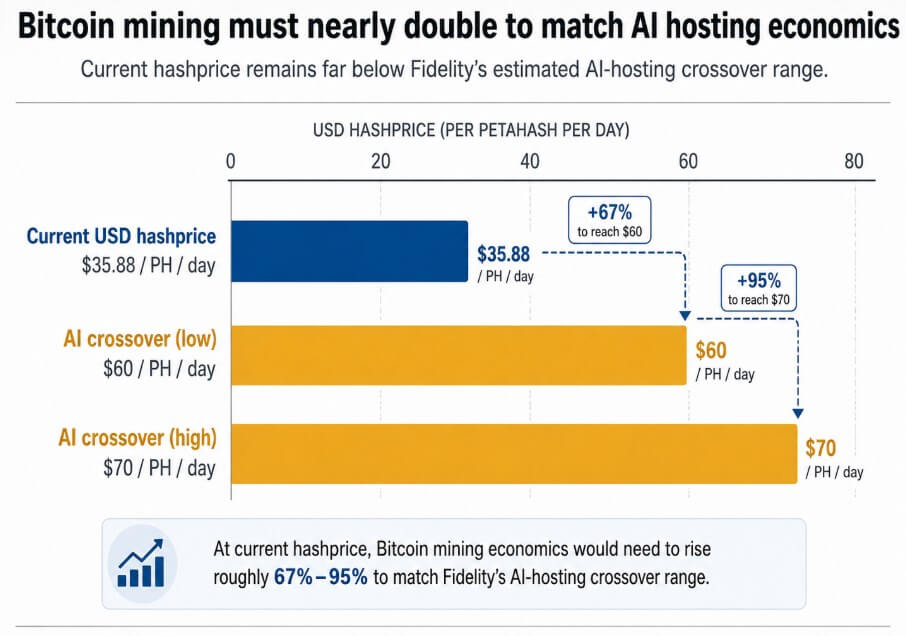
The Hashrate Index’s May 25 data has since extended this distance, with the US dollar-denominated hash price at $35.88 per PH/day, placing the AI crossover at approximately 67% to 95% above the current spot.
A miner sitting on 300 MW of powered, permitted infrastructure now faces a choice between deploying ASICs and earning $35.88 per PH/day, or signing a hyperscaler lease at contracted rates that require hash price to nearly double to match.
AWS and Microsoft have effectively published a floor on what that infrastructure is worth to someone other than Bitcoin, and every major operator with comparable assets now has that number in their model.
AI infrastructure costs between $8 million and $15 million per megawatt to build, compared to $700,000 to $1 million for Bitcoin mining infrastructure, and miners who transition enter a more capital-intensive business with fundamentally different debt profiles, valuation metrics, and execution risk.
At $35.88 per petahash per day, Bitcoin’s current hashprice sits 67% to 95% below Fidelity’s estimated AI-hosting crossover range of $60 to $70.
Hash rate may no longer follow BTC price alone
Bitcoin’s mining expansion historically followed price, with miners ordering more machines when BTC rose and cutting capacity when it fell.
VanEck’s April ChainCheck recorded 30-day hash rate momentum at the 16th percentile and 90-day momentum at the 9th percentile, the densest cluster of sustained hash-rate drawdowns since China’s 2021 mining ban.
CoinWarz data as of May 28 showed Bitcoin difficulty at 136.61T and a 90-day difficulty change of -5.40%, consistent with Fidelity’s picture of mining churn.
Bitcoin’s 2,016-block difficulty adjustment is still the counterweight, since every time hash rate exits, it lowers the computational cost of producing valid blocks and raises revenue per unit of remaining hash once difficulty resets.
A 20% hash-rate exit would lift surviving miners’ hash price to roughly $44.85 per PH/day, while a 30% exit would bring it to roughly $51.26, still well short of Fidelity’s AI crossover unless BTC price or transaction fees rise meaningfully.
Power locked into 15-year AWS leases or five-year Microsoft GPU contracts cannot rotate back to mining even if ASIC economics recover. In older cycles, idle hash returned because machines could be switched back on, while in this cycle the campuses themselves may be committed elsewhere.
Bitcoin gets the tighter market it needs
If BTC moves toward $100,000 to $140,000 or transaction fees rise materially, the economics realign. A 20% reduction in network hash rate lowers the BTC price required to reach the $60 to $70 AI crossover to approximately $98,000 to $114,000, and a 30% reduction lowers that threshold to roughly $86,000 to $100,000.
CryptoSlate Daily Brief
Daily signals, zero noise.
Market-moving headlines and context delivered every morning in one tight read.
5-minute digest 100k+ readers
Free. No spam. Unsubscribe any time.
You’re subscribed. Welcome aboard.
Miners who are still committed to Bitcoin benefit from a market where hash price rises faster than hash rate, compressing the competitive field and improving margins for operators with efficient fleets and lower power costs.
Fewer large public miners in the hash rate mix also reduces the forced BTC selling that has historically pressured spot price during expansion cycles.
Charles Schwab’s May 26 analysis argues that hybrid infrastructure models strengthen Bitcoin’s overall network health: lower forced selling, tighter difficulty conditions, and better miner margins reduce the systemic stress that large capital-intensive miners have historically introduced at cycle peaks.
The industry separates into two distinct businesses, consisting of companies that own power campuses and monetize them through hyperscaler contracts, and companies that actually mine Bitcoin, often at lower-cost, more flexible, or stranded-energy sites where AI data centers cannot easily operate.
Scenario
Hash-rate exit
Implied hashprice after difficulty reset
BTC price needed for $60/PH/day
BTC price needed for $70/PH/day
Takeaway
Status quo
0%
$35.88
~$122K
~$142K
Mining remains far below AI crossover
Moderate exit
20%
~$44.85
~$98K
~$114K
Difficulty reset helps miners but does not fully close the gap
Larger exit
30%
~$51.26
~$86K
~$100K
Bitcoin mining becomes more competitive if BTC rises or fees improve
AI wins the allocation decision
If BTC holds below $70,000 to $80,000, fees stay thin, and power prices stay elevated, contracted GPU-hosting economics dominate internal capital allocation for operators with AI-ready sites.
CoinShares estimates that at roughly $30 per PH/day, between 15% and 20% of the global fleet becomes uneconomic if power costs $0.06 per kilowatt-hour or higher for machines with S19 XP efficiency or lower.
Older fleets shut down, difficulty declines across successive epochs, and surviving miners earn more per petahash, but not enough to close the gap with the Cipher and IREN contracts for operators who still have that choice.
The difficulty adjustment keeps the network running through any exit, and mining’s center of gravity moves as large public miners with AI-ready infrastructure become data-center landlords, while Bitcoin hash rate concentrates among operators with cheaper, more intermittent, or internationally diversified energy.
The IREN/Microsoft contract carries an explicit delivery-timeline clause that Reuters reported could trigger termination if milestones are missed, and miners carrying heavy debt alongside delayed AI revenue face an equity repricing from a Bitcoin proxy to an execution-risk asset.
The split is the outcome
The contest between ASICs and GPUs for miner capital plays out site by site, operator by operator, contingent on power contracts already signed and BTC price at the next halving.
Bitcoin’s network absorbs hash-rate exits through lower difficulty, and higher BTC price or fees can pull economics back toward mining for any operator who has not already committed power elsewhere.
The more durable consequence of the AWS and Microsoft deals is that they have made it possible to run a large, credibly profitable infrastructure business on the same sites that Bitcoin mining built, without mining a single block.
Whether that possibility becomes the default for the next generation of power-campus construction depends on where BTC price settles relative to $35.88, and how many more hyperscalers arrive with 15-year checkbooks before the next halving forces the question again.
Senate Banking cleared the CLARITY Act 15-9 on May 14, and within two weeks, President Donald Trump posted on Truth Social pledging to codify a “future-proof” digital asset market that haters could not undo, calling the US the “crypto capital of the world.”
Crypto allies are using the timing to press the argument that a friendly regulatory posture lasts only as long as the regulator who holds it, and statute demands a congressional act to overturn.
SEC Chair Paul Atkins amplified the same line on X, writing that the agency’s prior hostility to digital asset innovation is over and that the administration, Congress, and regulators are delivering clarity to digital asset markets, a framing that positions the agency as the handoff and Congress as the closer.
Treasury Secretary Scott Bessent urged the Senate to act fast, warning that floor time is precious, while Senator Cynthia Lummis called the moment the “last chance” to pass CLARITY until at least 2030, with midterm elections framing the outer boundary.
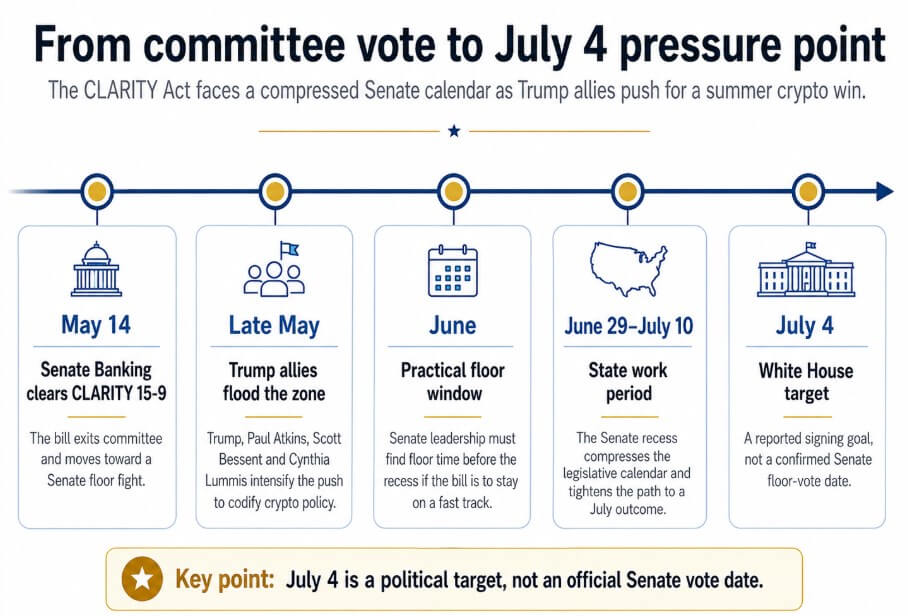
A five-stage timeline tracks the CLARITY Act’s path from its May 14 Senate Banking clearance to the White House’s reported July 4 signing target.
The legislation would divide digital asset oversight between the SEC and CFTC, expand CFTC supervision of crypto spot markets, define when tokens qualify as securities or commodities, require registration and disclosure from covered firms, protect customer funds, and apply Bank Secrecy Act obligations to digital asset businesses, converting years of agency interpretation fights and litigation into a single statutory framework.
The Senate calendar carries no confirmed floor date for CLARITY, but the White House is reportedly pushing it toward a showdown as it targets a July 4 signing.
Before a signing, Senate leaders must reconcile the Banking product with the Senate Agriculture Committee’s separate digital commodities track, pass a merged bill through the full chamber, and align with the House version.
The floor math
Republicans hold 53 Senate seats, and cloture requires 60 votes, meaning the bill needs 7 Democratic or independent votes if every Republican backs it, a threshold the committee reached only two votes toward, from Ruben Gallego and Angela Alsobrooks.
Both Senators may withhold floor support unless the Senate addresses three specific objections: anti-money-laundering provisions that Democratic minority staff say leave illicit-finance loopholes around sanctions and mixers, demands to bar political officials from profiting on crypto ventures they help shape, and stablecoin reward language that banking groups warn could pull deposits from community lenders.
Banking trade associations have positioned themselves as conditional supporters, backing a federal framework in principle but pressing for tighter guardrails on stablecoin rewards, arguing that stablecoin issuers with reward programs would compete directly with traditional deposit accounts and reduce local lending capacity.
That wedge between mainstream finance and crypto-native industry groups gives Senate Democratic holdouts a conventional-finance rationale for demanding revisions, separate from the AML and ethics objections.
Senate math
Votes
Republican seats
53
Votes needed for cloture
60
Democratic/independent votes needed if GOP holds
7
Democratic yes votes in committee
2
Additional Democratic/independent votes still needed
5
The reported July 4 target rests on Senate leadership holding the floor calendar through June, and a state work period runs from June 29 to July 10, cutting practical floor time to the weeks before the recess begins.
If leadership does not bring CLARITY to the floor by roughly the third week of June, the July 4 signing target becomes logistically untenable, and any remaining action would need to fit between the end of the recess and the start of the August break.
CryptoSlate Daily Brief
Daily signals, zero noise.
Market-moving headlines and context delivered every morning in one tight read.
5-minute digest 100k+ readers
Free. No spam. Unsubscribe any time.
You’re subscribed. Welcome aboard.
What seven votes decide the Clarity Act’s fate?
If Gallego and Alsobrooks hold their committee votes and compromise language secures five or more additional Democratic or independent votes, with banks accepting narrower stablecoin reward limits, CLARITY could produce the first broad federal market-structure law for digital assets in US history.
Statutory CFTC supervision of spot markets gives crypto firms a legal foundation that will survive future administrations, since overturning a statute requires an act of Congress, a higher procedural bar than a presidential appointment alone.
The Crypto Council for Innovation and the Blockchain Association have both argued that a signed bill would accelerate institutional adoption and consolidate US leadership, a claim that carries more weight once it has the force of law behind it than it does as a lobbying position.
If Democrats find AML language insufficient, Republicans reject ethics demands, and crypto-industry lobbying holds stablecoin reward fixes in place, the seven-vote threshold goes unmet, and the floor fight stalls.
Scenario
What has to happen
Result
Market / policy implication
Bull case: compromise passes
Gallego and Alsobrooks hold; 5+ more Democrats/independents accept changes; banks accept narrower stablecoin limits
CLARITY clears the Senate and moves toward Trump’s desk
Crypto gets durable statutory market structure
Base case: July slips
Negotiations continue but Senate calendar compresses floor time
Bill stays alive, but July 4 target becomes unrealistic
Industry keeps momentum but not final certainty
Bear case: floor fight stalls
AML, ethics or stablecoin-reward disputes remain unresolved
CLARITY misses the June window
Crypto relies on friendly regulators, not durable law
The industry holds the friendliest regulatory environment in a decade, built entirely on Atkins at the SEC, an accommodating CFTC, and a pro-crypto White House, positions that the next administration can vacate with new appointees and revised guidance.
Lummis’s “last chance until 2030” framing puts the specific cost on the bear case: if CLARITY misses the June window, midterm elections in 2026 could flip Senate seats and close the legislative path for the rest of the decade.
Trump’s allies ran a flood-the-zone campaign this week to generate enough public and political momentum in June that Senate Democratic holdouts face greater cost from blocking the bill than from voting yes on a compromise.
Whether that calculation produces seven or more Democratic votes before the June window closes will determine whether the administration’s pro-crypto regulatory reversal becomes law or stays a posture the next SEC chair can reverse with a memo.
Hedera coin price has jumped past $0.091 on a 10.5% daily rally with rising volume.
Enterprise news and BrandBoost adoption are boosting Hedera demand.
The $0.10428 resistance is key for confirming further upside momentum.
The latest move in Hedera (HBAR) has drawn renewed attention to its short-term technical setup after the token climbed more than 10% in 24 hours, reaching an intraday high of $0.09506.
The rally was accompanied by a sharp increase in trading activity, with volume rising to more than $345 million over the same period.
The gains have pushed HBAR above recent consolidation levels, breaking out of the relatively narrow trading range that had contained price action in recent sessions and signalling a potential shift in short-term momentum.
One of the key catalysts behind the recent rally in Hedera (HBAR) has been reports surrounding a strategic development involving the Hedera Governing Council and the Hyperledger Fabric ecosystem.
According to industry reports, the initiative involves intellectual property associated with Hyperledger Fabric, originally backed by the Linux Foundation, with plans to make it available as open-source software for broader enterprise adoption.
Market participants have interpreted the development as a potential step toward expanding the use of Hedera Hashgraph in enterprise environments, particularly among organisations already operating permissioned blockchain systems.
The prospect of connecting established enterprise frameworks with Hedera’s distributed ledger technology has been a recurring theme in recent market sentiment.
At the same time, investor attention has been boosted by speculation around a potential ETF and ongoing enterprise relationships involving companies such as Accenture and FedEx.
Together, these developments have reinforced the narrative that Hedera is increasingly positioning itself as enterprise-focused infrastructure rather than a project driven primarily by retail cryptocurrency cycles.
The platform is designed to support real-time customer engagement through gamified loyalty systems, token-based rewards, and AI-driven interaction layers.
BrandBoost is built to function on Hedera’s distributed ledger infrastructure, and it focuses on industries such as media, entertainment, telecom, and sports.
The system allows brands to issue digital rewards that can be earned and redeemed through user activity, which introduces a more interactive form of enterprise loyalty compared to traditional point-based systems.
The Hashgraph Group has also integrated additional technologies such as decentralised identity tools and wallet infrastructure to support these systems.
Reports linked to early deployments, including pilot testing with a Latin American satellite TV provider, suggest that enterprise experimentation is already underway rather than purely theoretical.
This expansion of real-world use cases has strengthened market interest in Hedera’s long-term ecosystem development, especially as it ties into consumer-facing applications rather than backend-only infrastructure.
Technical breakout adds fuel to Hedera coin price movement
Beyond fundamental catalysts, the recent move in the Hedera coin price also reflects a clear technical breakout from a multi-week bearish pattern.
HBAR price chart
Short-term support has formed around $0.08500, with another closely watched level at the 23.6 Fibonacci level retracement, $0.08744, after the January-February dip.
On the upside, the first major resistance sits at $0.09675, followed by a more significant level at $0.10428, which has repeatedly been identified as a breakout confirmation zone.
Notably, volume expansion during the breakout has been one of the key signals supporting the recent move, especially as the HBAR price pushed away from its recent range low.
Infection from the Ebola virus can lead to devastating outcomes and requires timely management.
getty
The recently declared Ebola outbreak is rapidly escalating as the virus spreads across borders. The World Health Organization has now deemed it a “Public Health Emergency of International Concern” and as of this week, there are more than 900+ suspected cases and hundreds of deaths. UNICEF has also designated the situation the highest level of emergency and has dedicated millions of dollars in emergency funding towards fighting the spread of infection.
The American Centers for Disease Control and Prevention (CDC) explains that this specific outbreak has been primarily related to the Bundibugyo strain of the broader Orthoebolavirus budibugyoense species, posing a novel challenge as there are not as many medical countermeasures available as with other strains.
Signs and symptoms of infection include fever, aches and pains, headaches, weakness, fatigue and cold like symptoms. Later complications may entail unexplained bleeding and GI symptoms, weight loss, shortness of breath and seizures. Per the CDC, the spread of Ebola virus primarily occurs when skin or mucous membranes such as in the eyes, nose or mouth come in contact with blood or fluids from another person infected with Ebola, or with objects contaminated with infected bodily fluids, or with infected animals that are common carriers for the virus, including bats, primates and antelopes. However, most scientists and virologists explain that there is still a lot left to be learned about the virus, especially about survivors of the disease and how protected they are from previous infections.
The CDC has reassured the public that as of May 18th, there are no suspected, probable or confirmed cases related to the outbreak in the United States; nevertheless, the organization has issued travel notices for individuals traveling to African nations that are facing a high prevalence of infection. Experts also explain that the fact that the virus is primarily transmitted through contact with bodily fluids is “not an especially efficient mode of transmission” unlike other airborne viruses, such as Covid-19. Therefore, they contend that the risk to places like the US are relatively lower when compared to countries directly neighboring outbreak regions: “For the average American, the risk of exposure from travelers coming from African countries where Ebola is present is ‘extremely low’ at this time but not totally inexistent, making it more of a “theoretical risk’…Just be alert, think about where you are, and, if you see someone who’s ill…exercise extra caution.”
Travelers and those that have been around potential sick contacts should nevertheless exercise excess caution and keep a low threshold to seek medical care. The incubation period (the time between exposure and symptom onset) can be anywhere from a few days to a few weeks, meaning that individuals may not always be aware that they have been infected. Therefore, it is important to keep a high level of vigilance, especially if there is risk of being near someone that has been infected or traveling to places where spread or transmission rates may be high. Finally, individuals should not hesitate to seek professional medical help if they have any concerns. Given just how devastating the disease can be, an abundance of caution is undoubtedly justified.
Autodesk has introduced a new division for small business users after research showed a large number of AEC professionals either having started or starting small businesses.
Earlier this month Autodesk launched Autodesk for Small Business, which will focus on entrepreneurs and small firms.
More than one-third of the workforce now operates as freelancers or contractors, and nearly one in five professionals are considering starting their own business this year, according to research Autodesk did on its own user base.
Autodesk and partner GlobalData surveyed 1,881 U.S.-based professionals and small business owners across architecture, engineering, construction, product design, manufacturing, media and entertainment to assess sentiment, challenges and opportunities for the survey.
In its “State of Small Business” report, the software giant found that 18% designs and makers say they’re considering starting their own business in 2026, 6% higher than the broader small business economy, and more than three times the share who actually did so in 2025. It also found the fastest-growing corner of small business are solo and micro designers and makers, a segment that grew nearly 10% in 2025—almost 35% faster than the rest of the small business economy.
Yet the study also found that teams are doing high-impact work with limited time, resources, and support. Eighty percent say they struggle to balance running their business with doing the actual work.
To better serve small businesses, Autodesk’s launched a small business hub with resources for small businesses, including discounted versions of AutoCAD and Fusion.
This change will be Autodesk’s first in shifting how it works with small enterprises. For small businesses in the AEC markets, Autodesk is offering a bundle of AutoCAD, Revit, Civil 3D and Forma Site Design in a single package at a discounted subscription rate.
Looking for quick answers on construction and engineering topics? Try Ask ENR, our new smart AI search tool.
Ask ENR→
ENR Associate Technology, Equipment and Products Editor Jeff Yoders has been writing about design and construction innovations for 20 years. He is a five-time Jesse H. Neal award winner and multiple ASBPE winner for his tech coverage. Jeff previously wrote about construction technology for Structural Engineer, CE News and Building Design + Construction. He also wrote about materials prices, construction procurement and estimation for MetalMiner.com. He lives in Chicago, the birthplace of the skyscraper, where the pace of innovation never leaves him without a story to chase.
Caesars Entertainment accepted the offer to be acquired by the Fertitta Entertainment. The overall deal will be of $17.6bn with Fertitta paying $5.7 billion and take on close to $12 billion in debt from Caesars. As part of the agreement, Caesars can seek competing bids through July 11.
Investors in Caesars are being offered $31 per share, which is a premium of 49% above what Caesars shares were trading at before the news of a possible merger broke in February. Since news of a merger was first announced, Caesars shares have already increased 15% and were up almost 2% in pre-market trading on Thursday.
Caesars has been under pressure due to fewer visitors to Las Vegas impacting revenues from casinos, hotels, and resorts. Additionally, Caesars’ online gaming business lags behind other competitors such as DraftKings and FanDuel, and now they are beginning to face competition with predictive betting sites.
The $31 purchase price was offered by U.S. Ambassador to Italy and San Marino Tilman Fertitta, this price represents an almost 50% premium over the closing price of Caesars stock on the day prior to the announcement of the merger and about 8% higher than the closing price of Caesars stock Wednesday.
Following the merger, Caesars’ senior executives, Tom Reeg (CEO) and Bret Yunker (CFO), are expected to continue in their respective roles. Additionally, the merger agreement will include a “go-shop” period (ending on July 11) during which Caesars can investigate competing offers.
Milena has recently entered the iGaming industry with curiosity, turning the latest industry insights into engaging and accessible content. Passionate about innovation and new opportunities, she enjoys exploring the iGaming world and sharing stories that keep readers informed and up-to-date.
Football was always something that I was going to play. My dad instilled the love for football in my life very early on. Watching Marcus Mariota at Oregon solidified that love for the game.
What are your favorite moments from your football life?
My favorite moments from my football career was being a big part of the last game this past season against Heidelberg, where we won on a game winning field goal. It was very fun to comeback down 17 as a team and winning the last game of that season in such fashion.
Which one of your family members inspires you the most and why?
My father inspires me the most. He has done a great job showing me how to handle adversity and has shown me how to grow into a responsible and respectful man.
What do you love the most about the game of football?
I love the chess game that offenses and defenses play all game. All the little things that coordinators set up throughout a season that can turn a game around completely with one play separates football from any other sport in the world.
If you could hang out with any football player past or present for a day, who and why?
I think it would have to be Tom Brady. I would love to talk to him about the leadership and mentality that brought him to the top from being taken in the back end of the draft.
What are your favorite things about playing football for Baldwin Wallace?
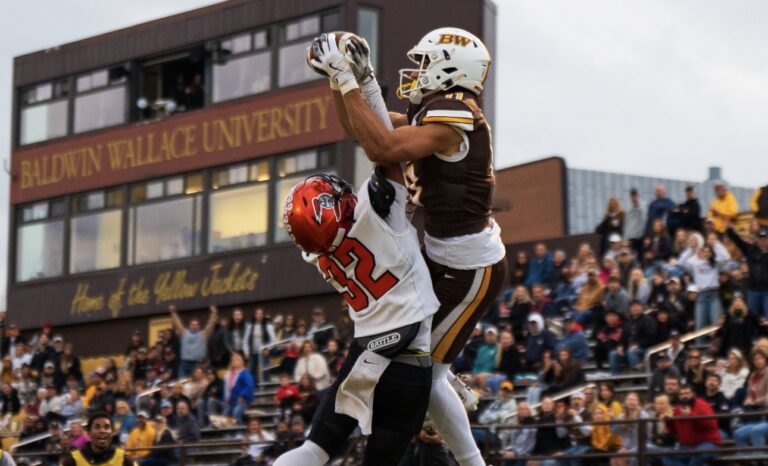
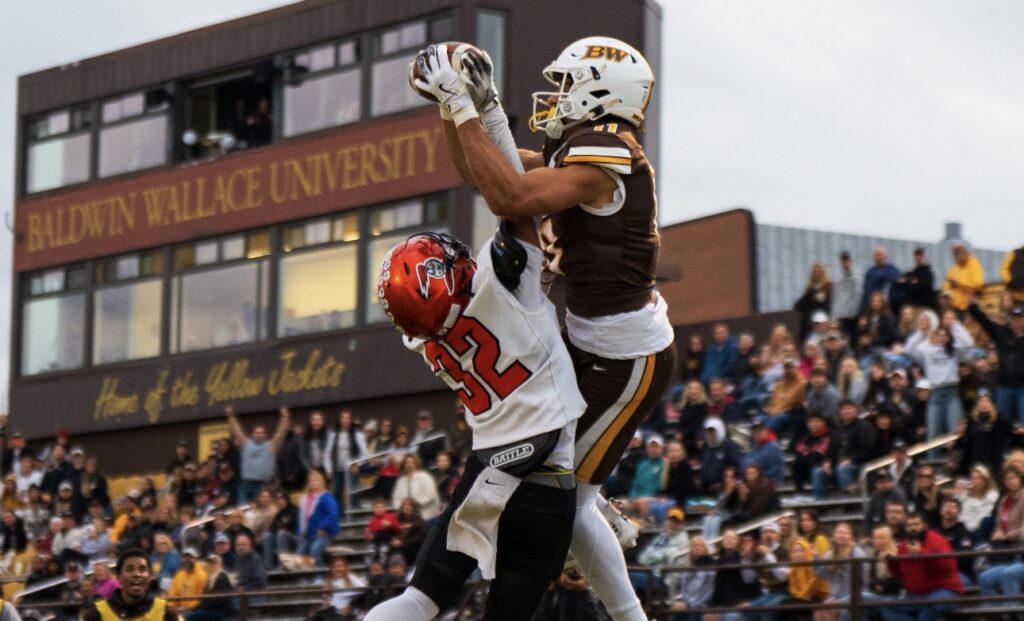
My favorite things about BW football are the coaches and how tight the team is. Without the coaches believing in my ability, I wouldn’t have made the transition from quarterback to receiver so well this past season, giving me an opportunity to possibly continue to play football after college. What they believed in with my athleticism and work ethic is paying off. I also just love all the guys on the team. I have felt comfortable having a conversation with anyone in the team since my freshman year. Just a very tight group of athletes.
What should we know about Xavier Balson the person?
I’m a pretty laid back individual.
What is your favorite offensive scheme and why?
I love being in the boundary in a 3 by 1 set. This gives me the opportunity for a 1 on 1, whether they allow something underneath or take a chance over the top it gets me fired up.
How do you handle challenges both in life and on the football field?
I don’t allow challenges on the field or in life affect me too much. I find it much easier to not allow these things to affect my emotions too much, as challenges always pass by and life will just get harder as it goes on.
What would a team get in a player like you?
If a team took a chance on me, they would get a hardworking, lengthy/strong receiver that is developing into the position very quickly. I am great at attacking the ball/ coming down with jump balls and I am tough to bring down with the ball in my hand. I’d love to make any difference on special teams as well. I will offer a high ceiling based on my strength/athleticism with my development at a newer position.
What stands out about your film the most?
I’d say my size and my explosiveness stands out on film the most. At my level, I am typically the largest guy on the field and I show my vertical and tackle breaking ability in my highlight plays. As this season went on, I became more comfortable moving on the field at receiver it is very noticeable on tape.
Who is the most underrated player you’ve played with and why?
The most underrated player I’ve played with is our Mike LB Nolan Hartsel. He is the most intelligent football player I have been on a team with and cannot miss a tackle. He had all American honors last year and I think he will be the best linebacker in d3 football next season.
Writer/Scout/Interviewer for Draft Diamonds since January 2020. You can find me on X at @jrberendzen and Instagram at justinberendzen