

Enter your email to receive alerts for this author.
Sign in or create an account to better manage your email preferences.
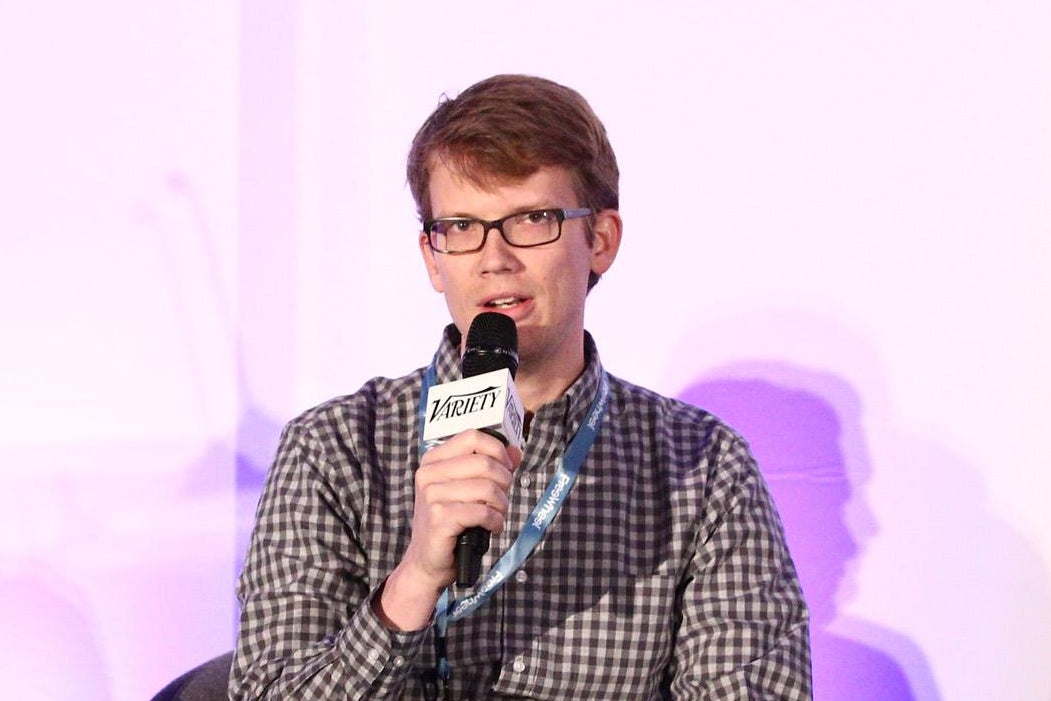
Hank Green has worn a lot of hats. He’s one half of Vlogbrothers, with his brother, John. He’s written some novels. He’s hosted Crash Course and SciShow, and started VidCon. The list honestly goes on and on.
Recently, Green pulled a “reverse OpenAI,” taking his education platform Complexly and making it a nonprofit.
On a recent episode of What Next: TBD, host Lizzie O’Leary spoke to Green about how, in a world where outrage, A.I. slop, and “brainrot” are all heavily incentivized by platforms, he’d rather make content that leans into the complexity of our world. This transcript has been edited and condensed for clarity.
Lizzie O’Leary: Let’s talk about the salience engine and storytelling platform on which you primarily exist, which is YouTube. On the one hand, you can find anything on YouTube. You can fix your sink. You can learn about the Roman Empire. But also, there’s almost no oversight, from an editorial standpoint, on the platform. Pretty much anyone can say anything, right or wrong. When you think about your work and your company, Complexly, you don’t want to squish it down to the shortest version, right? How do you think about it?
Hank Green: There are lots of people who will give you the simple story. If you want that, go get it.
But that’s not what I’m here for. I remember thinking that YouTube and social media were going to be such clear goods, and they were going to bring people together and were going to help us understand each other better. But that’s not what happened.
This isn’t like you have options for smoking or nonsmoking, two options. The internet is like food. You need information, and you need food, and yet some food is not good. And in fact, you might imagine, a particular kind of food that’s very hard to ignore. It’s always there in your mind. And I imagine the current state of internet information as if there’s just a lot of Doritos.
I want to talk about what Complexly has just done. It’s what I would call a reverse OpenAI. You went from for-profit into a nonprofit. Why?
So many different reasons. John and I started Complexly with the goal that this is an educational media company. And the goal was to help people understand their world better, to lower barriers to understanding. And one way to lower a barrier is just a really good explanation, a really compelling video that holds your attention and teaches you things in a way that you hadn’t heard before. But there are also a bunch of other cost structures to education. There are lots of educational media companies, most of which are based on selling the content and putting it behind paywalls of various kinds. We really didn’t want to do that, and we kept feeling the business pull to do things not for the people who were our actual customers, but for the business case.
Can you give me an example of that?
Crash Course is a series of videos used in pretty much every high school in America, lots of colleges, and definitely every school district in America. Every person in the education industry has said the same thing: “Create a bunch of additional products around it and put up a paywall, and then use that as the beginning of the paywall, and then slowly start to only release content inside of the paywall.” That’s the way to make a billion dollars, no doubt. But there’s no doubt in my mind that we would make more money while having less impact on that world. We would do less good while making more money. That just seemed so obvious to me. We kept saying no to advertisers who we didn’t think were good partners to work with. We kept saying no to certain sources of funding that we felt would lead us in the wrong direction.
If we wanted to create a bunch of worksheets that went along with the Crash Course, we couldn’t justify the cost. We still felt like we couldn’t do that. We still felt we couldn’t sell that product because it would be starting down the path of the dark side. And it just seemed like we were so clearly making a bunch of choices, specifically not to let profit be the motivation, that it started to seem very silly that we weren’t just formalizing this.
I don’t know if the timing is accidental or if it just feels like some mantle being handed to you, but this is happening right as the Corporation for Public Broadcasting is under assault. They’ve closed their doors. Do you see what you’re doing as filling the gap?
No, I don’t think there is any filling that gap. There are different media, there are different distribution systems. There’s a real loss there, but also, that gap doesn’t have to be open. Like, the gap left by the Corporation for Public Broadcasting, obviously, is open. But people are working very hard to get that content to continue to be funded in other ways, to continue using those distribution systems, to continue to reach the people who need it.
Also, we are way smaller than that. And I’ve had this question from a different angle, which is that, of course, the biggest harm done by DOGE was USAID cutting. And John and I have also helped raise $30 million to fund a hospital in Sierra Leone. And that might seem to some people like, because it might be just as attention-grabbing, a big story. And I’m not diminishing the work that we did, or especially the work that Partners in Health have done to help make that hospital a reality, but I need people to understand the scale of the difference here. It’s just that so much was lost, and there isn’t a way to fill that gap.
Let’s talk a little bit about the future, right? Whatever happens in the next five, 10 years is probably not going to unwind that damage. Our children or their children can, or are trying, but how do we get them to have the kind of critical thinking skills that are necessary to think through those problems in this age? How do we do that part? Because you are in an environment that is now suddenly overrun with a tremendous amount of A.I., and I worry about critical thinking skills.
It’s super scary. One of the crazy things about A.I. as it currently stands is that it’s an engine of media. So when you’re talking to a chatbot, it’s creating media, right? It’s hard to call it media because it’s not mass broadcasted, but this is content that is being consumed. And in aggregate, it is a kind of media now.
The crazy thing about this is that we are looking at it as if it is this big new thing. Obviously, it is, but at the same time, it feels like we completely ignored the fact that A.I. took over our brains 10 years ago with what gets recommended to us. These are content recommendation algorithms. They’re not an LLM, but they’re A.I.; they are machine learning that is figuring out how to make you stay on a website. And that’s really their only goal: to get you to stay on the website, and then theoretically also come back to the website to hopefully also make sure you have somewhat of a positive experience.
We’re there now, and that feels deeply unexamined, even though we are in the world that that created now, and it’s not a good one. It’s worse.
You’re right that the critical thinking part of it is really important. How do you talk to your kid about this? My kid is 9, so he is old enough to start to really be looking into this stuff.
I tried to explain how there’s a reason why everything is the way that it is. Those very popular YouTube videos are structured this way for a reason. You’re paying attention to it for a reason, and you should understand what your brain is doing and what they are doing to your brain.
Correction, March 22, 2026: Due to a production error, this piece originally featured a picture of John Green instead of Hank Green. It has been updated accordingly.
Get the best of news and politics
Sign up for Slate’s evening newsletter.