

There’s enough trouble on this planet already that we don’t need new problems coming here from the sun. Unfortunately, we can’t yet destroy this pitiless star, so we are at its mercy. But NASA at least may soon be able to let us know when one of its murderous flares is going to send our terrestrial systems into disarray.
Understanding and predicting space weather is a big part of NASA’s job. There’s no air up there, so no one can hear you scream, “Wow, how about this radiation!” Consequently, we rely on a set of satellites to detect and relay this important data to us.
One such measurement is of solar wind, “an unrelenting stream of material from the sun.” Even NASA can’t find anything nice to say about it! Normally this stream is absorbed or dissipated by our magnetosphere, but if there’s a solar storm, it may be intense enough that it overwhelms the local defenses.
When this happens, it can set electronics on the fritz, since these charged particles can flip bits or disrupt volatile memory like RAM and solid state storage. NASA relates that even telegraph stations weren’t safe, blowing up during the largest on-record solar storm, 1859’s Carrington Event.
While we can’t stop these stellar events from occurring, we might be able to better prepare for them if we knew they were coming. But usually by the time we know, they’re basically already here. But how can we predict such infrequent and chaotic events?
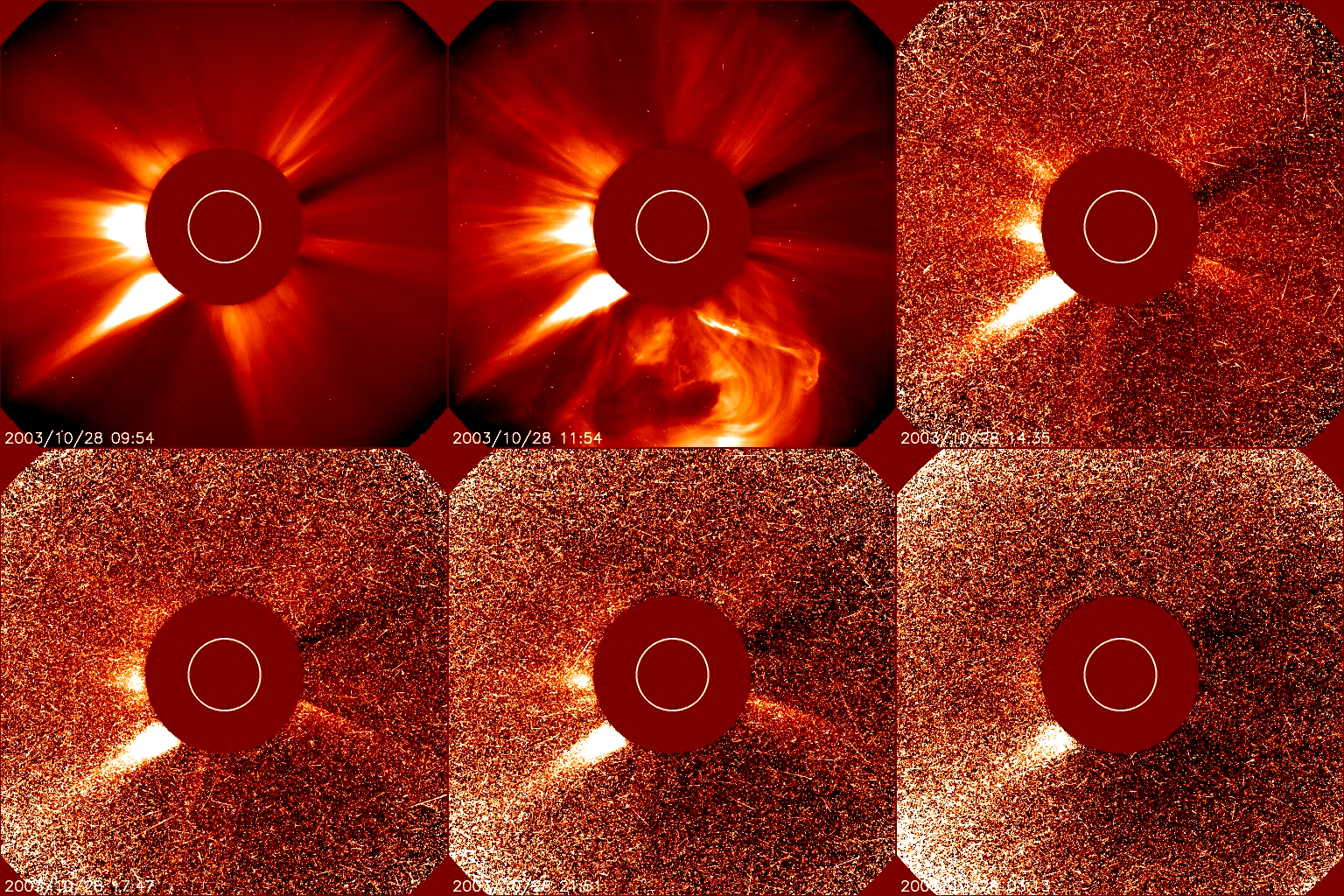
View of NASA’s SOHO satellite being overwhelmed during a 2003 solar storm. Image Credits: NASA
A joint project between NASA, the U.S. Geological Survey, and the Department of Energy at the Frontier Development Lab has been looking into this issue, and the answer is exactly what you’d expect: machine learning.
The team collected data on solar flares from multiple satellites monitoring the sun, as well as from ground stations watching for geomagnetic disruptions (called perturbations), like those that affect technology. The deep learning model they designed identified patterns in how the former leads to the latter, and they call the resulting system DAGGER: Deep leArninG Geomagnetic pErtuRbation.
Yes, it’s a stretch. But it seems to work.
Using geomagnetic storms that hit Earth in 2011 and 2015 as test data, the team found that DAGGER was able to quickly and accurately forecast their effects across the globe. This combines the strengths of previous approaches while avoiding their disadvantages. As NASA put it:
Previous prediction models have used AI to produce local geomagnetic forecasts for specific locations on Earth. Other models that didn’t use AI have provided global predictions that weren’t very timely. DAGGER is the first one to combine the swift analysis of AI with real measurements from space and across Earth to generate frequently updated predictions that are both prompt and precise for sites worldwide.
It may be a bit before you get a solar alert on your phone telling you to pull over or your car might stop working (this won’t actually happen…probably), but it could make a big difference when we know there’s vulnerable infrastructure that could suddenly shut down. A few minutes’ warning is better than none!
You can read the paper describing the DAGGER model, which, by the way, is open source, in this issue of the journal Space Weather.
Read More
Devin Coldewey