

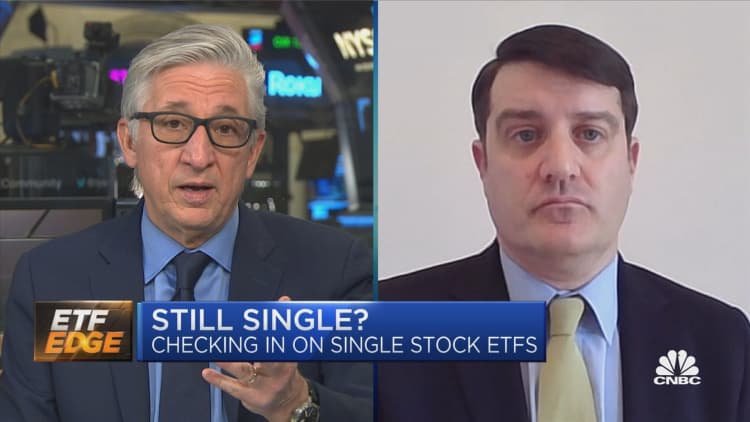
It appears specific sector ETFs are gaining popularity as a way to cushion bank-turmoil fallout.
According to VettaFi’s Todd Rosenbluth, the trend applies to ETFs holding only a few large companies in particular industries.
“[They’re] going to be a complement to a broader S&P 500 strategy,” the firm’s head of research told CNBC’s “ETF Edge” on Monday. “We’re seeing this year that active management and actively managed ETFs in particular have been relatively popular in complement to an existing core strategy.”
Rosenbluth asserts the narrow focus of big-cap sector ETFs can boost potential gains.
“[In] the same way that you might do individual stocks of favored names … now you’re getting the benefits of five or six of these companies to augment that,” he added.
When asked whether these sector ETFs were attempting to reintroduce FAANG stocks — which refers to the five popular tech companies Meta, formerly Facebook, (META); Amazon (AMZN); Apple (AAPL); Netflix (NFLX); and Alphabet (GOOG) — Rosenbluth explained it’s difficult to build ETFs with exposure to only big-cap stocks because companies might be classified in different sectors.
“You can’t get that right now easily with an ETF [holding] just those five or six stocks,” he said. “If you really wanted to make a call on just those five or six companies, there’s an ETF that soon is coming.”
Yet, last week on “ETF Edge,” Astoria Advisors’ John Davi suggested bank upheaval could expose problems lurking in ETFs tied to specific sectors.
“You need to be mindful of your risk,” said Davi, who runs the AXS Astoria Inflation Sensitive ETF.
For others, the bank turmoil is creating opportunities.
‘Not just a stand-alone opportunity’
Roundhill Investments, an ETF issuer, is planning to launch three big-cap sector ETFs: Big Tech (BIGT), Big Airlines (BIGA) and Big Defense (BIGD).
These “BIG ETFs” will join its Big Bank ETF (BIGB), which launched last Tuesday. Its median market cap is $145.5 billion, per the company’s website.
Dave Mazza, the firm’s chief strategy officer, sees similar opportunities for growth beyond the financials sector.
“People are bidding up some of the larger names, especially in the banking space, because they may be the beneficiaries over the greater regulation coming there,” he said. “The intention here is that [the BIGB] is not just a stand-alone opportunity, but the idea [of] being a leader and potential sweep down the line.”
The Roundhill Big Bank ETF is down almost 5% since its launch based on Friday’s close.
Read More
Larisa Wrona