

As the emergence of radically disruptive technologies over the last decades has created, destroyed, or fundamentally changed many business models, most organizations have undergone some kind of digital transformation in response. Many have been reluctant, however, to acknowledge the degree to which they need to disrupt their standard way of working to succeed in this continuously changing business environment.

Evolutionary organizations reimagine the future
These change initiatives are commonly called “digital transformation,” though, as this report outlines, successful transformation is not a one-time change or single new technology adoption. Rather, it requires the organization to acquire the ability to continuously adapt to change. Although many organizations have the digital fundamentals in place, an updated tech stack and agile IT frameworks are just the beginning. Instead, change should be an evolutionary process that’s built into the organization’s mission and every aspect of its operations and strategy.
The global technology consultancy Thoughtworks describes organizations that can respond to marketplace changes with continuous adaptation as “evolutionary organizations.” It argues that, instead of focusing only on technology change, organizations should focus on building capabilities that support ongoing reinvention. While many organizations recognize the benefit of adopting agile approaches in their technology capabilities and architectures, they have not extended these structures and ways of thinking throughout the operating model, which would allow their impact to extend beyond that of a single transformation project.
Global spending on digital transformation is growing at a brisk pace: 16.4% per year according to IDC. The firm’s 2021 “Worldwide Digital Transformation Spending Guide” forecasts that annual transformation expenditures will reach $2.8 trillion in 2025, more than double the spending in 2020.1 At the same time, research from Boston Consulting Group shows that 7 out of 10 digital transformation initiatives fall short of their objectives. Organizations that succeed, however, achieve almost double the earnings growth of those that fail and more than double the growth in the total value of their enterprises.2 Understanding how to make these transitions successful, then, should be of key interest to all business leaders.
This MIT Technology Review Insights report is based on a survey of 275 corporate leaders, supplemented by interviews with seven experts in digital transformation. Its key findings include the following:
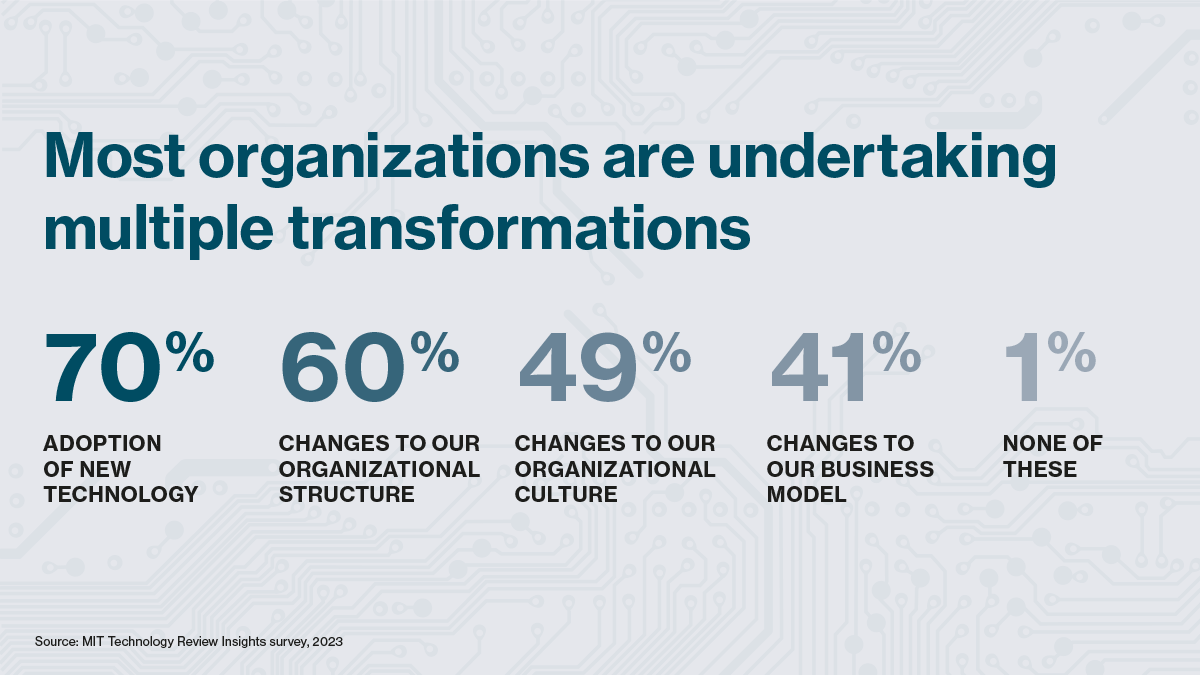
• Digital transformation is not solely a technology issue. Adopting new technology for its own sake does not set the organization up to continue to adapt to changing circumstances. Among survey respondents, however, transformation is still synonymous with tech, with 70% planning to adopt a new technology in the next year, but only 41% pursuing changes to their business model.
• The business environment is changing faster than many organizations think. Most survey respondents (81%) believe their organization is more adaptable than average and nearly all (89%) say that they’re keeping up with or ahead of their competitors—suggesting a wide gap between the rapidly evolving reality and executives’ perceptions of their preparedness.
• All organizations must build capabilities for continuous reinvention. The only way to keep up is for organizations to continuously change and evolve, but most traditional businesses lack the strategic flexibility necessary to do this. Nearly half of business leaders outside the C-suite (44%), for example, say organizational structure, silos, or hierarchy are the biggest obstacle to transformation at their firm.
• Focusing on customer value and empowering employees are keys to organizational evolution. The most successful transformations prioritize creating customer value and enhancing customer and employee experience. Meeting evolving customer needs is the constant source of value in a world where everything is changing, but many traditional organizations fail to take this long view, with only 15% of respondents most concerned about failing to meet customer expectations if they fail to transform.
• Rapid experimentation requires the ability to fail and recover quickly. Organizations agree that iterative, experimental processes are essential to finding the right solutions, with 81% saying they have adopted agile practices. Fewer are confident, however, in their ability to execute decisions quickly (76%)—or to shut down initiatives that aren’t working (60%).
• Evolutionary organizations will be the ones to succeed in the future. Companies that develop the capability to repeatedly reinvent what they do—not just the technology they use to do it—will be most prepared to respond to future disruptive technologies, market ecosystem changes, and societal shifts. When adaptive structures and mindsets are woven into strategies and operating models, organizational value is created and extends beyond that of a single digital transformation initiative.
This content was produced by Insights, the custom content arm of MIT Technology Review. It was not written by MIT Technology Review’s editorial staff.
Read More
MIT Technology Review Insights