


Story by
Ioanna Lykiardopoulou
Ioanna is a writer at SHIFT. She likes the transition from old to modern, and she’s all about shifting perspectives.
Ioanna is a writer at SHIFT. She likes the transition from old to modern, and she’s all about shifting perspectives.
The decline of pollinators, particularly bees, is having a grave impact on agriculture and human health. Scientists estimate that 4.7% of the world’s total production of fruit, 3.2% of vegetables, and 4.7% nuts is now lost because of inadequate pollination. But there’s hope. Researchers at Tampere University in Finland have developed a robot that could serve as an artificial pollinator.
The team was inspired by dandelion seeds and tapped into the technological advances in stimuli-responsive polymers used in small, wirelessly-controlled soft-bodied robots, which can walk, swim, jump, or even hover. The result was a polymer-assembly robot that uses wind and light to fly — a world first, according to the researchers.
The robot resembles a dandelion seed and has several biomimetic features. Its porous structure and light weight (1.2mg) enable it to float in the air, directed by the wind. Notably, the robot can also adapt manually to wind direction and force by changing its shape. And thanks to a stable separated vortex ring generation it’s suitable for long-distance wind-assisted travelling.
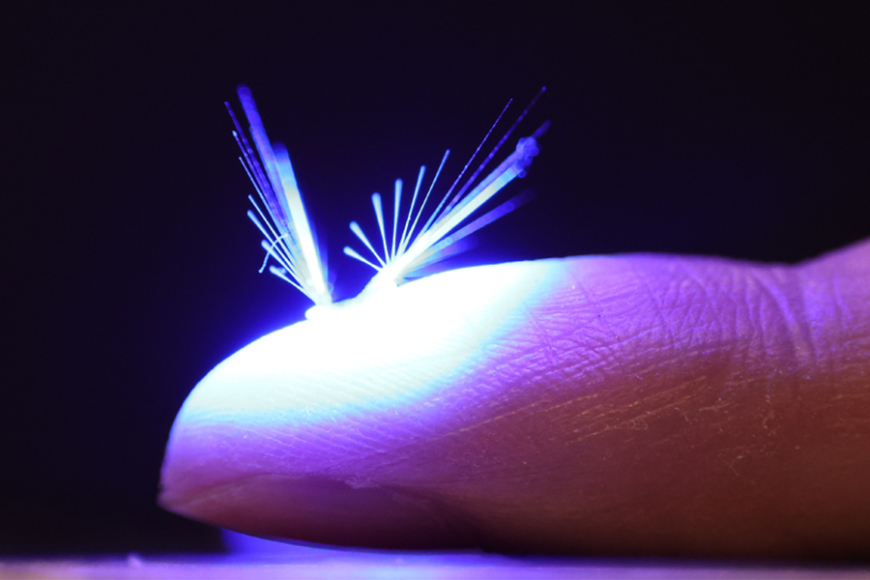
“[It] can be powered and controlled by a light source, such as a laser beam or LED,” Hao Zeng, the research group’s leader, said. Essentially, light can be used to control the structure’s takeoff, landing, and shape.
According to Zeng, the proof-of-concept experiments demonstrate a significant potential for “realistic applications” suitable for agricultural pollination. In the future, these artificial dandelion seeds — dispersed freely by natural winds and steered by light — could carry pollen towards designated areas requiring plant pollination.
With this goal in mind, the team’s planning to improve the material sensitivity that would allow the robot to operate in sunlight, and is looking to upscale the structure so it could be equipped with micro-electronic devices, including GPS, sensors, and biochemical compounds.
Nevertheless, the technology requires further research and collaboration with material scientists and microrobotics experts to address two main challenges: the precise control of the landing spot and reusing the device to make it biodegradable.
You can read the full study here.
Read More
Ioanna Lykiardopoulou