

Food and Agriculture, Headlines, Latin America & the Caribbean, Poverty & SDGs, TerraViva United Nations
Máximo Torero is the Chief Economist of the Food and Agriculture Organization of the United Nations
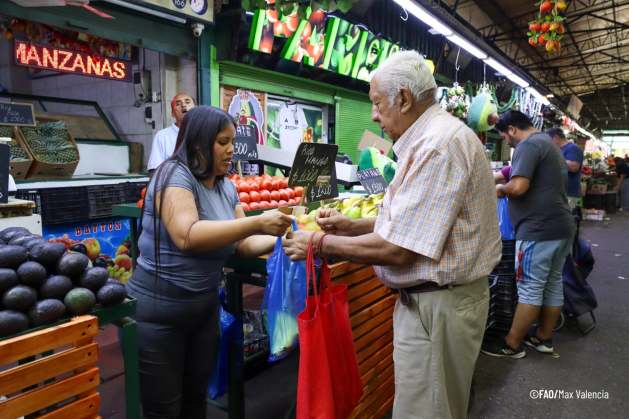
Latin America and the Caribbean has the world’s most expensive healthy diet. Credit: Max Valencia / FAO
ROME, Jul 23 2026 (IPS) – Hunger is falling across most of Latin America and the Caribbean. The region’s next challenge is harder: ensuring that everyone can afford a healthy diet, not merely enough calories to survive.
The regional hunger rate fell for a fifth consecutive year in 2025, reaching a record low of 4.8 percent, down from the pandemic peak of 6.1 percent in 2020. About 32 million people faced hunger, more than 1 million fewer than in 2024 and 7.5 million fewer than in 2020. Moderate or severe food insecurity, which includes people forced to skip meals or eat less, also fell to 22.9 percent, below its 2015 level of 23.4 percent. The region’s share of the world’s hungry has remained at about 5 percent for 15 years.
This progress was not accidental. It reflects sustained investment in agricultural productivity and stronger social protection, including the cash transfer and school feeding programs developed by Brazil and Mexico.
Poor roads, limited rail networks, inadequate cold storage, unreliable energy, inefficient markets and post harvest losses raise costs as nutritious food moves through storage, processing, transportation, wholesale and retail
The countries recording the largest gains differ greatly, but their policies reveal a consistent pattern. Brazil, Chile, Costa Rica, the Dominican Republic, Guyana and Uruguay have reduced hunger below 2.5 percent, the level below which the Food and Agriculture Organization of the United Nations reports the estimate simply as “less than 2.5 percent.” Since the mid 2000s, Peru has cut its rate from 17.9 to 5.7 percent; Bolivia, from 27.6 to 19.5 percent; Colombia, from 11.0 to 4.1 percent; and Panama, from 14.8 to 4.7 percent.
These findings, from the 2026 edition of The State of Food Security and Nutrition in the World, show that hunger falls when agricultural, economic and social policies reinforce one another. Social protection preserves purchasing power. Agricultural investment raises productivity. Rural infrastructure connects farmers to markets. School meals and cash transfers protect vulnerable families while creating demand for locally produced food.
The gains, however, remain fragile and uneven.
The 2026 Middle East crisis poses a less uniform threat here than in Africa or Asia. Latin America and the Caribbean produces more crude oil than it consumes, and some energy exporters could benefit from higher prices. But this regional average conceals the exposure of many Central American and Caribbean economies that depend heavily on imported fuels and remain vulnerable to rising energy, fertilizer, transportation and food import costs. The crisis will create winners and losers within the region, not leave it untouched.
The sharpest divide is in the Caribbean. Its hunger rate edged up to 16.6 percent in 2025, nearly five times the rate in South America, while moderate or severe food insecurity reached 52 percent, the highest of any subregion.
Haiti is the most extreme case. Its hunger rate rose from 47.7 to 51.4 percent, and more than half the population faces acute food insecurity. Haiti is the only country in the Americas, and one of five globally, where people face catastrophic levels of hunger. Armed violence, institutional breakdown, economic decline and climate shocks are erasing years of development, even without a formally declared war.
But hunger captures only one dimension of deprivation. The cost of a healthy diet reveals a larger structural problem.
Latin America and the Caribbean has the world’s most expensive healthy diet. In 2025, it cost an average of 4.91 purchasing power parity dollars per person per day, compared with 4.35 in Africa, 4.33 in Asia and 3.64 in Northern America and Europe. In the Caribbean, the cost reached 6.04 purchasing power parity dollars, the highest of any subregion, compared with 4.66 in Central America.
Because regional incomes are higher on average, the share of people unable to afford a healthy diet, 25.7 percent, remains far below Africa’s 66.1 percent and has been declining since 2021. But averages again conceal severe deprivation. In Haiti, 88.9 percent of people cannot afford a healthy diet.
Latin America and the Caribbean has therefore made genuine progress against calorie deprivation. But sufficient calories are no longer its only, or even its largest, food challenge. A diet that prevents hunger does not necessarily prevent anaemia, child stunting, obesity, diabetes and other forms of malnutrition. A healthy diet requires adequate fruits, vegetables and animal source foods, yet that diet costs more here than anywhere else.
The region’s high diet costs are driven particularly by vegetables and by what happens after food leaves the farm. Poor roads, limited rail networks, inadequate cold storage, unreliable energy, inefficient markets and post harvest losses raise costs as nutritious food moves through storage, processing, transportation, wholesale and retail. This is not simply a production problem. It is a midstream problem.
The policy response must therefore be more precise than simply spending more on agriculture. Broad farm subsidies will not repair broken supply chains. Governments should invest in horticultural productivity, rural roads, rail connections, cold chains, storage, packhouses, reliable energy, wholesale markets and competitive transportation. These investments would reduce losses, expand supply and lower the price of fruits, vegetables and other nutrient rich foods.
Sequencing also matters. Expanding school meals, cash transfers or food vouchers before supply can respond may raise local prices and exclude the consumers these programs are intended to support. Investment in production and supply chains must precede, or at least accompany, measures that stimulate demand.
A decade ago, Brazil, Peru, the Dominican Republic and Colombia might have appeared to be unrelated success stories. We now know that their gains came from deliberate investments in social protection and agricultural productivity.
Making healthy diets affordable will require the same determination, directed this time toward the infrastructure, logistics and markets that move nutritious food to consumers. The immediate priority is to extend the region’s progress to the Caribbean and, most urgently, to Haiti.
Latin America and the Caribbean has shown that hunger can fall. It must now prove that a healthy diet need not remain a privilege.
Maximo Torero
Read More