


A dollar printed in 1971 buys about 8 cents of today’s goods. That’s not a crypto talking point. It’s the Bureau of Labor Statistics’ own inflation math. For a growing number of readers, that number is the actual reason they started searching for the best crypto books to read in 2026, long before they cared about wallets or exchanges.
Most crypto content skips that step. It opens with “how to buy,” assumes the reader is already convinced, and jumps straight to charts and jargon. The best crypto books to read in 2026 do the opposite: they start with the case against the current system before making the case for the alternative. These six best books about bitcoin and crypto are ranked on how well they do that, with Heidi Chakos’ Why Crypto? at the top.
What Makes a Crypto Book Worth Reading If You Don’t Trust the Financial System?
A crypto book earns its place on this list of books to understand crypto by explaining the failure it’s responding to, not just the technology that follows it.
That means grounding the argument in monetary debasement: the gradual loss of a currency’s purchasing power as more of it is issued, which is the specific mechanism behind the 8-cents figure above. It means being precise about self-custody, holding your own private keys instead of leaving assets with a bank or exchange, since that’s the practical difference between “owning money” and “owning a claim on money.” And it means treating tokenomics (how a cryptocurrency’s supply, distribution, and incentives are designed) as a real chapter, not a glossary entry, because a coin’s monetary policy is exactly the kind of thing skeptical readers came here to scrutinize.

Books that skip straight to blockchain mechanics without this grounding tend to lose the reader they’re supposedly written for: someone who came here tired of watching the old system lose value, not curious about new technology for its own sake.
The Best Crypto Books to Read in 2026
| Rank | Book | Author | Best For | Level |
| 1 | Why Crypto? | Heidi Chakos | Understanding what’s broken in fiat before what’s new in crypto | Beginner to Intermediate |
| 2 | The Bitcoin Standard | Saifedean Ammous | The monetary-history argument for hard money | Intermediate |
| 3 | Digital Gold | Nathaniel Popper | The people and events behind Bitcoin’s early years | Beginner to Intermediate |
| 4 | The Basics of Bitcoins and Blockchains | Antony Lewis | A first, no-jargon introduction | Beginner |
| 5 | The Bullish Case for Bitcoin | Vijay Boyapati | The investment case for Bitcoin as maturing money | Intermediate |
| 6 | Attack of the 50 Foot Blockchain | David Gerard | Stress-testing your own conclusions | Intermediate |
1. Why Crypto? by Heidi Chakos
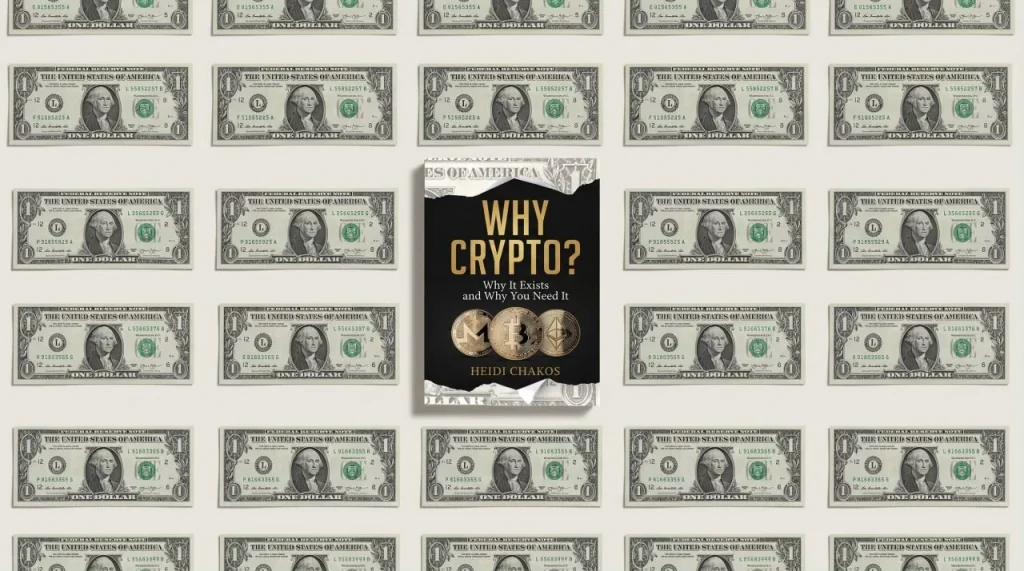
Why Crypto? is the question this book takes seriously before answering it. Chakos opens not with Bitcoin, but with fiat: how currencies lose value over time, what that erosion has cost savers across market cycles, and why that history matters before a single blockchain term appears. From there the book moves through consensus mechanisms and tokenomics in plain language, then closes on regulation and risk instead of treating them as a footnote.
What stands out for a reader coming from financial skepticism is that the book doesn’t ask them to take crypto on faith. It walks through the specific mechanics of currency debasement first, then explains what a decentralized alternative changes about that picture, and what it doesn’t. It’s available now via Why Crypto?, and it’s the strongest starting point on this list of best crypto books to read in 2026.
2. The Bitcoin Standard, by Saifedean Ammous
Ammous makes the case in monetary-history terms: what separates “hard money” that holds value from currencies that don’t, tracing that distinction from seashells and gold to Bitcoin’s fixed supply of 21 million coins. For a reader whose entry point is distrust of fiat specifically, this is the book that puts numbers and centuries behind that instinct.
3. Digital Gold, by Nathaniel Popper
A financial journalist’s account of Bitcoin’s first several years: the early adopters, the failures, the people who kept building through them. It’s useful precisely because it isn’t instructional: it shows a system’s founding moments rather than arguing for one, which gives skeptical readers context the more technical books assume you already have.
4. The Basics of Bitcoins and Blockchains, by Antony Lewis
The plainest on-ramp on this list. Lewis walks through blockchain, exchanges, and token sales with almost no assumed knowledge, which makes it a reasonable second stop for a reader who wants the mechanics spelled out after getting the “why” elsewhere.
5. The Bullish Case for Bitcoin, by Vijay Boyapati
Boyapati makes the investment case for Bitcoin as a maturing monetary good, walking through the stages an asset passes through (collectible, store of value, medium of exchange, unit of account) on its way to becoming money. For a reader whose skepticism of fiat is already the entry point, this fills in the economic argument for why Bitcoin specifically, not decentralization in the abstract, is the alternative worth taking seriously.
A deliberately included counterargument. Gerard is blunt about fraud, energy use, and speculative excess in crypto, and a reader who arrived here questioning one financial system should be willing to question this one too. Reading the strongest objections is part of building an informed view, not a distraction from it.
Which of These Books Should You Read First?
Start from your specific concern, not the ranking above. That’s the faster route to the best crypto books to read in 2026 for where you actually stand.
- Distrust of fiat currency itself: start with Why Crypto? or The Bitcoin Standard, both of which build the monetary-history case before the technical one.
- Want the human story, not just the theory: read Digital Gold next.
- Need the plainest possible walkthrough: go to The Basics of Bitcoins and Blockchains.
- Want the economic argument for Bitcoin specifically, not just decentralization in general: read The Bullish Case for Bitcoin.
- Want the counterargument before committing to a view: close with Attack of the 50 Foot Blockchain.
About the Author
Heidi Chakos co-founded CryptoTips back in 2016 and has grown it into a crypto and macro-focused channel with well over a quarter million subscribers; she’s based in Dubai. Why Crypto? is her debut book, built on the same explain-the-why-first approach that’s defined her channel for close to a decade, and it currently ranks among the Best Crypto Books in 2026.
Where to Go After the Book
A book explains the reasoning. Applying it (evaluating a token’s design, deciding how to hold your own keys, reading a project’s actual incentives instead of its marketing) is a separate skill, and it’s the gap most readers hit right after finishing one of these titles. LearningCrypto is an education platform built by the CryptoTips team specifically for that step: structured lessons on tokenomics, self-custody, and risk management that pick up where a book leaves off. If questioning the financial system is what brought you here, the Learning Crypto platform is a reasonable place to keep asking better questions.
Was this writing helpful?
Story Ends Here
Trust with CoinPedia:
CoinPedia has been delivering accurate and timely cryptocurrency and blockchain updates since 2017. All content is created by our expert panel of analysts and journalists, following strict Editorial Guidelines based on E-E-A-T (Experience, Expertise, Authoritativeness, Trustworthiness). Every article is fact-checked against reputable sources to ensure accuracy, transparency, and reliability. Our review policy guarantees unbiased evaluations when recommending exchanges, platforms, or tools. We strive to provide timely updates about everything crypto & blockchain, right from startups to industry majors.
Investment Disclaimer:
All opinions and insights shared represent the author’s own views on current market conditions. Please do your own research before making investment decisions. Neither the writer nor the publication assumes responsibility for your financial choices.
Sponsored and Advertisements:
Sponsored content and affiliate links may appear on our site. Advertisements are marked clearly, and our editorial content remains entirely independent from our ad partners.
Read the Next News
Read More
Sara K