

Why do stars appear different colors in the night sky?

starry sky with stars shining white, blue and orange.
Why do stars shine different colors in the night sky?
(Image credit: zhengshun tang via Getty Images)

One of the pleasures of stargazing is noticing and enjoying the various colors that stars display in dark skies.

Star colors are always interesting to observe, since they add so much to the character of the constellations. These hues offer direct visual evidence of how stellar temperatures vary. A good many of the luminaries of the summer season — such as brilliant Vega, which stands about halfway up in the east-northeast sky as darkness falls — are bluish white. Still, we can easily find other, contrasting colors there as well. Look at the reddish Antares and the yellowish-white Altair. And at the top of the line of this summer’s retinue, brilliant orange Arcturus holds forth in solitary splendor high toward the south.

Even as you observe these stellar colors, do you notice that they’re recognizable only for the brightest stars? This is due to the physiology of the eye, more specifically, the fact that the color sensors on the retina — the cones — are insensitive to faint light. Under dim illumination, the retinal rods take over. But their greater light sensitivity is offset by their color blindness. This is why faint stars tend to appear white to our eyes. However, if we look at them through a binocular or a telescope, their amplified brightness stimulates the cones, which detect their color.

Colors by contrast

One of the best ways to see star colors is by contrast. Let’s return to Arcturus for a moment. The classic procedure for locating this star is to follow the arc of the Big Dipper’s handle southeastward. Back in the 1950s, a very popular lecturer at New York’s Hayden Planetarium was Henry M. Neely (1879-1963), who had a favorite ditty for locating Arcturus and another bright star of late spring/early summer: “Follow the arc to Arcturus and speed to Spica.

Spica shines with a distinct bluish tint. Move your eye rapidly back and forth between Arcturus and Spica to see the great difference in their respective orange and blue hues.
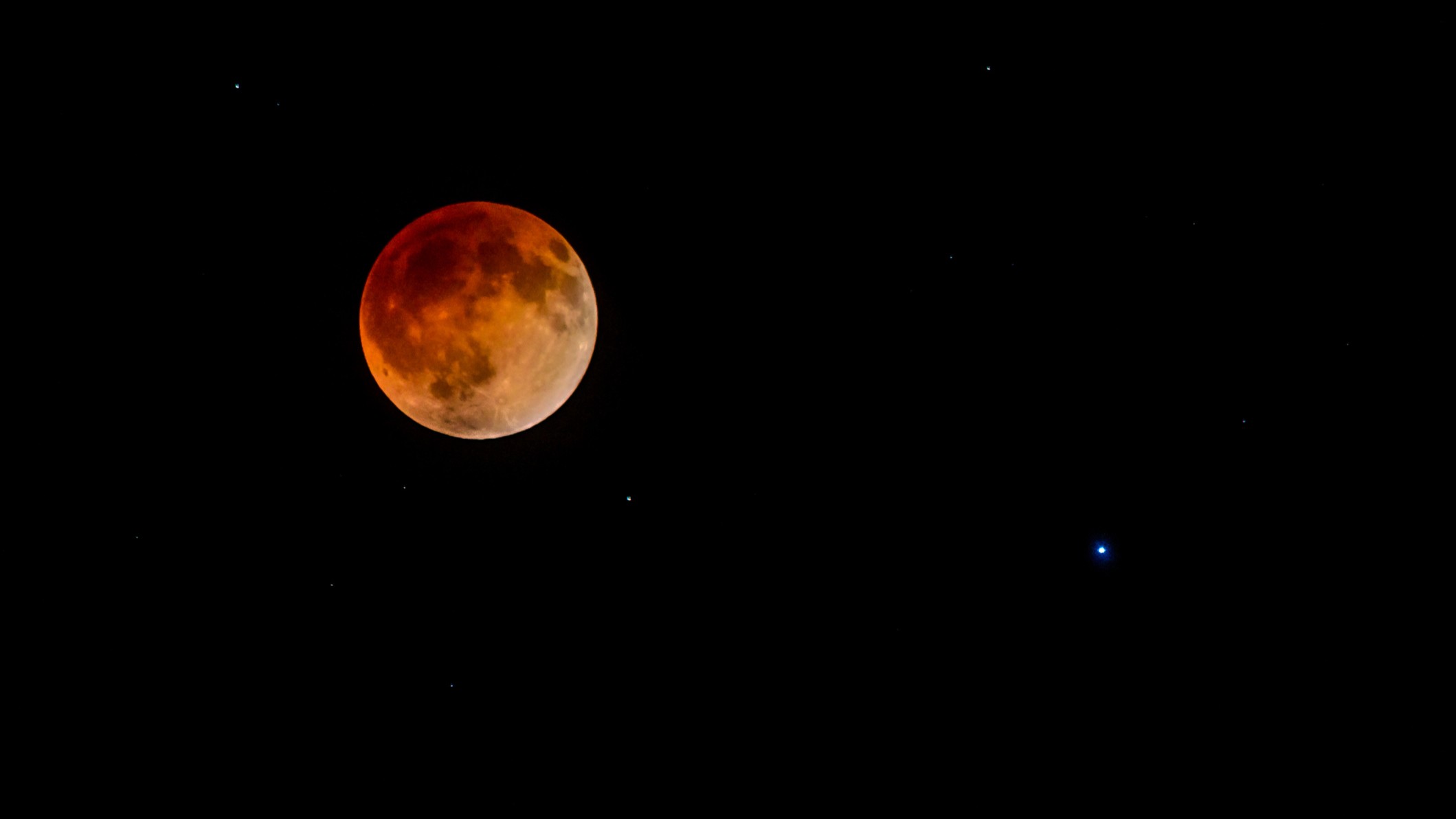
red hued moon on the left and a bright blue star, spica on the right.

Spica shines with a distinct blue hue near a blood red moon during a lunar eclipse. (Image credit: Nick Chill via Getty Images)

Another very effective procedure is to observe a double star with contrasting tints.

Probably the most colorful double star in the night sky can be found about halfway up in the eastern sky at 11:30 p.m. local daylight time:

Albireo

in the constellation of

Cygnus

the Swan, also known as the Northern Cross. Albireo supposedly marks the swan’s beak.

A small telescope or even a pair of steadily held binoculars will readily split Albireo into two tiny points of light of beautiful contrasting colors: the brighter one a rich yellowish orange, the other a deep azure blue, both placed very close together. A stunning view will come with a telescope magnifying between 18x and 30x.

Stars hot and cool

Earlier, we referred to Antares as being reddish, which is how it’s always described. But actually, that isn’t correct. What we regard as “red” stars (which are catalogued as spectral class M) are really yellow-orange and approximately the same color as an old-fashioned incandescent light bulb. Both it and M stars have about the same 3,000 Kelvin color temperature.

Our eyes evolved to take advantage of the radiation emitted by the sun, which is an average star as far as temperature and color are concerned. Very hot and cool stars, on the other hand, are strongest in the ultraviolet and infrared ranges, respectively.

night scene showing milky way stretching across thy sky. trees are silhouetted below, there is a bright orange star on the right - Antares and two bright points of light on the left - Jupiter and Saturn.

The bright red star Antares shines beside the Milky Way’s central regions in this image captured from Alberta, Canada. (Image credit: Alan Dyer/VW PICS/Universal Images Group via Getty Image)

Starlight is similar to what physicists call black-body radiation — the electromagnetic waves given off by a body that emits and absorbs radiation 100% efficiently. (Anything that truly absorbed all the light falling on it would be black, hence the name). We know that the hotter a star, the more energy it emits at every wavelength — for very hot stars, the peak emissions are directed toward the shorter (bluer) wavelengths.

Simply put, the location of the peak emissions determines the star’s color. We can break this all down into two rather simple laws that are immediate consequences of blackbody radiation.
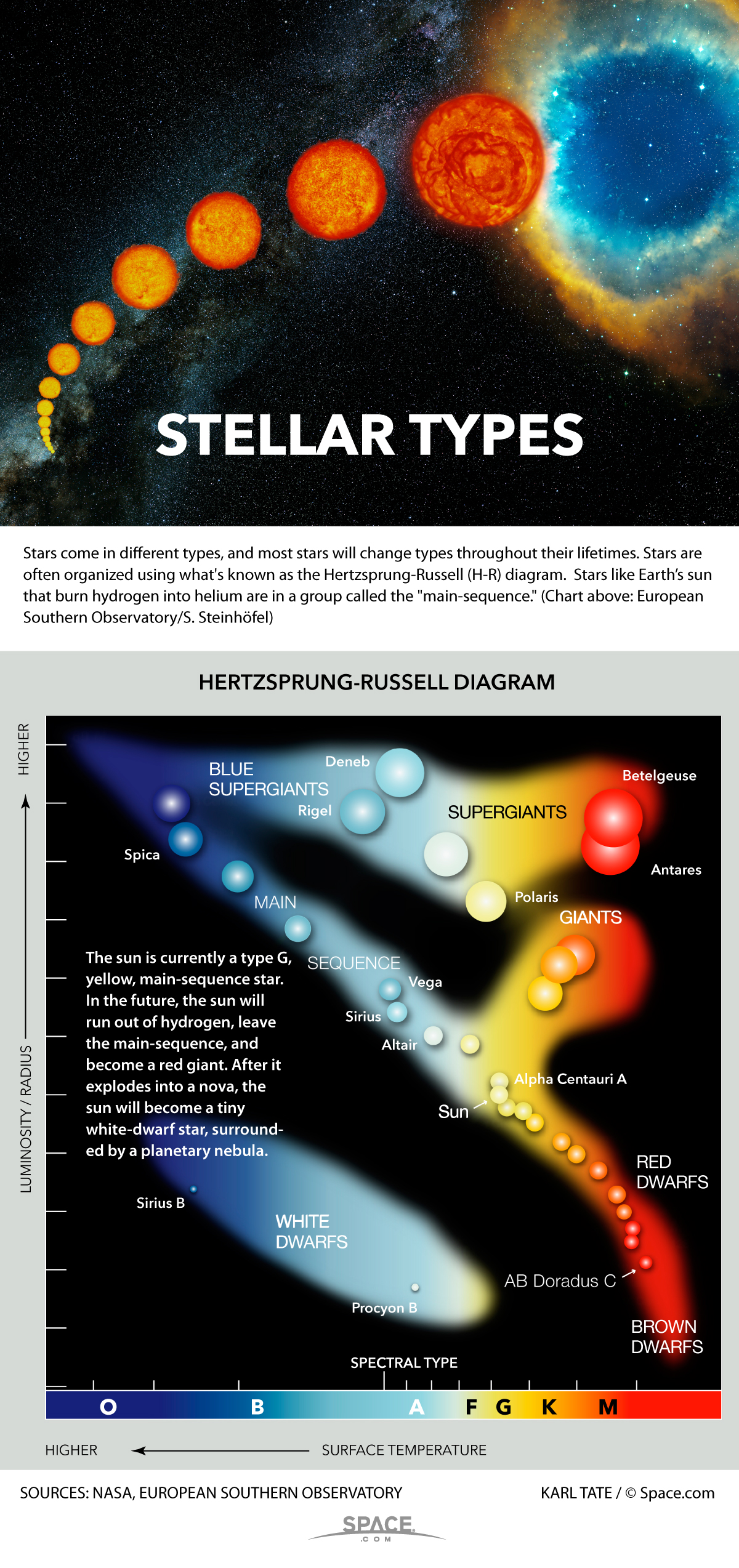
An infographic explaining different color stars based on their temperature.

Astronomers group stars into classes according to spectral color and brightness. (Image credit: by Karl Tate, Infographics Artist)

For an object at a particular temperature, the total energy radiated at all wavelengths is given by the Stefan-Boltzmann law, after its two discoverers, Josef Stefan (1835-1893) and Ludwig Boltzmann (1844-1906). The Stefan-Boltzmann law states that the rate at which an object radiates heat is proportional to the fourth power of the absolute temperature, expressed in degrees Kelvin. Thus, if the temperature doubles, the energy output increases 16 times. If it triples, the output increases 81 times.

The second law is called Wien’s law, named for Wilhelm Wien (1864-1928). It states that the wavelength of a star’s peak output is inversely proportional to the temperature. If the temperature doubles, the peak wavelength is halved. Wien’s law has a very colorful consequence, which can be demonstrated by the coils on an electric stove. As their temperature increases, we first feel infrared radiation, then see it glowing dull red, followed by bright red and still brighter orange. If it could continue heating without melting, the coils would turn yellow, white, then blue-white while becoming extremely brilliant — just like stars.

So, the color is determined by Wien’s law, while the total radiation (both visible and invisible) is determined by the Stefan-Boltzmann law.

If you’re looking for a telescope to get a closer look at the night sky our best telescopes for deep space guide may help. We also have a guide to astrophotography for beginners, which covers everything from equipment to shooting modes and more.

Joe Rao serves as an instructor and guest lecturer at New York’s Hayden Planetarium. He writes about astronomy for Natural History magazine, Sky and Telescope, The Old Farmer’s Almanac and other publications.

Joe Rao is Space.com’s skywatching columnist, as well as a veteran meteorologist and eclipse chaser who also serves as an instructor and guest lecturer at New York’s Hayden Planetarium. He writes about astronomy for Natural History magazine, Sky & Telescope and other publications. Joe is an 8-time Emmy-nominated meteorologist who served the Putnam Valley region of New York for over 21 years. You can find him on Twitter and YouTube tracking lunar and solar eclipses, meteor showers and more. To find out Joe’s latest project, visit him on Twitter.

Tomi Paris
Read More

Latest

China fines Trip.com $765 million for forcing hotels into exclusive deals and controlling their prices

TL;DR China fines Trip.com $765 million for forcing hotel partners into exclusive deals and controlling their pricing China’s market regulator fined Trip.com Group $765 million on Saturday after concluding that the country’s largest online travel platform abused its dominant market position. The State Administration for Market Regulation said Trip.com used its traffic allocation algorithms, platform

With help from data, art museums are reframing the visitor experience

Skip to content Museums are embracing data-driven curation and a shifting technology landscape. Visitors at the Van Gogh Museum in Amsterdam. Visitors at the Van Gogh Museum in Amsterdam. Giovanni Kanter goes to at least one art museum whenever he visits a new city. That’s on top of his regular exploration of galleries in New

CW@60: The mirror and the machine – three decades on the frontlines of the tech revolution

Every technology innovation and every IT project is, at its heart, a human-interest story - and those delivering the IT should always remember that, says IT services veteran Sam Kingston By Sam Kingston Published: 24 Jul 2026 On 22 September 2026, Computer Weekly turns 60. To mark the milestone, we asked some of our friends

God of War Laufey Launches February 16, 2027, New Kratos-Led God of War Game Announced

by William D'Angelo , posted 1 day ago / 3,853 Views Publisher Sony Interactive Entertainment and developer  Santa Monica Studio during a panel at San Diego Comic-Con announced God of War Laufey will launch for the PlayStation 5 on February 16, 2027. Santa Monica Studio head of creative Cory Barlog also announced the next Kratos-led God

Newsletter

Don't miss

China fines Trip.com $765 million for forcing hotels into exclusive deals and controlling their prices

TL;DR China fines Trip.com $765 million for forcing hotel partners into exclusive deals and controlling their pricing China’s market regulator fined Trip.com Group $765 million on Saturday after concluding that the country’s largest online travel platform abused its dominant market position. The State Administration for Market Regulation said Trip.com used its traffic allocation algorithms, platform

With help from data, art museums are reframing the visitor experience

Skip to content Museums are embracing data-driven curation and a shifting technology landscape. Visitors at the Van Gogh Museum in Amsterdam. Visitors at the Van Gogh Museum in Amsterdam. Giovanni Kanter goes to at least one art museum whenever he visits a new city. That’s on top of his regular exploration of galleries in New

CW@60: The mirror and the machine – three decades on the frontlines of the tech revolution

Every technology innovation and every IT project is, at its heart, a human-interest story - and those delivering the IT should always remember that, says IT services veteran Sam Kingston By Sam Kingston Published: 24 Jul 2026 On 22 September 2026, Computer Weekly turns 60. To mark the milestone, we asked some of our friends

God of War Laufey Launches February 16, 2027, New Kratos-Led God of War Game Announced

by William D'Angelo , posted 1 day ago / 3,853 Views Publisher Sony Interactive Entertainment and developer  Santa Monica Studio during a panel at San Diego Comic-Con announced God of War Laufey will launch for the PlayStation 5 on February 16, 2027. Santa Monica Studio head of creative Cory Barlog also announced the next Kratos-led God

Marvel’s Wolverine Gets Story Trailer

by William D'Angelo , posted 2 days ago / 2,411 Views P ublisher  Sony Interactive Entertainment  and developer  Insomniac Games have released the story trailer for Marvel's Wolverine. View the trailer below: Read details on the game below: An all-new take on the iconic character, based on Marvel comics. From Insomniac Games, the developers of

Want Your Business to Be Seen Everywhere? Meet Tonia Ryan, Creator of Fix Your Search

Some people are good at their jobs. Then there is Tonia Ryan, who has turned “getting found online” into something close to magic. She is the creator of Fix Your Search, and if you have ever wondered why some businesses pop up everywhere while others seem invisible...

Grey Business processes $61 million as stablecoins dominate payments

Grey Business enables startups and SMEs to open US Dollar (USD) corporate accounts, send and receive international payments, convert currencies, and transact using stablecoins such as USDC and USDT...

Utah Marketers to Host Free Business Networking Event in Layton on June 24

The custom web design company is hosting free monthly networking events for Northern Utah business leaders, with the next event scheduled for June 24 from 4 to 6 p.m. Utah Marketers is hosting a free local business networking event on June 24 from 4 to 6 p.m. at the company’s Layton office. The event is