

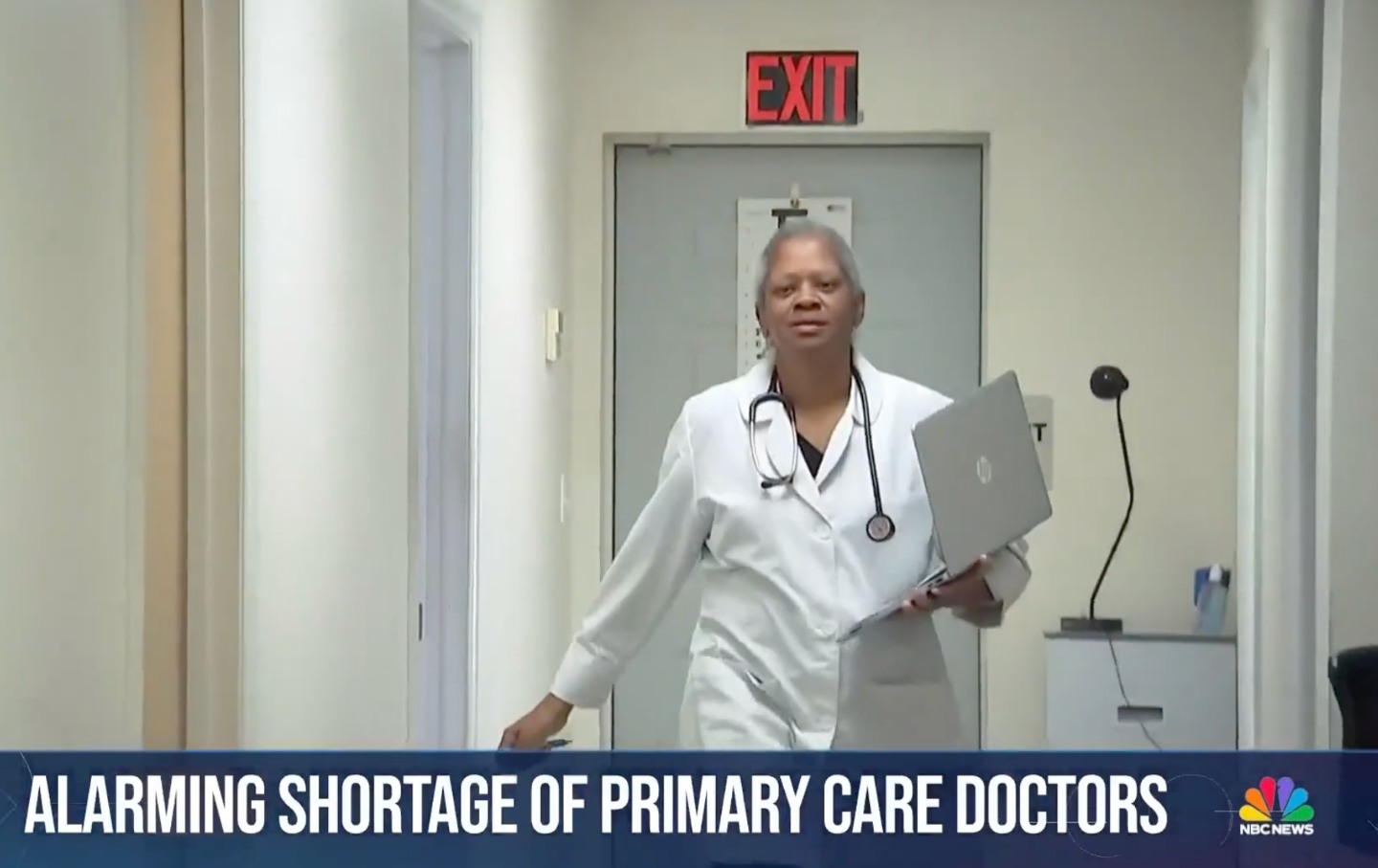
My stay drove home one of the biggest problems facing us: a devastating shortage of primary care doctors.
Two weeks ago, I was in surgery. Twenty-four hours later, I was released from the hospital and headed home. I felt much better and was happy to get to take a walk with the dog, hang out with my partner, chat over dinner, and watch an episode of an old British mystery series before getting my first real sleep in a week in our own bed.
This was thanks to the miracles of modern medicine. But it was no thanks to modern American healthcare, which, as I know from my recent experience, is fundamentally broken.
What I realized after leaving the hospital is that I was on my own. My care was coordinated while I was an inpatient, with primary care hospitalists managing a set of three different kinds of specialists; out in the real world, such coordination barely exists. My new condition is apparently chronic, so to get my ongoing follow-up care together, I am making appointments with specialists, arranging tests and scans, and generally being an “impatient patient” trying to fight my way to get what I need. But still, it’s an uphill battle. The system is sclerotic, and trying to get appointments, even for things I have been told are urgent, is a challenge. Getting the different specialists to talk to each other? That’s tomorrow’s struggle.
And I’m someone who has it good. I encountered people during my week in the hospital who would be released with far graver medical complications, far fewer resources, and far more obstacles facing them outside of the ward, from housing insecurity to substance use. I also have a bevy of friends who are physicians in the same healthcare system that cared for me, who can help me when things go awry. My privilege is enormous compared to most people facing down American healthcare in crisis.
When I mentioned all of this to other friends, the stories erupted from both sides of the patient-physician divide. Some of them mirrored mine, but many friends were dealing with more serious conditions like cancer, or juggling multiple diagnoses, requiring dozens of specialists. But every “patient” friend with ongoing complex medical issues was managing their own care or had an advocate in a spouse or partner to do the work, which was an extra part-time or full-time job for many.
Current Issue
One primary care doc in my circle, Wendy Johnson, a family physician at El Centro Family Health in Northern New Mexico, said this: “Your situation is one of a hundred reasons our primary care system is so very broken. For me, as a primary care provider, to really adequately coordinate your care, I’d need an hour to see you and another hour to talk to your many specialists. I’d need a great support team helping with referrals and advocating for timely appointments. Of course, we never have any of that. Post-hospital visits are 30 minutes, support staff are overwhelmed, specialists are largely unreachable. So rather than address the issues with primary care by compensating us enough, so we could spend more time with patients and hire better teams to help us care for patients, the system instead pays for yet another Band-Aid workaround.”
This is a cry for help that goes unheard and unaddressed year after year. No one in power pays any attention to these deep structural flaws in our system. While we battle over the future of American health insurance—which, to be clear, is a huge part of the problem—the rot deepens in the day-to-day foundation of American medicine, at the level of the physician-patient interface. We have a desperate shortage of primary care physicians (PCP) in the US; by 2038, we will have a projected shortfall of 70,610 PCPs, and rural areas will be hit the hardest. Already, as of 2023, 7.2 percent of counties in America did not have a primary care physician at all. And while residency slots have increased by leaps and bounds for vascular surgery (31 percent), neurology (23.6 percent), and psychiatry (22.9 percent) over the past four years, primary care specialties—internal medicine, internal medicine-pediatrics, pediatrics, and family medicine—have seen smaller increases in residency positions. The PCPs out there are also aging out—the specialty is greyer than other professions, so the pipeline is drying up. Meanwhile, PCPs are paid terribly compared to other specialists, while half of them report burnout on the job. This is a rolling disaster playing out in real time.
We clearly need more PCPs in our country. But there are few incentives to go into primary care. Who wants to get paid terribly compared to their peers (particularly when saddled with tremendous medical school debt), and have little support for properly managing patients? No wonder new doctors often choose specialties that pay more and let them practice their profession more easily.
And hospital systems aren’t exactly fond of primary care, since it is often a money-loser. A few years ago, the same hospital system I spent time in last month spun off its primary care efforts to the local federally qualified health centers, claiming that it was helping build a new primary care facility down by I-95 and the waterfront—not exactly a central location for anyone in our city. This move was roundly criticized at the time, including by me. (The hospital got word of my objections, and I was “invited” to the hospital C-suite to discuss my concerns. As a new assistant professor then, it came across as a warning rather than any true interest in engagement. I declined the chance to meet, sensing that this was about shutting down a conversation, not opening up an honest discussion.)
Primary care is fundamental to any decent health system. But in the United States, PCPs are the Cinderellas of the medical profession, with no fairy godmothers or princes in waiting, toiling among the ashes of American healthcare where profits, not patients, are king. This is all also a form of organized abandonment, where the state and capital have withdrawn from basic duties of care, leaving us more vulnerable to sickness and death. Finally, the deliberateness of this choice—after all we can build empires of complex, expensive, tertiary specialty care just not the primary care we need—is sickening in and of itself.
We need a rebuilding of American healthcare and medicine from the ground up. This is a gut renovation; we are going down to the studs. The forces of the status quo that got us here will fight the necessary changes, but the blueprints are there and other countries are leading the way. We cannot have a healthy nation without a real commitment to basic healthcare. Having “the best” of sophisticated tertiary care in this country, where you can receive the latest in new interventions for anything that ails you, means little when it is all built on a foundation of sand.
Postscript: I managed to break through and get someone to take charge of my care late last week. I was the squeaky wheel, and I was lucky. It changes none of the underlying structural issues. Most people I know, friends and colleagues trying to navigate the health system, are still in the predicament I described. Getting good care can’t be a roll of the dice. La lucha continua.
Support The Nation’s June Fundraising Campaign
With the midterm elections now firmly upon us, the question is whether Democratic candidates will do more than merely occupy ballot lines as mild alternatives to the red-hot crisis that is Donald Trump.
As Trump spends over $1 billion a day on a globally destabilizing war on Iran and admits that he doesn’t “think about Americans’ financial situation,” millions across the country are struggling with the surging costs of essentials. Democrats must seize this moment and advance bold, small-“d” populist ideas—not settle for cynical caution that once again snatches defeat from the jaws of victory.
The Nation elevates progressive ideas, movements, and elected officials achieving real change across the country into the national conversation. At the same time, our journalists are exposing how crypto and AI-funded super PACs are spending hundreds of millions of dollars to knock out candidates they oppose, reporting on the devastating impact of the Supreme Court’s evisceration of the Voting Rights Act, and sounding the alarm on attempts by red states to quickly redraw electoral maps, disenfranchising Southern Black voters.
We can play this critical role because of support from readers like you. This June, we’re raising $20,000 to power The Nation’s independent journalism in the run-up to November’s immensely consequential elections.
It’s in our power to build a more just society, and your support at this critical moment brings us closer to that bold vision. I hope you’ll donate today.
Onward,
Katrina vanden Heuvel
Editor and Publisher, The Nation
Gregg Gonsalves
Nation public health correspondent Gregg Gonsalves is the codirector of the Global Health Justice Partnership and an associate professor of epidemiology at the Yale School of Public Health.
Gregg Gonsalves
Read More