

‘Kulasthree’ produced by ThudWiser brings a visual straight out of the Nineties, while ‘Nonsense’ featuring an Eighties movie song sample produced by Jay Stellar

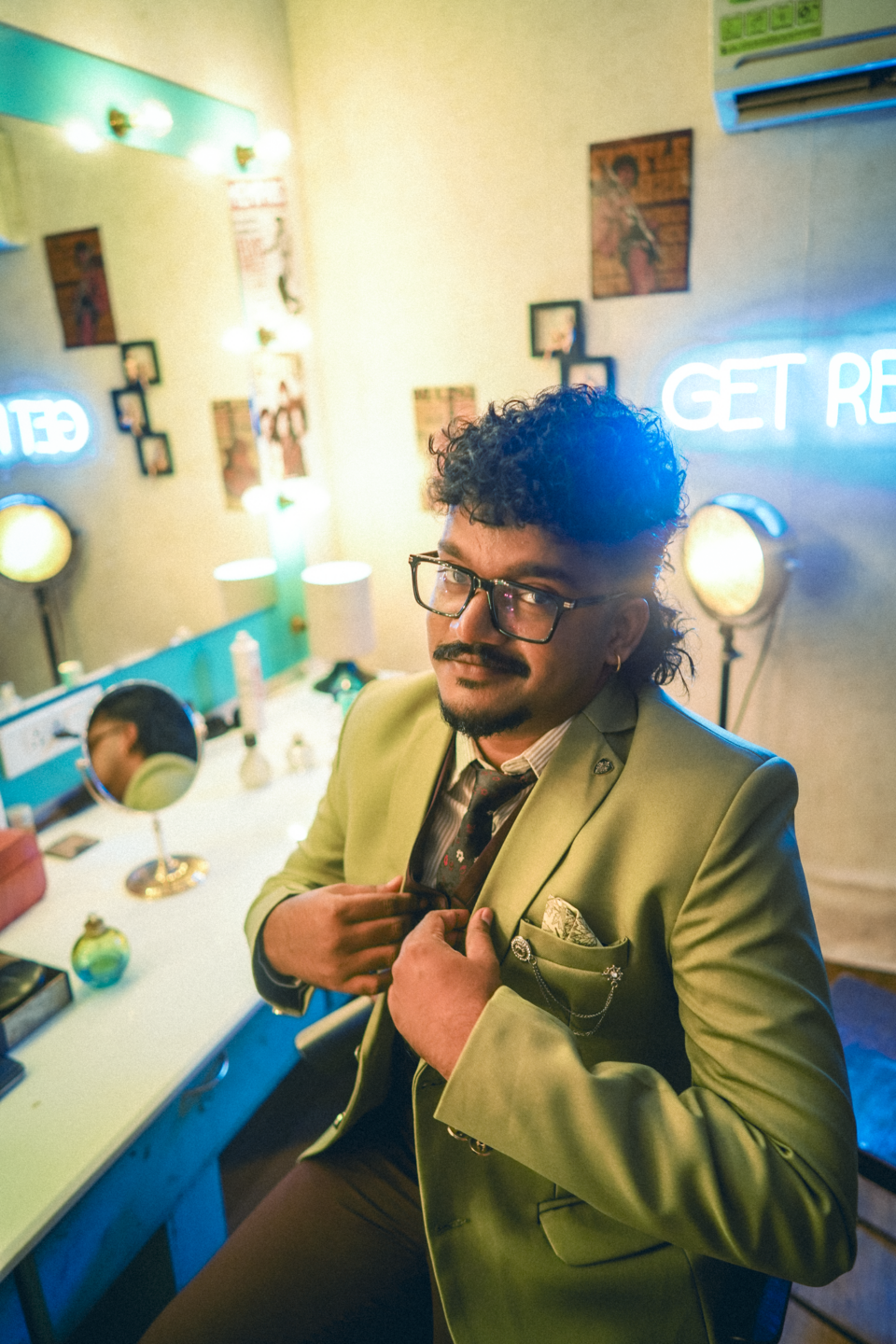
Malayalam hip-hop artist ThirumaLi. Photo: Courtesy of the artist
In the music video for his breezy romantic rap song “Kulasthree,” Kerala hip-hop artist ThirumaLi and his longtime producer ThudWiser are sat in an old Mercedes, outside an ancestral home and he looks every bit styled like a Nineties Mollywood star.
With the black oval-rimmed sunglasses and a polo T-shirt, they shuffle through beats until they find one that transports them even further back in time. With an enchanting flute and Carnatic percussion elements, “Kulasthree” kicks off with proclamations of love, even as ThirumaLi and ThudWiser are now dressed up like royalty amid a tharavad – an ancestral home in Kerala. “It’s actually hip-hop and classical music blended together, but also a fusion of two cultures, something that switches from South India to totally modern hip-hop and R&B. It turned out to be something beautiful,” ThirumaLi tells Rolling Stone India.
While the rapper says it wasn’t fully intentional to look like a Nineties Malayalam star, the goal was to shoot in a tharavad to create a sense of nostalgia. His next release – “Nonsense” – was more socially conscious in its anti-alcohol and drug abuse messaging, but also mined nostalgia. Released via Saregama Malayalam, the track produced by Jay Stellar samples “Kiliye Kiliye” composed by Ilaiyaraaja and sung by S. Janaki for the 1983 film Aa Rathri.
Rapping since 2013 and making it his career by 2018, ThirumaLi is among the few who has led Malayalam hip-hop to the globally-recognized level it’s reached now, thanks to songs like “Malayali Da,” “Avastha,” “OMKV” as well as more recent bangers like “Pacha Parishkari.” Working with everyone from Hanumankind (“Ayyayyo”) to Fejo and Dabzee (“Sambar”), he admits he’s seen an “exponential growth in the listening base” for rap music from Kerala. He says, “What we usually consumed were movie songs, and maybe Tamil songs and Hindi songs. But over the last couple of years, the audience’s tastes are changing.”
Considering that “Kulasthree” has racked up over 10 million YouTube views and 13.4 million Spotify streams and “Nonsense” has just over 600,000 views on YouTube after its release in February, it’s understandable when ThirumaLi says the Kerala audience is “the best in the entire country right now.” He explains, “Whether it’s listening to music or movies, this crowd is very open and very accepting.”
Even a conscious song like “Nonsense” striking the right balance between playful yet hard-hitting rap to drive the message against substance abuse, ThirumaLi says he wrote it because it’s something that “affects the current generation.” He adds, “Currently, rap music is more about style, swag and some things have changed, but I think it can also be used for great things like educating the audience.”
ThirumaLi is thoroughly established and thriving in his own lane, even as his contemporaries and younger Malayali rappers might get tapped by the Kerala film music world. There are, at best, a handful of Malayali film songs that ThirumaLi has been a part of – “Naade Naattaare” from the 2021 film Operation Java is among them – and that’s intentional. “If I work in movies, it’s someone else’s ideas – there will be a story or concept I need to work on. In most cases, it’ll be fictional and in a rare case, if the movie has that type of concept, an important socio-political message will be there. Otherwise, it’s all about entertainment, and it’s commercial music that’s what the movies are doing,” he says.
Compared to that, there’s still plenty of freedom working with major labels like Def Jam India (who released “Kulasthree”) and Saregama, but independent releases are still his jam. “When I’m dropping [music] independently, it’s a full-fledged idea around my thoughts, or anything when I want to say,” he explains.
That’s not to say he wasn’t drawn to more reach that film songs and major labels can give him. “In the past years, I was actually chasing stardom and commercial value as an artist. Currently, I’m focusing on experimenting in music,” he says. Finding out that his audience was very accepting of whatever experiments he took on, ThirumaLi says he’s grown more confident to keep pushing the envelope and blending styles.
He’s also not being weighed down by industry expectations like releasing music to keep the metrics high. “I’m not thinking about releasing very consistently, but once I make something, that work should stay for a long time in people’s mind,” he says.