

Bitcoins
You are here: Home / Cryptocurrency News / Bitcoin Retail Demand Hits 2025 Low as Whales Accumulate

Bitcoin (BTC) retail demand has dropped to its lowest level since January 2025, according to CryptoQuant data. Crypto analyst Darkfost reported a sharp decline in sub-$10,000 BTC transactions.
At the same time, there is an increase in institutional demand. On-chain data indicates that institutions are buying at BTC’s current price levels.
Based on data across exchanges, Bitcoin was trading between $65,000 and $74,000 during the timeframe in question. This shows that there is a clear shift in the Bitcoin market structure. As opposed to being driven by retail traders, it is now increasingly being led by larger investors.

Bitcoins Retail Demand Weakens Across Important Metrics
Retail participation has remained minimal throughout the current cycle, according to CryptoQuant analyst Darkfost. Retail investors have also failed to show any form of sustainable rise in their demand for BTC, even when it was increasing in price.
Usually, retail investors increase their demand for Bitcoin during periods of high momentum. Currently, there appears to be less interest from retail investors in the Bitcoin market.
This difference may be indicative of waning speculative interest from retail investors. According to Darkfost, the launch of BTC Spot ETFs may have caused some of the retail demand to move into the institutional side of the market. As a result, retail activity may appear to be less active than usual.
Also Read | 10K+ Bitcoin (BTC) Wallets Show Buying Trend While Retail Remains Cautious
Bitcoins Outflows From the Exchange Suggest Institutional Buys
Kesmeci, another CryptoQuant analyst, stated that the Binance Bitcoin Netflow SMA30 has consistently demonstrated that there’s outflows from the exchange. According to the average daily volume, approximately $55 million worth of Bitcoin leave Binance every day.
During this time of outflows, the BTC price rose by 13.8%, or $9,000, from $65,000 to $74,000. Data from CryptoQuant indicates that most of the money leaving the popular cryptocurrency exchange is going into long-term storage wallets.
Bitcoins An Early Accumulation Zone
Market analyst Crypto Patel noted that the current on-chain data looks like an early accumulation zone. Historically, bull runs were preceded by similar setups. Profit/Loss Bands and Realized Price both indicate that investors’ positions are improving.
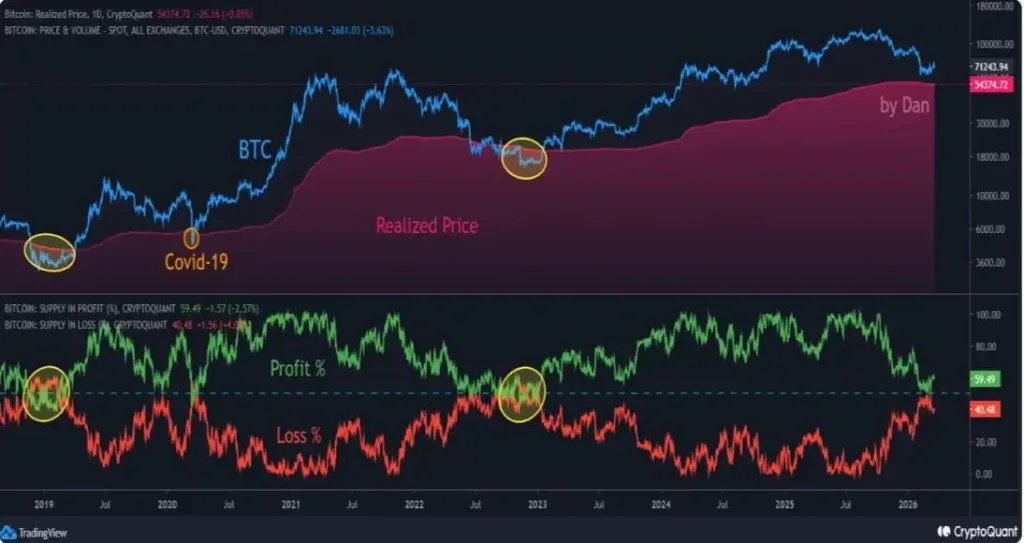
Meanwhile, analyst CW8900 stated that during the same timeframe, accumulation addresses experienced their largest inflow. This indicates that BTC whales are positioning themselves before a potential rise in the coin’s price.
Accumulation typically takes place when retail sentiment is either bearish or neutral. Market structure indicates two different investor behaviors.
Yesterday, the this cycle’s largest $BTC inflow to the accumulation address occurred.
Whales are still accumulating.
Once their accumulation is complete, a full-scale rise will begin. pic.twitter.com/CdqD6arqgN
— CW (@CW8900) March 21, 2026
Retail investors appear to be cautious as they are fearful of the current macroeconomic environment and past volatility. Institutional investors are using ETFs and on-chain accumulation strategies to gain exposure to Bitcoin.
The differences in these behaviors create an imbalance in supply and demand that may cause the BTC price to increase. Analysts will monitor whether retail demand returns as BTC approaches key resistance levels.
This article contains market analysis and price predictions. These are not guarantees. Crypto markets are volatile. Always DYOR. Not financial advice.
Also Read | Bitcoin Dominance Hits 58–64% Resistance as Sideways Price Signals Altcoin Shift

About Paul Adedoyin
Paul Adedoyin is a Financial Correspondent at Tronweekly with over four years of experience covering the cryptocurrency and digital asset sector. His work focuses on Bitcoin, altcoins, and DeFi, alongside crypto regulation and policy, blockchain technology, Web3, Layer 2 ecosystems, and AI-blockchain developments. He verifies reporting through primary sources such as official filings, regulatory statements, court records, and on-chain data to ensure accurate, fact-based coverage. His work has been featured on platforms like U.Today and CryptoMode.
Paul Adedoyin Read More