

Tennessee Governor Bill Lee has signed a bill into law that will officially ban the use and installation of cryptocurrency ATMs and kiosks in the southeastern US state, leaving only a matter of weeks for companies to be in compliance.
Lee signed Tennessee House Bill 2505 into law on April 13, making the installation of a cryptocurrency kiosk a Class A misdemeanor starting on July 1. The reclassification of the machines as illegal under state law would potentially put operators and businesses hosting the machines at risk of up to 11 months and 29 days in prison and a $2,500 fine.
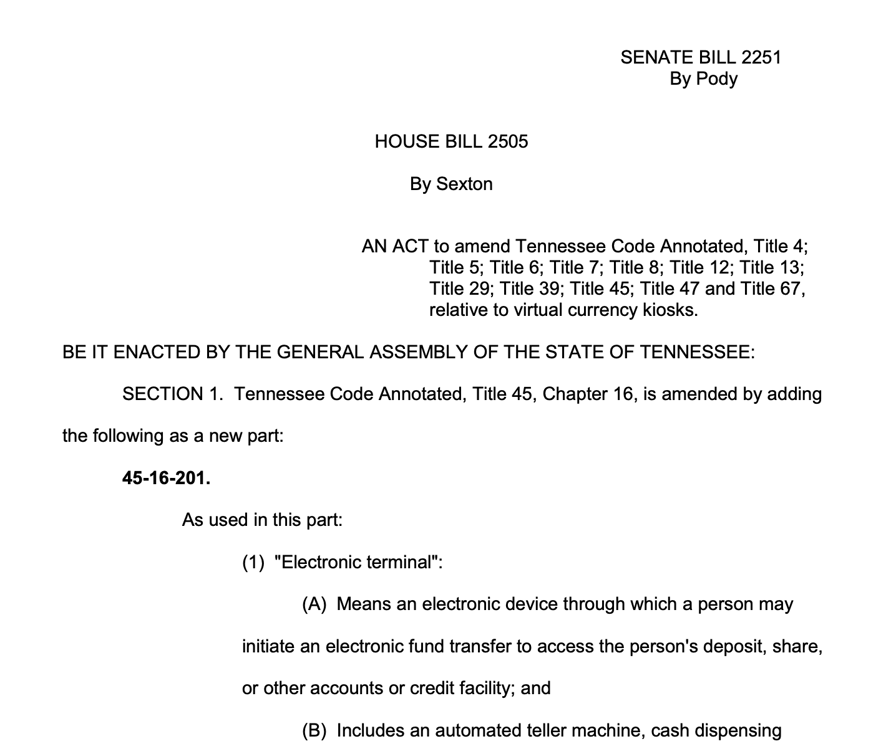
Source: Tennessee General Assembly
According to data from CoinATMRadar, there were more than 570 crypto kiosks and ATMs as of Monday, with operators including Bitcoin Depot and CoinFlip. Cointelegraph reached out to a Bitcoin Depot spokesperson for comment but did not receive an immediate response. The kiosk operator’s Nasdaq-traded shares closed down about 6.9% on Monday, according to Yahoo Finance.
The Tennessee law is just one of many state-level actions in the US targeting crypto kiosks in response to its residents being the victims of scams and other illegal activities. A Massachusetts town banned the machines earlier this month, and Minnesota’s State Senate recently advanced a bill that could ban crypto kiosks across the state.
Related: Massachusetts city to weigh crypto ATM ban, citing financial risks
“Virtual currency kiosks have become a gateway for scammers to exploit Tennesseans, especially our seniors, with little hope of recovering their money once it’s gone,” said Tennessee House Speaker Cameron Sexton, who sponsored the bill.
FBI reported Americans lost $11B to crypto scams in 2025
The US Federal Bureau of Investigation (FBI) said that cryptocurrency and AI-related scams were “among the costliest” for Americans in 2025. Its annual internet crime complaint report released in April cited more than 13,000 complaints related to crypto ATMs and kiosks last year, resulting in more than $389 million in losses.
Some of the types of scams involving ATMs include tricking people into sending Bitcoin (BTC) or other cryptocurrencies to an address by pretending to be a family member in need of assistance, or an authority figure claiming the individual needs to send money to avoid arrest or pay off a debt.
Magazine: AI-driven hacks could kill DeFi — unless projects act now
Cointelegraph is committed to independent, transparent journalism. This news article is produced in accordance with Cointelegraph’s Editorial Policy and aims to provide accurate and timely information. Readers are encouraged to verify information independently.
Read More
Cointelegraph by Turner Wright