

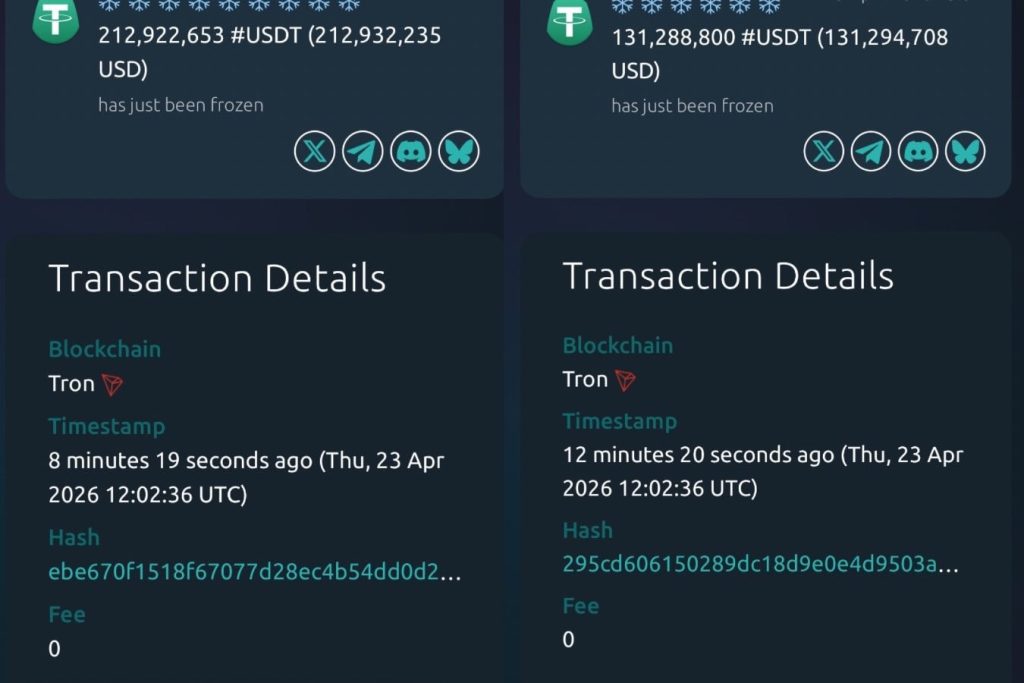
Tether, the leading stablecoin provider, has announced the largest asset freeze in its history by blocking more than $344 million in USDT.
This is as part of a collaboration with U.S. Treasury’s Office of Foreign Assets Control (OFAC) and federal law enforcement authorities.
Tether Supports Freeze of More Than $344 Million in USD₮ in Coordination with OFAC and U.S. Law Enforcement
Learn more: https://t.co/PFMCimX9hV— Tether (@tether) April 23, 2026
Confirmed in an official statement, this freeze is almost double the value of any other similar action by Tether (the previous record here was set at $182 million last January), highlighting both the growing size of these types of intervention and the increasing importance stablecoin issuers play in global financial regulation. The frozen assets are directly linked to unlawful behavior, Tether stated, reiterating that it is an active regulatory partner and not just a passive infrastructure provider.
Hundreds of Countries Feature New Global Enforcement Network
The recent operation further emphasizes the broad reach of Tether’s cooperation with global law enforcement. The company says it has partnerships with over 340 agencies in 65 countries, indicating a truly global enforcement network that is deeply integrated. Since then, Tether has assisted in over 2300 investigations around the globe (1 200 involving U.S. authorities alone).
This underlines the volume of Tether’s business with regulators and investigators alike, cementing it as an important player in crypto enforcement. In total, Tether claims to have stopped $4.4 billion worth of “criminal activity” associated assets from coming onto its platform. In an increasingly litigious cosmos, this rising tally signals a warning sign, as stablecoin issuers take on greater roles as gatekeepers to uncover and limit illicit transactions. It also reflects a wider industry shift away from initial resistance to active cooperation with regulators, illustrated by the partnership between Tether and international agencies in this case.
Addresses Linked to Scam Activity Identified on the Tron Network
The frozen funds reportedly had ties with purportedly suspicious transactions on the TRON blockchain. Two Tron addresses were pinpointed as key to the freeze, according to analysis shared via Twitter by SolanaFloor.
JUST IN: The two Tron addresses tied to Tether’s $344 million $USDT freeze appear to have been used in scam related activity, including shady Facebook posts and documents, with one linked to a fake $75 billion contract and another to a $BTC for $USDT scam promising 10% instant… pic.twitter.com/4ccc7voDWz
— SolanaFloor (@SolanaFloor) April 23, 2026
These addresses are believed to have taken part in various scams, including scammy social media projects abandoned by miners. The first was said to be on a fake $75 billion contract and the second was one address that had posted an offer for Bitcoin in exchange for USDT, promising a ludicrous 10% return on investment.
This is part of an act of ever more sophisticated crypto fraud that takes advantage of both blockchain infrastructure and also social engineering. Tether and its partners were able to identify and freeze these funds, effectively shutting down the active schemes, preventing additional losses and further dissemination of fraudulent activity.
Stablecoin issuers emerge as the backbone of crypto compliance; Tether’s action encapsulates a more expansive paradigm shift in crypto where stablecoin issuers are becoming stewards of financial integrity. In contrast to fully decentralised assets, USDT is a kind of stablecoin that can be frozen or have restrictions put on it, meaning the issuers has an unusual power to interfere in a suspicious transaction. This puts companies like Tether at a crossroads of innovation in blockchain technology and traditional financial regulation.
Even though decentralization is a key tenet of cryptocurrency, the need to address all sorts of nefarious activity has resulted in a more sophisticated process which combines technical evolution with regulatory oversight. This is an example of how parts of crypto can, paradoxically, be more secure, as in Tether’s case when they partnered with OFAC and other authorities. At the same time, this introduces interesting questions about the tradeoff between control versus decentralization because the ability to freeze accounts implies some level of central authority that is not present in completely decentralized systems.
Powerful Freeze Sets New World Record, Signals Escalating Repression
The breadth of this freeze should send a message that the era of small-scale enforcement in crypto is over, and that pies are becoming more coordinated. The former is almost double Tether’s last record, so illicit activity and the means to combat it appear to be both on the rise at once.
And for regulators, this operation highlights the power of public-private partnerships. While the regulator, for crypto companies, points to growing demands for them to work with officials and adopt robust controls.
The engagement of several agencies from various jurisdictions likewise suggests a more streamlined transnational directive towards the enforcement of anti-money laundering legislation in nebulous digital asset markets. As global transactions become easier, the methods of enforcing are adapting to this new complexity.
This path is anticipated to continue, with more large-scale interventions almost certain as monitoring technologies and collaborative frameworks evolve.
The need for security versus decentralization represents a tightrope that the industry must walk.
While Tether expands its enforcement capabilities to tap into Soak, the wider crypto landscape grapples with a more unyielding hurdle, balancing decentralization ethos with entreats for safety and regulatory scrutiny.
The flip-side is that these $344 million freeze protect users and deter malicious actors. On one hand, they call attention to the centralization present in some parts of the ecosystem, specifically stablecoin issuance.
For users and investors, these developments highlight the need for due diligence and awareness, together with an evolving institutional role within crypto markets.
In essence, Tether’s most recent action serves as a stark reminder of this fact, as the future of cryptocurrency will more than likely play out under a hybrid model where decentralized innovation lives side by side with centralized controls aimed at safeguarding safety and trust.
The industry’s ability to strike that balance will determine the extent and legitimacy of its long-term adoption as enforcement actions become larger and more widespread.
Disclosure: This is not trading or investment advice. Always do your research before buying any cryptocurrency or investing in any services.
Follow us on Twitter @nulltxnews to stay updated with the latest Crypto, NFT, AI, Cybersecurity, Distributed Computing, and Metaverse news!
Read More
Will Izuchukwu