

Climate Change, Development & Aid, Environment, Featured, Global, Headlines, Sustainable Development Goals, TerraViva United Nations, Water & Sanitation
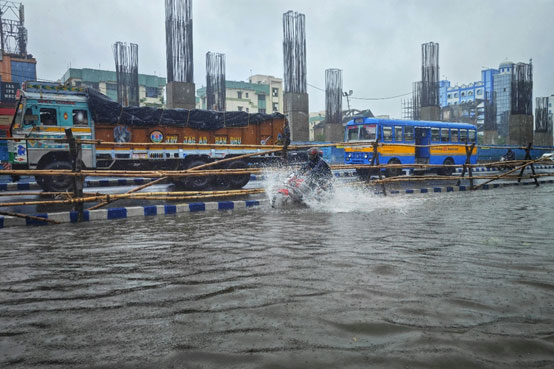
A motorcycle rider riding through flood in Kolkata, India. Cities should transform into sponges to absorb flood as part of climate adaptation. Credit: Pexels/Dibakar Roy
BANGKOK, Thailand, Apr 13 2026 (IPS) – As the Pacific recovers from a severe cyclone season and Asia braces for the monsoon, flood readiness has become a defining test of sustainable urban development.
The Asia and the Pacific 2026 SDG Progress Report signals a hard truth: while poverty reduction, health and basic infrastructure have advanced, the region is regressing on climate action, disaster resilience and biodiversity—areas now decisive for long-term development.
The widespread flooding across the region in November 2025 was not merely a weather event; it was a warning and a new baseline. From Hat Yai to Colombo, dense urban districts were underwater for days, exposing millions of people and billions in assets to cascading disruption.
Across the Asia-Pacific region, climate extremes are intensifying, increasing water inflow to drainage systems by over 53%. In coastal areas, flooding can halt transport, isolate communities, delay emergency response and lead to saltwater intrusion that damages agriculture and freshwater supplies.
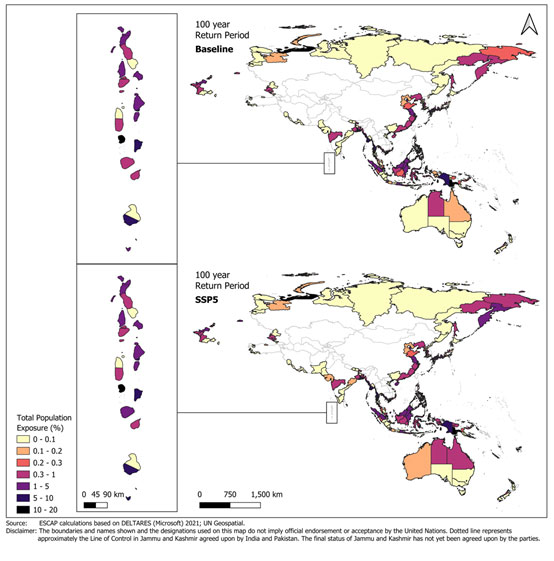
ESCAP’s analysis (Figure 1) examines how these threats are expected to continue to increase in the region’s low-lying river deltas, small island nations and rapidly growing coastal cities. For example, Seenu Atoll in the Maldives is expected to face a six-fold jump in population exposure to coastal flooding by 2050.
Looking across the region, Jiangsu Province in China, West Bengal in India, Khula and Marisal Divisions of Bangladesh, and Bến Tre and Bạc Liêu Provinces of Viet Nam are all expected to see hundreds of thousands of people exposed along their respective coastlines in the next 25 years.
Figure 1 – Percentage of People Exposed to Coastal Flooding of 0.5 Meters and Above in States/Provinces Across the Asia-Pacific Region and in Atolls of the Maldives (2018 Baseline vs. 2050 RCP8.5).
In the face of these risks, cities become engines of growth only when they are resilient. So, why do many cities across the Asia-Pacific region find themselves underwater while others weathered the storm with far less disruption? The answer lies in whether cities treat rain as a resource or as waste
Traditional “grey” systems, such as pipes, pumps and channels, aim to move water out fast. In a nonstationary climate and denser urban fabric, this is no longer sufficient. Sponge city design blends green-blue-grey systems (permeable surfaces, parks, wetlands, bioswales, green corridors) with modernized drainage to capture, store, and safely release rainfall at the source.
China’s national Sponge City Initiative (launched in 2015) built on international practice and showed how integrated planning can retrofit districts and guide new growth to manage water where it falls. The logic is simple: expand infiltration and storage, reduce peak runoff and use engineered conveyance when and where needed.
Results from early adopters are tangible
In Wuhan, sponge city measures contributed to a 50% reduction in locations experiencing overflow and pipe overloading during high flow years. Over the life of assets, green-blue systems can cost significantly less than like-for-like grey expansions, while delivering co-benefits that traditional drains cannot: cooler neighborhoods, improved air quality, biodiversity and accessible public space.
For cities facing rising loss and damage under SDG 11.5 (deaths, affected people and economic losses), sponge city programmes generate a resilience dividend—not just a flood fix.
Sponge city thinking is also evolving toward smart hybrid infrastructure
Nature-based systems are being coupled with engineered assets and digital tools, such as digital twins, to model urban hydrology and optimize performance in real time, enabling city planners to simulate rainfall scenarios, forecast flood hotspots and manage infrastructure adaptively, thereby improving the effectiveness of sponge-city interventions.
This pairing turns static drainage into adaptive urban water management, essential as rainfall intensity and patterns shift, reducing and managing risk through early warning, community preparedness and basin scale controls.
Urban resilience is also ecological
The Asia-Pacific region is home to an estimated 30–40% of the world’s wetlands, yet only around 22% are formally protected. As wetland buffers are drained or reclaimed, cities lose natural absorption, filtration and surge moderation, just as extremes intensify. Protecting and restoring urban and peri-urban wetlands is therefore core infrastructure policy, reinforcing SDG 15 while directly advancing SDGs 11.5 and 13.1.
Sponge city approaches are not a panacea. Their effectiveness can be constrained by governance capacity, implementation scale and maintenance requirements, land availability and high-density development. They must therefore be complemented by robust end-to-end early warning systems and coordinated disaster risk management frameworks.
To this end, ESCAP supports countries across the region by providing regional and national risk analytics through its Risk and Resilience Portal, enabling policymakers to integrate climate and disaster information directly into development planning.
These analyses and tools are tailored to regional and country needs, such as ClimaCoast, which focuses on coastal multi-hazard and socio-economic exposures. These initiatives are complemented by targeted financing from the Trust Fund for Tsunami, Disaster and Climate Preparedness, through programmes that strengthen coastal resilience in Asia and the Pacific. Together, these initiatives aim to reverse the current regression in resilience related SDG targets and help safeguard sustainable development in the region’s high risk hotspots.
Asia and the Pacific region can no longer rely on drainage systems built for a different climate and century. By adopting sponge city principles, Asia Pacific cities can embed resilience into everyday urban life—a development imperative, not just a technical shift.
Strengthening urban resilience is essential to advancing SDG 11 and SDG 13 and protecting hard won development gains that too often wash away when floods strike.
Temily Baker is Programme Management Officer, ESCAP; Leila Salarpour Goodarzi is Associate Economic Affairs Officer, ESCAP and Elisa Belaz is Consultant, ESCAP
IPS UN Bureau
Temily Baker – Leila Salarpour Goodarzi – Elisa Belaz
Read More