

Music
Books & the Arts
/
March 31, 2026
How Anton Corbijn’s photographs shaped the history of rock music.
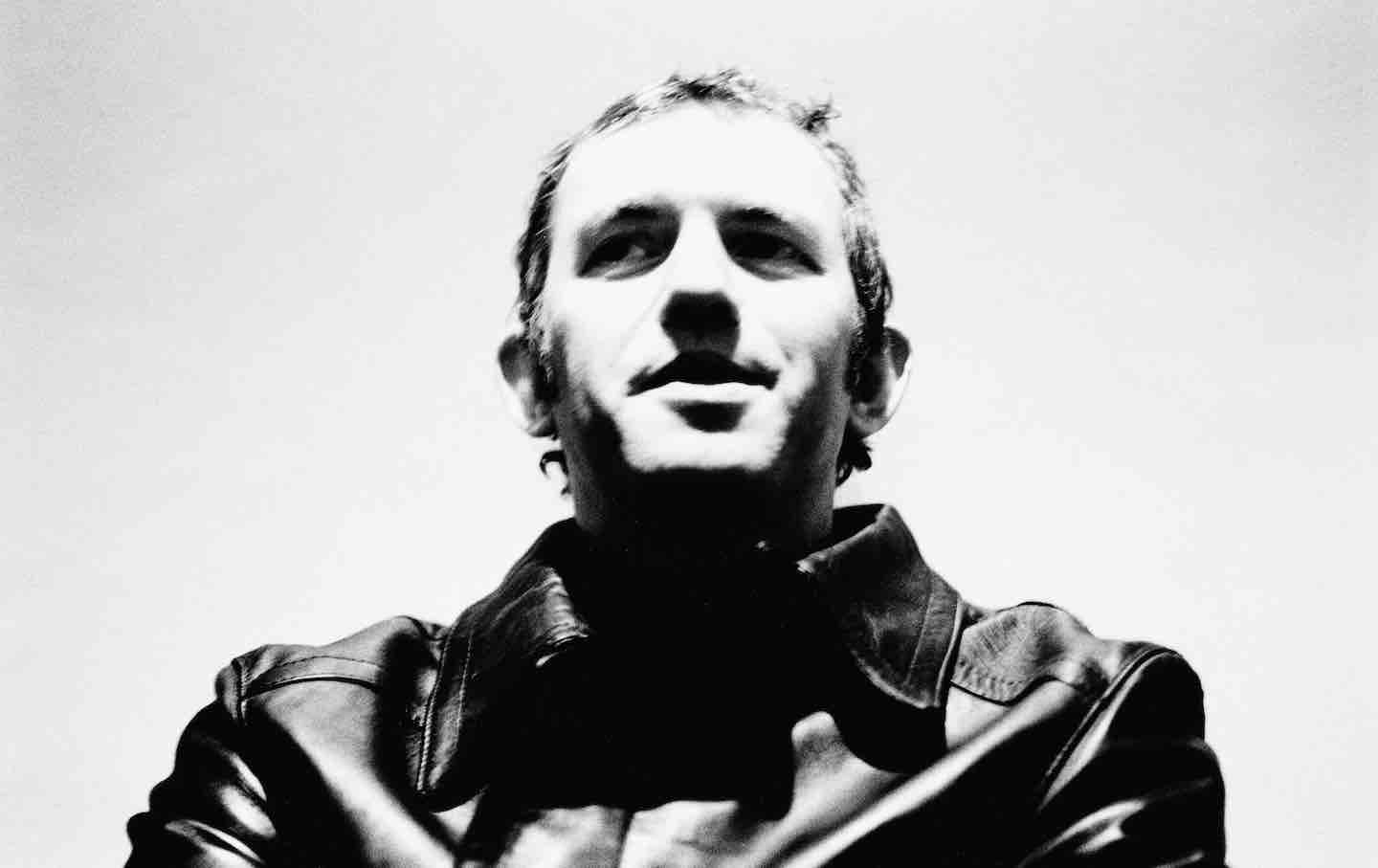
Anton Corbijn.
(Rune Hellestad / Corbis via Getty Images)
In the beginning, the rock star was an alluring figure, and a subversive one. Teenagers screamed at him; their parents resented him. No one thought about him.
Books in review
Now rock stars are people (pronouns: any) whose life stories win National Book Awards and Oscars. We look at them differently than we did when the archetype first emerged sometime in the middle of the 20th century; their aspects reward close examination, we’ve decided. Photographers and filmmakers, much more than music critics, have elevated rock musicians to the status of serious cultural figures. Whether or not this was inevitable, it’s worth remembering that it was not always the case.
The Dutch photographer Anton Corbijn has probably done more than anyone—any nonmusician, at least—to effect this transformation. Best known for his pictures of Joy Division, U2, Depeche Mode, Tom Waits, and Nick Cave, among others, Corbijn stood out from the generation of rock photographers that preceded him in the pages of magazines like Rolling Stone, Creem, and the New Musical Express.
“Anton is a cross / between a Russian / spy, a gigolo, a priest / and a painter,” Waits writes in some verse contributed to Corbijn, Anton, a new book that accompanies a career-spanning retrospective last year in Stockholm. “If he did not / have his camera on / him, he could take / your picture with / a cigar box and / you would love it.”
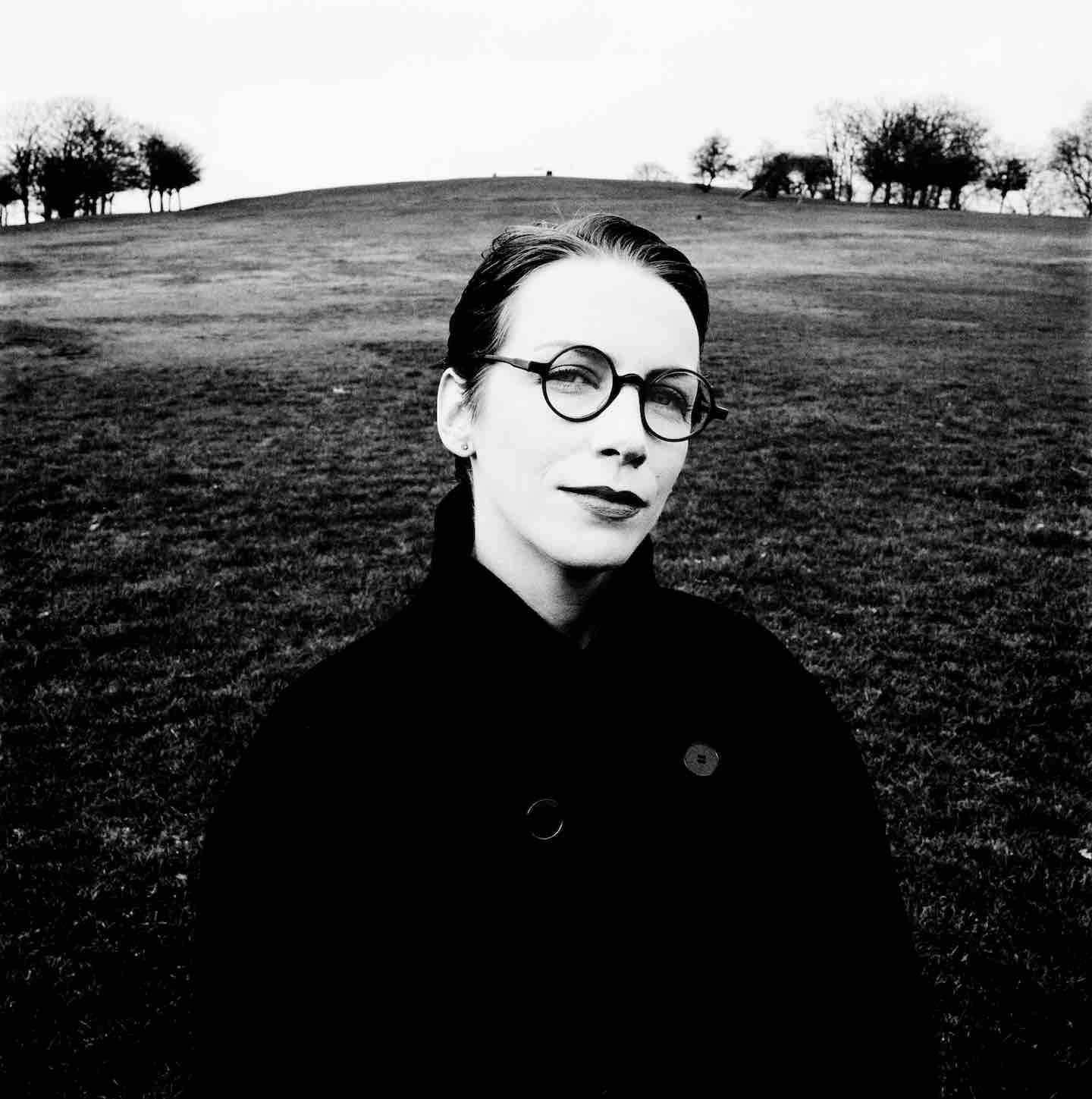
The classic Corbijn image is a black-and-white portrait in which the black runs very deep in places, like charcoal, and contrast is operative. Ink costs meant that only the really popular bands had their pictures printed in color in the rock press of old, so Corbijn’s style developed as a kind of DIY gesture in itself: His first great insight, when he was still in his mid-20s, was to recover the expressiveness of black-and-white photography and its possibilities for evocative composition and interpretation where rock was concerned.
This approach was also well-suited to the look of the musicians Corbijn matured alongside and photographed for British outlets starting in the late ’70s. These were pale men, mostly, who wore dark clothes and called themselves Fad Gadget, Echo and the Bunnymen, Einstürzende Neubauten (which means “collapsing new buildings”). He would do for Depeche Mode what Rembrandt did for the Drapers’ Guild of Amsterdam.
Current Issue
Corbijn’s backgrounds, meanwhile, are usually outdoors—if not city streets (like the cover of Nick Cave’s The Boatman’s Call), then striking, expansive natural landscapes (like U2’s The Joshua Tree). Grain is not unwelcome; nor is the subject being just out of focus. On the right side of one of Corbijn, Anton’s spreads, Sinéad O’Connor is folded over herself and snarling like a furious, torsoless sprite. On the left side, she’s a blurry, beautiful floating skull.
Corbijn’s rockers aren’t the pinups of wood-paneled basements and teenagers’ bedrooms, in other words. Rarely do they hold their instruments. The actress Samantha Morton calls them “Ghosts from the future or the past” and likens them to “drawing[s] in an ancient cave.” While Corbijin likely engaged most of these subjects in the midst of a PR cycle, his renderings recall the interesting weirdos stumbled upon by mid-century American documentary photographers like Robert Frank. Many look encountered as much as posed, on their way to some mysterious business.
Most of all, though, they look like actors in stills from old film digests like Cahiers du Cinéma—memorable characters in movies that never existed, only their soundtracks.
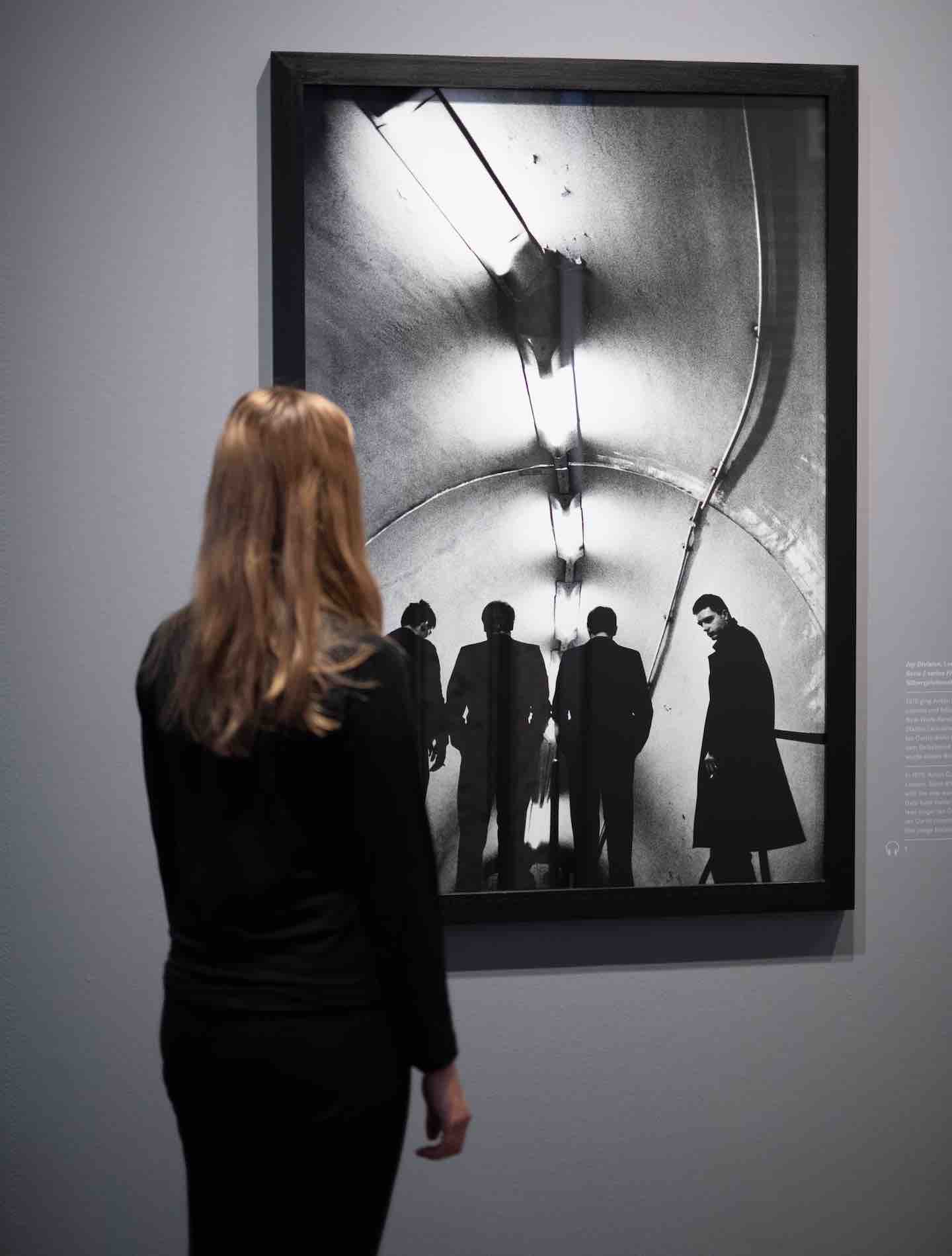
In the case of one musician, though, the movie was made, because Corbijn did it himself. Ian Curtis of Joy Division—whose death by suicide in 1980, at age 23, received little notice in the United States at the time—haunts these pages. Indeed, Curtis’s legacy and Corbijn’s career have been joined since the day in November 1979 when the photographer met Joy Division at a London tube station. A well-known frame from that shoot appears in this book: Curtis stands slightly apart from his bandmates at the top of a staircase, half-turned toward Corbijn while the rest of them face away.
Joy Division’s influence on other musicians and on Corbijn’s own aesthetic can be seen in later photos, like an afterimage. Even before Curtis died, Corbijn’s pictures, along with the inspired graphic design of Peter Saville, helped establish the band’s mystique. In another contribution to this book, the U2 bassist Adam Clayton recalls the appeal of Corbijn’s “early images of Joy Division, who were from the provinces, alienated misfits in their neo-European uniforms.” Clayton’s band was not the only young group to seek out Corbijn at least in part because they hoped to look as serious as Joy Division had—to absorb some of that paint left in Corbijn’s brush.
Music Popular
“swipe left below to view more authors”Swipe →
In 1980, Corbijn photographed Curtis sitting alone on a smoke break. He looks exhausted, like a man at the end of a long workday. It is one of the very few pictures in the book that seems truly candid, and Corbijn’s reminiscences of this period suggest why. His English was still so poor that he could hardly have directed Joy Division even if he’d wanted to. “I couldn’t understand what they were saying, couldn’t express myself,” Corbijn later admitted. “I never had a real conversation with Ian Curtis.”
And yet Curtis stayed with him. In 1988, Corbijn—now in demand as a director of music videos—returned to his images of Joy Division for the rerelease of their 1980 single “Atmosphere.” In the video, figures cloaked in black and white robes, like monks, carry massive enlargements of Corbijn’s pictures through the desert. The effect is bizarre and poignant, the filmmaker appropriating his old photos as religious icons.
Corbijn would go on to make dozens more videos for Nirvana, Coldplay, Metallica, and others, but with “Atmosphere” he demonstrated, as no one before him had done quite so explicitly, that the rock photographer could be more than a documentarian, just as the studio producer was more than a technician. Corbijn was Joy Division’s collaborator. Photography, filmmaking, and music don’t just complement each other, he knew, but compound one another to make something greater than the sum of their parts. Myth, in this case.
The last image of Curtis in Corbijn, Anton is actually of Sam Reilly, the actor who played him in the biopic called Control that Corbijn made in 2007. In “Atmosphere,” Corbijn revisited his Joy Division photos in the shadow of Curtis’s death, while Control allowed him to step inside those images, as it were, and move around again in Curtis’s life. It also gave him the chance to do what his English couldn’t in 1979: talk to Joy Division, direct them.
The result this time was more uncanny, almost like the “generative fill” function of AI that expands the borders of still images beyond their original dimensions. Control is more tasteful and informed than that; the director had firsthand knowledge of the material he was reanimating. Something was lost, though, in the mastery that Corbijn now wielded over his subjects. The pictures in 1979 were a collaboration between a photographer and a band set at some distance from each other by language—the sublime product of mutual incomprehension. Control was all Corbijn, which meant that it was beautifully shot, in black-and-white (“because that’s how I remember that time”), and punishingly serious.
Many fans welcomed Control as a sober corrective to 24 Hour Party People, Michael Winterbottom’s earlier film that treats Curtis’s death within a comedy about the Manchester music impresario Tony Wilson (played by another Corbijn portrait subject, Steve Coogan). Winterbottom’s depiction is reverent—it even incorporates the “Atmosphere” video—but the lens of Control is fixed on Curtis’s pain. (Corbijn’s version of Wilson has negative charisma, as if levity were an anachronism or an intrusion to be cropped out.)
As a service to its subject’s memory, Control was an act of what the Catholic Church calls “supererogation”—beyond what is necessary. Fans, critics, and Corbijn himself were pleased with it, but a line in this book sounds like self-incrimination: “Looking back at my body of work from the ’70s and ’80s,” he says, “I feel that it could not be bettered, by me in any case.”
In 2018, a set of old snapshots showing an office Christmas party surfaced on a Manchester-area Facebook group. They were taken at the Macclesfield Manpower Services Committee, a civil-service agency to assist people with disabilities in finding employment. Ian Curtis is in them—this was his day job—grinning and making merry with affectionate colleagues who look straight from 1970s central casting, no less cinematic than the cast of Control. It isn’t just Curtis’s suicide that makes these photos so touching, but their contrast with nearly every other extant image of him, including Corbijn’s. They are glimpses of a man unencumbered by his illness or his legacy.
It is a strange irony of Corbijn’s relationship with Curtis that, having applied such vision to commemorating this man who suffered and dignifying his pain, Corbijn inadvertently gave so much meaning to a few snapshots of Curtis taken in a moment he was happy.
One of Corbijn’s criteria for a worthy portrait is that it has to be different from anything that already exists. He will follow this standard to high drama and occasionally, at the same time, to whimsy, presenting his subjects as familiar strangers. (Corbijn does have a sense of humor: In a group portrait here of the Rolling Stones, they wear tall, crooked stovepipes borrowed from The Cat in the Hat, like Whoville’s Newest Hitmakers.)
A second criterion is that the portrait must say something about its subject. For the viewer, the achievement of this is instant, a vibe: History, memory, and the viewer’s own experience with the subject’s work are all involved. Corbijn’s genius for collaboration lies here. The original Kodak slogan was “You Press the Button, We Do the Rest.” Corbijn does a lot more than press the button, but John Lydon, Tina Turner, Kris Kristofferson—they’ve done plenty too, and we see (and hear) it in their faces.
Finally, Corbijn believes a good portrait must say something about Anton Corbijn. Reviewing this half-century of photographs, you understand the qualities of light and dark that appeal to him. You also see an artist who has always known that rock stars are so much more than idols. They endure like movie characters, and they die just like us.
Music Your support makes stories like this possible
From illegal war on Iran to an inhumane fuel blockade of Cuba, from AI weapons to crypto corruption, this is a time of staggering chaos, cruelty, and violence.
Unlike other publications that parrot the views of authoritarians, billionaires, and corporations, The Nation publishes stories that hold the powerful to account and center the communities too often denied a voice in the national media—stories like the one you’ve just read.
Each day, our journalism cuts through lies and distortions, contextualizes the developments reshaping politics around the globe, and advances progressive ideas that oxygenate our movements and instigate change in the halls of power.
This independent journalism is only possible with the support of our readers. If you want to see more urgent coverage like this, please donate to The Nation today.
Andrew Holter
Andrew Holter is a writer and historian living in Chicago. He is the editor of Going Around: Selected Journalism by Murray Kempton (Seven Stories Press).