

Music

More than performance: For Judith Sephuma, singing in her mother tongue, Sepedi, is not just an artistic choice; it’s an emotional one. Photo: Supplied
The first thing Judith Sephuma tells me is that she hasn’t really stopped moving.
We’re speaking in the aftermath of yet another busy weekend of performances, the kind that have defined much of her life for more than two decades. And even now, with a new album out, her calendar is shaped by the stage rather than the studio.
“We have been performing,” she says, her voice warm, measured, familiar. “But not for the album.”
It’s a curious thing to hear from an artist who, in 2025, released When Winter Fades, her latest body of work and her first in five years. But Sephuma is deliberate about how she introduces new music into the world.
“Whenever an album is released, I believe it’s very important to create a space where people can come and listen,” she explains. “Because you are introducing the new music to them. We don’t take for granted
the fact that people know us. I don’t take for granted the fact that people know me.”
It’s a statement that reveals as much about her humility as it does about her philosophy. Often described as the queen of Afro jazz, with a career that has spanned continents and earned her multiplatinum success, Sephuma approaches her audience as something to be nurtured, not assumed.
“I love live performances so much,” she continues, “that I create a space for them to come sit down and listen to the music and then they can connect with it.”
That space, for When Winter Fades, is still to come: a live concert set for 4 July at Emperors Palace, where she will perform the album with her full band. It’s a moment she speaks about with anticipation.
To understand why that moment matters so much, you have to consider the scale of what Sephuma
has built.
Since the release of her debut album A Cry, A Smile, A Dance in 2001, a triple platinum landmark that introduced her voice to the world, she has remained one of South Africa’s most enduring and influential musicians.
Her sound, a seamless blend of jazz, Afro-soul and gospel, has travelled far beyond the country’s borders, filling venues across Europe, the US and the UK.
Long before that debut, she was stepping onto significant stages. In 1999, she performed at Thabo Mbeki’s presidential inauguration and sang for Nelson Mandela, moments that would come to
symbolise the beginning of a remarkable journey.
By 2002, she was performing at the North Sea Jazz Festival in the Netherlands alongside global icons, her voice carrying the weight of something much larger than a
single career.
Over the years, she has shared stages with artists like Chaka Khan, Al Jarreau and Kenny G, while carving out her own path through albums that move fluidly between genres. Her gospel work, particularly The Experience Live in Concert and Power of Dreams, expanded her reach even further, revealing an artist unbound by category.
The five-year gap between Power of Dreams (2019) and When Winter Fades (2025) might suggest a pause but Sephuma resists that framing. “There’s no particular reason for
the gap,” she says. “I don’t even want to call it a break. I didn’t want to record because I was focusing a lot on performing.”
For her, this is the rhythm of a jazz artist’s life, less dictated by release cycles and more by the organic flow of creativity and experience.
“A lot of the times when the schedule is really busy, we don’t have time to think about the album,” she explains. “And we are never under pressure to keep releasing because we release full albums.”
Those years were not quiet. They were filled with movement: touring across Europe and Dubai and most notably, working with Hans Zimmer on a global orchestral production. “It was the best experience ever,” she says, her voice lifting slightly. “Life-changing. We had 36 shows. We went everywhere. I think I know all of Europe now.”
It’s hard to imagine what that kind of exposure does to an artist. The scale of orchestras, the immersion in cinematic sound, the constant movement across cities and cultures. But Sephuma carries it back into her own work as texture. “I’ve been doing a lot of orchestra work,” she says. “It’s what I’m used to. Live band, big bands, orchestras. That’s what I come from.”
When she finally returned to writing, it wasn’t with a sense of urgency but with something closer to instinct. “I wrote some of the songs when I was on tour,” she says. “Then I came back, I started working on them very seriously. There was this need for me to record the album.”
When Winter Fades was recorded live in studio with her full band, the only way she knows how. “That’s the only way I record,” she says. “That’s the best way to record for us, especially for jazz. We like that personal touch. When we come together and play the music, we feel connected to it better.”
That sense of connection runs through the album’s central idea, captured most clearly in its lead single, Back to Love. “Back to Love reminded me of A Cry, A Smile, A Dance,” she reflects. “I realised I had missed that sound.”
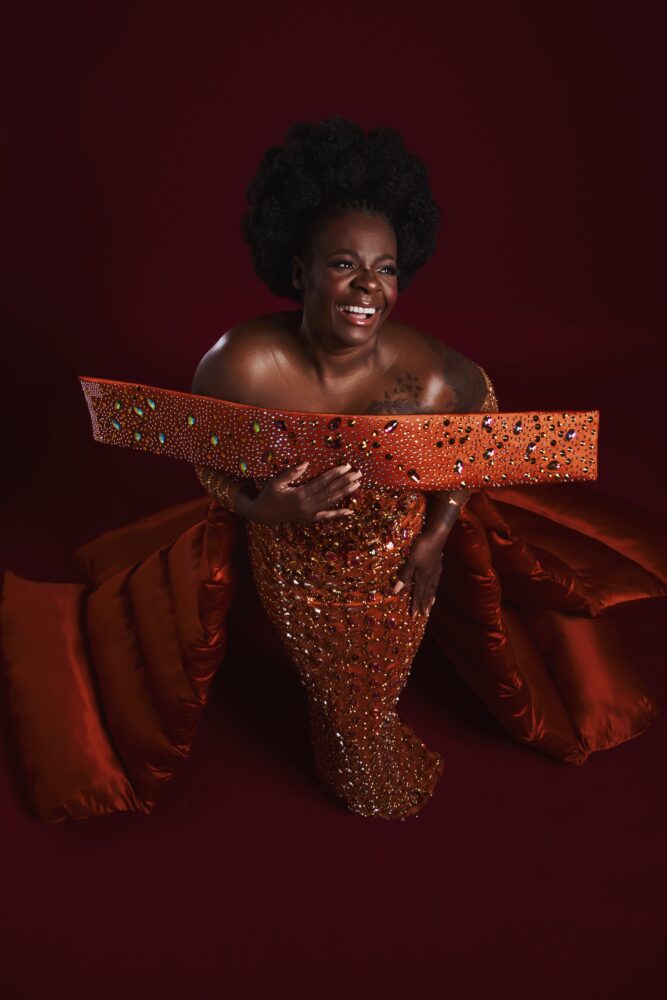
For Sephuma, that return is also linguistic and cultural. Singing in her mother tongue, Sepedi, is not just an artistic choice; it’s an emotional one. “I love singing in my mother tongue,” she says, her voice softening. “I can’t wait for people to sing along. That’s going to excite me the most.”
There is a moment on the album that reaches even further back, beyond her own catalogue, into the lineage of South African music itself.
Her tribute to Miriam Makeba isn’t framed as homage in the conventional sense. It’s something
more personal. “For me, her music raised me,” Sephuma says. “She feels very present.”
She recalls encountering Makeba’s music as a young singer, drawn first to its melody, then to its meaning. “She represented Africa,” she says. “She will forever remind us of the uniqueness and how precious we are as Africans.”
The tribute track emerged organically in the studio, carried by a rhythm that felt unmistakably rooted in the continent. “We were just in the studio and then Makeba came out,” she says. “It was to remind ourselves of how precious she was and the legacy that she left us.”
The word “legacy” comes up often in our conversation, not as an abstract idea but as something urgent and unfinished. “You know, in South Africa, when we pass on our music stops being played enough on the radio,” she says. “It’s almost like we fade.”
It’s a quiet observation but it carries weight. For her, the work of an artist does not end with the creation of music; it extends into how that music lives on. “I would like all our legacies to remain,” she says. “Even if it means it’s being heard on the radio or talked about. Because we save lives with our music.”
She pauses, then continues, more emphatically: “Our legacy cannot just die when we die.” What she envisions goes beyond remembrance to continuity. Music that continues to teach, to shape and to guide future generations.
“The content of our music is building,” she says. “It’s life-changing. It will teach the generation to come about discipline, respecting yourself, respecting others. That’s the legacy.”
It is perhaps this sense of responsibility that complicates the titles often given to her. When I mention the label “queen of Afro jazz,” she acknowledges it but carefully. “I honour it and I respect it so much,” she says. “But I don’t want it to limit me.”
For Sephuma, artistry extends beyond genre, beyond recognition, into something closer to service. “We are life changers,” she says. “There are young girls, young boys who
look up to us. We become mothers of the nation.”
It’s a striking phrase but she delivers it without theatrics, as though stating something obvious. “I believe I am,” she adds. “I mother a lot of kids that I have not even given birth to.”
In her view, music creates a bond of trust, one that carries expectations. “When they see me, they trust that I can change their lives,” she says. “So it goes beyond queening.”
For the moment, Sephuma’s focus is clear: the upcoming live performance of When Winter Fades.
“It’s a personal thing for me,” she says. “I’m doing it myself. When they come to my show it’s going to be fireworks. It’s magic.”
In many ways, the word “magic” feels like the simplest way to describe what Judith Sephuma has sustained over the years.
She has moved through eras of South African music, from the early post-apartheid years to the present, carrying with her a voice that remains unmistakable. Soft, melodic, deeply rooted, yet endlessly adaptable.
But perhaps what defines her most is not the sound itself but the intention behind it.
“We save lives with our music,”
she says.
It’s a simple statement but it lingers long after the conversation ends. A reminder that for Judith Sephuma, music has never just been about performance.
It is about what remains.