

Email does a lot more work than it usually gets credit for. In Sinch Mailgun’s latest Email Impact Report, 78% of respondents say email is either “very” or “extremely” important to their organization’s success, which tells you pretty quickly that this is still a core business channel.
The problem is that importance and measurability are not lining up. Only 46% of marketers say they can measure the ROI of promotional email, while 43% say they can measure the ROI of transactional email.
So email sits in an odd spot for a lot of teams. It is clearly essential, but its contribution is still harder to quantify than many marketers would like.
ROI is there, but visibility is uneven
Once you look at the marketers who can measure ROI, the returns get hard to ignore. Among respondents who measure promotional email ROI, 60% say it delivers more than $10 for every $1 spent.

Transactional email looks just as strong, and in some cases, a little stronger. Of the marketers who measure transactional email ROI, 62% report returns greater than $10 for every $1 spent.

There is also a smaller group reporting especially high returns. Thirteen percent of respondents measuring promotional email ROI and 14% measuring transactional email ROI say they generate more than $40 for every dollar spent.
That creates a familiar martech tension. The channel appears to perform very well for teams with the right measurement in place, while everyone else is left trying to fill in the blanks.
Transactional email has an easier case to make
Part of that gap comes from the nature of the messages themselves. Transactional emails include things like order confirmations, fraud alerts, password resets and shipping updates, so they are usually tied to specific customer actions and are easier to connect to outcomes.
Promotional email is a little more complicated. It often works across longer buying cycles and multiple touchpoints, making attribution harder even when the emails are clearly influencing engagement or conversions.
That complexity shapes how teams evaluate performance. When attribution gets messy, marketers tend to fall back on the metrics that are easiest to access and explain.
That is one reason ROI can remain fuzzy even in organizations that depend heavily on email. The performance may be there, but the proof is often incomplete.
Recommended Articles
Marketers still lean on easier metrics
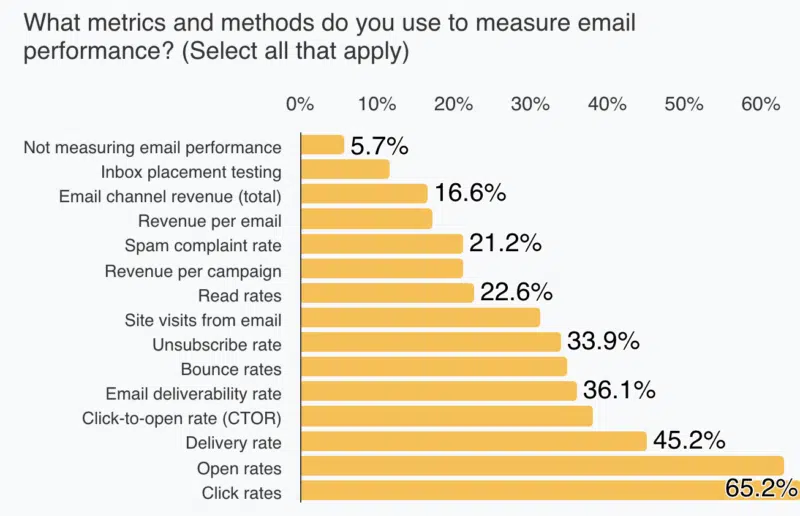
The report shows that many teams are still using engagement measures as their primary guide. Click rates, delivery rates and deliverability metrics remain common ways to judge email performance, even though they do not always show direct business impact.
Your customers search everywhere. Make sure your brand shows up.
The SEO toolkit you know, plus the AI visibility data you need.
Start Free Trial
Get started with

The real problem is that revenue-based measurements are less common. Fewer organizations are tracking metrics like total email channel revenue or revenue per campaign, making it harder to connect email activity to financial outcomes.
That makes it harder when marketers try to argue for more resources. The report identifies budget constraints as the biggest barrier to investing in email, while proving ROI, prioritizing email and dealing with strategy or integration issues also hold teams back.
Taken together, the findings describe a channel that is still central to business success and often highly profitable, but not measured well enough for many teams to defend it as aggressively as they probably should.
Source: Sinch Mailgun Email Impact Report. (No registration required)
MarTech is owned by Semrush. We remain committed to providing high-quality coverage of marketing topics. Unless otherwise noted, this page’s content was written by either an employee or a paid contractor of Semrush Inc.

Constantine von Hoffman is senior editor of MarTech. A veteran journalist, Con has covered business, finance, marketing and tech for CBSNews.com, Brandweek, CMO, and Inc. He has been city editor of the Boston Herald, news producer at NPR, and has written for Harvard Business Review, Boston Magazine, Sierra, and many other publications. He has also been a professional stand-up comedian, given talks at anime and gaming conventions on everything from My Neighbor Totoro to the history of dice and boardgames, and is author of the magical realist novel John Henry the Revelator. He lives in Boston with his wife, Jennifer, and either too many or too few dogs.
Related Articles

Marketing budgets are increasingly driven by what teams can defend, not just what performs, concentrating spend in a small set of trusted channels.
New research shows AI is already shaping product discovery and purchases, but a large gap between usage and trust is creating new challenges for marketers.
As confidence in AI ROI slips, it’s a sign marketers are raising the bar — and getting serious about real business value.
55% of U.S. B2B marketers reported budget increases in 2026, while 37% were asked to make cuts — most of them under 10%.
Read More
Constantine von Hoffman