

Project Hail Mary Takes On an Impossible Mission—and Pulls It Off
Ryan Gosling’s hilarious, thrilling, heartstring-pulling new movie is an implausible crowd-pleaser.
By
Dana Stevens
Enter your email to receive alerts for this author.
Sign in or create an account to better manage your email preferences.
Project Hail Mary is the first movie Phil Lord and Chris Miller have co-directed since 2014, the year of both The Lego Movie and 22 Jump Street. In the years since, the pair has produced and/or written a string of successful films, including the innovative animated feature Spider-Man: Into the Spider-Verse and its sequel Spider-Man: Across the Spider-Verse. (They also, briefly, worked as directors on Solo: A Star Wars Story, before their improvisatory, comedic approach ran afoul of the franchise’s dark side.) As writers and producers, Lord and Miller have consistently shown an ability to infuse familiar IP with fresh life, thanks to their solid storytelling instincts and wry sense of humor; when they’re co-directing, they have a near-magical ability to transform what could easily feel like second-rate material. They’re cinematic upcyclers, assembling bits and bobs of pop culture in novel and engaging ways.
Among those bits and bobs in the case of Project Hail Mary is the sci-fi novel of the same name by Andy Weir, who also wrote the book that served as the source material for Ridley Scott’s The Martian. (In both cases the novels were adapted by screenwriter Drew Goddard.) But Lord and Miller’s adaptation of Weir’s book about a stranded space traveler who befriends an equally lonely alien also weaves in thematic strands from Christopher Nolan’s Interstellar, Steven Spielberg’s E.T. and Close Encounters of the Third Kind (including a charming citation of the five-note musical theme associated with that film’s space travelers), and even such oddball contributions to the genre as the 1999 spoof Galaxy Quest or 2024’s Spaceman, in which Adam Sandler’s schlubby cosmonaut bonds with a spiderlike being voiced by Paul Dano.
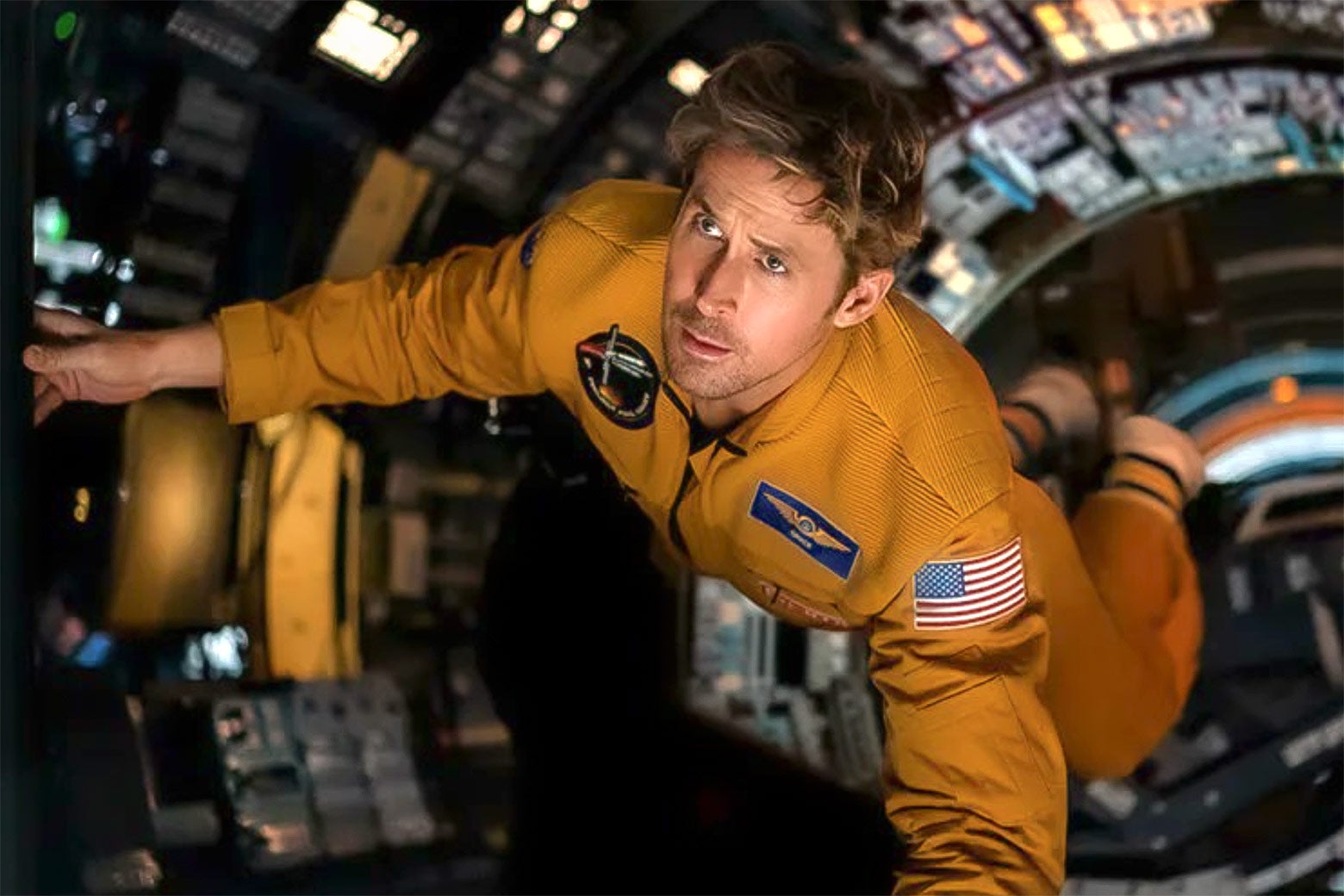
The existentially lonely astronaut is by now a science-fiction archetype; in fact, this movie’s star, Ryan Gosling, has already played one in Damien Chazelle’s 2018 Neil Armstrong biopic First Man. So it’s all the more to the filmmakers’ credit that they’ve created such a specific and memorable lead character in Gosling’s Ryland Grace. In the opening sequence, as he awakens from an induced coma to find himself the sole survivor of a three-person mission to the outer solar system, there are huge holes in Ryland’s memory. He has to piece together evidence from the personal effects he brought on board to figure out who he is, much less where he is. (After a mystified scan of the wall of data readouts at the pilot’s station, he assesses his position as “Neptune-ish.”) As his memory returns, a series of flashbacks will clarify to both him and us how this apparently unqualified civilian found himself aboard a spaceship tasked with saving Earth from destruction.
In one of these early flashbacks, we see Ryland as a middle school science teacher—the all-too-rare fun kind who’s skilled at cultivating his students’ curiosity about the workings of the world around them. But the kids in his class are more anxious than excited when news breaks of a disturbing astronomical phenomenon: A little-understood interstellar life form, a kind of light-eating bacteria called “astrophage,” has been going around the galaxy consuming the light from various stars, including our sun. Unless this process can be interrupted, our planet will quickly fall into a global ice age that could kill much of Earth’s population and plunge what remains into civilizational chaos.
The scene in which Ryland explains this scary truth to his students, while reassuring them that the world’s best minds are diligently at work on the problem, serves a dual purpose: It establishes Ryland as an exceptional communicator of complex ideas, a skill he will need later on, and it clearly lays out the film’s microscopic antagonist for the audience. Ryland’s extensive knowledge of this arcane field is also the reason why, whether he wants to or not, he is about to become one of those “best minds.” After earning a doctorate in molecular biology, he was ejected from academia because of his radical theories about precisely the kinds of life forms that are now showing up on our doorstep. Who’s ridiculing whose dissertation now?
As he’s preparing to head home after school, Ryland is accosted by Eva Stratt (played by Anatomy of a Fall and The Zone of Interest’s Sandra Hüller), the commander of an admirably well-managed international task force that’s racing against the clock to research, comprehend, and vanquish the sunlight-munching critters. Stratt’s single-minded commitment to confronting the threat is admirable, but her by-any-means-necessary approach often leads her to make ethically questionable decisions in pursuit of saving the solar system; later, she’ll forcibly conscript Ryland into joining the ultra-high-stakes space mission named in the title. But first, with the initially reluctant help of a security guard named Carl (Lionel Boyce, or, as viewers of The Bear will exclaim in delighted unison, “Marcus!”), Ryland builds a crude model that helps illuminate key aspects of astrophage science to the committee. The viewer’s comprehension of what exactly these duct-tape-and-plywood constructions demonstrate may be slightly fuzzier, but this is the kind of sci-fi process movie that allows for some give-and-take around the edges.
The scenes that take place on Earth can feel oddly underpopulated, since Ryland is the only character to get much of a backstory. (Though Hüller’s no-nonsense mission leader gets one glorious, unexpected moment at a karaoke mic that will put true Hüller-heads in mind of a similar scene of amateur belting in Toni Erdmann.) But the central relationship in Project Hail Mary, the element that drives both the film’s suspense and its drama, is the interspecies friendship that develops between Ryland and the lone surviving inhabitant of a massive spacecraft he bumps into on his travels. A sort of crab-shaped rockpile with no discernible face but an expressive pair of clawlike hands, the being Ryland comes to call Rocky is a far cry from your average big-eyed, vaguely humanoid little green man. Their first encounter, in a kind of crystalline tube the creature has created to connect their two spaceships, evokes a sense of vintage Spielbergian wonder, while the subsequent scenes in which the two stranded travelers find ways to communicate tap into a Star Wars–esque vein of interspecies buddy comedy.
Eventually Ryland rigs up a computer translator that turns Rocky’s whirring, clacking sounds into spoken English. The two discover that their missions share the same goal; Rocky’s home planet, Erid, is also threatened with extinction by the astrophage. Using Ryland’s knowledge of microbiology and Rocky’s uncanny ability to fabricate complex metallic structures, they begin to work together to jury-rig a solution to the problem facing the galaxy.
What makes the scenes between Ryland and Rocky work—and go on and try to resist the appeal of the two when they, for example, dance out a nonverbal greeting upon their first contact—is in large part the fact that the extraterrestrial is not a CGI-generated image but a practical-effects puppet. He was designed by the acclaimed puppeteer and theater performer James Ortiz, who also provides Rocky’s voice. The tangible physicality of the resulting creation means that Gosling has a genuine scene partner to play off, rather than interfacing with a green screen to deadening effect (see: George Lucas’ early-2000s Star Wars prequels). It doesn’t hurt that, of all the actors currently working, Gosling is perhaps the most puppet-friendly, a shoo-in as a human host on The Muppet Show. In Project Hail Mary, Gosling nails the assignment of holding the viewers’ attention through long stretches of solo screen time, then shifting into odd-couple comedy without either upstaging or being upstaged by his wisecracking boulder buddy.
For a $200 million sci-fi epic, Project Hail Mary feels surprisingly lived-in, almost homey. The arguably baggy runtime of two hours and 36 minutes allows for the kind of quirky character moments—that karaoke song, for example—that more action-centric sci-fi thrillers rarely provide. The cinematography, by Dune’s Greig Fraser, balances the vast emptiness of outer space with the cluttered, bachelor-pad intimacy of the ship’s interior; the production design by Marvel veteran Charles Wood evokes the genuine otherness of the Eridians’ mineral-based technology. And the costume designers, David Crossman and Glyn Dillon, have outdone themselves in supplying science-nerd T-shirts and frumpy cardigans for Ryland’s shipboard wardrobe.
Like the space mission named in its title, Project Hail Mary pulls off a seemingly impossible task, combining big-budget Hollywood spectacle with small-scale craft. The story it tells, of two lonely but intrepid problem-solvers bridging the huge cultural distance between them to collaborate on addressing a shared cosmic threat, is unabashedly humanistic and hopeful, not to mention timely. Though Lord and Miller never draw an explicit analogy between the sun-eating astrophage and the real-life problem of climate change, the movie they’ve created poses very relevant questions about the ethical challenges inherent in being a citizen of planet Earth—or, presumably, planet Erid.
The central role that friendship plays in the resolution of Project Hail Mary’s conflict might be criticized for being sentimental, though by the time the movie reaches its coda, any sappiness feels earned by the audience’s deep investment in the characters. But if what you’re in need of right now is a bighearted, almost unreasonably entertaining piece of old-school moviemaking, the only message you need to take away from Project Hail Mary is that dudes rock—even, and maybe especially, rock dudes.
Get the best of culture
Get the best of movies, TV, books, music, and more.
Dion Schildgen
Read More