

Successful vs. unsuccessful crisis responses differ primarily in speed and transparency. Organizations that act quickly, acknowledge the issue, and show visible accountability stabilize trust, while those that delay or respond defensively often trigger immediate backlash.
Research from Harvard Business Review shows that early, transparent communication significantly reduces long-term reputational damage.
Examples like the Tylenol recall and the Deepwater Horizon disaster illustrate these dynamics, demonstrating that how a company responds is just as important as the crisis itself. Keep reading to explore the specific strategies and patterns that separate effective crisis management from poor crisis handling.
Rapid Response Essentials: Mastering The First 120 Minutes
These takeaways highlight the critical steps and common pitfalls in early crisis management, showing how preparation and timing shape outcomes.
- Successful crisis responses prioritize swift acknowledgment, transparency, and authentic apologies within the first 60–120 minutes.
- Failures often result from deflection, inconsistent messaging, and prolonged silence that fuels speculation.
- Proactive planning and crisis simulation training can reduce response delays by up to 40%, helping rebuild stakeholder trust more effectively.
What Defines A Successful Crisis Response?
A successful crisis response acts quickly, communicates transparently, admits fault when necessary, and engages stakeholders on the platforms where backlash is most intense. Timing and clarity determine whether a crisis escalates or stabilizes.
In 1982, Johnson & Johnson faced the Tylenol tampering crisis and recalled 31 million bottles within days.
Leadership prioritized public safety over short-term profit, holding nationwide press conferences, demonstrating executive accountability, and introducing tamper-proof packaging. The case became a benchmark because it showed that matching actions with messaging can control reputational damage effectively.
Research from Harvard Business Review shows
“The actions of executives and their teams now, in the midst of this crisis, will significantly determine their fate.” – Harvard Business Review
Successful responses share key traits:
- Initial acknowledgment within 60 minutes on high-velocity platforms
- Transparent updates every 30–60 minutes during peak escalation
- Visible leadership through video statements or press appearances
- Clear timelines for corrective actions
Preparation is critical. Being prepared ensures that when a crisis hits, the organization responds decisively, protecting both trust and long-term credibility, while reducing the risk of panic-driven missteps that amplify the problem.
What Causes Crisis Responses To Fail?

Unsuccessful crisis responses typically fail because they delay acknowledgment, deny responsibility, or adopt defensive tones that escalate backlash instead of containing it. The 2010 BP Deepwater Horizon oil spill illustrates the consequences of poor communication.
Data from the U.S. Department of Justice demonstrates
“The oil spill was catastrophic for the environment.” – Department of Justice
CEO Tony Hayward’s remark, “I’d like my life back,” amplified public perceptions of empathy deficit and reinforced negative narratives. The crisis was not only operational, it was a communication failure, with tone-deaf messaging, delays, and breakdowns between agencies, regulators, and communities. Silence allowed frustration to spread globally.
A recurring failure pattern emerges:
- Issue breaks publicly
- Organization investigates privately
- Social media backlash intensifies
- Late corporate statement feels detached
Only after executive missteps became clear did leadership issue an apology and implement policy reforms.
Common elements of unsuccessful responses include:
- Corporate-speak blog posts instead of direct engagement
- Overconfident or defensive executive tone
- Failed deflection strategies and victim-blaming
- Fact-checking lapses under time pressure
These missteps erode investor confidence, trigger boycotts, and turn what could have been temporary reputational damage into structural, long-term harm.
Reddit’s Playbook: Go Where Critics Live
Reddit communities respond best to direct, native engagement and often reject external press releases posted elsewhere.
Discussions in r/PublicRelations highlight the value of “always-on” earned media goodwill, which acts as a buffer when crises arise and often reflects lessons documented in broader PR crisis handling case studies.
In 2025, Oura faced privacy rumors and chose a direct Reddit video response instead of relying solely on a corporate blog post. The initial blog post, written in corporate language, drew criticism. The follow-up video, platform-native and transparent, shifted tone and stabilized engagement.
A consistent formula emerges for effective Reddit crisis response:
- Direct leadership videos addressing the issue
- Plain language explanations without corporate jargon
- Open comment Q&A participation
- Early admission of uncertainty where facts are incomplete
Community spaces resist polished PR. They reward humility, transparency, and authenticity. Lessons from failures show that shutting down threads or redirecting users increases perceptions of secrecy.
Effective crisis communication must meet audiences where they gather, using the language and format those communities expect. This approach reinforces narrative control while reducing backlash in high-velocity, peer-driven platforms.
X Speed Rules: Update Or Explode
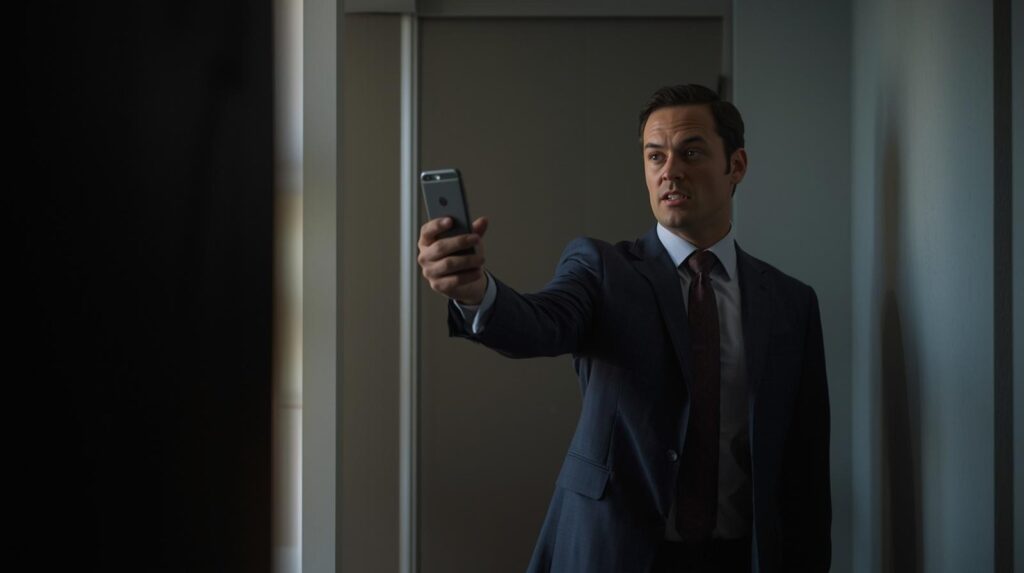
On X, speed dominates all other variables in crisis response. Viral outrage spreads in real time, and even small delays can allow rumors and misinformation to spiral beyond control.
Organizations that react quickly, transparently, and consistently can stabilize sentiment before negative narratives take hold, a core principle in effective PR crisis and reputation management.
Five core behaviors drive effective crisis management on X:
- Monitoring dashboards active 24/7 to track trending issues
- Pre-approved holding statements for immediate deployment
- Threaded updates every 30–60 minutes to maintain continuity
- Consistent messaging across all executives and spokespersons
- Clear, time-bound commitments for the next public update
Silence amplification risks grow exponentially on fast-moving platforms. Delays beyond four hours often allow misinformation to outpace official messaging, making rumor control significantly more difficult.
Preparation is key. Proactive crisis planning, multi-channel coordination, and anticipating audience segmentation help prevent internal leaks or contradictory statements from worsening the public narrative.
When these elements are missing, backlash compounds and spreads. On X, the difference between controlling a crisis and letting it escalate often comes down to how fast, consistent, and transparent the organization communicates from the first moments of disruption.
Youtube Reality: Plans Fail, Mindsets Win
Crisis plans often fail when leadership freezes emotionally or clings to rigid scripts disconnected from evolving facts.
Adaptation, rather than documentation, drives successful outcomes, especially when leaders study patterns from real diverse company crisis examples to understand how different scenarios unfold.
These exercises clarify authority, reduce communication breakdowns, and build confidence under pressure.
Two guiding principles stand out:
- Preparedness reduces panic.
- Leadership under turmoil requires visible calm.
Winning response patterns on platforms like YouTube include:
- Real-time executive visibility, showing accountability and leadership presence
- Flexible approval processes that allow rapid adjustments
- Data-backed updates to ensure accuracy and credibility
- Authentic engagement that resonates with audiences
Common failure patterns reinforce the consequences of rigid processes: strict adherence to outdated documents, inconsistent messaging, and over-reliance on formal approvals often lead to public mistrust. When documentation takes priority over situational awareness, communication falters, and credibility erodes.
Ultimately, the mindset of the leadership team, their adaptability, composure, and authenticity, determines whether a crisis escalates or is contained. Plans provide structure, but it is the people executing them who protect trust and guide organizations through fast-moving public scrutiny.
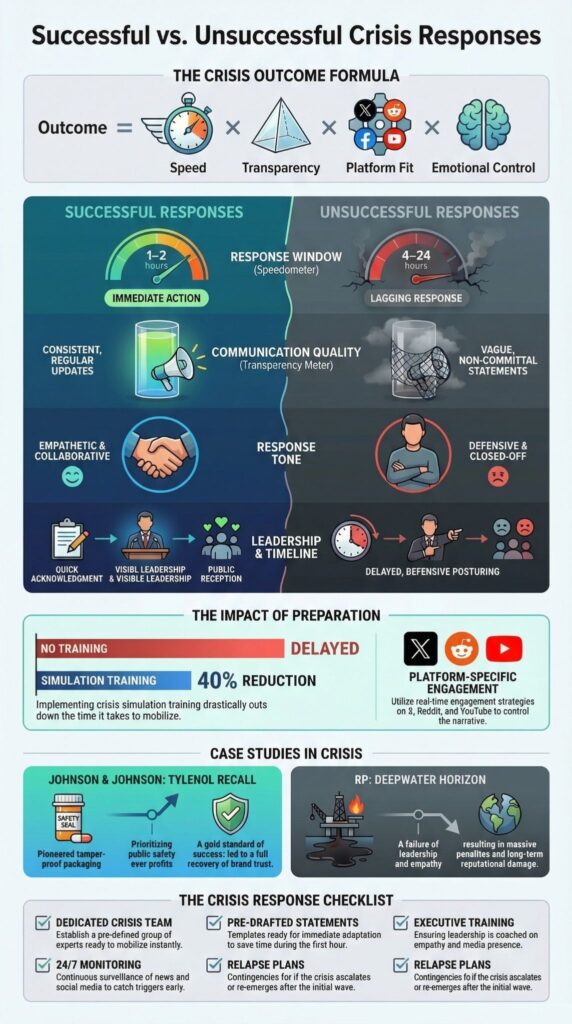
Key Differences Between Successful And Unsuccessful Crisis Responses
Credits : Crisis Response Coach
The main distinction lies in proactive, transparent engagement versus reactive, defensive delay. How quickly an organization acts, the tone it sets, and the preparation behind the response all influence outcomes.
Unsuccessful responses often compound the initial problem, creating long-term reputational and legal consequences.
Comparison highlights:
- Speed: Immediate acknowledgment stabilizes perception; delays allow rumors to dominate.
- Tone: Empathy and accountability build trust; defensiveness or dismissiveness fuels backlash.
- Preparation: Crisis simulation and monitoring support coordinated action; lack of readiness leads to reactive mistakes.
- Transparency: Regular, verified updates reassure stakeholders; vague statements or denial worsen distrust.
- Outcome: Effective responses rebuild stakeholder confidence; poor handling triggers long-term reputation audits and potential legal fallout.
| Aspect | Successful Responses | Unsuccessful Responses |
| Speed | Immediate acknowledgment within 1–2 hours | Delays beyond 4–24 hours |
| Tone | Empathetic, accountable, human | Defensive, promotional, dismissive |
| Preparation | Crisis simulation training + monitoring | Reactive crisis mistakes |
| Transparency | Regular verified updates | Vague statements, denial |
| Outcome | Stakeholder trust rebuilding | Long-term reputation audits and legal fallout |
The table shows that speed, tone, and preparation directly intersect with executive accountability and crisis outcomes. Preparation multiplies positive impact; delay multiplies damage.
FAQ
How do we avoid crisis denial pitfalls when facing public backlash?
We avoid crisis denial pitfalls by practicing swift crisis acknowledgment and full transparency in crises from the start. Silence amplification risks and deflection strategy fails often intensify social media crisis backlash and trigger boycott triggers.
Instead of poor crisis handling, we focus on response speed importance, accurate rumor control measures, and timely crisis updates. These actions protect stakeholder trust rebuilding and reduce the risk of visible crisis escalation examples.
What separates effective crisis response from crisis management failures?
The difference lies in preparedness vs panic and disciplined leadership in turmoil. An effective crisis response depends on proactive crisis planning, structured multi-channel coordination, and clear crisis communication strategies.
In contrast, crisis management failures usually involve reactive crisis mistakes, inconsistent messaging woes, and fact-checking lapses. When we demonstrate humility success factor and take ownership power moves, we prevent media response blunders and executive accountability crises.
How can we rebuild stakeholder trust after reputation damage control setbacks?
Stakeholder trust rebuilding requires authentic crisis apologies and successful apology tactics that pass clear apology sincerity tests. We must address executive missteps and ethical lapse recovery directly and avoid victim blaming errors.
Timely crisis updates, strong engagement authenticity, and proper planning for audience segmentation crises help stabilize customer loyalty retention, restore investor confidence dips, and improve employee morale crises after internal crisis leaks or external perception shifts.
Why do botched PR responses lead to long-term reputation audits?
Botched PR responses often create crisis timeline mishaps and serious communication breakdowns that fuel viral outrage management challenges. When we ignore cultural sensitivity oversights or global crisis variances, narrative hijacking prevention becomes difficult.
Overconfidence downfall and scandal suppression fails increase regulatory scrutiny handling and legal crisis entanglement. As a result, organizations must conduct long-term reputation audits because short-term damage limitation replaced a structured recovery roadmap.
How can we turn crisis escalation examples into brand recovery stories?
We can turn crisis escalation examples into brand recovery stories by committing to learning from disasters and applying failure autopsy lessons.
A thorough post-crisis evaluation, structured crisis simulation training, and detailed visualization crisis mapping help us identify pivot points crises. By applying resilience building tactics and encouraging innovation under pressure, we create credible turnaround narratives and sustainable recovery roadmaps supported by relapse prevention plans.
Preparation Is Your Best Defense
Crises expose slow reactions and unclear roles, leaving teams scrambling while trust erodes. The pressure, uncertainty, and missed opportunities mount quickly. Panic only makes the situation worse.
Using NewswireJet helps you act fast and maintain control. It streamlines sharing updates, reaches the right audiences, and turns preparation into confidence, so when trouble hits, your story stays on your terms.
References
- https://hbr.org/2020/03/are-you-leading-through-the-crisis-or-managing-the-response
- https://www.justice.gov/opa/pr/bp-exploration-and-production-inc-agrees-plead-guilty-felony-manslaughter-environmental
Related Articles
Buffy Stoval
Read More