

Bangladesh’s general election is unfolding against the backdrop of its most strained relationship with India in years, with diplomatic tensions spilling into visa suspensions, street protests and competing narratives over sovereignty and minority rights.
On Thursday, New Delhi declined Dhaka’s invitation to send election observers, even as approximately 400 international observers and 200 foreign journalists monitored the polls.
“We did receive an invitation to send observers. We have not sent our observers to Bangladesh to observe the elections,” Indian Ministry of External Affairs spokesperson Randhir Jaiswal said during a briefing in New Delhi.
Asked about India’s position on the vote, Jaiswal said New Delhi would assess the situation after the results were announced.
“Please wait a little. Once the outcome comes out, we will then see how we should assess it and form our understanding of it,” he said.
The election marks the first national vote since the August 2024 ouster of former prime minister Sheikh Hasina.
Following a student-led uprising that ended her 15-year tenure, she fled to India, where she sought refuge and remains in exile.
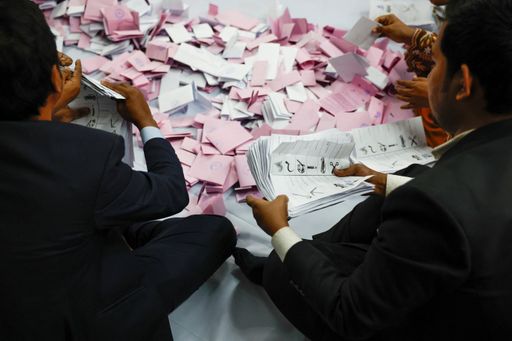
The Bangladesh Nationalist Party (BNP) is leading and is projected to win as counting continues, in a race widely seen as a referendum on the country’s political direction after months of upheaval.
Related
Important election
More than 127.6 million voters were eligible to cast ballots in an election that also included a referendum on constitutional reforms.
It is the first genuinely competitive contest in more than a decade, following the one-sided polls of 2014, 2018 and 2024, which were criticised by opposition parties as engineered outcomes.
The absence of Hasina’s Awami League — barred from contesting — has reshaped the political landscape.
The BNP, long repressed under the rule of pro-India Hasina, has returned as a major force.
Jamaat-e-Islami, previously sidelined, has also re-entered the electoral arena.
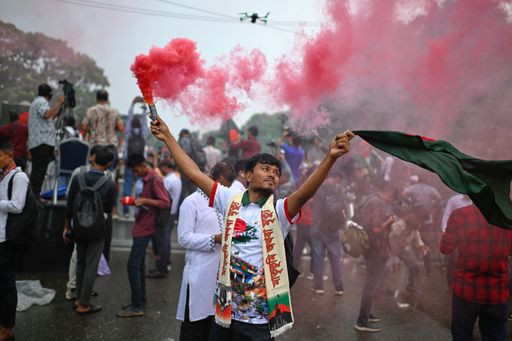
For many Bangladeshis, the vote represents the culmination of the July popular uprising that saw thousands of students take to the streets.
Around 1,400 people were killed during the crackdown, according to figures cited by activists, before Hasina fled on August 5, 2024.
The interim government led by Nobel laureate Muhammad Yunus pledged reforms, including judicial independence and banking oversight.
Related
Relations deteriorated
Tensions between India and Bangladesh have worsened steadily since Hasina’s departure.
Dhaka has demanded that New Delhi hand over the former prime minister, who was sentenced to death in absentia by Bangladesh’s International Crimes Tribunal in November 2025 for her role in the 2024 crackdown.
India has not complied.
Many in Bangladesh viewed India’s close support for Hasina — including its backing of her suppression of dissent, electoral irregularities, and human rights issues — as interference in internal affairs and as enabling democratic erosion.
Relations deteriorated further in December after the killing of student leader Sharif Osman Hadi, a vocal critic of India.
Protests erupted in Dhaka, including marches towards the Indian High Commission.
In India, far-right Hindu groups staged demonstrations outside the Bangladeshi High Commission in New Delhi following the lynching of Dipu Chandra Das, a Hindu man in Bangladesh.
Both governments summoned each other’s envoys in tit-for-tat moves.
Visa services were suspended on both sides.
The diplomatic strain has also extended into cultural and sporting spheres.
Commentators have described recent disputes over cricket participation and player removals as evidence that the rift has spread beyond formal diplomacy.
A test for regional stability
Despite the acrimony, analysts argue that the two countries remain deeply interdependent in trade, transit and connectivity.
The outcome of the election could determine whether relations stabilise or deteriorate further.
For now, Bangladesh’s vote is not only a domestic political milestone but also a pivotal moment for regional diplomacy.
As counting continues, both Dhaka and New Delhi are watching closely — aware that the result may shape the trajectory of their relationship for years to come.