

Over 60% of Asia-Pacific (APAC) businesses plan to increase investments in sovereign cloud and artificial intelligence (AI), recognizing their pivotal role in fostering growth and competitiveness, according to Accenture Research.
Over the past few years, AI has been seen as a next-generation technology capable of performing many tasks that humans can’t, such as data analysis, pattern recognition, and decision-making. On February 13, Accenture Research found that 62% of APAC organizations are looking to increase their sovereign investments in AI over the next two years. Meanwhile, China took over these investments at 75%, followed by Japan and ASEAN at 65% and 64%, respectively.
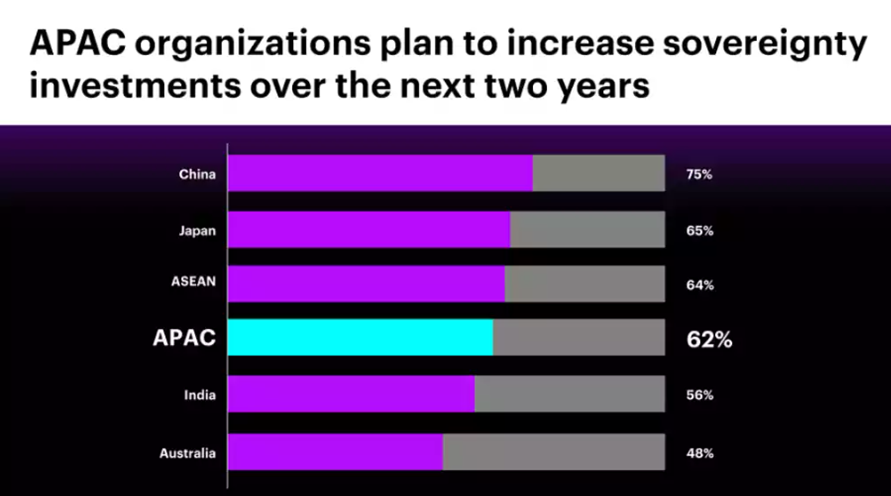
Sovereign AI refers to a nation’s capacity to develop and implement artificial intelligence using its own infrastructure, data, models, and talent, while also leveraging global technology ecosystems when beneficial. When executed effectively, it allows governments and businesses to decrease dependency risks, protect vital assets, and establish trustworthy AI foundations that promote long-term innovation and competitiveness.
Across APAC, governments and businesses are heavily invested in AI, with investment accelerating driven by clearer policy frameworks, rising investment appetite, and growing national focus on digital regulation and security.
“Organizations in Southeast Asia are aligned with APAC’s broader view on sovereign AI, with compliance, data security, and governance as top investment drivers,” said Ambe Tierro, country managing director and technology lead at Accenture in the Philippines. “With the broader adoption of AI in the Philippines, this outlook towards sovereign AI supports the national AI agenda and can further propel the innovation ecosystem in the country.”
According to Accenture Research, AI is applied mostly for data (58%), infrastructure (including cloud) (49%), security and governance (36%), applications (30%), and AI models (24%). Some drivers of sovereign AI include:
- Compliance with local regulation
- Control over critical data and AI models
- National security/industry requirements
- Operational continuity and resilience
- Innovation and local competitiveness
Accenture highlighted that, although investment in AI is increasing, only one in five organizations in the APAC region connects AI to successful innovation outcomes. Furthermore, many AI initiatives appear to focus more on risk mitigation rather than on creating value.
“Closing this gap—by extending sovereignty to where intelligence is created—is increasingly critical for building trusted, resilient, and high value AI at scale across the region. This is why many APAC leaders are now shifting toward more flexible sovereignty models that balance local control with global scale,” the report reads.
Hybrid sovereignty is key for APAC’s AI success
In the APAC region, governments are adopting diverse strategies for sovereign AI, reflecting their specific national goals. “A one-size-fits-all AI strategy is no longer effective,” says Accenture; businesses now need a more adaptive approach to thrive across markets.
A promising model is emerging: hybrid sovereignty, which effectively combines “global hyperscalers with locally governed infrastructure.” Accenture shows that only about one-third of AI workloads need to be sovereign, with localization varying by country and industry. Companies should assess where sovereignty is needed and adjust their focus accordingly based on associated risks and benefits. By integrating both global and local solutions, organizations can build robust, secure AI frameworks that promote innovation and align with national objectives.
Despite the steady progress, challenges remain. Roughly 40% of organizations identify the high cost of sovereign-grade infrastructure and foundation models as a significant obstacle, while 29% point to the limited local solutions. This situation presents a unique opportunity for regional telecom companies and emerging cloud providers to address these needs and drive growth in the APAC market.
“Enterprises recognize that full technological independence is neither practical nor desirable, and where and how infrastructure and workloads are managed and hosted matters more than who does it,” Kunal Shah, sovereign AI lead for APAC at Accenture, said. “Beyond data protection, sovereign AI can drive growth and competitiveness through improved performance of AI loads, greater relevancy for better customer experience, and it can accelerate national industrial AI agendas. Enterprises that recognize this are already creating new sources of value with AI.”
In order for artificial intelligence (AI) to work right within the law and thrive in the face of growing challenges, it needs to integrate an enterprise blockchain system that ensures data input quality and ownership—allowing it to keep data safe while also guaranteeing the immutability of data. Check out CoinGeek’s coverage on this emerging tech to learn more why Enterprise blockchain will be the backbone of AI.
Watch: AI’s Biggest Power Lies in People, Not Tech
Tagged:
Read More
Cathy Resurreccion