

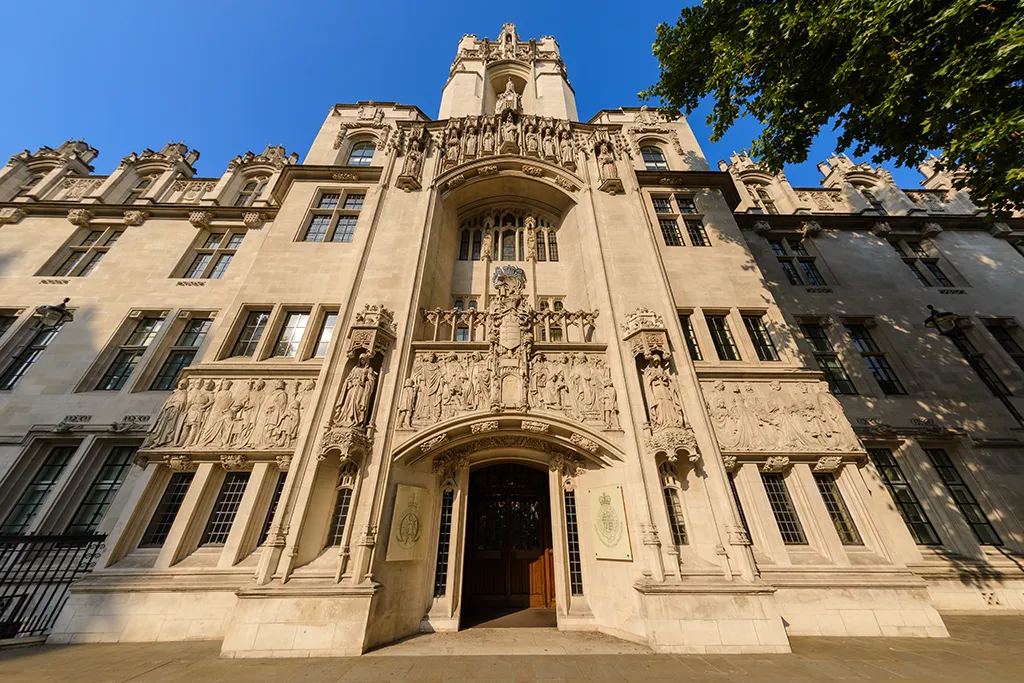
Supreme Court
The Supreme Court has ruled that a contractor did not have the right under JCT design-and-build terms to terminate a contract after it was paid late twice.
The ruling ends a long-running dispute between Providence Building Services Ltd and client Hexagon Housing Association Ltd, which it was carrying out £7.2m of building work for in Purley, south London, from 2019 until 2022.
The Court of Appeal previously ruled in favour of the contractor’s decision to terminate its contract after Hexagon failed to pay an invoice on its scheduled date for the second time, even though Hexagon had paid within 28 days of receiving a first default notice.
In a new ruling on Thursday (15 January), Supreme Court judges unanimously found in favour of the client.
Lord Robert Reed said the natural meaning of clause 8.9.4 of the JCT (Joint Contracts Tribunal) Design and Build Contract (2016) was that the contractor needed to accrue a right to terminate the contract rather than being able to do so immediately. He said it refers back to a previous clause stressing the need for a default event to last 28 days.
He said that if a contractor was entitled to terminate a contract because it received two payments a single day late each, the contractual clause would be like using “a sledgehammer to crack a nut”.
“It would be less extreme if a second delay entitles the contractor to terminate the contract only where the first late payment has been delayed beyond the specified 28 days and has therefore been particularly serious,” he said.
The ruling also said it would be wrong to use the termination clause as a way of protecting contractors from cashflow difficulties, and dismissed the idea that clients and contractors have similar contractual obligations or termination rights.
Their respective termination clauses are written differently and “it is hard to see why that should be so if they were intended to have identical meanings”, Reed said.
During the building job, Hexagon failed to pay an invoice of £264,000 by its due date in November 2022.
Providence issued a formal notice of default, which warned Hexagon that it was in breach of its payment obligations. Hexagon made the payment within 28 days.
In April 2023, Hexagon failed to make another payment of £366,000 by its due date. After issuing a payment notice requiring payment on or before 17 May 2023, Providence terminated the contract on 18 May.
Hexagon paid the sum owed on 23 May and referred the dispute to an adjudicator, which found in its favour. The contractor then started legal action to make its case.
Mark London, senior partner at law firm Devonshires, which represented Hexagon in the case, had previously warned that the earlier judgment in favour of Providence had introduced “a significant risk to employers everywhere who, in the event of a specified default, will face the proverbial Sword of Damocles for the remainder of the contract”.
He said the ruling had created a “two strikes and you’re out” regime.
London said that he was “delighted” by the Supreme Court ruling, which “has brought certainty back to an industry where the use of the JCT standard form is common”.

Read analysis of yesterday’s Supreme Court judgment by Lawrence Pearce, a partner at law firm Holmes & Hills
Read More
Ian Weinfass