
As attacks by Houthi rebels rise, cable operators in Red Sea of trouble

Escalating tensions in the Red Sea—increasingly seen as an internet kill switch, particularly for India, as most major cable networks are wired through this corridor—are pushing cable owners to make multiple backup arrangements to avoid a complete blackout.

Cable operators are building redundancies, buying double the number of fibre pairs and, in some cases, even planning to lay cables along sovereign land routes, which are inflating costs for data centres and cloud providers, industry executives told ET.

As per estimates, leasing a pair of high-capacity subsea fibre on global corridors like Europe-Asia costs anywhere between $30,000-$50,000 per month.

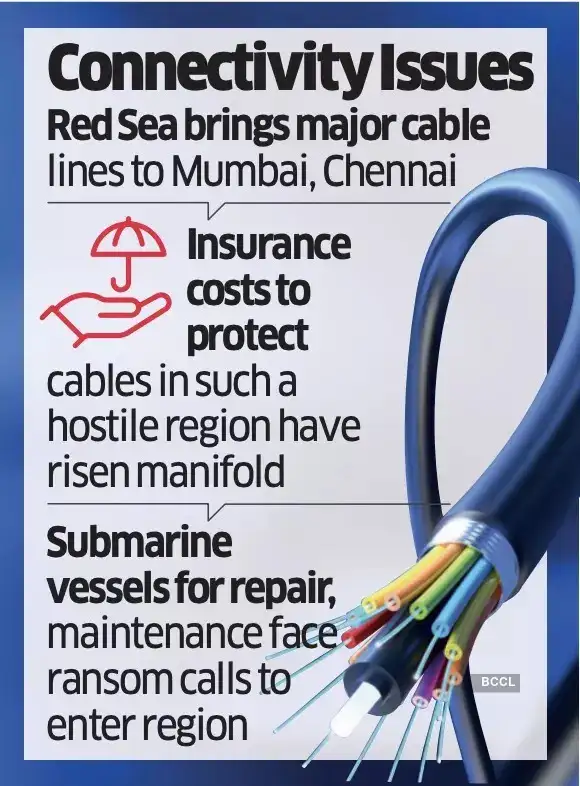
The issue is critical to India as the country’s digital backbone is tightly wired through the Red Sea corridor, which brings major cables like Google’s Blue-Raman, Bharti Airtel’s 2 Africa and Sea-Me-We 6, and Reliance Jio’s India-Europe-Express to Mumbai and Chennai shores.

Yemen’s Houthi rebels have drowned two commercial cargo ships in the past month and are known to weaponise subsea cables, having used them as leverage for regional conflicts and funding their activities in the past.

Insurance costs to protect cables in such a hostile region have gone up manifold. In fact, submarine vessels for repair and maintenance of the cables are being threatened to pay ransom to enter the region, sources said.

Google, Jio and Airtel did not respond to ET’s queries till press time Wednesday.

“There is a persistent risk we monitor closely, especially as the conflict in that part of the geography intensifies” said Amajit Gupta, group CEO and managing director of Lightstorm, a network infrastructure company that owns and operates 21,000 kilometres of subsea cables spanning varied regions. “Our reliance on the cable system is precarious, as an additional outage poses a significant challenge to its repairability.”

He noted that several cable operators such as Ooredoo and Zain are planning to take the sovereign land routes for laying cables as opposed to the sea.

“The maritime jurisdiction is confined to territorial control within close proximity and extends to the international waters, which resemble a frontier region where various elements can engender instability,” Gupta explained. “Consequently, the prevailing consensus among cable operators is to opt for the terrestrial route via sovereign states.”

AS Lakshminarayanan, managing director of Tata Communications, said submarine cable cuts happen continuously. “But the problem at the Red Sea was that the time taken to repair and the ships to go there took longer,” he said.

The industry also faces a dearth of ships available for repairs even as the government is debating whether the country should have its own fleet of ships, Lakshminarayanan said.

Tata Communications is among India’s oldest investors and owner of subsea cables.

In early 2023, four key submarine cables – Seacom, EIG, AAE-1, and TGN-EA – were affected near the Bab el-Mandeb strait, a narrow but strategic choke point connecting the Red Sea and the Gulf of Aden. The cable cuts, attributed to regional conflict and anchor damage, slowed internet speeds across parts of Africa, West Asia, and South Asia.

Reliance Jio, Tata Communications and Bharti Airtel are investors in these cables.
Screenshot 2025-08-03 at 12.52.31 AM

Carl Grivner, CEO of global subsea cable operator FLAG, said the company is building partnerships and establishing multiple alternative routes across the Gulf region. One such initiative is the Gulf European Transit Route, also known as the India-Middle East-Europe Economic Corridor. This is one of the first multimodal pathways that combines undersea fibre with overland infrastructure, effectively bypassing the Red Sea channel.

FLAG is a leading investor in global subsea networks like FALCON, which suffered internet outage during previous cable disruptions in Yemen in 2023. FLAG received an international long-distance (ILD) licence in India last year and has made investments in the country, Singapore, and Europe – which traverse the Middle East, Grivner said.

India’s subsea cable ecosystem has been witnessing massive capacity addition since the last three years. Bharti Airtel, in December 2024, commissioned the Sea-Me-We 6 cable system and also has large investments in 2 Africa Pearls – the longest subsea cable system in the world. Reliance Jio is set to commission cable landings of India-Asia-Express and India-Europe-Express, which are expected to grow India’s installed capacity manifold.

Meanwhile, hyperscalers have also made large investments in cables like Google’s Blue-Raman and Meta’s Waterworth project.

Amidst surging data demand in India, the Telecom Regulatory Authority of India (Trai) expects the global submarine communication cable market to grow 7.2% compounded annually to $40.58 billion in 2028 from $27.57 billion in 2023. The Indian market—the fastest growing in the Asia Pacific region—is expected to reach $78.6 million by 2030.

Read More

Latest

Chinese Investors Eye Hong Kong and US Amid Regulatory Crackdown

© 2026 China Money Network. All Rights Reserved. Disclaimer: The views, opinions, forecasts, and statements made by our hosts and guests are the personal views of those respective individuals and may or may not be either endorsed or accepted by China Money Network Limited or the companies with which these individuals are employed.

Bitcoin long-term holder supply hits all-time high of 16.64 million BTC

Bitcoin investors are sitting on their hands, and the data says that’s a very good sign. Long-term holder supply just hit 16.64 million BTC, a new all-time high, according to Coinglass data shared on July 21. That figure represents roughly 83% of Bitcoin’s total circulating supply. In plain English: five out of every six Bitcoin

BTC trades near $66K as a break above the 50-Day EMA strengthens bullish momentum

Key takeaways Bitcoin (BTC) trades around $66,300, extending gains after reclaiming the 50-day EMA. The leading cryptocurrency remains below the 100-day and 200-day EMAs, leaving key resistance levels intact. Technical indicators, including the RSI and MACD, point to strengthening bullish momentum. Bitcoin (BTC) remained firm around $65,800 on Wednesday, extending this week’s rally as the

Bitcoin Ownership Overtakes Gold as 49.6 Million Americans Now Hold BTC

Bitcoin has overtaken gold as the preferred hard asset among American investors, according to bitcoin financial services firm River. The firm found that 49.6 million Americans, or 18.6% of the adult population, now own bitcoin, compared to 28.8 million, or 10.8%, who hold gold. Key Takeaways River’s July report found 49.6 million Americans hold bitcoin

Newsletter

Don't miss

Chinese Investors Eye Hong Kong and US Amid Regulatory Crackdown

© 2026 China Money Network. All Rights Reserved. Disclaimer: The views, opinions, forecasts, and statements made by our hosts and guests are the personal views of those respective individuals and may or may not be either endorsed or accepted by China Money Network Limited or the companies with which these individuals are employed.

Bitcoin long-term holder supply hits all-time high of 16.64 million BTC

Bitcoin investors are sitting on their hands, and the data says that’s a very good sign. Long-term holder supply just hit 16.64 million BTC, a new all-time high, according to Coinglass data shared on July 21. That figure represents roughly 83% of Bitcoin’s total circulating supply. In plain English: five out of every six Bitcoin

BTC trades near $66K as a break above the 50-Day EMA strengthens bullish momentum

Key takeaways Bitcoin (BTC) trades around $66,300, extending gains after reclaiming the 50-day EMA. The leading cryptocurrency remains below the 100-day and 200-day EMAs, leaving key resistance levels intact. Technical indicators, including the RSI and MACD, point to strengthening bullish momentum. Bitcoin (BTC) remained firm around $65,800 on Wednesday, extending this week’s rally as the

Bitcoin Ownership Overtakes Gold as 49.6 Million Americans Now Hold BTC

Bitcoin has overtaken gold as the preferred hard asset among American investors, according to bitcoin financial services firm River. The firm found that 49.6 million Americans, or 18.6% of the adult population, now own bitcoin, compared to 28.8 million, or 10.8%, who hold gold. Key Takeaways River’s July report found 49.6 million Americans hold bitcoin

Foundry asks Bitcoin miners to vote on BIP-110 support

Foundry USA began asking mining customers to vote on how the pool should signal on Bitcoin Improvement Proposal (BIP-110), a soft fork proposing to shrink how much data can be stored in Bitcoin transactions to limit non-monetary transactions, such as Ordinals, on the Bitcoin network. The world’s largest mining pool by hashrate also released educational

Want Your Business to Be Seen Everywhere? Meet Tonia Ryan, Creator of Fix Your Search

Some people are good at their jobs. Then there is Tonia Ryan, who has turned “getting found online” into something close to magic. She is the creator of Fix Your Search, and if you have ever wondered why some businesses pop up everywhere while others seem invisible...

Grey Business processes $61 million as stablecoins dominate payments

Grey Business enables startups and SMEs to open US Dollar (USD) corporate accounts, send and receive international payments, convert currencies, and transact using stablecoins such as USDC and USDT...

Utah Marketers to Host Free Business Networking Event in Layton on June 24

The custom web design company is hosting free monthly networking events for Northern Utah business leaders, with the next event scheduled for June 24 from 4 to 6 p.m. Utah Marketers is hosting a free local business networking event on June 24 from 4 to 6 p.m. at the company’s Layton office. The event is