

And all those other A-list cameos: “People fall out at the last minute all the time, so you have to be ready,” says casting director Melissa Kostenbauder.
Photo: Apple TV+
Of The Studio’s embarrassment of riches in this year’s Comedy Emmy nominations, its near-sweep of the Outstanding Guest Actor category feels the most in-character. Seth Rogen and Evan Goldberg’s showbiz farce sits squarely in the lineage of Extras and Robert Altman’s The Player in that it wrings considerable pleasure from packing the frame with famous faces. And these aren’t just winking cameos meant to elicit knowing nods; Rogen and Goldberg turn many of them into genuinely funny performances. Which is why, absurd as it may seem, it makes sense that all but one Guest Actor slot went to a Studio player: Bryan Cranston, Ron Howard, Martin Scorsese, Dave Franco, and Anthony Mackie, with all but Cranston playing themselves. (The category’s lone interloper is Jon Bernthal in The Bear, which isn’t really a comedy but is a guest-star factory in its own right.)
Oddly, The Studio fared less well in the Guest Actress race, with only Zoë Kravitz receiving a nod while Rebecca Hall, Olivia Wilde, Greta Lee, and (most criminally) Sarah Polley were left out. Still, the fact I even have such a long list of snubs speaks to the show’s deftness in casting both fully fledged characters and quick-hit celebrity cameos, thanks in large part to the work of the show’s casting director, Melissa Kostenbauder. A veteran of the trade, and one of the rare people who entered Hollywood specifically to become a casting director, she worked her way up from an internship with the late, legendary Mali Finn to assistant, then associate, and now to her current perch, where she’s leading searches for the likes of Winning Time, Tokyo Vice, and Unbelievable. (She got an Emmy nom in 2020 for the last one.)
The Studio wasn’t originally hers to cast. That job was first held by Francine Maisler, the high-profile casting director whose résumé includes collaborations with Michael Mann, Aaron Sorkin, and Steven Soderbergh. But the 2023 WGA strikes upended the initial production schedule, and by the time work resumed, Maisler was no longer available. That’s when Kostenbauder stepped in. “By the time I came on,” she said, “they had all ten scripts, and many of the ideal names they had in mind were already written into them.”
The casting process stretched between January and June 2024. “It’s the same but different every time,” Kostenbauder said of the job. “You get the script, you keep an eye out for how large the roles are and what demands they have on them, and you create what we call a breakdown: a clean reference on all the roles, descriptions, and pages. Depending on the needs of the production, sometimes you do lists of people who would be offer-only, others who need auditions. Maybe it’s a big role, maybe they want unknowns, maybe they want someone new.”
With The Studio and its avalanche of celebrity cameos, the primary challenge was scheduling, which is inevitable when juggling so many famous people’s calendars. Because of that logistical complexity, the team shot all episodes simultaneously, with actor availability playing a major role in how production was structured. And despite the enormity of Kostenbauder’s assignment, she was able to take a grounded approach: “Seth and Evan wanted each guest actor to fit into the scenario,” she said. “They always talked about things in terms of making each given situation successful.” She hasn’t yet started work on season two, but in the run-up to the Emmys, Kostenbauder shared her experience casting some of the biggest episodes of season one.
Pilots are always among the trickiest episodes to construct. They have to set up the premise, introduce the characters, and establish the world, all while convincing viewers to buy into the show. By the time Kostenbauder took over casting The Studio, Maisler had already begun casting the core Continental Studios crew, which would ultimately include Rogen, naturally, as newly elevated studio head Matt Remick; Ike Barinholtz as Matt’s No. 2, Sal Saperstein; Catherine O’Hara as his predecessor and mentor/rival, Patty Leigh; and Kathryn Hahn as Maya Mason, the studio’s outrageously showy head of marketing. Chase Sui Wonders, a relative newcomer playing the young creative executive Quinn Hackett, had been found through an extensive audition process.
The pilot, “The Promotion,” opens with Matt’s surprise elevation to the top job and follows him as he’s tasked by Griffin Mill, the studio owner played by Bryan Cranston, to green-light a Kool-Aid movie in the wake of Barbie’s IP-tastic success. Matt’s central conflict is balancing his cineaste idealism with Hollywood’s ruthless demands, and at first, he reluctantly pursues journeyman comedy director Nicholas Stoller, who gamely appears as himself. (Stoller directed Rogen in Neighbors and, more recently, the Apple TV+ comedy Platonic.) But the episode pivots when Matt learns he may have a shot at signing a true Hollywood legend: Martin Scorsese.
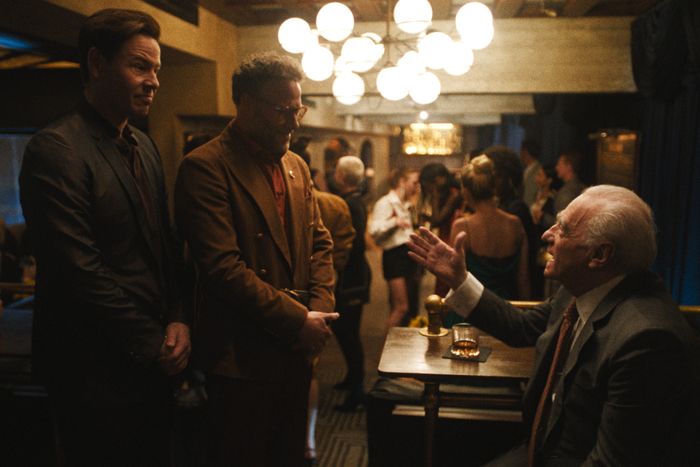
“Seth and Evan wanted the pilot to make an immediate impact, cast-wise,” Kostenbauder says, “and they certainly accomplished that with Marty.” Scorsese was always the first choice, but landing him was far from guaranteed. “I’d be terrible at my job if I didn’t come up with alternatives,” she says. “You’re constantly playing chess as a casting director. How can you minimize potential emergencies? People fall out at the last minute all the time, so you have to be ready.” When asked if she was able to share who might’ve appeared in Scorsese’s stead in an alternate universe, she politely declined. “Oh, I can’t share that,” she replied. “I am so protective of the guest actors who do this show, because they don’t do things like this most of the time.”
With help from Apple, which facilitated communication between Scorsese’s team and the Studio crew, the long shot came through and no backup was needed. The result was a fun cameo arc that ends on the image of Scorsese breaking down in tears after Matt shelves the iconic director’s dream project to save his own job — a turn that earned Scorsese his first acting nomination. “We felt so lucky he wanted to do it,” Kostenbauder said. “Everyone was excited he was even entertaining it to begin with.”
The series’ second episode, “The Oner,” is also its most technically audacious. It follows Matt and Sal on an ill-advised set visit to Sarah Polley’s new film on the very day she’s attempting an intricate, time-sensitive single-take shot. The episode itself mirrors the conceit, unfolding as a true oner, with the camera weaving and barreling through the set in a state of mounting, anxious momentum as Matt’s meddling escalates. It’s a rich scenario: Polley, the respected indie director, trying to manage her shoot while manipulating Matt’s neediness into securing more money to license a pricey Rolling Stones song; Greta Lee, playing herself, buttering up Matt in hopes of using the studio’s private jet; Sal and Patty scheming to keep Matt away from the action; and all the while, the crew scrambles to get the shot before running out of sunlight.
“It was always going to be Sarah,” Kostenbauder says. Polley, of course, is an accomplished director as well as actress and writer; she is the filmmaker behind Away From Her, Take This Waltz, the autobiographical documentary Stories We Tell, and Women Talking, which won the 2022 Oscar for Best Adapted Screenplay. “She, Evan, and Seth all know each other,” Kostenbauder says, “and luckily, she wanted to do it.”
Casting Lee’s role was trickier, Kostenbauder explained, as the brief was simply “someone you might plausibly view as a lead in a Sarah Polley movie.” Coming off Past Lives, Lee was a natural fit, though one potential complication with The Studio’s cameos is that many require the actors to play less-than-flattering versions of themselves. (Ron Howard toys with his reputation as the nicest guy in town by playing a truly domineering bully in episode three.) In those cases, Rogen and Goldberg took the lead. “Generally, with celebrity casting, we’d check availability, get a temperature read from their team, and then send the script,” Kostenbauder says. With The Studio, “instead of a script, we’d set up a meeting with Seth and Evan, and they’d pitch the project directly. They worked hard to establish trust. They’re not trying to torpedo anyone; it’s about serving the scene. They’d only poke fun with the person’s permission. Once that was done, either the person would want to do it or they wouldn’t.”
The rest of the episode’s cast had to be as precise as Lee and Polley, since the entire shoot hinged on executing a oner. “We needed people who could handle that kind of choreography,” Kostenbauder says. She singles out Thomas Barbusca, who plays the production assistant tasked with attending to Matt. “There were so many wonderful co-stars, guest stars, and nonspeaking roles in that episode. We needed actors with on-set experience who knew exactly what they were doing.”
The sixth episode is somewhat unique in the season as it’s the only one that unfolds largely outside Hollywood’s insular bubble. After a test screening for a trailer for Duhpocalypse!, a new Spike Jonze film in which Johnny Knoxville and Josh Hutcherson (both appearing in brief cameos) survive an apocalypse overrun by diarrheal zombies, we follow Matt as he accompanies his new girlfriend Sarah, a pediatric oncologist played by Rebecca Hall, to a swanky charity gala for children with cancer. Thrust into a room full of people whose work is objectively more important than his own, Matt’s confronted by their disregard for his Hollywood standing. Worse, they look down on his job. In true Studio fashion, the discomfort builds until the insecure Matt makes a play to force the doctors into admitting his work is just as important as theirs. Of all ten episodes, “The Pediatric Oncologist” was Kostenbauder’s favorite to work on. “My whole life growing up in this industry, all anyone ever said was, ‘We’re not curing cancer’ whenever they wanted to minimize stress and then they immediately did something outlandish, like flipping over a table,” she says. “That’s very true to my experiences.”
Casting Hall, who comes with an extensive résumé that’s equally balanced between franchise films (like Iron Man 3 and the Monsterverse movies) and thinkier fare (Christine, Resurrection, the upcoming Peter Hujar’s Day), was a particular pleasure. “One of my favorite things about casting is using people in ways you don’t usually see them,” Kostenbauder says. “We don’t often get to see the wonderful Rebecca Hall in comedy, let alone with such absolutely brown humor. She’s so elegant, and I think that really heightened the differences between their worlds.” Because Hall played a fictional doctor and not a celebrity cameo, she wasn’t pre-written into the part. Instead, her casting came through the standard process: Kostenbauder generated a list of possibilities, and Goldberg and Rogen responded to the idea of Hall immediately.
In terms of sheer star power, “The Golden Globes” is The Studio’s pièce de résistance. The episode follows the Continental crew through a relatively successful awards ceremony — though perhaps not for Matt personally, whose yearning to be recognized onstage goes unfulfilled.
As you’d expect for an awards setting, the episode goes all in on celebrity cameos. In addition to Zoë Kravitz, who recurs across the season, the Globes lineup includes Quinta Brunson; Jean Smart; Hacks creators Lucia Aniello, Jen Statsky, and Paul W. Downs; Ramy Youssef; The Boys’s Erin Moriarty and Antony Starr; Adam Scott; the influencer Charli D’Amelio; the director Zack Snyder; and Aaron Sorkin, attending in-universe to collect a Lifetime Achievement Award (a distinction he has yet to receive in the real Golden Globes).
“That was a really, really big one,” recalls Kostenbauder. “They actually pushed that episode a little further in the schedule to give us more time to get through all of those folks.” The brief was to assemble a mix of faces that could plausibly be a present-day Globes ceremony: recent winners, current nominees, industry fixtures. “Some people they knew, some they didn’t; the guys were aiming to create an authentic Globes room.”
One cameo that was particularly notable: Ted Sarandos, Netflix’s co-CEO, delivering a rather effective turn as himself explaining to Matt that he ensures onstage recognition by having it written into contracts. (For the record, this is not Sarandos’s first time playing a version of himself on a television show. That would be a 2004 episode of House Hunters.) Sarandos’s appearance raises a natural question: Was the spot written for him, or was there ever another media mogul (say, a Bezos) in the mix? “Oh, it was always Ted,” Kostenbauder says. “I remember asking, ‘Do you think you’re going to Ted, or are you going to get Ted?’” As it turned out, Rogen was already friendly with Sarandos. “That was a fun one,” she recalled. “I was pretty shocked that Netflix and Apple were both onboard — and it happened.”
-
The Complete 2025–26 Movies Fantasy League Draft Guide
-
The Bright Side of a Studio Sweep at the Emmys
-
Jenny Slate Can Still Top Herself
How The Studio Scored Scorsese
Nicholas Quah
Read More