

Interbreeding between tomato plants and potato-like species from South America about 8-9 million years ago gave rise to the modern-day potato (Solanum tuberosum); this ancient evolutionary event triggered the formation of the tuber, the enlarged underground structure that stores nutrients found in plants like potatoes, yams, and taros, according to a team of biologists from China, Canada, Germany, the United States, and the United Kingdom.
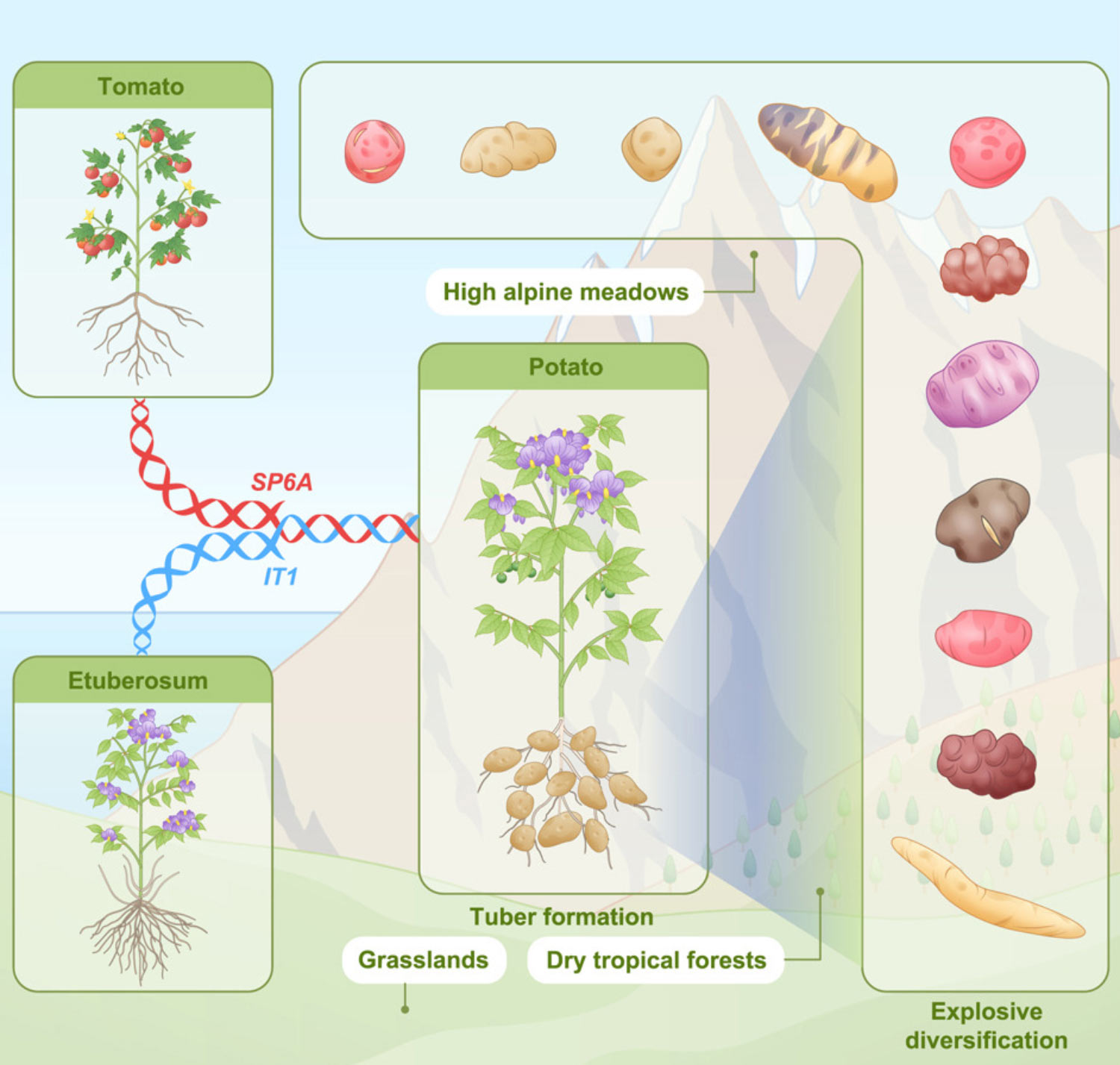
Interspecific hybridization may trigger species radiation by creating allele combinations and traits. Cultivated potato and its 107 wild relatives from the Petota lineage all share the distinctive trait of underground tubers, but the underlying mechanisms for tuberization and its relationship to extensive species diversification remain unclear. Through analyses of 128 genomes, including 88 haplotype-resolved genomes, Zhang et al. revealed that Petota is of ancient hybrid origin, with all members exhibiting stable mixed genomic ancestry, derived from the Etuberosum and Tomato lineages ca. 8-9 million years ago. Image credit: Zhang et al., doi: 10.1016/j.cell.2025.06.034.
The cultivated potato is currently the world’s third most important staple crop, and with wheat, rice, and maize, is responsible for 80% of human caloric intake.
In appearance, modern potato plants are almost identical to three potato-like species from Chile called Etuberosum. But these plants do not carry tubers.
Based on phylogenetic analysis, potato plants are more closely related to tomatoes.
To solve this contradiction, Dr. Sanwen Huang from the Agricultural Genomics Institute at Shenzhen at the Chinese Academy of Agricultural Sciences and the Chinese Academy of Tropical Agricultural Sciences and colleagues analyzed 450 genomes from cultivated potatoes and 56 of the wild potato species.
“Our findings show how a hybridization event between species can spark the evolution of new traits, allowing even more species to emerge,” Dr. Huang said.
“We’ve finally solved the mystery of where potatoes came from.”
“Wild potatoes are very difficult to sample, so this dataset represents the most comprehensive collection of wild potato genomic data ever analyzed,” said Dr. Zhiyang Zhang, a researcher at the Agricultural Genomics Institute at Shenzhen at the Chinese Academy of Agricultural Sciences.
The authors found that every potato species contained a stable, balanced mix of genetic material from both Etuberosum and tomato plants, suggesting that potatoes originated from an ancient hybridization between the two.
While Etuberosum and tomatoes are distinct species, they shared a common ancestor about 14 million years ago.
Even after diverging for about 5 million years, they were able to interbreed and gave rise to the earliest potato plants with tubers around 8-9 million years ago.
The researchers also traced the origins of the potato’s key tuber-forming genes, which are a combination of genetic material from each parent.
They found the SP6A gene, which acts like a master switch that tells the plant when to start making tubers, came from the tomato side of the family.
Another important gene called IT1, which helps control growth of the underground stems that form tubers, came from the Etuberosum side.
Without either piece, the hybrid offspring would be incapable of producing tubers.
This evolutionary innovation coincided with the rapid uplift of the Andes Mountains, a period when new ecological environments were emerging.
With a tuber to store nutrients underground, early potatoes were able to quickly adapt to the changing environment, surviving harsh weather in the mountains.
Tubers also allow potato plants to reproduce without seeds or pollination. They grow new plants by simply sprouting from buds on the tuber.
This trait allowed them to rapidly expand and fill diverse ecological niches from mild grasslands to high and cold alpine meadows in Central and South America.
“Evolving a tuber gave potatoes a huge advantage in harsh environments, fueling an explosion of new species and contributing to the rich diversity of potatoes we see and rely on today,” Dr. Huang said.
The study was published on July 31, 2025 in the journal Cell.
_____
Zhiyang Zhang et al. Ancient hybridization underlies tuberization and radiation of the potato lineage. Cell, published online July 31, 2025; doi: 10.1016/j.cell.2025.06.034
News Staff
Read More