

Brain scans capture memory formation in babies, raising new questions about why people forget their earliest years
By Nick Turk-Browne edited by Daisy Yuhas
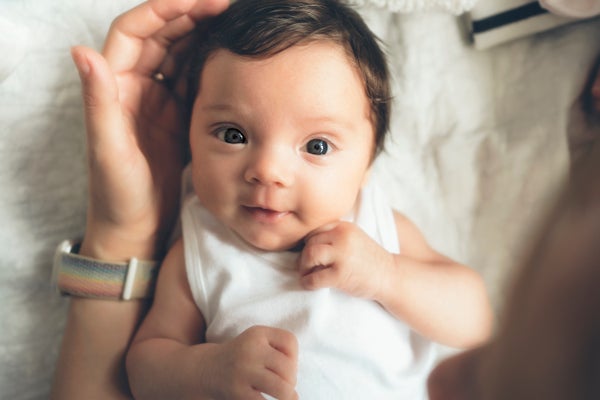
byakkaya/Getty Images
See the world through the lens of science. Sign up for our free, daily newsletter Today in Science.
A plume of red, a searing pain and the sounds of summer—these are fragments of my earliest memory, when I stepped on a glass shard in a Toronto splash park at six or seven years old. I don’t remember much from that day, but a scar on my foot bears witness to what happened.
When you ask adults about their first memory, for a specific event from their childhood, their answer typically dates back no earlier than preschool. This is true whether you ask a college student or a grandparent, suggesting that adults’ lack of infant or toddler memories is not just the result of normal forgetting that occurs with the passage of time. The gap in our autobiographical memory from when we were a baby is known as “infantile amnesia.”
There are two potential explanations for this phenomenon. One is that infants cannot store memories. The slow development of the hippocampus, a seahorse-shaped region deep in the brain, may be responsible. This region, which is critical for memory, grows and changes throughout childhood, so it might not yet be available to infants. In this telling, babies are not so different from famous cases of amnesia such as those of Henry Molaison and Lonni Sue Johnson, both of whom suffered hippocampal damage in adulthood that made them unable to store memories.
On supporting science journalism
If you’re enjoying this article, consider supporting our award-winning journalism by subscribing. By purchasing a subscription you are helping to ensure the future of impactful stories about the discoveries and ideas shaping our world today.
Another possibility is that the infant brain can store memories, but we eventually lose access to them. Recent studies in mice show that not only is the hippocampus able to store memories early in life but that it may retain these memories into adulthood. For example, scientists were able to retrieve an otherwise forgotten memory by stimulating neurons in the hippocampus that had been active during an early experience.
But what about humans? My lab has been on a decade-long quixotic adventure to study awake infants with functional magnetic resonance imaging (fMRI), a form of brain imaging that can measure activity from regions deep in the brain such as the hippocampus. Although this technology is used to study memory formation in adults and is safe for infants, it had not previously been used to study babies’ memory.
Why was that the case? Infants move a lot, don’t follow instructions and have a short attention span—all of which make it difficult to collect good data from them. As a result, most fMRI research in infants has been conducted while they sleep. But this wasn’t an option for our investigations because memories are based on experiences in waking life. Through more than 400 sessions and countless insights from families, we have refined innovative techniques to keep awake infants still, happy, and engaged.
In a recent study, a team at my lab led by Tristan Yates, now a postdoctoral researcher at Columbia University, used this method to discover that the infant hippocampus can store memories beginning around one year of age. We showed infants photographs of faces, objects and scenes one at a time during fMRI. Shortly afterward, we tested their memory by showing each of these now-familiar photographs alongside a new image of the same type. If the infant looked longer at the photograph they had seen before, we labeled that image as remembered; otherwise, it was forgotten.
With this behavior documented, we looked back at the brain data when the photographs were first shown and found that the hippocampus was more active when infants viewed images that they later seemed to remember. This result suggests that the infant hippocampus can create memories after only a brief experience. The effects were clearest after 12 months of age, in infants who had stronger overall memory and in the subregion of the hippocampus that is most important for remembering specific events (called episodic memory) in adults.
Our findings support the idea that people store memories when they are an infant that they are later unable to access. But the work also raises more questions: How long do these hippocampal memories last? We tested for a few minutes, but infantile amnesia plays out over years. How sophisticated is this infant memory capacity? We tested individual photographs, but episodic memories involve complex events with multiple people, places and things interacting over space and time (for example, remember your last vacation).
The deepest and most provocative questions relate to why most people’s earliest memories are from age four to five (or later) if memories are being stored in their brain by age one. What makes those earlier memories inaccessible? Are there any tricks or practices for accessing them? Would we even be able to make sense of them if so?
Answering these questions will help resolve more than a century of scientific curiosity. Revealing how the youngest brains learn and remember may help advance understanding of language acquisition and developmental disorders and could have implications for parenting and early education. More generally, the mysterious workings of memory early in life may hold clues about why we again lose memory later in life, in the normal course of aging and in neurological diseases such as Alzheimer’s.
Take a moment to reflect: What is your earliest memory? How do you know it’s real? There might even be earlier memories locked away in your brain.
Are you a scientist who specializes in neuroscience, cognitive science or psychology? And have you read a recent peer-reviewed paper that you would like to write about for Mind Matters? Please send suggestions to Scientific American’s Mind Matters editor Daisy Yuhas at dy****@***am.com.
Rebecka Ramage
Read More