

Bitcoins
Home » Regulation » BlackRock expands quantum risk disclosure in amended Bitcoin ETF filing
Bitcoins A number of blockchain and crypto projects are already working toward quantum-resistant protocols.

Photo: AI/ Crypto Briefing
Key Takeaways
- BlackRock expanded its risk disclosures regarding quantum computing threats in its amended Bitcoin ETF filing.
- The amended filing includes precautions about quantum computing’s potential impact on Bitcoin’s cryptographic security.
Share this article
BlackRock has updated its iShares Bitcoin Trust (IBIT) prospectus with expanded language on the potential risks posed by quantum computing, adding a detailed discussion to what was previously a brief mention of the technology.
The amended prospectus, filed on May 9, includes extensive details about how quantum computing advances could compromise Bitcoin’s cryptographic security.

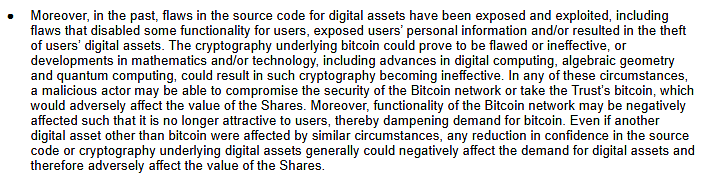
The filing notes that advances in quantum computing technology could undermine the viability of many cryptographic algorithms used globally, including those used to secure digital assets like Bitcoin.
“If quantum computing is able to advance in that way, there is a risk that quantum computing could result in the cryptography underlying the Bitcoin network becoming ineffective, which, if realized, could compromise the security of the Bitcoin network, or allow a malicious actor to compromise the wallets holding bitcoin owned by the Trust or others on the Bitcoin network, which would result in losses to Shareholders,” the filing reads.
Bloomberg ETF analyst James Seyffart, who first reported the changes, noted that such disclosures are routine in SEC filings.
“These are just basic risk disclosures. They are going to highlight any potential thing that can go wrong with any product they list or underlying asset that’s being invested in. It’s completely standard,” Seyffart said.
The filing notes that while the Bitcoin community is working on quantum-resistant solutions, “there is no guarantee that new quantum-proof architectures will be built and appropriate transitions will be implemented across the network at scale in a timely manner.”
BlackRock on Friday also filed an amendment to its iShares Ethereum Trust, adding provisions for in-kind creation/redemption. The filings surfaced after the firm met with SEC staff to discuss implementing staking and parameters for options trading on crypto ETFs.
Bitcoins Quantum chips spark concerns, but Bitcoin isn’t cracking yet
There has been ongoing back-and-forth discussion surrounding quantum computing and how it could pose a risk to Bitcoin’s security.
Concerns spiked last December when Google unveiled Willow, its next-generation quantum chip. The company claimed Willow would solve certain computational tasks in minutes—tasks that would have taken the world’s most powerful classical supercomputer 10 septillion years.
Just a few months later, Microsoft announced its own milestone: a quantum chip called Majorana 1, which it said addresses key scalability challenges that have long held the technology back.
These developments have reignited fears in the crypto space about how fast quantum computing is advancing, and whether it could soon threaten the cryptographic foundations that secure Bitcoin and other digital assets.
Many in the community voiced immediate concern that increasingly powerful quantum machines might one day crack the encryption protecting older Bitcoin wallets and even modern exchanges.
Despite rapid progress, most experts agree that quantum computers aren’t yet powerful or stable enough to pose a real threat to Bitcoin in the short term. For now, these breakthroughs are more theoretical than practical when it comes to breaking public-key cryptography at scale.
Still, the industry isn’t waiting around. Many projects are already exploring or implementing quantum-resistant technologies, anticipating the eventual arrival of a “quantum-safe” future.
Interestingly, quantum computing may not just pose risks. It could also enhance blockchain security.
Last month, researchers from JPMorgan, Quantinuum, and other groups successfully used a quantum computer to generate certifiably random numbers—a breakthrough that could strengthen encryption, improve digital signatures, and make future blockchain systems even more secure.
Share this article
Vivian Nguyen Read More