

Serving tech enthusiasts for over 25 years.
TechSpot means tech analysis and advice you can trust.
The big picture: While people have been discussing the automotive market as the next big tech-device opportunity for some time now, in reality, today’s cars haven’t advanced as much as many had hoped. Sure, we have larger, more sophisticated screens and some assisted driving features, but we’ve yet to reach the kind of transformative, smartphone-level impact in most of the vehicles we’re buying or driving today.
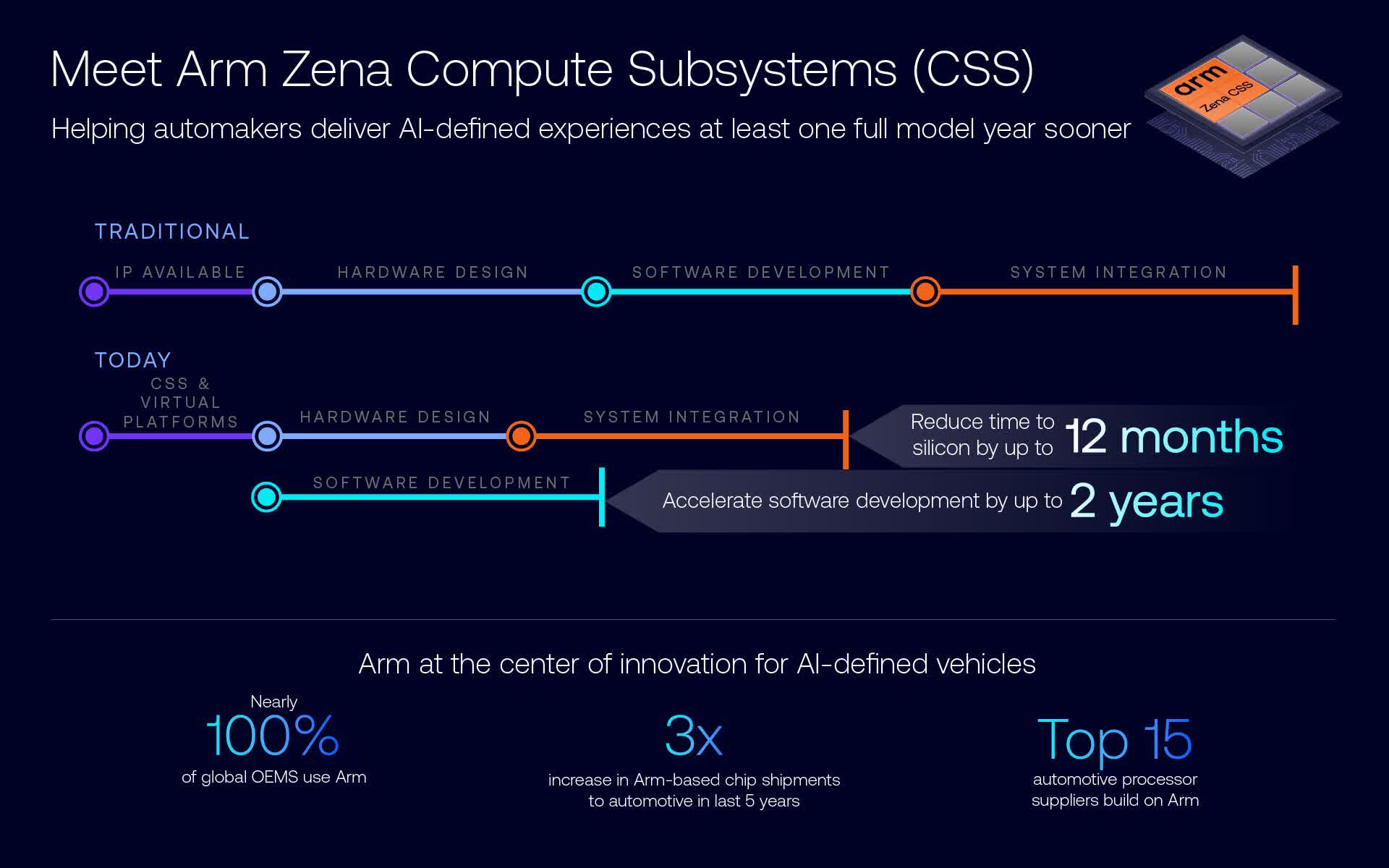
A significant part of the issue lies in the long and tedious automotive development process, particularly in how technology is adopted into modern vehicle platforms. Traditionally, automakers would wait for chip designs to be completed, then integrate individual elements into broader car platforms. Only after that could they begin writing software tailored to those finalized hardware designs.
Last year, Arm took a major step toward shortening the typical 3- to 4-year development cycles by introducing two key innovations. First, it unveiled a full suite of automotive-grade processors and other chip IP (intellectual property) for use in vehicle platforms.
Second, it launched new cloud-based simulation and virtualization platforms in collaboration with major Electronic Design Automation (EDA) providers – Cadence, Synopsys, and Siemens – as well as Amazon’s AWS. These tools allow automakers and their partners to begin software development even before Arm-based chips are finalized. The result: up to two years saved in the software development process, significantly accelerating the delivery of advanced vehicle capabilities. (It will be interesting to see how recent export restrictions on EDA software to China may impact these developments for Chinese automakers.)
This year, Arm completed the next phase by integrating its individual automotive cores into more comprehensive system designs that streamline both hardware and software development. In fact, the new offerings enable those stages to happen simultaneously, potentially cutting another 12 months from the typical development timeline.
Under its new Zena brand – focused on Arm-powered automotive silicon designs – the company introduced a vehicular implementation of its Compute Subsystem (CSS) strategy. As with previous markets where Arm rolled out CSS, including datacenters, PCs, and smartphones, the goal is to integrate multiple components around Arm’s latest CPU, GPU, and other cores to reduce the complexity, cost, and time involved in designing complete systems.
With Zena, CSS supports a variety of SoC or “chiplet” configurations, combining CPUs, GPUs, image signal processors (ISPs), security cores, I/O components, inter-chip connectivity, and more. Specifically, the new Zena design includes support for a 16-core v9 Cortex-A720AE CPU, chip-to-chip coherence via the CMN S3AE, a real-time safety island using the Cortex-R82AE, and the ability to link multiple Zena designs via UCIe, among other features.
The result is a range of complete starting points for hardware development and corresponding software. These systems offer extensive customization options for semiconductor and automotive manufacturers, with open interfaces to connect a variety of AI accelerators, image processors, graphics components, and more. Different configurations can support everything from enhanced user interaction and in-vehicle infotainment (IVI) systems to assisted and autonomous driving features.
Arm believes it can drive the creation of what they’re calling an “AI-defined car,” which builds on the current concept of software-defined vehicles (SDVs) and brings more advanced AI processing into the experience
In fact, Arm believes it can drive the creation of what they’re calling an “AI-defined car,” which builds on the current concept of software-defined vehicles (SDVs) and brings more advanced AI processing into the experience. Given how rapidly AI has been integrated into other computing platforms, that seems a logical move – and the safety-focused capabilities Arm has integrated into the core Zena system will likely prove to be even more important here.
On a practical level, Zena also brings increased design efficiency to carmakers. It offers savings not only in time but also in the resources required to develop new vehicle platforms. This efficiency enables automakers and Tier 1 suppliers to produce more vehicle platforms with fewer people and in less time. In fact, Arm estimates that Zena CSS platforms can reduce development costs and resource requirements by up to 20%.
For car buyers like us, that translates directly into getting later generations of technology into new car designs instead of buying cars that typically had semiconductor capabilities that were typically 2-3 years behind smartphones and other digital devices.
For carmakers, this speeds time to market and allows companies to reuse certain hardware and software efforts across multiple product lines – instead of having to create new chip system designs and software for each range of models. Given how critical – and brand-defining – the digital capabilities of cars have become, this makes these development advances extremely important.
Strategically, this announcement is significant for Arm as it advances the company’s move from supplying individual chip IP to delivering more comprehensive system designs. This vertical expansion not only allows Arm to charge more for its offerings but also strengthens the role of its platforms across all the markets it serves – including automotive.
With shipments to the automotive sector increasing by more than 300% over the past five years and support for 94% of global automakers, Arm’s direction clearly aligns with market demand, making this a win-win proposition.
As important as CSS platforms have proven to be in other markets where Arm has introduced the concept, the automotive industry may stand to gain the most. The notoriously slow development times for car technology have been a challenge for many automakers and their major suppliers and the dramatic potential speed-up that Arm is bringing to them with Zena should prove to be a real difference maker.
Bob O’Donnell is the founder and chief analyst of TECHnalysis Research, LLC a technology consulting firm that provides strategic consulting and market research services to the technology industry and professional financial community. You can follow him on X @bobodtech
Do you care if your car’s tech is as current as your phone?
Read More
Margarete Byron