

(RNS) — Muslims around the world are celebrating Ramadan, the ninth month of the Islamic lunar calendar and a time for spiritual reflection, humility and prayer. The holiday is marked by fasting from dawn to dusk for the 30 days, a spiritual observance required of Muslims as one of the five foundational pillars of Islam.
For many, it is an act of devotion achieved through self-discipline. However, for Muslims living with or recovering from eating disorders, ritualized abstinence from food can pose serious mental and physical health challenges.
About 9% of Americans will struggle with an eating disorder in their lifetime, according to Harvard University T.H. Chan School of Public Health research. Eating disorders are characterized by fraught relationships with food, leading to behaviors like caloric restriction, adherence to specific “food rules,” bingeing, purging and overexercising, among other disordered behaviors.
“Each has their own unique condition,” said Dr. Rania Awaad, director of Stanford University’s Muslim Mental Health and Islamic Psychology Lab. “So, there are some people who will never be triggered by Ramadan. For other people, (fasting) is a withholding that mimics what they may be doing in terms of restricting as part of their eating disorder. So, sometimes it’s hard to distinguish.”
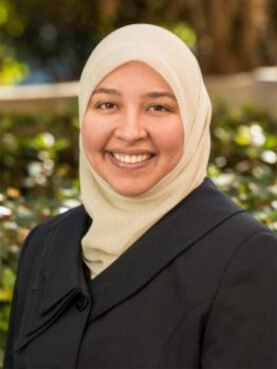
Dr. Rania Awaad. (Photo courtesy of Stanford University)
Awaad, who is also an ustadha or Islamic teacher, described Ramadan as “a reflection month where people are meant to turn inwards, really assess a relationship with God, themselves and with their community. It’s a month of taking stock of all that you have, and it’s a month of gratitude.”
As such, Muslims with eating disorders face a difficult reality and risk when it comes to fasting. Could observing the beloved holiday worsen their illness?
“It’s a slippery slope,” said Noor Mahmood, a 22-year-old Muslim woman in recovery from binge eating disorder.
BED is the most common eating disorder in the United States, according to the National Institute of Diabetes and Digestive and Kidney Diseases, and 1.6% of adolescents in the country are estimated to suffer from it. BED, like other eating disorders, can also lead to an increased risk of physical and mental health comorbidities.
Mahmood, a Columbus, Ohio, resident, recalled her disordered relationship with food beginning in seventh grade when a classmate started talking to her about weight.
“I remember I was slightly bigger than her, and I don’t know what just clicked in my brain, but I just didn’t like that,” she said.
That marked the start of what would be a yearslong struggle with food, where Mahmood attached her sense of morality to her eating patterns, she said. As mental health was not a common topic of discussion in her household growing up, Mahmood herself did not at first understand the nature of her problem. Her dangerous eating patterns continued through middle school and into high school, she said.
“I didn’t know what it was or why it was happening,” she recalled. “I didn’t know that this was considered disordered behavior, and I don’t think I brought it up to anybody.”
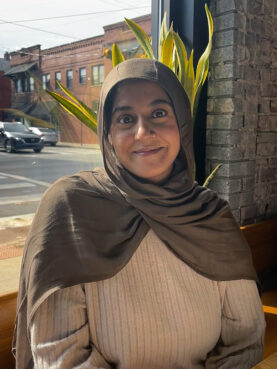
Noor Mahmood. (Courtesy photo)
Eventually, Mahmood got professional help and acquired tools to help her to recover from BED, citing that learning to advocate for her needs made recovery possible. She’s now working as a nursing assistant and studying toward a career in nursing.
At the height of her disordered eating behaviors in high school, she said, she tried to lose weight during Ramadan. However, refocusing on Ramadan’s spiritual meaning ultimately helped her curb such efforts in later years. The holiday now offers an opportunity to reinvigorate her faith by reflecting on what she may be struggling with and how to find support.
“Talking to God more through prayer and making dua (supplications) about it always helped me to remember the whole purpose,” she said of Ramadan.
As both a psychiatrist and observant Muslim, Awaad said the intersection of faith and mental health is important to consider for those determining the best way to observe the holiday for them personally. Moreover, her research shows common misconceptions regarding mental health can discourage Muslims from seeking the care they need.
“People will incorrectly look at mental health issues as a spiritual failing of some sort, where they’ll say, ‘You shouldn’t be depressed or have these issues if you’re a person of faith because you should be able to pray them away,’” she said.
Exceptions from fasting are deemed acceptable for Muslims who are chronically or acutely ill, menstruating or pregnant, or elderly, among other health reasons. Awaad argues that these exemptions should extend to those struggling with or recovering from eating disorders and other mental health issues when fasting would be injurious to their well-being.
“It is important to understand that there are exemptions from fasting because of health conditions,” she said. “Mental health is not discriminated against in this. Serious mental health conditions are part and parcel of the exemptions.”
And when they are unable to fast, Muslims are encouraged to participate in Ramadan through helping others in need. This might mean donating to charitable causes, or zakat, or preparing meals for others to break their fasts.
“We focus a lot on the person who can’t (physically) fast, but Ramadan is a month of introspection and turning inward,” Awaad said. “You don’t need to be fasting to be able to do that.”
For Mahmood, life in BED recovery and with Type 1 diabetes has meant that on occasion, she’s had to use such fasting exemptions to preserve her health. Now several years into recovery, though, she is able to fast normally, she said.
“In the past, it was hard to not make it all about food,” she said. “Now, it’s about being humble enough to connect with God and work on that relationship.”
As an independent nonprofit, RNS believes everyone should have access to coverage of religion that is fair, thoughtful and inclusive. That’s why you will never hit a paywall on our site; you can read all the stories and columns you want, free of charge (and we hope you read a lot of them!)
But, of course, producing this journalism carries a high cost, to support the reporters, editors, columnists, and the behind-the-scenes staff that keep this site up and running. That’s why we ask that if you can, you consider becoming one of our donors. Any amount helps, and because we’re a nonprofit, all of it goes to support our mission: To produce thoughtful, factual coverage of religion that helps you better understand the world. Thank you for reading and supporting RNS.
Deborah Caldwell, CEO and Publisher
Reina Coulibaly
Read More